Today’s infographic, The Rise of Craft Breweries, was created recently, at least after this year’s GABF, by Danielle Rodabaugh for Surety Bonds Insider.

CLick here to see the infographic full size.
By Jay Brooks

Today’s infographic, The Rise of Craft Breweries, was created recently, at least after this year’s GABF, by Danielle Rodabaugh for Surety Bonds Insider.

CLick here to see the infographic full size.
By Jay Brooks

Friday’s ad is for Rheingold Beer, from 1959, and features Miss Rheingold from that year, Robbin Bain. The ad is set at an amusement park where Miss Rheingold has won a trio of stuffed animals on the Midway. The teddy bear I get, and the doll in the red snowsuit with the weird red elf hat is sort of understandable, but what the hell is that thing in her right hand? Is it Humpty Dumpty in a plaid outfit? Or what?

By Jay Brooks

After my post a couple of days ago about Genetically Engineered Yeast, Chaz from Alaskan Brewing sent me a link to an interesting blog post by Dmitri, an amateur yeast wrangler who writes about his yeasty adventures at BKYeast. The post is a review of science literature from Cerevisia, the Belgian Journal of Brewing and Biotechnology. The article in question is titled Selecting and Generating Superior Yeasts for the Brewing Industry, which was published in 2012. It’s deliciously geeky and technical, but should be scrutable to anyone who brews either professionally or at home, thanks to Dmitri’s writing, as his goal is to take the jargon and science and make it accessible to a broader audience. As brewers struggle to have their beers stand out in an ever-increasingly crowded marketplace, it should be obvious that we’ll be seeing more and more experimentation with flavors and ingredients and ultimately more unique beers, and even new types of beers as others copy the successful ones, in the coming years. As the author notes, new varieties of hops are already facilitating that effort, and it seems likely that new strains of yeast are a logical next step in that evolution. And that’s what this research by a group from Leuven, Belgium is trying to make easier, finding the right yeast to create the right range of flavors for your beer. Give it a read.

“Graphical representation (heat map) of different characteristics of industrial yeast strains. Every row consists of data from a different yeast strain, every column is a different characteristic. ‘Yellow’ is a low score, and ‘red’ is a high score for this certain characteristic. The dendrogram on the left represents the genetic relatedness of the yeasts, based on an AFLP fingerprint exploiting transposon TY1 insertion site polymorphisms. The colour code on the top right indicates the origin of the yeast strains. This kind of analysis allows us to select yeasts with specific beneficial traits, for example to use in industry, or for breeding.”
By Jay Brooks

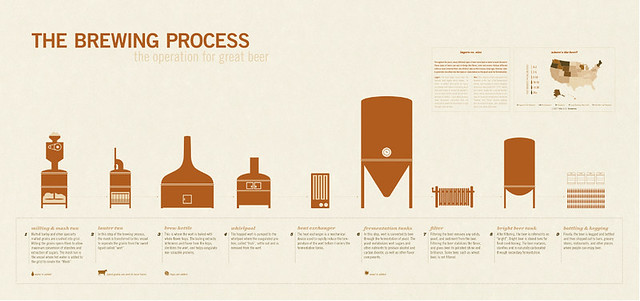
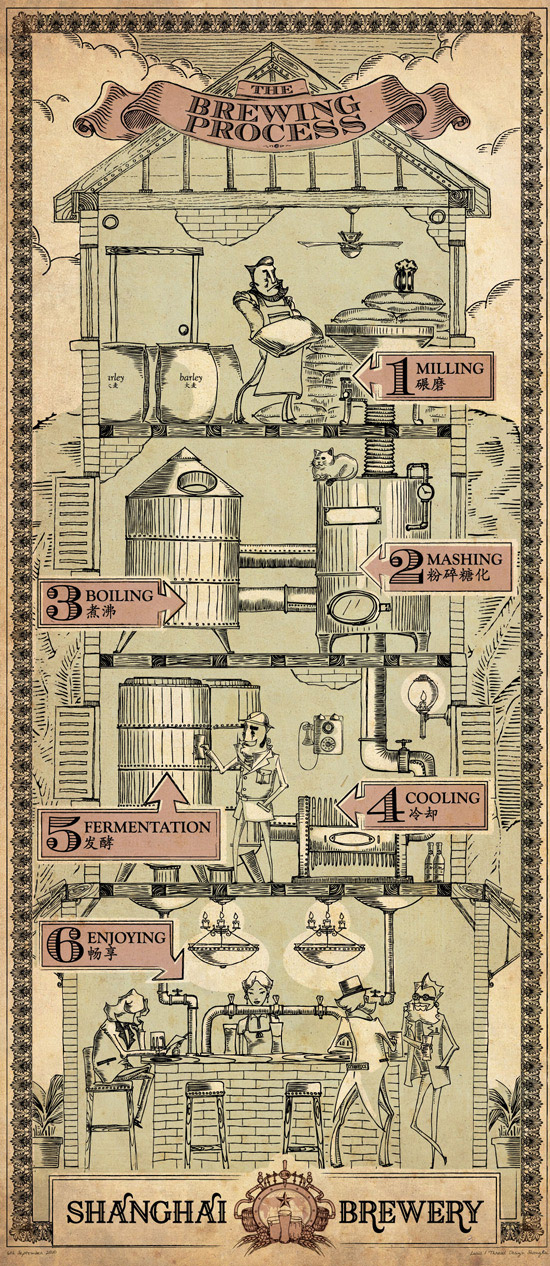
Today’s infographic, the Art of Beer, shows a variety of aspects of beer, including glassware, the brewing process and the BA”s definition of craft beer. It was created by Louis R. Zurn, a student at the Minnesota State University Moorhead.

Click here to see the infographic full size.
By Jay Brooks
By Jay Brooks

Today’s infographic shows each of Major League Baseball’s teams with their prices for beer equalized so they be compared more easily. The chart was compiled and created by Benchwarmer Sports. I don’t know if this is a coincidence or not, but yesterday the Boston Red Sox and the St. Louis Cardinals began the 2013 World Series, and their two stadiums are the most-expensive one to buy a beer. Hmm.
By Jay Brooks

Wednesday’s ad is for Budweiser, from 1958. It’s one from Anheuser-Busch’s long-running “Where There’s Like … There’s Bud” series. In this one, a smiling redhead is having her pilsner glass filled, but notice that it’s already full to the brim, but there’s still a stream of beer coming out of the bottle, plus you can see a fair amount of beer still inside the bottle, too. A lot of these ads show this impossible scene of a bottomless beer bottle where despite the fact that glass is full, the bottle that filled it is still likewise full. It’s magic. And check out the length of her painted fingernails. They seem pretty long for 1958. Of course, I was minus one that year, so what do I know?

By Jay Brooks

While it’s been a rumor for a number of years — I first learned about it at least four years back, but like a monk was sworn to silence — finally it’s out in the public. America is getting its first officially sanctioned Trappist brewery. St. Joseph’s Abbey of Spencer, Massachusetts will be adding brewing to its daily routine, and selling under the name Spencer Brewing Co.

The abbey was established in upstate New York in 1950, and is part of the Catholic Order of Cistercians of the Strict Observance (O.C.S.O.), better known as “Trappists.” Many reports have indicated there’s 180 of them worldwide, but I count 175 at the list on the order’s official website.

The abbey already sells preserves, and has done so for a long time, since around 1954. They also sell “liturgical vestments, and run a farm” to fund the abbey. Apparently the Scourmont Abbey, which makes Chimay, is helping the monks of St. Joseph’s in some capacity, whether through education, logistical support or just consultation I’m not sure. I also know that Dann Paquette from Pretty Things had been helping out, at least in the early stages, as he’d befriended a couple of the monks there as they gathered information and were considering the project of opening a brewery. Records indicate the building for brewing will be 50,000 square feet and their goal to brew 10,000 bbl per year. The first beer will be a Pater, a type of beer made by several Belgian breweries. Here’s how the back label describes the beer:
“Inspired by traditional refectory ales brewed by monks for the monks’ table, Spencer is a full-bodied, golden-hued Trappist ale with fruity accents, a dry finish and light hop bitterness.”
The brewery website is still empty, with just a Go Daddy holding page, and there’s no word on when the beer might be available. With the now Belgian-owned Anheuser-Busch InBev, Sierra Nevada working with Ovila, Moortgat buying Boulevard Brewing, and now this, there’s going to be a lot more Belgian-inspired, and Belgian-made, beer in the U.S. in coming years. But it’s hard not to be excited about this development.

And the hexagonal Trappist logo is on the back label.

By Jay Brooks

Mashable had an interesting piece about Genetically Engineered Yeast being done by at least two companines, Amyris and Evolva, and based in part on a New York Times article, What’s That Smell? Exotic Scents Made From Re-engineered Yeast. In the Times article Amyris co-founder Jay Keasling explained “that the process is ‘just like brewing beer, but rather than spit out alcohol, the yeast spits out these products.'” The relatively new discipline, dubbed synthetic biology, is only about a decade old. There are apparently issues about whether it would be considered natural. SOme say no, because the synthetic version “contains scores of components besides” what it’s being used as, while John B. Hallagan, from the Flavor and Extract Manufacturers Association believes “it conceivably could be called a natural ingredient since it is made in a living organism.”
By Jay Brooks

In case you’ve missed all of the reminders and e-mail blasts, today is the last day to register for the California Craft Beer Association‘s Northern California General Meeting, which will take place October 29 at the University of California Davis Conference Center, located at 550 Alumni Lane, Davis, CA 95616. You can register online via Eventbrite, and check out the schedule of the day’s itinerary.