Not sure how I missed this, but a couple of years ago Lagunitas posted a video showing techniques for Mastering The Lagunitas Butterfly Bottle Opener. Shortly thereafter, they posted a second video showing advanced techniques for using their butterfly beer opener.
Oktoberfest Munich Infographic

Today’s infographic is still yet another poster about Oktoberfest, which began six days ago in Munich, Germany. This one is titled simply Oktoberfest Munich and was created by Destination, a travel website. It features several factoids and then compares two other prominent Oktoberfests, one in Brazil and the other in Cincinnati.

CLick here to see the infographic full size.
Oregon Brewed Film

I got an e-mail last evening from David Panton, letting me know that his short film, Oregon Brewed, is now available to watch on Vimeo.
It runs just over twenty minutes, and has done well in some local film festivals. It was chosen as the Best Oregon Film at the Oregon Independent Film Festival and won “Best of Oregon” at the Oregon Film Awards. Here’s the description of the film.
Beer has made a lasting historical mark throughout history. Today in Oregon, beer continues to make history. The unique culture of brewers and beer drinkers in Oregon is an important part not only to the beer itself, but to the people that live here as well. This documentary on Oregon craft beer looks at a few different breweries all different sizes and ages, to find out what really makes beer in Oregon unique.
The film features four Oregon breweries: Ambacht, Full Sail, Laurelwood and Oregon Trail. Enjoy.
Oregon Brewed from David Panton on Vimeo.
Beer In Ads #985: A Little More Exciting … A Little More Inviting

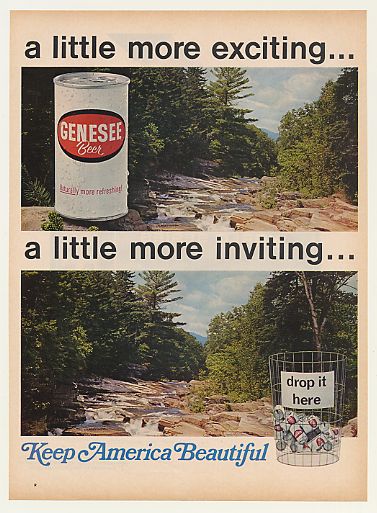
Thursday’s ad is for Genesee Beer, from 1968. The ad is a product of its time, when the ecology movement, as it was known back then, was just starting to spread awareness of such concepts as recycling. But I have to admit, that beautiful stream definitely looks better in its pristine state, without beer cans littering that idyllic natural setting. And can that wire trashcan really be out there by the stream? Keep American Beautiful, indeed.
Beer Distributor Prank

I don’t know exactly which beer distributor this took place at, but a Jake Dell pulled a great prank on his boss Paul, and filmed the whole thing. Enjoy.
Get Ready … For Oktoberfest
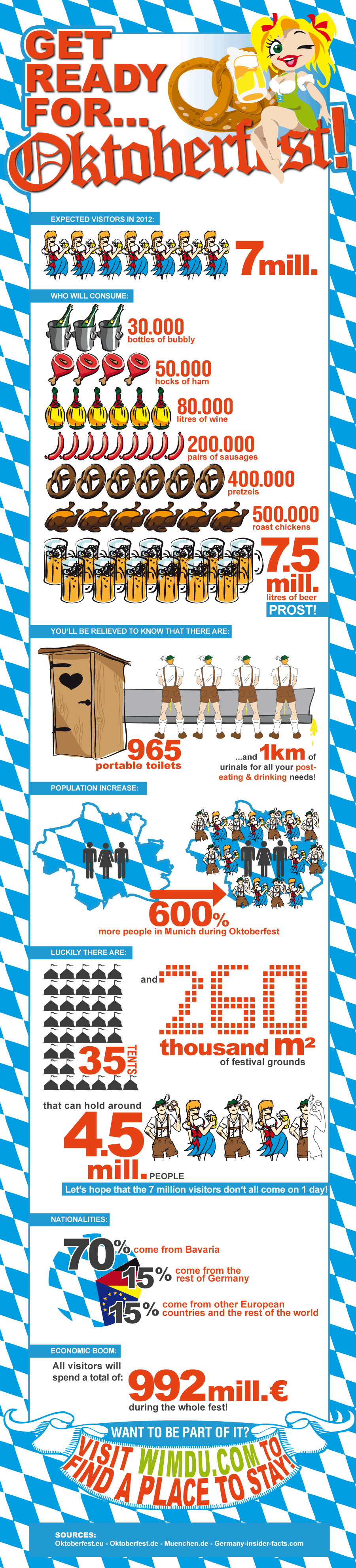
Today’s infographic is yet another poster about Oktoberfest, which began five days ago in Munich, Germany. This one is called Get Ready … For Oktoberfest and was created by Wimdu, a house and apartment rental website.
CLick here to see the infographic full size.
Beer In Ads #984: Stronger Bolder Taste Really Means Business!
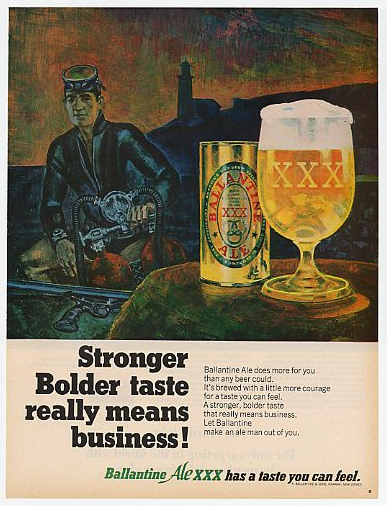
Wednesday’s ad is for Ballantine, from 1968. I just watched the James Bond film “Thunderball” with my son this weekend, and this dark drawing of the scuba diver reminds me a bit of it, as if they’re invoking the idea or romance of James Bond to sell Ballantine. Thunderball came out in 1965, and was the most popular Bond film to date, so it’s possible, I suppose. But that tagline, “Stronger Bolder Taste Really Means Business!,” it seems to be mixing too many ideas, and just doesn’t roll off the tongue. And then there’s that other tagline at the bottom of the ad. “Ballantine Ale XXX has a taste you can feel.” Hmm, taste you can feel?
How Alcohol Effects Moods In Males & Females

I’m not quite sure what to make of this study, which looked into the issues of “how does alcohol consumption affect anger, sadness, and happiness?” and “how do anger, sadness, and happiness affect alcohol consumption?” Alcohol, Moods and Male-Female Differences was published by the Rand corporation, and was conducted by the Psychiatry Department at the University of Vermont. Essentially they surveyed less than 300 heavy drinkers to make their findings. Here’s the abstract:
AIMS: The goal of this study was to better understand the predictive relationship in both directions between negative (anger, sadness) and positive (happiness) moods and alcohol consumption using daily process data among heavy drinkers. METHODS: Longitudinal daily reports of moods, alcohol use and other covariates such as level of stress were assessed over 180 days using interactive voice response telephone technology. Participants were heavy drinkers (majority meeting criteria for alcohol dependence at baseline) recruited through their primary care provider. The sample included 246 (166 men, 80 women) mostly Caucasian adults. Longitudinal statistical models were used to explore the varying associations between number of alcoholic drinks and mood scores the next day and vice versa with gender as a moderator. RESULTS: Increased alcohol use significantly predicted decreased happiness the next day (P < 0.005), more strongly for females than males. Increased anger predicted higher average alcohol use the next day for males only (P < 0.005). CONCLUSION: This daily process study challenges the notion that alcohol use enhances positive mood for both males and females. Our findings also suggest a strong association between anger and alcohol use that is specific to males. Thus, discussions about the effects of drinking on one’s feeling of happiness may be beneficial for males and females as well as anger interventions may be especially beneficial for heavy-drinking males.
Their overall bullet point conclusions? “Increased alcohol use dampens a positive mood the next day, especially for women. Increased anger causes men to drink more.”
In the full text, they go through an interesting history of similar studies examining emotions and alcohol use. Curiously, this study was published earlier this year, but the actual participants were first recruited between 2000 and 2003, and they were monitored for 30 days. What took place in the intervening decade, I’m not sure, and it doesn’t seemed to be explained in the article, though perhaps I’m missing something. It certainly couldn’t have taken ten years to analyze the data.
They begin a discussion in the text with this. “While it is generally accepted that moods and alcohol use are associated, the current body of literature reports contradictory findings with regard to the directionality and strength of the association.” What follows is, at least, an honest presentation of what they did, the limitations of how they conducted the study and some conclusions they were able to draw. For example:
Contrary to our first hypothesis that increased alcohol consumption would predict lower levels of anger and sadness and higher levels of happiness the next day, we found no association between total number of drinks and next day anger or sadness. Surprisingly, we found that as the total number of drinks increased, average scores for next day happiness decreased.
Likewise, “increased happiness was related to increased alcohol use the next day, while increased sadness was related to decreased alcohol use the next day.”

Click here to see the chart full size.
So overall, their results seemed to indicate clear differences between how men and women react to the use of alcohol, and more so not during drinking, but the next day.
It is often assumed that alcohol use helps moderate emotions, yet the results of this study do not support the theory that alcohol enhances positive mood or dampens negative mood. On the contrary, these results suggest that an increase in alcohol use dampens next day happiness, a topic that can be explored in primary care brief interventions, and does not have a significant effect on next day anger or sadness. Our results do support the theory that negative mood (specifically anger) predicts alcohol use. In particular, males seem to react to increases in anger by increasing their alcohol use the next day while females do not.
Based on my own experience, I think it’s more likely that different people react to alcohol differently. Some people do indeed have their mood positively effected by drinking, while for others it acts as a depressant. Some can control their drinking, while a small minority aren’t able to, whether due to physical dependency or emotional or psychological, I can’t say. But in any sample of 240 or so people, you’re going to find some whose moods improve and some whose do not. If you’ve been around enough people drinking, that just seems like common sense.
How To Survive Oktoberfest
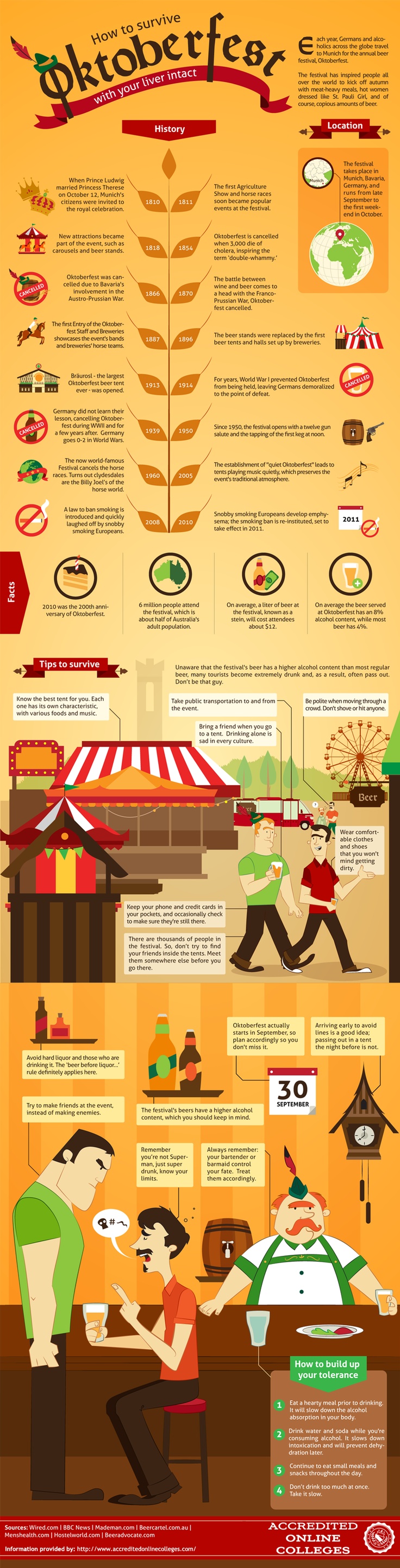
Today’s infographic is still another poster about Oktoberfest, which began four days ago in Munich, Germany. This one is called How To Survive Oktoberfest with Your Liver Intact and was created by Accredited Online Colleges. It features a brief history of Oktoberfest and some tips for navigating the festival.

Beer In Ads #983: The Goodness Of Malt In Fondue
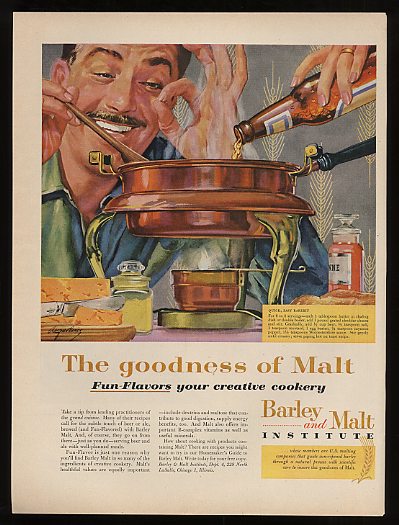
Tuesday’s ad is for the Barley and Malt Institute, from 1959. This is the fourth ad I have from the now defunct trade group for barley growers. In this one a feminine hand is adding beer to a fondue pot, while a man is stirring it and holding up the “OK” sign, presumably to indicate there’s enough beer in the mix. And that tagline, “Fun-Flavors your creative cookery;” I’m not even sure that quite makes sense. But cheese and beer? Now those are some fun flavors.