Our 112th Guinness ad is a rough draft for an ad by John Gilroy, one that I’ve never seen in its finished form. Since it shows the Brooklyn Bridge, I assume it was done when Guinness introduced draught beer to the United States, whenever that was.
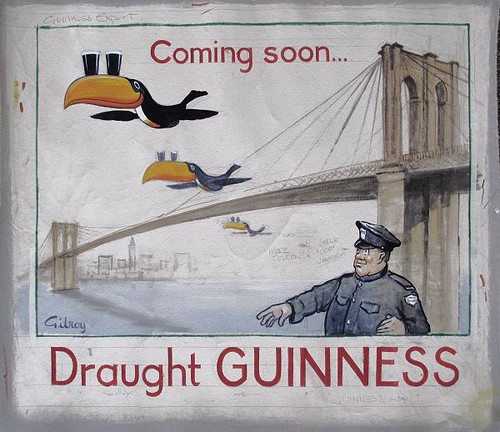

Our 112th Guinness ad is a rough draft for an ad by John Gilroy, one that I’ve never seen in its finished form. Since it shows the Brooklyn Bridge, I assume it was done when Guinness introduced draught beer to the United States, whenever that was.

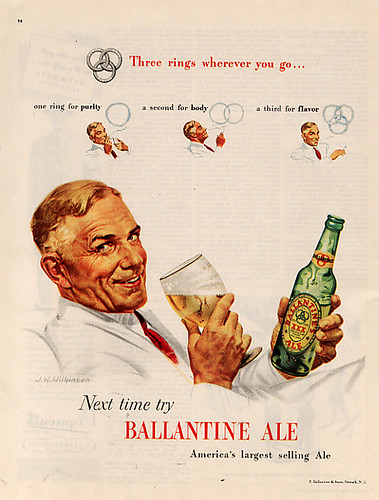
Friday’s ad is another older Ballantine Ale ad, with an illustration by J.W. Wilkinson. He was active beginning in 19-teens, and most prolific in the 30s and 40s so that’s my guess for when the ad originally ran. The man in the white suit looks a little Will Roger-esque, but of course could just be anyone from that time period.

Today I had a great experience that’s been a few months in the making. Last October, one of my newspaper columns was about the 35th anniversary of the date in 1976 when New Albion Brewery, the first modern microbrewery built from scratch, was incorporated by Jack McAuliffe. A homebrewer and beer collector in San Jose, Ed Davis, read my piece in the San Jose Mercury News and contacted me with an intriguing proposal. He had some full bottles of New Albion beer — Ale, Porter and Stout — and did I know anyone who might be interested in them? Obviously, I knew at least one person — me! — and I suggested that it might be fun to open them with Don Barkley, who would been involved in their creation, since he had been the assistant brewer there. Finding a day we were all available took some time, but today Ed and I traveled to Napa to Napa Smith Brewery and met with Don Barkley, who’s now the brewmaster there. But in addition to working at New Albion, Don also founded Mendocino Brewing during his illustrious career, before building and running the new Napa brewery.
Ed told me he’d bought the beers originally at Beltramo’s around 1979 and they’ve been stored in his garage ever since. While they were stored at a slightly higher than cellar temperature, the temperature was relatively consistent and they hadn’t been moved in all that time.
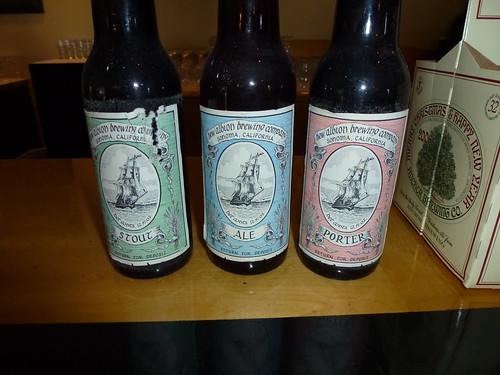
Ed brought one bottle each of Stout, Ale and Porter.
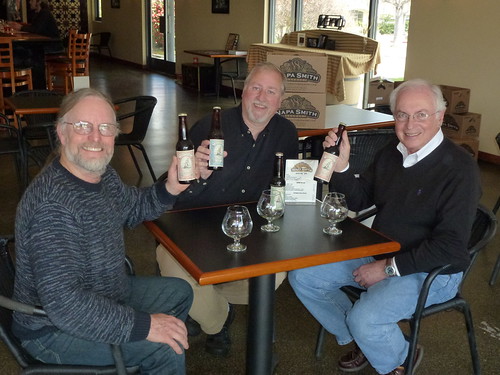
Don Barkley, me and Ed Davis each with a 1979 bottle of New Albion beer, that Ed was kind enough to donate to the cause.
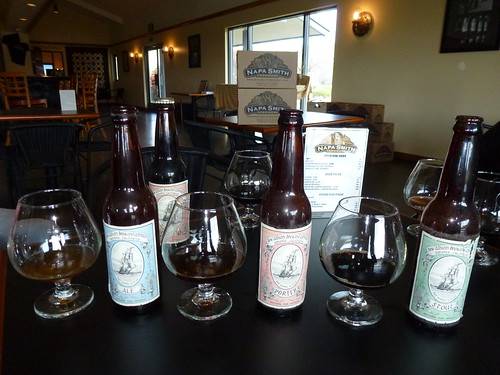
Each of the three beers and their bottles.
Below is a short video (about 14 minutes) of the three of us opening and tasting the three beers.
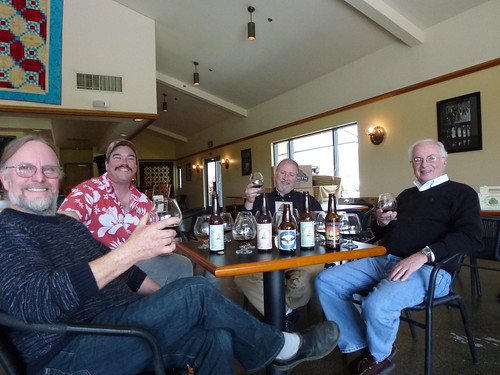
After the tasting, Don, Napa Smith lead brewer Michael Payne, me and Ed.
In addition to the New Albion beers, Ed also brought a few additional treats, too.
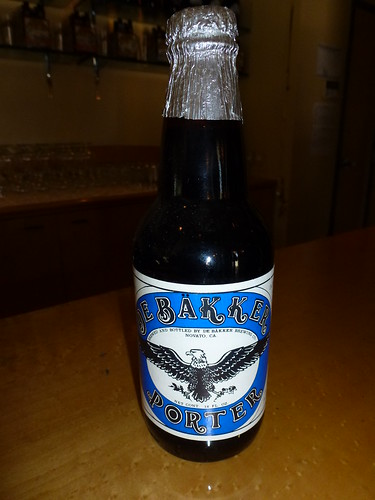
A bottle of DeBakker Porter. DeBakker was a short-lived brewery (1980-82, I believe) that was located in my hometown of Novato, California and was started by a fireman, Tom DeBakker, who had been a homebrewer for about a decade before he opened the brewery.
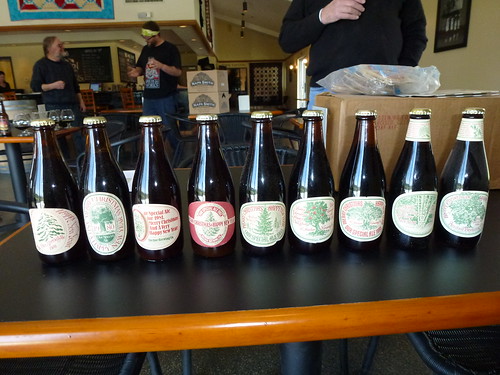
Ed also brought a run of old Anchor Christmas Ale, 1978, 1980 through 1985, 1991 and 1996.
What a great way to spend a Friday afternoon! I wish all my Fridays could be as enjoyable. The DeBakker porter also held up quite well, it still had a fair amount of carbonation with chocolate notes. The Anchor beers were a mixed bag, some were still terrific, others were past their prime though none were strictly speaking undrinkable. Some of the spicier ones were still showing those spices, though a few of the earlier ones were oxidized, at least a little. The real surprise, of course, was how well the New Albion beers had held up after 33 years. They were bottle-conditioned, which probably helped, but still I expected them to be in worse shape than they were. I think we all thought that, but we were pleasantly surprised. I could stand to be surprised like that more often. Thanks, Ed, for being able to not open those beers for over thirty years and for sharing them with us today. It was like opening and tasting a piece of history.
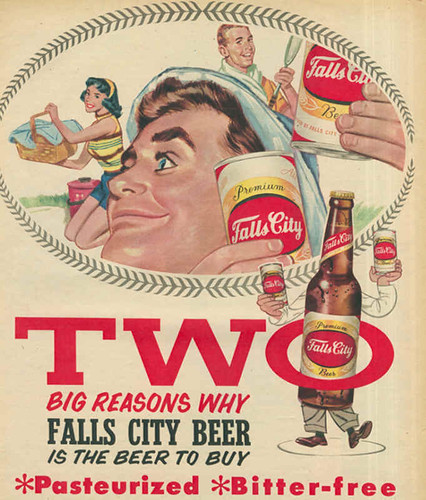
Thursday’s ad is for Falls City beer, a Louisville, Kentucky brand that was founded in 1905 that lasted until 1978. This is the second somewhat surreal ad for this brewery, the first was Falls City Gives You More. Like that first one, they seem to favor ads that rhyme, too. The ad copy is “Two Big Reasons Why Fall City is the Beer to Buy.” And the two reasons? They’re class, as well. “* Pasteurized * Bitter-free.” The big face in the foreground looks out of perspective somehow; it looks too big, too in your face.

Here’s an interesting infographic on beer — both history and factoids — created by Online Bachelor Degree Programs, presumably to drive traffic. But as I’m a sucker for infographics, I’ll happily fall for it. At least they listed their sources at the end. Enjoy!

To see it full size, go to Online Bachelor Degree Programs.
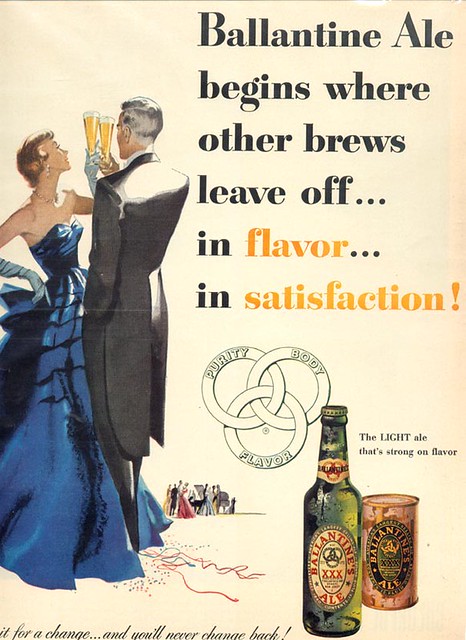
Wednesday’s ad is for Ballantine Ale from, I’m guessing, the later 40s or early 50s. Showing a couple dressed up in their finest haute couture, the woman in a stunning blue cocktail dress and the gentleman in a tuxedo with tails. They’re toasting something pretty important by the looks of it, the confetti at their feet suggesting possibly New Year’s Eve. But it’s not champagne in their glasses, but Ballantine Ale. Because, according to the tagline; “Ballantine Ale begins where other brews leave off … in flavor … in satisfaction!” I also love the throwaway line toward the bottom. “The LIGHT ale that’s strong on flavor.”

Today in 1990, Namibia gained their Independence from South Africa.
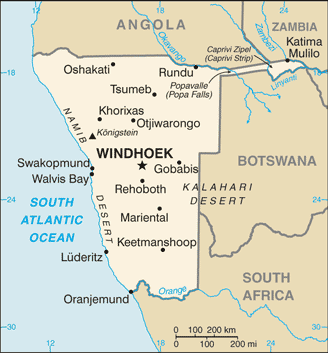
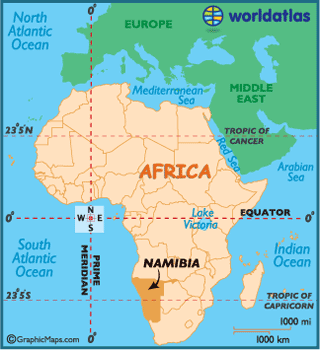
Namibia
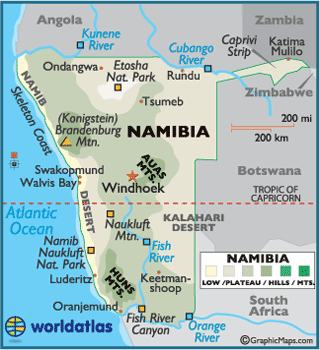
Namibia Breweries
Namibia Brewery Guides
Other Guides
Guild: None Known
National Regulatory Agency: None
Beverage Alcohol Labeling Requirements: Not Known
Drunk Driving Laws: BAC 0.08%



Alcohol Consumption By Type:
Alcohol Consumption Per Capita (in litres):
WHO Alcohol Data:
Patterns of Drinking Score: 3
Prohibition: None

With Alcohol Justice promoting it, I just knew there had to be more to the CNN story Movies May Increase Binge Drinking in Teens. The article is based on a study published in the journal Pediatrics with the more benign title Alcohol Consumption in Movies and Adolescent Binge Drinking in 6 European Countries. But either way, Hollywood is, of course, the bogeyman. The study “surveyed 16,500 students ages 10 to 19 from Germany, Iceland, Italy, the Netherlands, Poland and Scotland.”
The students were asked how often they drank five alcoholic beverages during one sitting [interesting a European study has adopted the ridiculous U.S. definition of “binge drinking”], and about the types of movies they watched. Participants were given a list of 50 movies to choose from, which included many top box-office hits from the U.S. The number of drinking scenes was tallied for each movie.
I don’t have the resources to pay to see the whole study, so I don’t know what films are on the list, but the first thing I have to wonder is how many of those films are age-appropriate for 10-year olds? Many Hollywood blockbusters would be at least “PG-13” (so no 10-12 year olds allowed) or “R” (no 10-17 year olds allowed). Are there many movies with “drinking scenes” that are “G” or that every parent would find appropriate for their 10 through 19 year old child? There’s also no breakdown of how many kids were 10, 15, 19, etc., but I have to believe there’s a vast difference between the effect of watching a film on a ten-year old and a young adult, age 18 or 19. The researchers apparently also considered other so-called “risk factors,” and somehow accounted for each “teen’s levels of rebelliousness or sensation-seeking, peer drinking levels, family drinking patterns, affluence and gender.” That’s a lot of data on 16,500 kids, and almost none of it could be considered the “hard facts” type.
The overall results were that “27% of the sample had consumed >5 drinks on at least 1 occasion in their life.” So roughly 1 out of 4 of the “kids” had consumed 5 drinks at least once, and possibly ONLY once, in their life. And of those 16,500, some of the “kids” were legally allowed to drink 5 beers if they wanted to. In Germany, Italy and the Netherlands, the minimum age for drinking is 16. In Poland and Scotland it’s 18 (though once source I have says it’s 16 in Poland). In Iceland it’s 20. So for at least half the countries where the kids were surveyed, they were permitted to drink at least beer 4 out of the 10 ages of “kids” in the study.
For five-sixths of the countries, at least some of the ages of children surveyed were likewise legally allowed to drink alcohol. Like the age breakdowns, there’s no information available (at least to me) about how many of those surveyed were from which country. Given all the supposed control factors they accounted for, the legal age at which people in the surveyed countries are permitted to drink alcohol seems nakedly absent and, at least to my way of thinking, a rather important omission.
And one last comment about their methodology, such as it was. To determine each film’s — I don’t know, “quotient,” “unworthiness” or whatever — “the number of drinking scenes was tallied for each movie” by the researchers. But is the sheer number of times there’s a scene of people drinking in any way relevant? Is there no context to each scene? Are there not positive and negative ways to portray drinking alcohol? I already know the answer to that one, as obviously the researchers are convinced that ANY depiction of people drinking alcohol they consider wrong, but of course a second’s thought will reveal that to be patently nonsense. Just counting how often people are seen drinking alcohol in a film really tells you nothing about how influential it will be, or indeed, if it registers anything at all. Shown being consumed responsibly, it could just as easily be a positive influence.
Personally, I’m much more concerned about my kids seeing casual violence in films than drinking. But there, as well as in America, research continues to claim that there’s a direct “link between drinking in movies and adolescent alcohol consumption habits.” This latest study’s conclusion likewise claims that the “link between alcohol use in movies and adolescent binge drinking was robust and seems relatively unaffected by cultural contexts.”
But in the last paragraphs — well after most people probably stopped reading — was what I’d been thinking as I read this, that “even though the European study shows a strong association between what is seen on the movie screen and binge drinking, it cannot show cause and effect.” Like Otto Preminger’s Anatomy of a Murder, not everything is as it seems.
And despite the tone of the story up until that point having been confidently certain, as expressed in the headline’s more movies, more binging (or better mo movies, mo binging), it may not be as certain as they would have you believe. Here’s the smoking gun.
It may be that binge drinking teens seek out movies that have alcohol scenes, or it could be that seeing scenes of alcohol use in movies makes them more likely to binge drink. More research is needed to confirm these findings.
I continue to be troubled by the wide range of ages surveyed, because in my experience those are the ages when people change more in a shorter period of time than at any other time in their entire life. The conclusion suggests that to combat this scourge, parents should “go to the movies with [their kids] and discuss what you’re seeing. What you say matters more than what one TV show or one movie says.” In other words, be a parent. So is this a problem of parenting or the movies? Should movies be stripped of adult content because kids might watch them? That does seem to be a common strategy by neo-prohibitionist groups, especially with regard to advertising.
In the end, this seems like yet another study riddled with more questions than answers. But, as is typical, those questions — if the media raises them at all — are buried at the end of the article, well after the average person has given up reading and has moved on to something else. What we’re left with is a “survey” (and we all now how teenagers always tell the truth about what they’re doing) of kids in six varied nations (with different minimum drinking ages) who are of widely different ages (from a childlike ten to a young adult 19) who appear to binge drink more (or at least once) if they see Hollywood blockbuster movies (or it may be teens who drink prefer those movies). Tell me again how exactly that’s news?

One of the unspoken benefits of beer is that it’s a very useful relaxation tool. After a hard, stressful day of work, a tasty beer is just the thing to calm one’s nerves. It would be nearly impossible to quantify, but I have to wonder how much better off many people are because of the relaxation afforded them through the simple act of drinking a beer. How many didn’t do something that they might later regret had they remained tense, stressed and on edge. It’s worth considering, especially as the neo-prohibitionists increasingly insist that beer has no health benefits. But the mental health benefits that most of us get from a calming glass of beer can’t be ignored.
But there’s apparently one more mental health benefit to a beer, as reported recently in the Wall Street Journal (and thanks to Jeff B. for sending me the link). The essay, by Jonah Lehrer, is How To Be Creative, and the teaser subtitle give a nutshell account of what’s to come. “The image of the ‘creative type’ is a myth. Jonah Lehrer on why anyone can innovate—and why a hot shower, a cold beer or a trip to your colleague’s desk might be the key to your next big idea.” The fascinating story is about where creativity and innovation come from, something science has only very recently even tried to explain. The essay discusses several theories and gives examples of different ways that creativity is sparked and influenced. One of those, of course, is through drinking a glass of beer.
Interestingly, Mr. Beeman and his colleagues have found that certain factors make people much more likely to have an insight, better able to detect the answers generated by the aSTG [superior anterior temporal gyrus]. For instance, exposing subjects to a short, humorous video—the scientists use a clip of Robin Williams doing stand-up—boosts the average success rate by about 20%.
Alcohol also works. Earlier this year, researchers at the University of Illinois at Chicago compared performance on insight puzzles between sober and intoxicated students. The scientists gave the subjects a battery of word problems known as remote associates, in which people have to find one additional word that goes with a triad of words. Here’s a sample problem:
Pine Crab Sauce
In this case, the answer is “apple.” (The compound words are pineapple, crab apple and apple sauce.) Drunk students solved nearly 30% more of these word problems than their sober peers.
What explains the creative benefits of relaxation and booze? The answer involves the surprising advantage of not paying attention. Although we live in an age that worships focus — we are always forcing ourselves to concentrate, chugging caffeine — this approach can inhibit the imagination. We might be focused, but we’re probably focused on the wrong answer.
And this is why relaxation helps: It isn’t until we’re soothed in the shower or distracted by the stand-up comic that we’re able to turn the spotlight of attention inward, eavesdropping on all those random associations unfolding in the far reaches of the brain’s right hemisphere. When we need an insight, those associations are often the source of the answer.
So if you’re having trouble with your latest creative project, stuck somewhere with no solution in sight? Relax, don’t worry, have a beer. That may prove to be just the thing to free your mind and in the process unlock the creativity necessary to solve your problem. Liquid gold indeed.
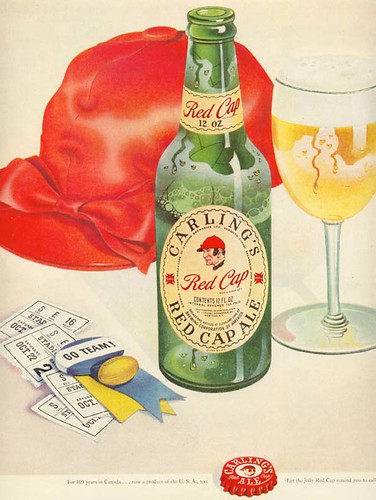
Tuesday’s ad is for Carling’s Red Cap Ale. I’m not sure of the year the ad ran, but there is a clue at the bottom. It says that for 109 years it was made in Canada but as of the date of the ad was being made in the U.S. It’s a great illustration and I’m assuming it ran in the fall, sometime during football season, since the only element in the ad is the generic “Go Team!” football badge in blue and gold and some ticket stubs, presumably from the game.