

Ouch, this doesn’t sound good, sad to say. The Motley Fool is reporting that the Craft Brewers Alliance is out of cash. In a post entitled Who’s Broke Now?, they indicate that the combined corporation that includes Widmer, RedHook, Kona and Goose Island “had only $13,000 in cash in its last reported numbers” and on top of that is “$19 million in debt.” I hope there’s more too it than that, because those are not good numbers. Anheuser-Busch InBev still owns 35% of CBA, but it’s unclear if they’d bail them out or even if that would be desirable.
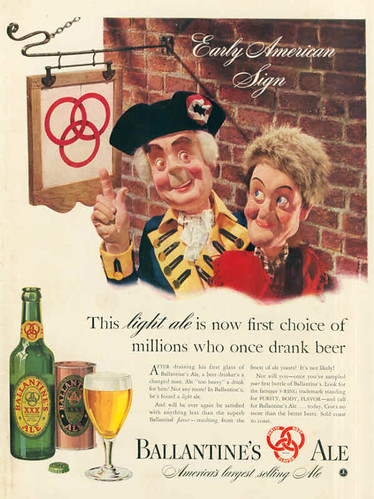
Beer In Ads #316: Ballantine’s Early American Sign

Tuesday’s ad is from 1941 and is for Ballantine Ale. The “Early American Sign” is the three-ring Ballantine logo that George Washington is pointing to on the tavern’s sign. Happy birthday George.
Simplifying Tasting Descriptions

Eric Asimov, who writes The Pour for the New York Times, had a very interesting post today on simplifying tasting notes for wine, entitled Wine in Two Words. Here’s the crux of his idea:
While it may seem heretical to say, the more specific the description of a wine, the less useful information is actually transmitted. See for yourself. All you have to do is compare two reviewers’ notes for a single bottle: one critic’s ripe raspberry, white pepper and huckleberry is another’s sweet-and-sour cherries and spice box. What’s the solution? Well, if you feel the urgent need to know precisely what a wine is going to taste like before you sniff and swallow, forget it. Experience will give you a general idea, but fixating on exactitude is a fool’s errand. Two bottles of the same wine can taste different depending on when, where and with whom you open them.
Besides, the aromas and flavors of good wines can evolve over the course of 20 minutes in a glass. Perhaps they can be captured momentarily like fireflies in a child’s hands, yet reach for them again a minute later and — whiff! — they’re somewhere else.
But the general character of a wine: now, that’s another matter. A brief depiction of the salient overall features of a wine, like its weight, texture and the broad nature of its aromas and flavors, can be far more helpful in determining whether you will like that bottle than a thousand points of detail. In fact, consumers could be helped immeasurably if the entire lexicon of wine descriptors were boiled down to two words: sweet or savory.
Asimov goes on to give greater detail to his idea of simplification, going so far that at the end he gives a list of varietals and where they fall in the sweet or savory list, admitting obvious exceptions will occur. And while I believe beer flavors are somewhat more complex, because of a greater number of ingredients and the endless combinations of them along with variations in the brewing process, the basic notions are sound and applicable.
Like wine, it’s true that the flavors of a particular beer change as it warms, too, and on any given day there are numerous things that can effect how a beer tastes. But even so, I don’t think you could distill beer down to just two descriptors. But I could see a smaller number being devised that could be useful in communicating basic information about the expectations of how a beer might taste, or at least its core components. There are specific styles that certainly have very recognizable characteristics, but just as many don’t or are exceptions to any rules. In a sense beer is like the English language, where there’s an exception to virtually every rule. Still it might be worth the effort to try and see what emerges and whether it could be useful. Anybody have any thoughts?
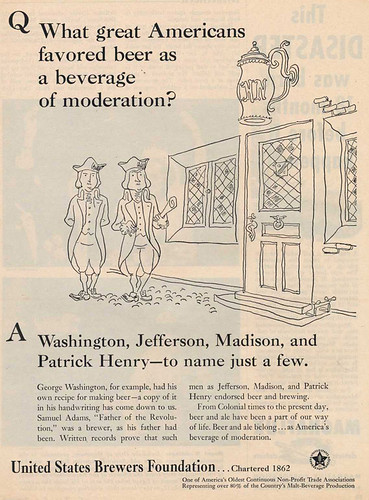
Beer In Ads #315: What Great Americans Favored Beer As A Beverage Of Moderation?
Monday’s ad is from 1951 and ran in Newsweek. It was produced by the U.S. Brewers Foundation, one of a series of historical ads showing the positive side of beer in a post-Prohibition America, a world, like today, in which the neo-prohibitionists continued nipping at their heels despite Prohibition’s massive, unmitigated failure. The ad answers the question “What Great Americans Favored Beer As A Beverage Of Moderation?” with “Washington, Jefferson, Madison and Patrick Henry—to name just a few.” Since today is Presidents Day, and their list includes three early American presidents, it seemed a good way to celebrate by remembering there was a time when beer wasn’t under constant attack and our most popular politicians openly supported it. Happy Presidents Day.
As We Like It

Thanks to Stan Hieronymus and Andrew Mason for tipping me to this little gem. It’s a pro-beer promotional film from 1952, created by the United States Brewers Foundation, the same trade group that created the Beer Belongs series. Using the tagline “sparkling, golden, pure, refreshing, a beverage as old as history,” it’s a great little gem of trying to promote the positive aspects of beer in the wake of Prohibition’s end. Enjoy.
Beer In Art #115: Ralston Crawford’s Buffalo Grain Elevators

This week’s work of art is by the Canadian-born artist Ralston Crawford. He spent his childhood in Buffalo, and most of the rest of his life traveling and in America, which is reflected in his oeuvre. Today’s painting, Buffalo Grain Elevators, was completed in 1937 and today is part of the Smithsonian Institute’s American Art Museum and is a part of their Scenes of American Life collection.
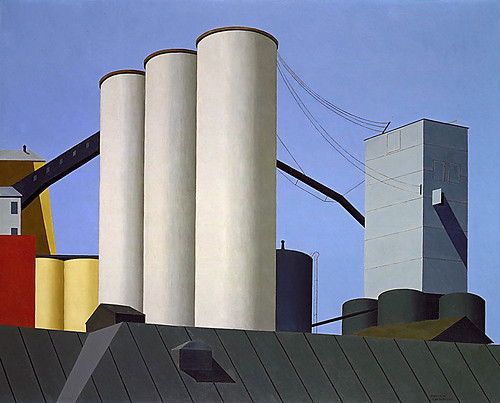
The Scenes of American Life exhibition describes the painting like this:
The huge grain elevators lining the waterfront in Buffalo, New York, fascinated Crawford, who transformed bridges, factories, and other modern industrial structures into volumes and planes. Here he contrasts the massive cylinders of the elevators with the thin lines of the pitched roof in the foreground, the delicate rungs of a ladder, and a series of gently sloping wires.
There’s a biography of Crawford at Wikipedia and also at the Smithsonian Institute and the Hollis Taggert Galleries. You can also find links to more of Crawford’s art at the ArtCyclopedia.
Taybeh: Palestine’s Only Brewery

Palestine has exactly one brewery, Taybeh Beer, founded in 1993 by Nadim Khoury, who learned to homebrew while living in Boston. He returned to his native Palestine after the “Oslo peace accords between Israel and the Palestinians in 1993, one of the approximately 12,000 Palestinian families who returned to the region to help kickstart the emerging Palestinian economy.” Since then business has grown, and is beer is imported to Germany and the UK, and they’re working on the U.S., but according to the video so far we won’t allow them to import because we don’t recognize Palestine as a separate nation. So much for supporting peace in the Middle East. At any rate, the video below gives a nice overview of the brewery.
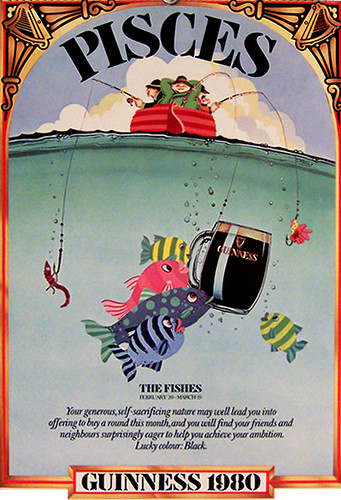
Beerstrology Sign: Pisces

While I don’t put any stock in astrology, in 1980 Guinness put out a calendar with each month representing one of the zodiac signs, and I thought it would be fun to share these throughout the year.
Pisces, the fish, is from February 20-March 19. To learn more, see:
- Astrology Online
- Universal Psychic Guild
- Wikipedia
- Zodiac Signs
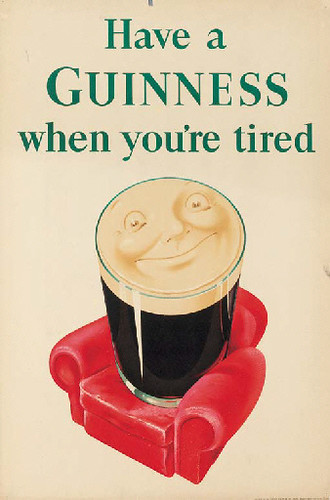
Guinness Ad #56: Tired Red Chair

Our 56th Guinness poster by John Gilroy shows the iconic pint of Guinness with a face being very tired, much like myself, and needing to rest on a red comfy chair. The slogan is “Have a Guinness when you’re tired.”
“For Good Living” Brown Derby Promotional Film

If you say my last post, Beer In Ads #314: Brown Derby’s For Good Living, now you know why I chose a Brown Derby ad. I also came across this promotional film from the same year as the ad, 1937, which was called “For Good Living,” and sponsored at the time by Safeway Stores. It’s a silent promotional film, but after some cheesy introductions shows the brewery where Brown Derby is made. Really, there’s a lot of early brewery porn. Obviously the basic process of making and packaging beer hasn’t changed all that much in the 70+ years since this video was made, but the machinery sure has. At just under twenty minutes, it’s a pretty thorough virtual tour, and includes both bottles and cans being produced. After the tour, the final minutes show the planned “For Good Living” advertising campaign. It’s quite a time capsule. I think every brewer should watch it. I’d love to hear some of their thoughts on then vs. now.