Brookston Beer Bulletin

Jay R. Brooks on Beer

  • Home
  • About
  • Editorial
  • Birthdays
  • Art & Beer

Socialize

  • Dribbble
  • Email
  • Facebook
  • Flickr
  • GitHub
  • Instagram
  • LinkedIn
  • Pinterest
  • RSS
  • Twitter
  • YouTube

Powered by Genesis

Patent No. 2225996A: Beer Foam Control Device

December 24, 2015 By Jay Brooks

patent-logo
Today in 1940, US Patent 2225996 A was issued, an invention of Carl W. Johnson, for his “Beer Foam Control Device.” There’s no Abstract, although in the description it includes this summary:

This invention relates to devices for controlling the amount of foam on beverages which are maintained in storage containers under gaseous pressure, and is particularly adaptable for use in connection with the dispensing of malt beverages such as beer and ale.

One of the difficulties encountered in the dispensing of malt beverages has been the inability to control the foam or cap which forms on the beer when it is drawn into a glass or other container. It is desirable to maintain beer in a keg under relatively high pressures to prevent the beer from becoming flat, the pressure applied to the liquid serving to retain the natural gases formed in the beer during the fermentation thereof. Heretofore it has been found, however, that beer cannot be placed under very much pressure because it will cause foaming with the result that the person dispensing the beverage must scrape a considerable quantity of foam off the top of the beer in a glass, and that part which is removed is wasted.

It is, therefore, a general object of my invention to provide a device for controlling the amount of foam which is produced in dispensing beverages, such as beer, in. order that the beverage may be maintained under relatively high pressure to prevent it from becoming flat, and at the same time permit it to be dispensed with very little foam or cap thereon.

Another object of the invention is to provide a device which can be easily adjusted to meet different pressure conditions in order that a uniform amount of foam will be produced at all times.

A further object of the invention is to provide a device of this general type which is of extremely simple construction and which can be readily cleaned to maintain the original flavor of the beer.
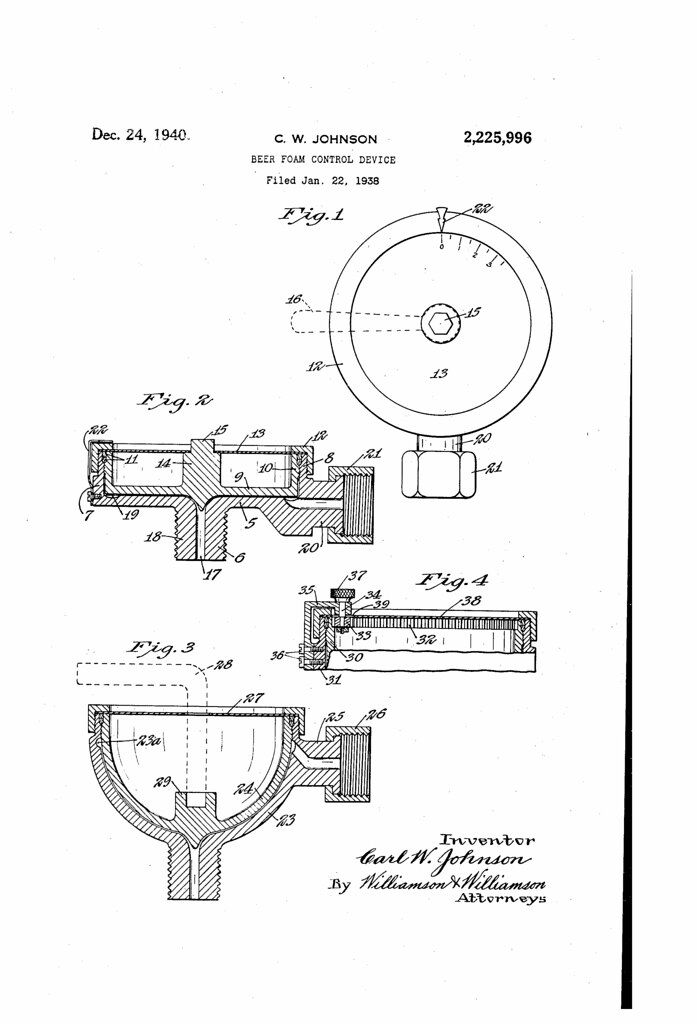
US2225996-0

Filed Under: Beers, Breweries, Just For Fun, Politics & Law, Related Pleasures Tagged With: Brewing Equipment, History, Law, Patent, Science of Brewing

Patent No. 2225996A: Stationary Beer Container

December 24, 2015 By Jay Brooks

patent-logo
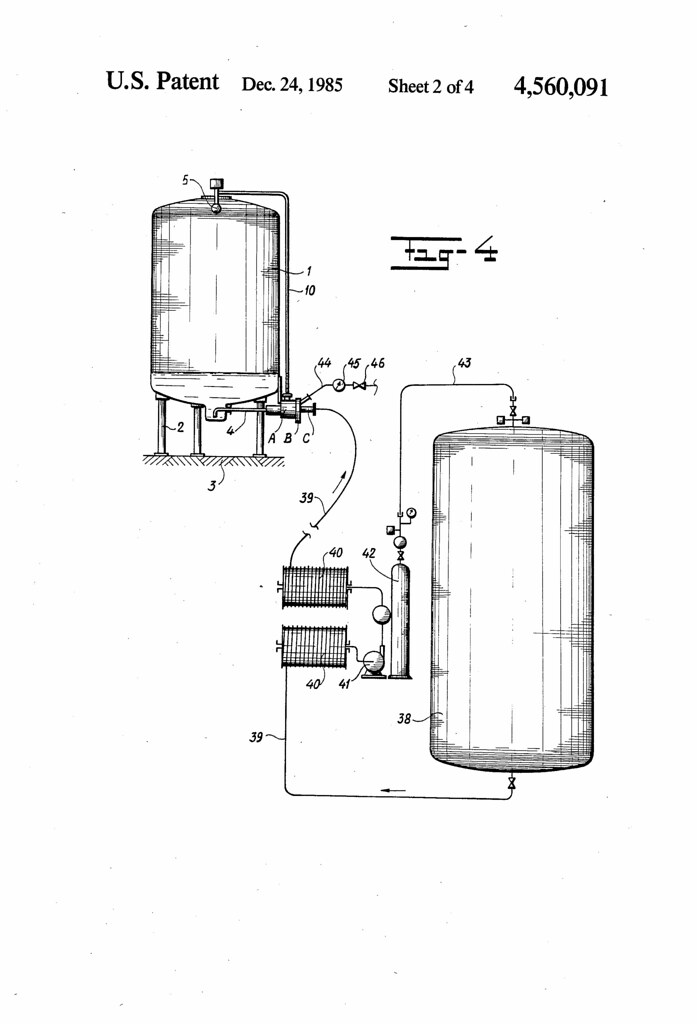
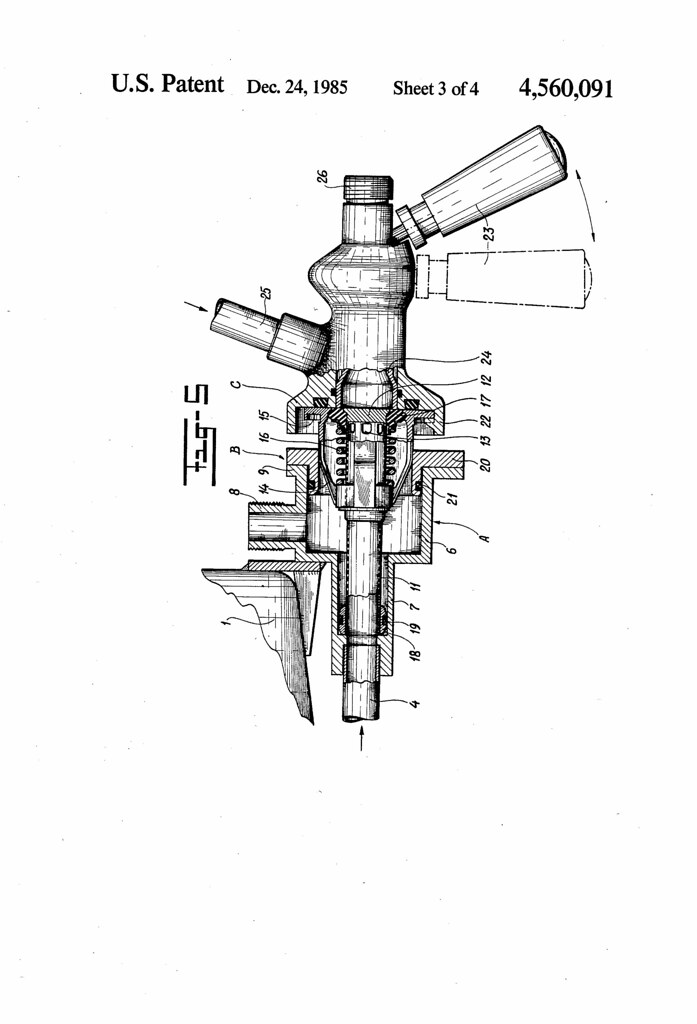
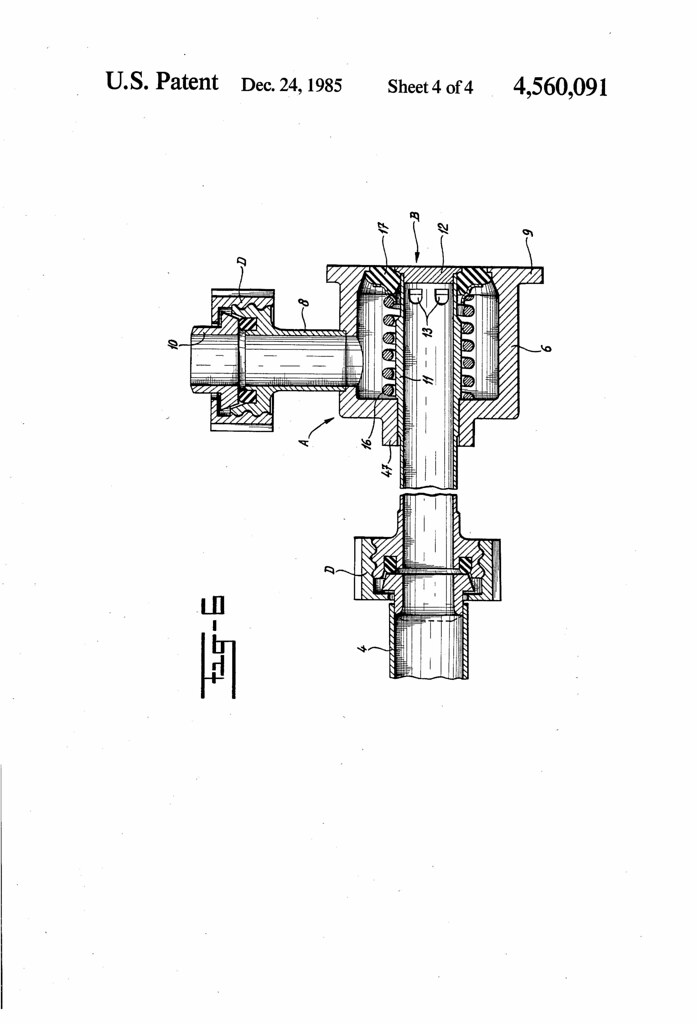
Today in 1985, US Patent 2225996 A was issued, an invention of Hubertus J. Souren, assigned to Grolsche Bierbrouwerij B.V., for his “Stationary Beer Container.” Here’s the Abstract:

A stationary beer container having upper and lower end connections coupled with a flow line coupling and valve assembly adapted to cooperate with a standard beer tap head used with barrels or kegs. The flow line coupling and housing assembly of the invention is connected with a line to the lower end of the beer container and a vertical line to the upper end of the container including a transparent section for determining the beer level in the container. The same type of tap head is used for tapping beer from the container, filing the container, and cleaning the container.

US4560091-1
US4560091-2
US4560091-3
US4560091-4

Filed Under: Beers, Breweries, Just For Fun, Politics & Law, Related Pleasures Tagged With: Brewing Equipment, History, Law, Patent, Science of Brewing

Patent No. 2305641A: Method Of And Apparatus For Making Beer

December 22, 2015 By Jay Brooks

patent-logo
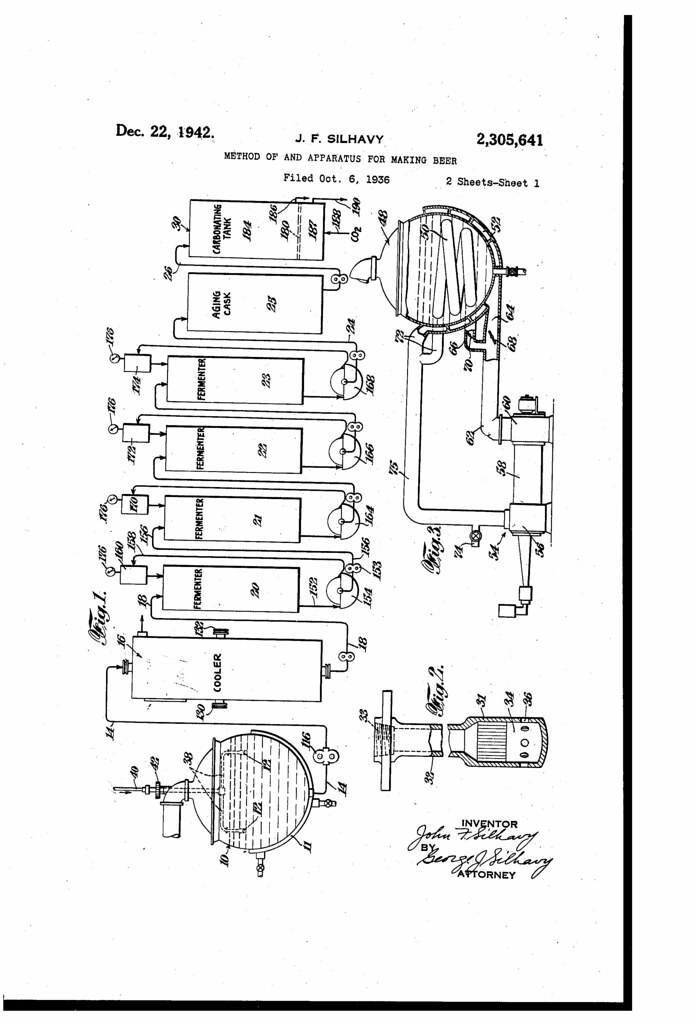
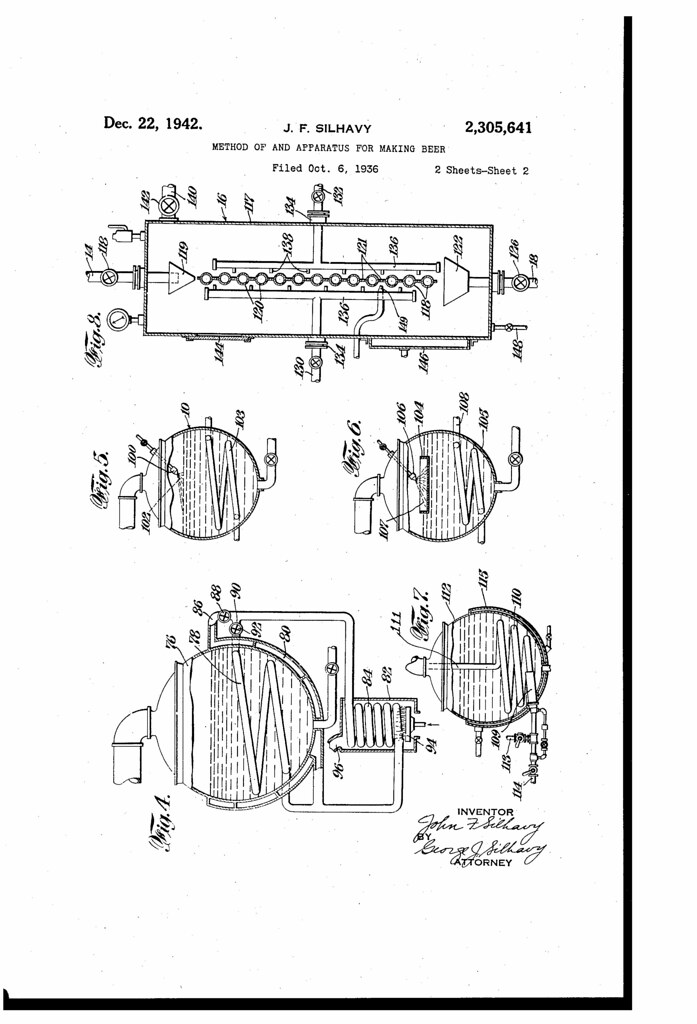
Today in 1942, US Patent 2305641 A was issued, an invention of John F. Silhavy, for his “Method of and Apparatus For Making Beer.” There’s no Abstract, although in the description it includes this summary:

I have invented new methods of and apparatus for heating `and boiling wort in the brew or hop kettle which will be described in connection with My invention is easily adaptable to and can be easily installed in existing kettles. When steam at 25 pounds gage pressure is used as a heating medium in the coil or jacket of a brew kettle, the temperature of the steam is about 265 F. According to my invention I employ heating means and mediums for the brew kettle which range in temperature from about 600 F to about 2000 F so that high’ heating temperatures far beyond those attainable by steam at ordinary pressures are obtained and by this new heating I obtain new and distinct advantages. In my heating systems I use high temperature heating mediums or means which are at a temperature greatly in excess of steam as now used and the wort is contacted with extremely hot surfaces or extremely hot gases. I have shown several ways in which these high and increased temperatures may be obtained but I- am not to be restricted thereto as any heating medium or means which produces high temperature is burned below the surface of the liquid mixture in the brew kettle. In Fig. 2 I have shown a simple form of a burner 3 which can be used but other submerged burners providing submerged combustion with high temperatures can be used. The burner has a tubular portion 32 with a threaded end 33, a combustion chamber 34 and outlet ports 35 for the combustion gases adjacent the combustion chamber. Gaseous fuels are preferably used and such fuels may be mixed with air in stoichiometric proportions in an industrial carburetor or the like and then forced under pressure through the tubular portion 32 and through the burner, being burned in the combustion chamber. By using excess gas a reducing flame is produced and by using excess air an oxidizing flame is obtained. Preferably purified gases such as hydrogen, C2H2 methane, or the like are used. The mixture of fuel and air is burned beneath the surface of the liquid mixture in the brew kettle. The burner may be positioned at any suitable height in the brew kettle but the burner should be placed sufficiently deep in the liquid being heated whereby the combustion gases will give up their heat to the liquid as they bubble through the liquid Wort, and so that the gases of combustion in escaping will not carry off valuable heat. The ideal position of the burner is to have the temperature of the outgoing combustion gases and the wort about the same.

US2305641-0
US2305641-1

Filed Under: Beers, Breweries, Just For Fun, Politics & Law, Related Pleasures Tagged With: Brewing Equipment, History, Law, Patent, Science of Brewing

Patent No. 3293040A: Method For Chill-Proofing Beer With Water Soluble Alkyl Cellulose Ethers

December 20, 2015 By Jay Brooks

patent-logo
Today in 1966, US Patent 3293040 A was issued, an invention of Raymond L. McAdam and Richard G. Shaler Jr., for their “Method for Chill-Proofing Beer with Water Soluble Alkyl Cellulose Ethers.” There’s no Abstract, although in the description it includes this summary:

This invention relates to beer, the treatment thereof during processing, and a novel composition having utility in such treatment and elsewhere. More particularly it relates to a method and composition for the treatment of beer during processing for chill-proofing the beer.

The present invention is in part an improvement in the now conventional method of chill-proofing beer by the addition to the beer of a swelling gelling clay such as hectorite during processing of the beer. In the preferred embodiment the present invention contemplates the combination of a water soluble cellulose ether with the clay. This combination is employed as the clay itself was previously employed. Through the use of the new combination it has been discovered that the chill-proofing properties of the clay are maintained as before but the sludge produced by the clay in the beer is substantially reduced. Also, it appears that the beer is less turbid than when the clay alone is used.

Sludge reduction is desirable since beer is trapped by the sludge and is lost when the sludge is removed. By reducing the sludge level a greater recovery and yield of beer is possible.

Thus the present invention provides an improvement in the method of treating beer with a swelling gelling clay to chill-proof the .beer which comprises adding about .120% with respect to the clay of a water soluble cellulose ether to the beer during the treatment thereof with the clay. The new composition of the present invention may be defined as a swelling gelling clay and about .1- 20% by weight with respect to the clay of a water soluble cellulose ether.

3293040

Filed Under: Beers, Breweries, Just For Fun, Politics & Law, Related Pleasures Tagged With: Brewing Equipment, History, Law, Patent, Science of Brewing

Patent No. D533739S1: Process For Energy Recovery In Beer Wort Boiling

December 19, 2015 By Jay Brooks

patent-logo
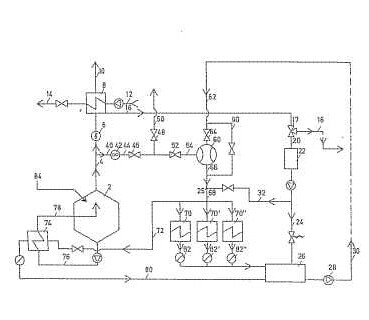
Today in 1985, US Patent D533739 S1 was issued, an invention of Jochen-Heiner Dipl-In Keilbach, assigned to Eichbaum Brauereien Ag, for his “Process for Energy Recovery in Beer Wort Boiling.” Here’s the Abstract:

The invention relates to a process for energy recovery in beer wort boiling by condensation of the vapours on heat exchangers, which is characterised in that, in a start-up phase, the vapours are conducted away virtually unpressurised via a copper vapour condenser (8), and the hop residue-containing condensate is discarded, whereupon in the main phase, part of the hop residue-free vapours is withdrawn virtually unpressurised with the exclusion of air using a steam jet pump (60) fed with superheated steam or saturated steam and condensed via further heat exchangers (70, 70′, 70”, 74) and fed to the steam circulation together with the condensate, likewise no longer containing hop residues, by the copper vapour condenser (8).

DE3424488

Filed Under: Beers, Breweries, Just For Fun, Politics & Law, Related Pleasures Tagged With: History, Law, Patent, Science of Brewing, Wort

Patent No. 3484244A: Fermenting And Aging A Malt Beverage

December 16, 2015 By Jay Brooks

patent-logo
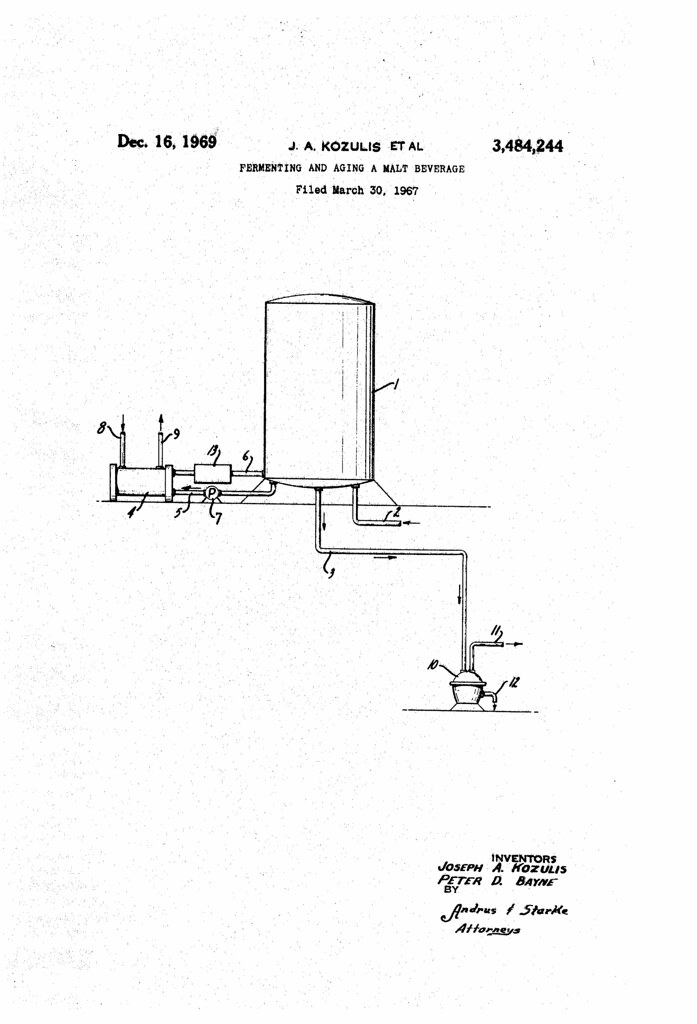
Today in 1968, US Patent 3484244 A was issued, an invention of Peter D. Bayne and Joseph A. Kozulis, assigned to Schlitz Brewing Co., for their “Fermenting and Aging a Malt Beverage.” There’s no Abstract, although in the description it includes this summary:

This invention relates to a method of brewing and more particularly to a method of fermenting and aging a malt beverage.

The present invention is directed to a method of fermenting and aging at malt beverage which is based on a concept directly opposed to traditional brewing practices. More specifically, the wort is introduced into a tank and pitched with yeast. Following the addition of yeast, the Wort is continuously circulated from the tank to a heat exchanger and returned to the tank in a closed flow system. A cooling medium is supplied to the heat exchanger to maintain the wort at a temperature in the range of 45 to 70 F. during the fermentation process.

When the fermentation has proceeded to a point where the specific gravity of the wort falls to a predetermined value below 5 Plato the supply of the cooling medium to the heat exchanger is terminated and the fermented wort circulating within the closed system will gradually increase in temperature due to the heat generated by the fermentation process. The temperature of the fermented wort is permitted to rise until it reaches a value at least 4 above the fermenting temperature, and generally in the range of 50 to F., and is maintained at this temperature by controlled circulation of the cooling medium. At this time the yeast is still present in the beer and the beer is continuously circulated through the system for a period of about one to five days and until the diacetyl content falls to a value below 0.2 p.p.m. and the acetaldehyde content decreases to a value below 5 p.p.m. At this time, the beer is considered to be fully aged or matured.

At the end of the maturation cycle, the temperature of the circulating beer is reduced to a value of about 29 to 32 F. approaching the freezing point of beer. With the beer at this temperature, the beer is withdrawn from the tank and pumped through a centrifuge to re move the yeast. Following the removal of yeast, the beer is prefiltered and carbonated, injected with enzymes, and other additives, polish filtered, the carbonation adjusted and then is stored in government storage tanks for packaging in accordance with conventional brewing procedures. In some instances, only one filtration may be necessary to prepare the beer for packaging.

US3484244-0

Filed Under: Beers, Breweries, Just For Fun, Politics & Law, Related Pleasures Tagged With: Brewing Equipment, History, Law, Patent, Science of Brewing

Patent No. 3161522A: Continuous Lautering Of Brewer’s Wort

December 15, 2015 By Jay Brooks

patent-logo
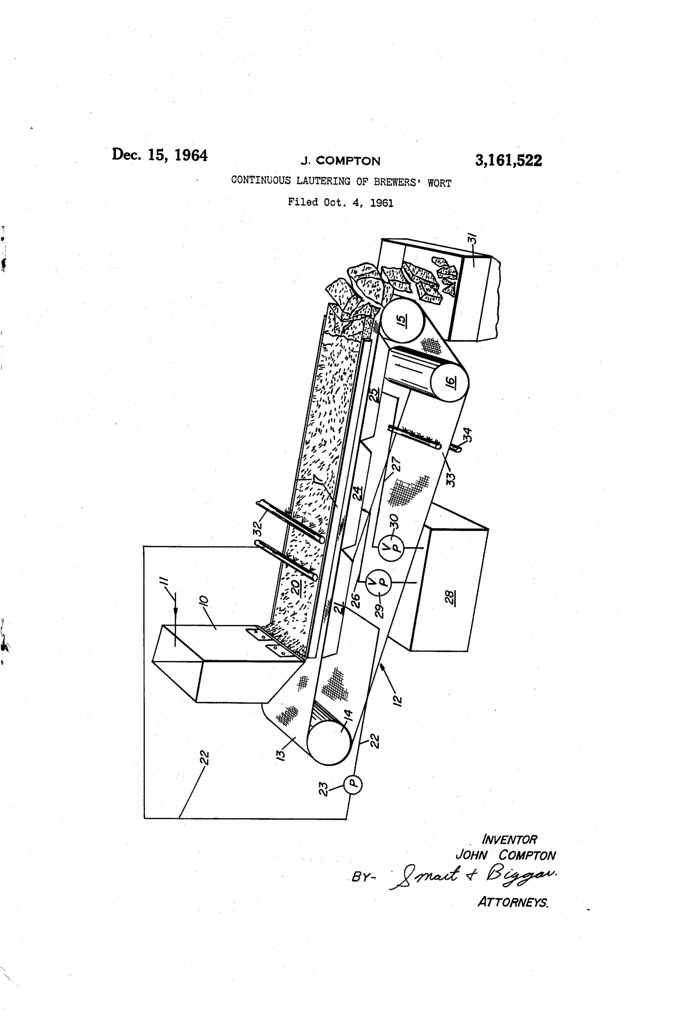
Today in 1964, US Patent 3161522 A was issued, an invention of John Compton, for his “Continuous Lautering Of Brewer’s Wort.” There’s no Abstract, although in the description it includes this summary:

This invention relates to a method of lautering, i.e., straining and recovery of wort liquid from mash grains in the brewing of beer. Lautering has been one of the most critical of the numerous operations involved in brewing and has heretofore required a great amount of skill and experience on the part of the operator to produce quality beer without lost time.

This method may generally be defined as a method of continuous lautering which comprises the steps of feeding a mixture of grains and wort liquid from a mashing operation in a brewing process onto the upper flight of a moving continuous perforated belt at a point adjacent one end of said upper flight, regulating the speed of said belt, and the rate of feed of the mash thereon to, to form a filtering bed of grains on said belt, collecting a filtrate of clear wort liquid which has passed downwardly through said grains and through the upper flight of said perforate belt, subjecting the filtering bed to water-spraying to sparge out residual sugar values and removing said bed of grains from said belt in the region of the other end of said upper flight.

US3161522-0

Filed Under: Beers, Breweries, Just For Fun, Politics & Law, Related Pleasures Tagged With: Brewing Equipment, History, Law, Patent, Science of Brewing

Patent No. 978476A: Hop-Extraction Process

December 13, 2015 By Jay Brooks

patent-logo
Today in 1910, US Patent 978476 A was issued, an invention of Arvid Nilson, assigned to the Wahl-Henius Institute Of Fermentology, for his “Hop-Extraction Process.” There’s no Abstract, although in the description it includes this summary:

The object of my invention is to provide a process of extracting these constituents from the hops which shall produce the extract in a peculiarly desirable condition for the uses referred to; and this I accomplish by the novel procedure hereinafter described and claimed.

Untitled

Untitled

Filed Under: Beers, Just For Fun, Politics & Law, Related Pleasures Tagged With: History, Hops, Law, Patent, Science of Brewing

Patent No. WO1997046116A1: Roasted Hop Solids

December 11, 2015 By Jay Brooks

patent-logo
Today in 1997, US Patent WO 1997046116 A1 was issued, an invention of Vinod K. Chaudhary, Laurel E. Maney, Robert J. Mizerak, David P. Newell, Sydney R. Rader, Subba C. Rao, David S. Ryder, Joseph E. Snyder, and Matthew L. Tripp, assigned to Miller Brewing, for their “Roasted Hop Solids and Methods of Using Them.” There’s no Abstract, although in the description it includes this summary:

A method of roasting hop solids (spent hops) is disclosed. The roasted hop solids are useful for making a light stable, fully kettle hop flavored beverage.

One aspect of the present invention provides a method of roasting hop solids, comprising the steps of feeding the hop solids to a heating means; and exposing the hop solids to a predetermined heating profile in the heating means to produce a roasted hop solids, wherein the predetermined heating profile is chosen so that a fermented hop flavored beverage made using the roasted hop solids has enhanced kettle hop flavor and greater light stability compared to such a beverage if made with an equal amount of unroasted hop solids. The heating means can be any type of dryer capable of drying particulate solids such as flakes, pellets, granules, powders, chips, shreds, leaf, agglomerates, and irregular shapes. For example, a truck dryer or a fluidized bed dry can be used. The predetermined heating profile is preferably further chosen so that substantially all the alpha acids are destroyed. Preferably, the predetermined heating profile is further chosen so that if a fermented hop flavored beverage is made using the roasted hop solids it is light stable. Most preferably, the predetermined heating profile is 98°C for 23-24 hours.

Another aspect of the invention provides a method of making a hop flavored beverage from a fermentable growth media, comprising the steps of adding to the media, prior to bio-conversion, a hop flavoring agent; and bio- converting the media to form the hop flavored beverage, wherein the hop flavoring agent comprises roasted hop solids.

A still further aspect of the invention provides a hop flavored beverage prepared by adding to a fermentable growth media, prior to bio-conversion, a hop flavoring agent comprising roasted hop solids, and then bio- convert the media to form the hop flavored beverage.

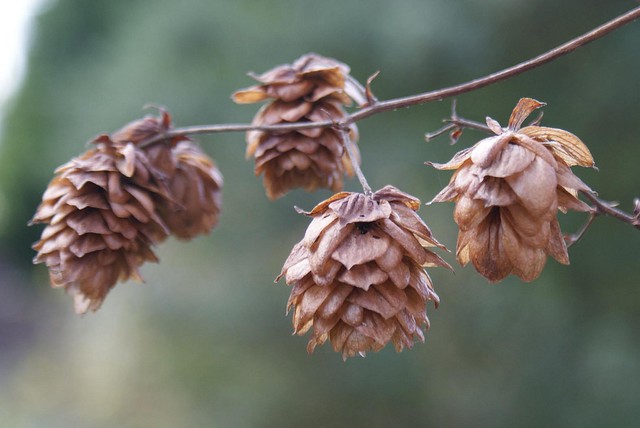
Several years ago, I gave a wine writer a hard time for, among other things, referring to the history of hops in northern California’s past, explaining how hops were once “roasted” throughout the region. Moonlight’s Brian Hunt chimed in, and claimed he’d actually “seen ‘roasted hops’ in print before.” So imagine my surprise when Miller Brewing actually patented a process for roasting hop solids, the spent hops after they’ve been used in the brew, and they also claim that “roasting the hop solids further enhances the fruity/estery hop character imparted by the hop solids.” Hmm.

old-hops

Filed Under: Beers, Breweries, Just For Fun, Politics & Law, Related Pleasures Tagged With: History, Hops, Law, Patent, Science of Brewing

Patent No. 2816031A: Beer Brewing Process

December 10, 2015 By Jay Brooks

patent-logo
Today in 1957, US Patent 2816031 A was issued, an invention of Wilhelm Eberhard Schultheis and Walter Specht, assigned to Ultra Technik G M B H, for his “Beer Brewing Process.” There’s no Abstract, although in the description it includes this summary:

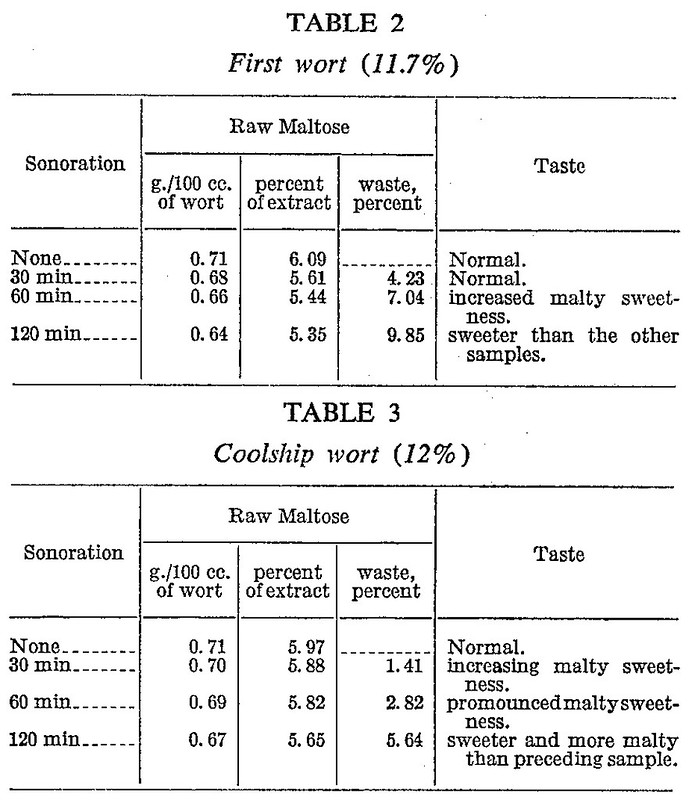
We have found that the production of beer may be made more economical and that beers of superior qualities may be obtained by the application of ultrasonic waves, which term is generally understood to define waves whose frequencies are greater than those which affect the human ear, that is, greater than about 18,000 per second. The ultrasonic irradiation, called hereinafter sonoration, may be applied to various stages of the brewing process. For instance, hops in the presence of water or aqueous solutions, intermediary products such as mash, wort, glattwasser (last wort), or by-products, such as trub, may be treated, singly or severally, also in mixture with each other, with ultrasonic waves to obtain advantages.

As an ultrasonic generator, e. g. the immersion device type T 300a, rotation irradiator with high frequency generator (1000 kilocycles), built by Ultrakust G. m. b; H., Ruhmannsfelden, Lower Bavaria, may be used. The apparatus is preferably operated with full output, whereby it transmits about 300 watts ultrasonic energy to the treated batch.

The sonorat-ion is preferably carried out at elevated temperatures, e. g. between about 50 to 100 (3., which temperatures should be kept constant, and with at least temporary circulation of the treated solution.

A well known drawback of the conventional hopping process, where hops as such are added to the wort, is due to the fact that in the boiling process only about one-third or one-fourth, generally not more than 35 percent, of the bitter principal ‘(resins) contained in the hops pass into the wort, and that, in addition, considerable amounts, e. g. about 3 to 7 percent, of aid resins are precipitated during fermentation and storage.

According to the invention, these drawbacks are obviated by subjecting hops to sonoration in the presence of water or aqueous solutions, e. g. softened brewing water, wort, or last wort; hereby the valuable resins of the hops are dispersed in the extracting liquid without objection: able loss, and the thus obtained resin extracts are used for hopping the wort.

As the hop resins are difficulty soluble in water, only limited amounts of said resins can be dissolved in the water or aqueous solutions used as solvents. In addition, the dissolved resins readily precipitate again, particularly in the presence of absorbent substances, such as spent hops, trub, yeast, or carbon dioxide bubbles. The separation of the resins is further assisted by the fact that the pH of the sweet wort changes during fermentation from United States Patent 2 5.5 to about 4.5, which reduces the solubility of the resins.

We have found that ultrasonic waves have the elfect of producing a fine colloidal dispersion of the difficulty soluble resins in the extract, and at the same time, a stabilization against objection-able precipitation of said dispersed resins in the extract and later in the wort. We believe that this stabilizing action is due to colloidal substances which pass by the sonoration together with the resins into the aqueous liquid, and also to colloidal substance contained in the wort; This may explain the phenomenon that res-ins isolated by sonoration from the hops and dispersed in the aqueous phase can be concentrated in the extract; even in the acid range, to a considerable’ extent and that on addition of the resin extracts thus obtained to the boiling wort objectionable precipitation of resins is substantially avoided. Therefore, the resins are essentially retained in the wort and do not pass, to the extent experienced heretofore, into the trub or during fermentation into the so-called curls or into the yeast.

The extraction of the resins by scnoration may be carried out separately in a metal vessel of a suitable size for the hatch, e. g. in the hop strainer available in breweries, and the resin extract thus obtained will be admixed to the wort in suitable amounts. For instance, we may mix the allotted amount of hops with the extracting liquid, which has been heated to about 50 to 60 C. or even higher, and first agitate the mixture, for instance by circulator, for several minutes to obtain swelling and only subsequently start the sonoration. As extracting liquid, we may use decarbonate’d brewing water, or the glattwasset (last wort) obtained by washing (sparging) the spent grains separated from the first wort, or even the first wort itself. The amount of liquid to be added to the hops depends on the desired concentration ratio between hops arid liquid. In determining the optimum working conditions, it must be taken into account that the maximum extraction effect is not only dependent on said concentration ratio, but also on the nature and composition of the extraction liquid, the pH value, the extraction temperature, the ultrasonic intensity and the sonoration time. Our experiments were carried out at a temperature of about 5060 C. and the temperature was kept constant throughout the extraction period. Under these conditions, a sonoration period of about one hour lproved generally to be sufficient; sometimes it was necessary to apply a somewhat longer sonoration, e.g. up to two hours, in order to obtain optimum results. The extraction by means of sonoration may, however, be carried through also at higher temperatures, e. g. between 60 and C. with a shortened sonoration.

After completion of the extraction, the resinous extract may be separated from the spent hops, e.g. by filtering with suction, and separately processed.

Untitled
Untitled

Filed Under: Beers, Breweries, Just For Fun, Politics & Law, Related Pleasures Tagged With: Brewing Equipment, History, Law, Patent, Science of Brewing

« Previous Page
Next Page »

Find Something

Northern California Breweries

Please consider purchasing my latest book, California Breweries North, available from Amazon, or ask for it at your local bookstore.

Recent Comments

  • Ernie Dewing on Historic Beer Birthday: Charles William Bergner 
  • Steve 'Pudgy' De Rose on Historic Beer Birthday: Jacob Schmidt
  • Jay Brooks on Beer Birthday: Bill Owens
  • Steve 'Pudgy' De Rose on Beer Birthday: Charles Finkel
  • Steve 'Pudgy' De Rose on Beer Birthday: Bill Owens

Recent Posts

  • Historic Beer Birthday: Philip Zorn February 21, 2026
  • Historic Beer Birthday: Rudolph J. Schaefer February 21, 2026
  • Beer Birthday: Kate Bernot February 21, 2026
  • Historic Beer Birthday: William J. Lemp February 21, 2026
  • Beer Birthday: Sayre Piotrkowski February 21, 2026

BBB Archives

Feedback

Head Quarter
This site is hosted and maintained by H25Q.dev. Any questions or comments for the webmaster can be directed here.