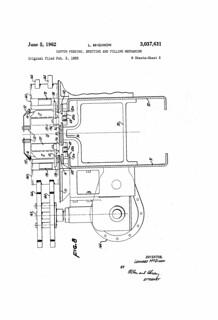
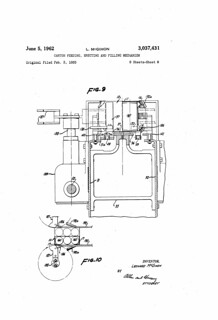
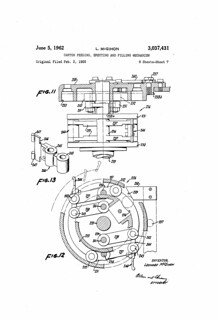
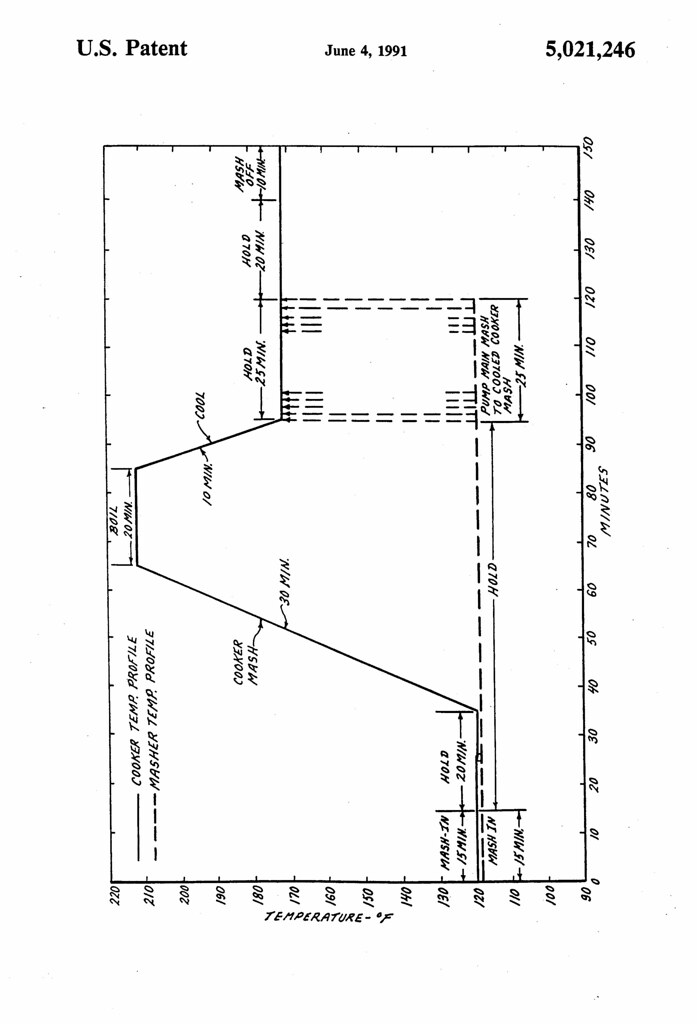
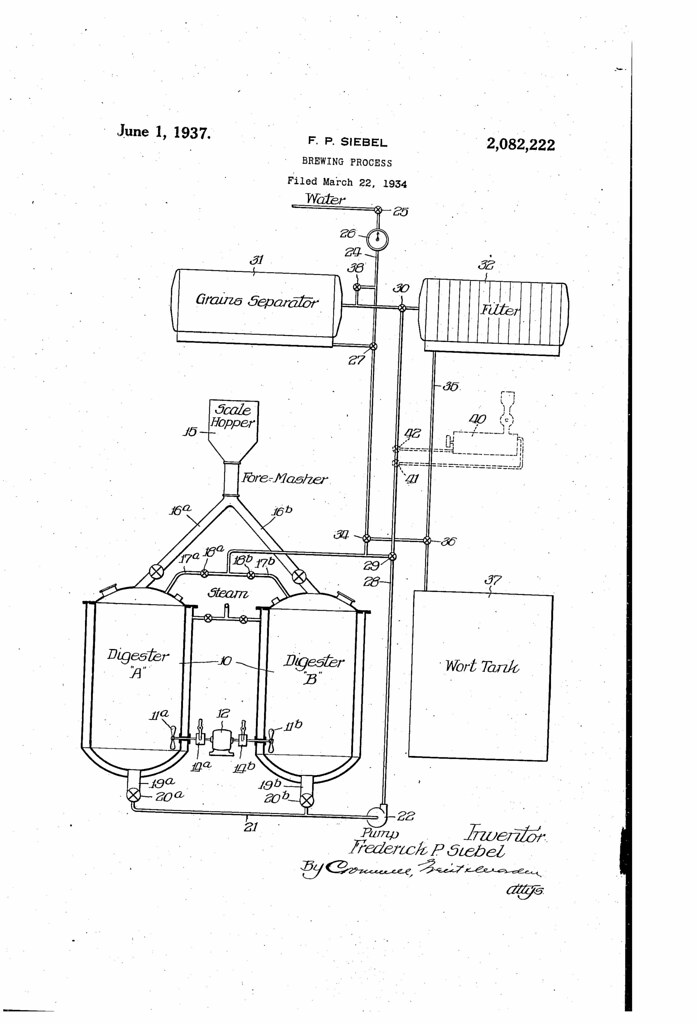
Today in 1960, US Patent 2936236 A was issued, an invention of Robert C. Gadsby, Schwaiger Joseph, and Frank H. Schwaiger, assigned to Anheuser Busch, for their “Method of Draining Off Wort From a Straining Tank.” There’s no Abstract, but the description states that the “invention relates to a straining tank or grain extractor or lauter tub, and more particularly to a new type of straining tank for use in the brewing industry to remove extract from brewers grains. This divisional application relates to the method of straining employed by said straining tank.”


Patent No. 1907994A: Cap

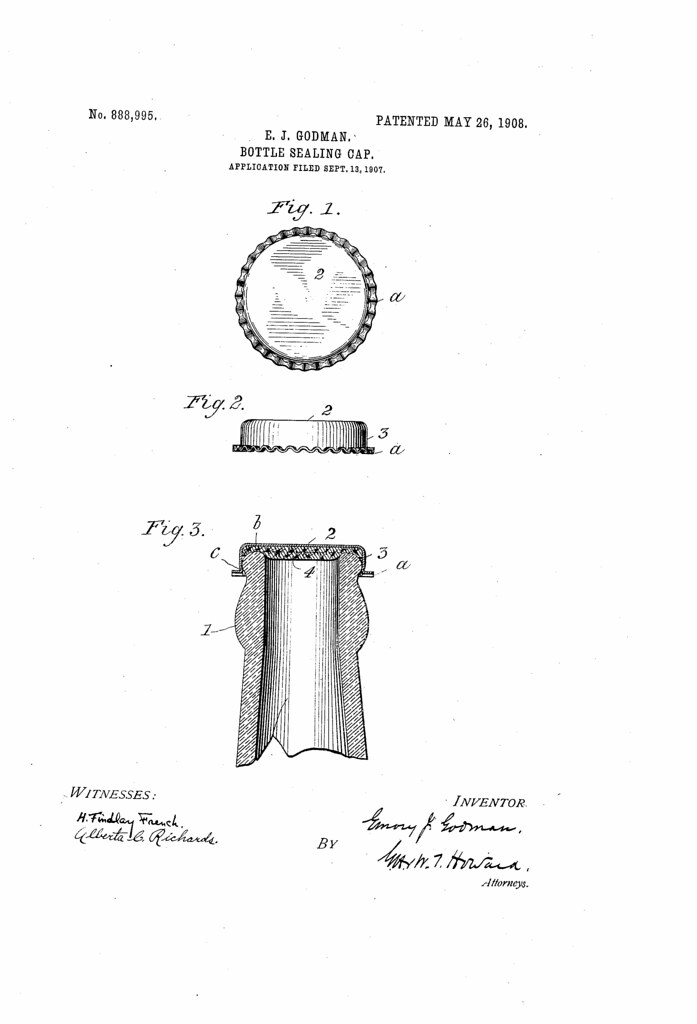
Today in 1933, US Patent 1907994 A was issued, an invention of Edward McManus Charles, assigned to Crown Cork & Seal Co., for his “Cap.” There’s no Abstract, but in the description they talk about an “invention relat[ing] to caps for containers and particularly contemplates a cap wherein a sealing ring or cushion is usually employed.” If you keep reading, it’s explained that this crown works better than previous ones for a variety of reasons, even though it looks pretty much the same as other crowns.

Patent No. 114671A: Improvement In The Manufacture Of Yeast And In The Application Of The Same In Mashing And Brewing

Today in 1871, US Patent 114671 A was issued, an invention of Duby Green, for his “Improvement in the Manufacture of Yeast and in the Application of the Same in Mashing and Brewing.” There’s no Abstract, and in the description there’s never really any simple overview or summation of the invention, Green just dives right it to explaining his formula and how it works. I guess he figured the crazy long title was enough.

Patent No. 3033762A: Straining Tank

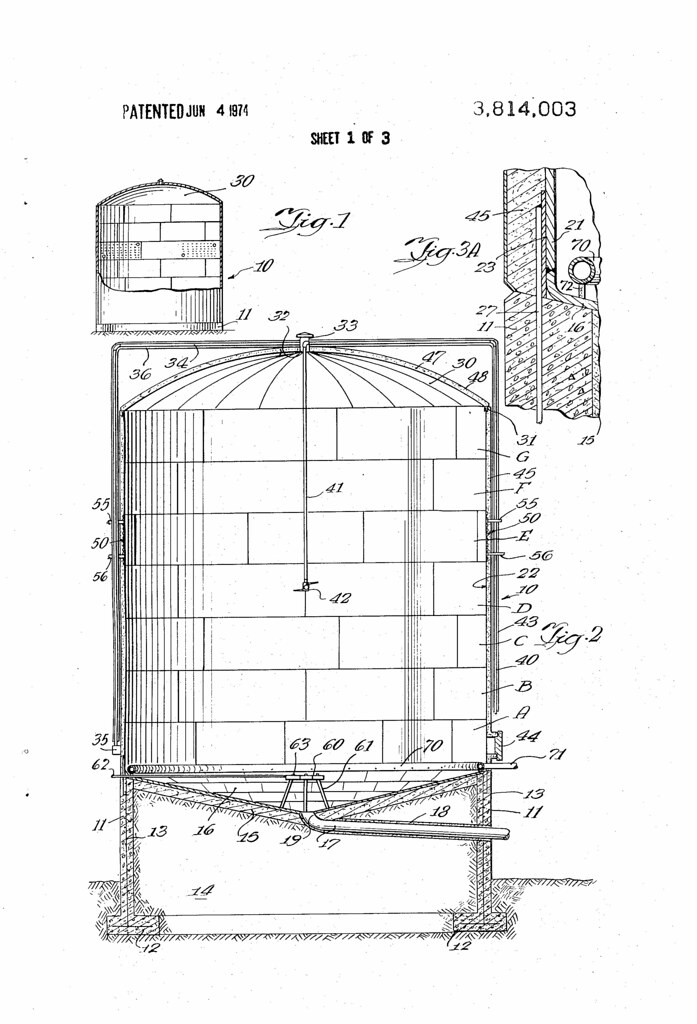
Today in 1962, US Patent 3033762 A was issued, an invention of Robert C. Gadsby, Schwaiger Joseph, and Frank H. Schwaiger, assigned to Anheuser-Busch, for their “Straining Tank.” There’s no Abstract, but in the description it’s stated that the “invention relates to an improved straining tank or grain extractor or lauter tub, and more particularly to an improvement in an existing kind of lauter tub presently in widespread use in the brewing industry to remove extract from brewers grains.” They later elaborate a bit more:
This invention relates to an improvement in existing lauter tubs having agitators therein which increases the efficiency or reduces the draw-o time to about two-thirds of the time previously required. This is important because the lautering step in the brewing process has in the past been one of the slowest and one of the bottlenecks in the production of beer. In other words, in the usual brewing operation today, the capacity of the step which uses lauter tubs or straining tanks largely determines the capacity of the brewery.


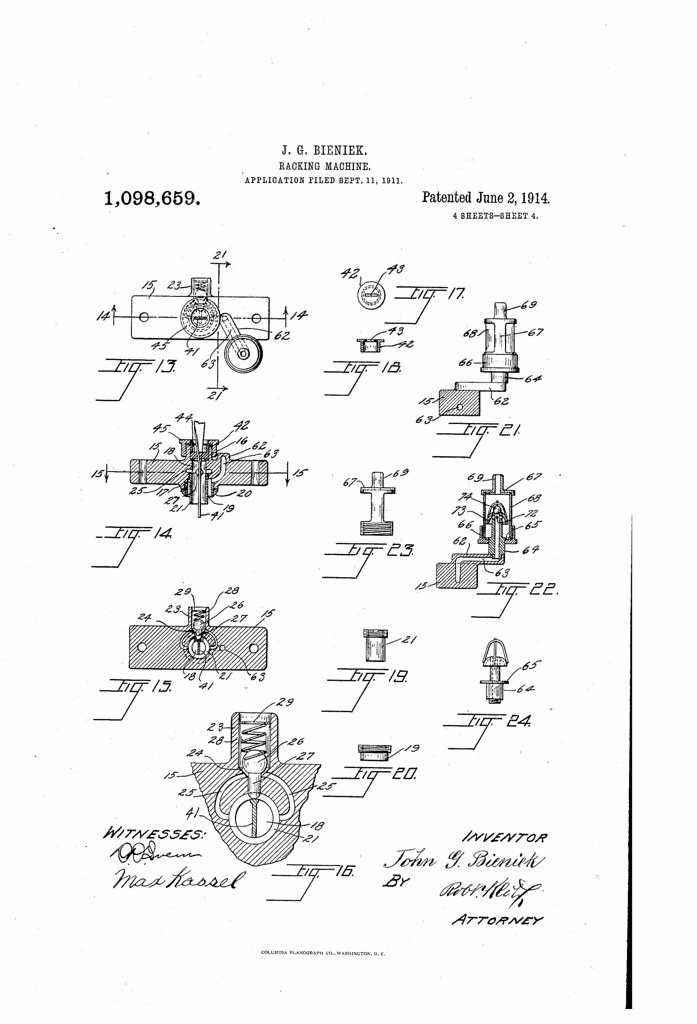
Patent No. 519513A: Apparatus For Racking Beer

Today in 1894, US Patent 519513 A was issued, an invention of Harry Torchiani, for his “Apparatus For Racking Beer.” There’s no Abstract, but in the description it’s stated that the “invention relates to that class of. devices that are used in drawing or filling beer from casks into the barrels, half-barrels, kegs, etc.,” adding this. “The object of my invention is to provide an apparatus of this kind, which can readily be adjusted for barrels or kegs of different sizes, and which prevents the spurting of the beer from the apparatus or keg when the apparatus is withdrawn from the keg.”

Economic Impact Of California Beer
![]()
The California Craft Brewers Association (CCBA) recently commissioned an economic impact study of the state’s brewing industry for last year. And the news is pretty great. Here’s some of the highlights:
Economic Impact: In 2014 craft beer contributed more than $6.5 billion to the economy of California. That’s up 18% from 2013. That’s a fairly conservative number and they’ll have a more accurate and most likely higher numbers in June when the full report is finished. The craft beer industry in California has a higher economic impact than any other state in the US.
Employment: In 2014 Craft Brewers employed more than 48,000 Californians.
Growth: During 2014 the number of operating breweries grew by over 24% giving us a total of 520 operating breweries in California.
Taxes: In 2014 California craft brewers paid over $56 million in State and federal excise taxes and paid more than $1.3 billion in income and other local, state and federal taxes ($880 million in state and local income taxes and $465 in federal income taxes).
Production Volume: 3.5 Million Barrels
Exports: 1.3 million barrels. (That’s still higher than the total production of all but two other states (PA and CO)).

Patent No. 1302549A: Process For Brewing Beer

Today in 1919, US Patent 1302549 A was issued, an invention of Herman Hausen, for his “Process For Brewing Beer.” There’s no Abstract, but as Prohibition began, the invention was specifically for non-alcoholic beer to satisfy demand for at least the taste of beer once the regular kind was outlawed. Here’s a fuller explanation.
My invention relates to the manufacture of non-alcoholic beer, of beer containing less than one-half of one percent of alcohol, and of temperance beer. In the processes heretofore employed for making such beverages, the de-alcoholizing occurs by distillation of the alcohol after the liquid vis fermented or the beer brewed. These old processes involve certain disadvantages which are obviated by my invention, which, generally speaking, consists in simultaneously boiling and fermenting the beer wort in a vacuum and within the range of beer fermentation temperatures at which the activity of the yeast is not destroyed to evaporate the alcohol and preserve live yeast in In the accompanying drawing I show more or less diagrammatically and mostly in sectional view all the apparatus required to carry out my new process.

Patent No. 3181684A: Transfer Mechanism For Conveyor Keg Palletizing Device

Today in 1965, US Patent 3181684 A was issued, an invention of John Miller, assigned to Schaefer Brewing Co., for his “Transfer Mechanism For Conveyor Keg Palletizing Device.” There’s no Abstract, but in the description it states that his “invention is to provide a more efficient transfer mechanism for the barrels or kegs and particularly such a transfer mechanism which is more reliable and sure in operation in transferring the barrels or kegs from the conveyor to the skids which convey such barrels or kegs to the palletizing position.”


Patent No. 2677378A: Method And Apparatus For Picking Hops

Today in 1954, US Patent 2677378 A was issued, an invention of Florian F. Dauenhauer, for his “Method and Apparatus for Picking Hops.” There’s no Abstract, but in the description it states that his “present invention relates to improvements in a method and apparatus for picking hops.”
An object of this invention is to provide an improved method of picking hops from vines, assuring a thorough removal of the hops, with out damaging the hops. More specifically stated, the vines are formed into wave-like configurations, defining alternate crests and valleys extending lengthwise of the vines.
The waves thus formed are advanced lengthwise of the vines to continually replace crests by valleys and vice versa, thereby undulating the vines in first one direction and then the other for causing pendulum-like movements and exposure of the hops by the continual weaving of the vines. The hops are removed during the undulating of the vines.
Moreover, the method employs the progressive increasing of the amplitudes of the waves as the hops are picked. Also, crests and valleys of the waves are interchanged abruptly as the picking of the hops continue, and the branches of the vines are spread out laterally to expose hops and preclude the vines from matting.


Patent No. 581700A: Bottling Apparatus

Today in 1897, US Patent 581700 A was issued, an invention of Alvin James Donally, for his “Bottling Apparatus.” There’s no Abstract, but in the description it states that he’s “invented certain new and useful Improvements in Bottling Apparatus.” While he never summarizes what those are in a short, concise sentence, he does offer this.
It is highly desirable in the bottling of various liquids, and more especially in the bottling of ale and beer, to maintain gas or air pressure on the liquid both for the purpose of retaining the gas of the liquid in solution and for the purpose of effecting the delivery of the liquid into the bottles under a steady pressure, so that there may not be any material variation in the rate of flow, and it is also desirable to keep the liquid as far as possible from exposure to the air of the place where the bottling is carried on. It is of course desirable also to prevent the waste of the liquid which frequently occurs through the filling of the bottles to overflowing. Some of these objects have been attained in part hitherto; but so far as I am aware no apparatus has been devised as yet which will enable all of these objects to be attained in a satisfactory manner. Thus it has been sought to maintain the pressure on the liquid and to prevent the waste of liquid by providing in addition to the filling-tube a second tube, which returns or conducts to the barrel or other supply vessel the air displaced from the bottle, but this alone is not altogether satisfactory. It has also been proposed to maintain the required pressure of carbonic acid gas in the keg or barrel in which the liquid is delivered to the bottler. This is possible sometimes; but in some cases it happens that the keg or barrel is not capable of standing the gas-pressure which is necessary to force the liquid into the bottles. I have sought to provide in the first place for the separation in large part of the air displaced in the bottles from whatever overflow of liquid there may be, and for the escape of the air from the apparatus, and the return of the liquid to the supply vessel. I have sought also to provide for the admission of gas to the supply vessel without interference with the escape of the air and the return of the overflow. Furthermore, I have sought to provide for the handling of the liquid under gas pressure, in the manner already referred to, in cases where the original keg or barrel is not calculated to withstand gas pressure and the liquid can be drawn therefrom only by gravity.