Brookston Beer Bulletin

Jay R. Brooks on Beer

  • Home
  • About
  • Editorial
  • Birthdays
  • Art & Beer

Socialize

  • Dribbble
  • Email
  • Facebook
  • Flickr
  • GitHub
  • Instagram
  • LinkedIn
  • Pinterest
  • RSS
  • Twitter
  • YouTube

Powered by Genesis

Win An Internship At An Oregon Brewery

September 9, 2009 By Jay Brooks

oregon-bounty
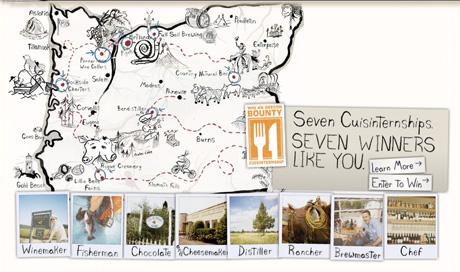
Oregon Bounty, which promotes travel to Oregon and specifically its local food and beverages, is sponsoring a very cool contest. They’re offering seven “cuisinternships” to local artisan businesses. You can be an intern chef, cheesemaker/choclatier, distiller, fisherman, rancher, winemaker, or — the coolest of the seven — craft brewer. Winners get an all-expenses paid trip to Oregon which includes round-trip airfare, six-nights lodging, and $1,000 cash spending money. You’ll then intern for five days.

You can enter online with a two-minute video and/or your 140-character essay on why you deserve to win an Oregon Bounty Cuisinternship. That’s basically a twitter post; a tweet. The deadline to enter is coming up; it’s Friday September 18. There’s also an FAQ if you have any questions about the contest.

The brewery Cuisinternship is with Jamie Emmerson at Full Sail Brewing in Hood River, Oregon. I’ve known Jamie for a long time now, and he and the staff of Full Sail couldn’t be nicer people. Plus, Hood River is an absolutely gorgeous part of the world.

Here’s a sample of what you’ll be doing if you win: Tour the Great Western Malting and Hop Farm, learn about mashing and the mash tun, learn about sparging and the lauter tun, understand the spice of the beer and the contributions of the hops and kettle, pitch the yeast (the magic ingredient), look under the microscope in the lab, partake in bottling at 500 beers per minute, fill kegs, and — most importantly — taste the rewards of your hard work. Whew, that doesn’t sound too bad, does it?

Here’s how the website describes it:

Along the shores of the mighty Columbia River Gorge, get a week-long lesson from some of the country’s craft brewing pioneers. From the hop farm to the mash tun to the microscope, you’ll feel, smell and taste beer from beginning to end. If you can tear yourself away from the tasting table, explore the charming town of Hood River, unofficial U.S. capitol of windsurfing, beer drinking and hanging out.

I’ve also been asked to judge the submissions and help pick the winner, so be sure to answer the question. “Why do you deserve to win?”
cuisinternships

Filed Under: Breweries, Events, Just For Fun, News Tagged With: Contest, Oregon

The Next “Session” Heads East

September 9, 2009 By Jay Brooks

session-the
Girl Likes Beer, who is hosting our next Session, has a personal goal to sample a beer from every country with their own brewery. She’s had quite a few west of her native Poland, but the east is still largely unexplored. So she’s invited us to go east with her. She explains:

I would like you to pick your favorite beer made east from your hometown but east enough that it is already in a different country. It can be from the closest country or from the furthest. Explain why do you like this beer. What is the coolest stereotype associated with the country the beer comes from (of course, according to you)? And one more thing. If you do a video or picture of the beer (not obligatory of course) try to include the flag of the country.

Well, this could be fun. Get out your maps, compasses and orienteering gear. And head east in search of beer.

Filed Under: Beers, Breweries, The Session Tagged With: Announcements, Asia, Australia, The East

Labor Day Hop Picking

September 8, 2009 By Jay Brooks

hop-leaf
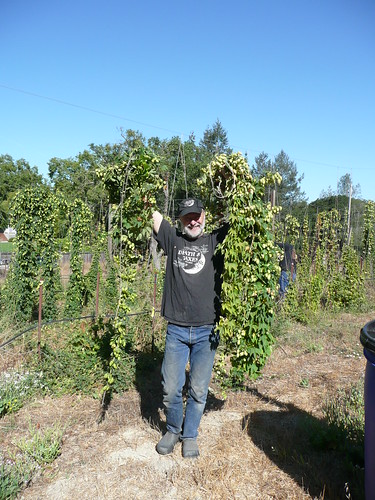
On Labor Day this year, Moonlight Brewing held their annual hop-picking event for friends and family to come and help harvest their hops. Since the kids were out of school and the lovely wife off work, we made a family outing of it, reminiscent of 19th century hop-picking when entire communities stopped what they were doing to help the farmers with the hop harvest. My daughter, Alice, was a hop-picking veteran, having come with me the previous year, but both Porter and my wife, Sarah, were newbies.

P1160111
Moonlight Brewery’s owner/brewer Brian Hunt with his hops.

It was a beautiful sunny day in whatever town Moonlighting says it’s in, and nearly three-dozen folks showed up to help. I’d guess we knew a little better than half the people there, so it was great fun sitting around, chatting, enjoying Brian’s beer straight from the tanks and picking the hops. There was also abundant food, and even Sean Paxton, the Homebrew Chef, put together a plate of some delicious cheeses. After we were done, we pulled out the Washoe Boards and played a few games, too.

P1160115
Alice wasn’t content just picking the hops, she wanted to help cut them down and carry them back, too. The kids had a blast and, as always, it felt great to pitch in and help. It was the perfect way to spend our Labor Day.

Below is a short slideshow of our day at Moonlight’s hopyard. If you click on the button on the bottom right with the four arrows pointing outward on it, you can see the photos in glorious full screen.

Filed Under: Breweries, Just For Fun Tagged With: Community, Family, Holidays, Hops, Photo Gallery

U.S. Select Beer Taste

September 6, 2009 By Jay Brooks

us-outline
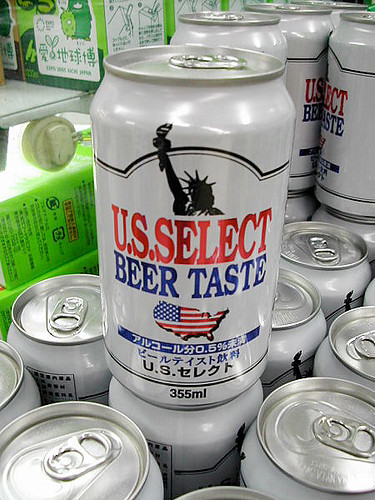
I stumbled on the photo of a peculiar beer below while looking for another image. It was on Holy Taco, a humor website as far as I can tell.

us-s-beer-taste

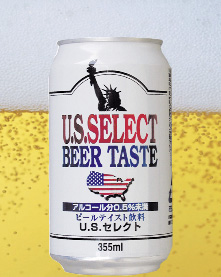
Best I could find out is that it’s a Japanese beer made by what appears to be a fairly large global food and drinks company called SC Foods Co., Ltd. The beer is called U.S. Select Beer Taste and is fairly resplendent with patriotic imagery from using a red, white and blue palette to the U.S. flag, an outline of the lower 48 and even part of the Statue of Liberty.

uss-beer-taste

It’s certainly an odd duck. But what fascinates me most is wondering what it tastes like. I mean that in an abstract sense. I know in reality it’s likely a clone of a tasteless American-style macro lager or similar low-calorie light beer. Or is it? What is the perception of the “select beer taste of the U.S.?” Is is still the former big three, or has craft beer managed to upstage that as an antiquated image of American beer?

I also can’t help but wonder, if it is an American light lager, why? The three major brands in Japan — Asahi, Kirin, Sapporo — aren’t substantially different from Bud, Miller or Coors. So if you’re going to label it U.S. Select Beer Taste, then it has to mean something to the intended consumer, which appears to be the Japanese. They have to perceive it as being something different than their own beer, don’t they? And if so, then doesn’t it follow that U.S. Select Beer Taste might be more craft-oriented in taste? It wouldn’t taste like a German, Belgian, Czech or English import. Sadly, I couldn’t find any ratings for the beer on either Beer Advocate of Rate Beer, so I don’t really know if it’s more Dale’s Pale Ale than Bud Light.

So what exactly is American Beer’s Taste perception in Japan and around the world? Among brewers and the über beer geeks certainly our reputation for quality is unsurpassed and the craft industry has staged a remarkable comeback for American beer since the low point of the 1970s. But that’s among the small, niche customer for whom beer matters. To the general consumer, I’m not so sure. Budweiser and Coors both sell surprisingly well in Great Britain and Bud is even making modest progress in Germany. What do you think U.S. Select Beer Taste is?

Filed Under: Beers, Breweries, Editorial, Just For Fun Tagged With: Asia, Japan, Packaging

Macro Beer Prices Finally Going Up

August 28, 2009 By Jay Brooks

abib
(updated below)

Anheuser-Busch InBev (ABIB) announced a couple of days ago that come fall, their prices would be going up. MillerCoors also made it clear that they would be taking a price increase as well. The Wall Street Journal reported that “Anheuser-Busch InBev NV, the largest U.S. beer seller by revenue, and MillerCoors LLC will increase beer prices in the majority of their U.S. sales regions, the two companies said Tuesday.” Bloomberg added that, at least for ABIB, “the plan has met with “general acceptance” from retailers.”

Finally. This will probably end up being controversial — though it shouldn’t be — but I think that’s very good news. For a long while now, the major beer companies have all kept their prices to consumers artificially low to maintain their volume sales. Part of the reason is simply the competition among one another — the big guys that is — and none of them wanting to be the company that blinks first. I’ve watched this for many years, especially when I was a beer buyer for a chain of California stores, when each year the big companies would try to keep their price increases as small as possible. Now obviously, no company wants to raise its prices too much, but in the big beer business the increases over time have not kept pace with inflation and especially with the rise of ingredient costs and other factors, such as transportation, fuel, etc. There are likely several reasons for that, but chief among them is needing to keep sales volume up in order to maintain and increase the share price. And so over the past decade or two, none of the big beer companies have taken prices increases up as far as they otherwise would have if they were just looking at the cost to wholesale/retail price ratio. Even with the economy tanking, eventually someone has to blink. ABIB, with the InBev predisposition toward profit at all costs, seems poised to end this period of artificially low price points.

A side benefit for them, though most likely merely an externality, is that the price difference between the average big beer and a craft beer has widened, giving the impression that the macro beers are a far greater value. That’s because most craft brewers have not had the resources to do likewise and the price of their beer is more realistic, taking into account all their costs for ingredients, transportation, staff, and costs of doing business. A few have tried to keep the price to wholesalers down, but the increase in hops, barley and fuel over the last two years has made that increasingly difficult, even for the larger craft breweries. If ABIB raises their price (and MillerCoors follows suit, as they usually do) to more realistic levels, the price differential between a big beer and a craft beer should decrease, making it more likely that consumers might trade up to a craft beer, if the difference isn’t as great in doing so. Because of the economy, that’s already happening to some extent, with craft beer being seen as an affordable luxury from two directions. One, some people are trading down from more expensive bottles of wine or spirits to more affordable craft beer and, two, people trading up and treating themselves to a nice of bottle of beer, which isn’t stretching their wallet as much as a more expensive beverage. But if the price gap shrinks, we should see an increase in craft beer sales.

On the other hand, although it’s not a popular stance, I’ve long thought that craft beer should be more expensive than it is. It should be priced according to its value instead of against the more popular, but inferior tasting products. Organic food offers a good analogy. Organic food is more expensive to grow for a variety of reasons and thus costs more in the grocery store. But if people aren’t willing to pay a little bit more for it, it will disappear entirely and we’ll have little choice in the food we eat. Luckily, many people recognize that organic food, despite its more expensive price tag, offers additional benefits that make its increased price worthwhile. In a sense, you get what you pay for. If organic food tastes better, is healthier for you, often keeps money in the local economy, and is better in the long run for the planet’s sustainability, paying a little bit more for it isn’t just a good idea, but a moral imperative. I believe the same applies to craft beer.

We all tend to look for whatever is the cheapest and often forget about what “value” even means. I’m as guilty as the next guy, but I try to consider it whenever possible. We’ve all been indoctrinated with the idea — the “Wal-Mart Syndrome” — that value means cheaper, but that’s just not the case. If I pay more for a better constructed (and probably more comfortable) pair of shoes, and they last twice as long as the cheap pair, the expensive ones are the better value. Similarly, if I spend more more for a bottle of good beer, it will taste better and I’ll enjoy it more, making it a far better value.

A motto for this idea could be “drink less, enjoy it more.” That might not work for large companies that depend on volume, but there plenty of small sustainable craft breweries for whom that model would work perfectly. All we have to do is be willing to pay the price.

UPDATE: The L.A. Times ran a story yesterday entitled Is the Price Increase Justified?, citing a supply management expert, Bob Zieger, who took “issue with the idea that “general commodity prices” are behind beer price increases.” He continued:

“After all, beer is not made from a combination of pork bellies, copper and cocoa. Its key price drivers, like hops and barley, are actually not experiencing a serious price increase right now. If there was ever a time to blame commodity costs for a necessary price increase, it was last year,” Zieger said.

As any brewer can tell you, hop prices have not returned to the levels they were three years ago, nor have barley prices, though they have abated a little better than hops. Of course, hops and barley aren’t the only cost increases, as fuel and transportation costs have skyrocketed, too. Naturally, Zieger has a blog — doesn’t everybody? — called Supply Excellence where he expands his criticism. I think it’s unfortunate that the L.A. Times cited him as an expert because while he may know a lot about supply management and commodities generally, he doesn’t know the brewing industry, its particularities and the history of this issue. This gives a bad impression, I think, since it’s the only criticism they cite and in fact his thoughts were the story. While he’s certainly welcome to voice his opinion — and it was interesting to read his full blog post — it seems odd, and perhaps even a little wrong, for the L.A. Times to do a story calling into question one of the reasons given for an increase of beer prices without having any contrary opinion or indeed any person connected with the beer industry who knows anything about it. That just seems like irresponsible journalism to present one man’s opinion as a news story. Isn’t that what the op-ed section is for?

Filed Under: Beers, Breweries, Editorial, News Tagged With: Anheuser-Busch InBev, Economy, MillerCoors

CNBC Talks Up Boutique Beer

August 27, 2009 By Jay Brooks

cnbc
CNBC did a short segment last week on craft beer, which they insisted on calling “boutique beer” — sigh — because the interviewer was Australian. Hey lady, you’re not in Australia anymore, call it by the name we use here! You don’t see American talking heads calling it soccer, instead of football, on English television, do you? Seriously, is it too much to expect that she’d learn the lingo?

But on the plus side, at least they interviewed people who actually know something about beer. First, there was Paul Gatza, president of the Brewers Association (and the man who compiles and interpret the brewing statistics) so it was great to see him on camera. The other person they interviewed was Justin Phillips of the Beer Table, a beer bar in Brooklyn. Despite the usual ignorance leading to perhaps not the best possible questions, it was still better than usual.

If you’re using a Firefox browser you may not be able to see the embedded video (I can’t) so here is a link to it on the CNBC News website.

Filed Under: Breweries, News Tagged With: Brewers Association, Economy, Statistics, Video

Fan Can Critics Show True Colors

August 26, 2009 By Jay Brooks

bud-fan-can
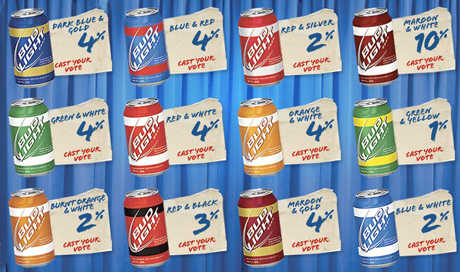
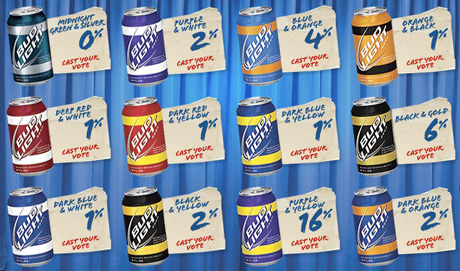
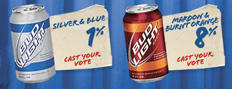
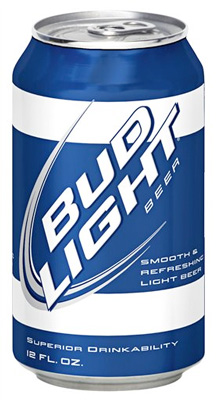
Just when I thought it was impossible for neo-prohibitionists to be any more idiotic, along comes the fan can controversy to prove me wrong once again. If you missed this one, I’ll recap. Anheuser-Busch created twenty-six different versions of its Bud Light can, each with the school colors of popular universities and colleges. There’s no school names, logos or mascots, just the colors. Here are some examples (you can see them all at Tailgate Approved, a Bud Light website).

fan-cans-1

Seems like good marketing to me. Commemorative beer cans are almost as old as beer cans themselves and are one of the most popular collectible items of breweriana. It’s not like these “institutions of higher learning” haven’t been prostituting themselves for decades, licensing literally everything to students, alumni and fans. Many care more for their sports programs then the actual edumacation they’re supposed to be providing students. But, as usual, otherwise reasonable people show their true colors as complete boobs who lose their sense of proportion and logic. Just add alcohol. It would almost be fun to watch if it wasn’t so terribly sad, pathetic and damaging to the enlightened, evolved and reasonable society I wish more people would be striving to create.

The hue and cry this time comes from “concerned people” afraid that a two-color beer can will encourage and promote underage drinking. According to Slashfood:

The cans are being marketed to match the colors of towns with college football teams, a move that has some school administrators up in arms, according to the Wall Street Journal. For example, purple-and-gold cans are being sold near the campus of Louisiana State University in Baton Rouge, La.

The University of Michigan has threatened to sue to make certain “maize and blue” cans are not sold anywhere in the Great Lakes state. At least 25 schools have asked Anheuser-Busch to stop selling the cans near their campuses, the paper said. The company said it would comply with any formal request by a university.

The Wall Street Journal reported that “[m]any college administrators contend that the promotions near college campuses will contribute to underage and binge drinking and give the impression that the colleges are endorsing the brew.” Huh? How exactly does that work? The laws concerning underage drinking aren’t altered in any way by changing the color of the cans, are they? It’s still against the law, isn’t it? This is what drives me insane about these “controversies.” They have no root in logic or common sense. People just fly off the handle without even thinking. I’m sure there are at least a few colleges whose colors are red and white. Is the demand for Coca-Cola greater there because people can be seen drinking a soda with their school colors on it?

The Journal article continues. “Samuel L. Stanley, president of New York’s Stony Brook University and a medical doctor, also objected. In a letter to Anheuser-Busch, he called the campaign ‘categorically unacceptable.'” He then goes on to list some statistics about alcohol-related deaths, which are entirely irrelevant to this issue. Changing the color on a can of beer does not automatically change the nature of the minimum drinking age or how many beers a person might consume in a sitting. Perhaps he’s tacitly admitting that he can’t stop underage drinking on his campus and thinks that this will make it even harder for him to enforce the current laws. Perhaps he should consider supporting lowering the drinking age as suggested by former college dean John McCardell and his Choose Responsibility organization and sign on to the Amethyst Initiative. That might make some headway in reducing drinking problems on his campus, because just banning certain color cans isn’t going to have any effect whatsoever.

fan-cans-2

My favorite so far is the ridiculous University of Michigan response, who “threatened legal action for alleged trademark infringement, demanding that Anheuser-Busch not sell the ‘maize and blue’ cans in the ‘entire state.'” Sadder still though is the fact that colors can actually be trademarked. Think UPS brown. That’s trademarked, though of course it’s the specific hue, not any brown. And last year, in a federal court case in Louisiana, Board of Supervisors of the Louisiana State Univ. et al. v. Smack Apparel Co., et al., C.A. No.: 04-1593, E.D. La., the judge ruled that Louisiana State University, Ohio State University, Oklahoma University, and the University of Southern California did indeed enjoy legal protections for their color schemes.

According to the IP Blawg,

In considering whether the unregistered color schemes were entitled to protection under Section 43(a) of the Lanham Act, the court looked for the requisite secondary meeting needed for a color to be protected, and found that it was present. The four universities had used their color combinations for more than 100 years, marketing hundreds of items with these color schemes, and garnering millions of dollars of retail sales from merchandise bearing these color schemes. The court then found that likelihood of confusion was established under the Fifth Circuit’s precedent where the marks had been in use for decades and were “extremely strong,” the color schemes were virtually identical, and Smack’s shirts were sold in retail outlets alongside plaintiffs’ shirts, and promoted in the same advertising media

The IP Blawg ends by wondering allowed whether or not the court made the right decision. I’d have to say this is almost as ridiculous as patenting seeds. I think what’s really at stake, both here and in the current issue, is that schools aren’t getting any licensing money. By simply using colors that are close to those of the respective schools, they don’t have to pay any licensing fees to the schools, and that’s probably what’s really pissed them off. Because most colleges aren’t exactly shy about hawking all sorts of crap with the school colors, logo and mascot on them. Walking through any university bookstore should convince anyone of that. The higher moral ground they’re flinging around about this is more about not sharing a piece of the pie, I’d wager.

fan-cans-3

Perhaps this might be a good time to have a debate on just how ridiculous is blind loyalty that’s reinforced throughout our lives. We wonder why people are so quick to go to war when our entire society is divided up into a million divisions that pretend to compete against one another. It starts with the street you live on, then your neighborhood, your school, your sports team, your college, your company and finally your country. You’re expected to show “support” for all of them, and usually in an unquestioning way that’s deeply damaging to reason or logic. It makes it much easier for things to never change and makes maintaining a status quo that’s unfair to a majority much easier. Did you ever notice that critical thinking is not taught in school? That’s not an accident. Critical thinking would lead to kids asking all sorts of uncomfortable questions and — gasp — thinking for themselves.

People obviously believe that when shown a can of beer in a person’s school colors, they’ll be unable to do anything but buy them and drink them. This idea of blind loyalty will all but force them to in order to be supportive. Frankly, I can’t even remember what my college’s school colors were. But even if I could, it’s such an obviously specious argument, that I’m amazed anyone could be taking it seriously.

bud-fan-can

But they know that a company as large as Anheuser-Busch InBev can’t risk appearing to do anything that might be even seen as possibly, maybe encouraging people to buy their products, especially those who are not allowed to buy them. So what exactly are companies supposed to do? Apparently, they all have to come up with packaging and marketing that appeals only to adults and specifically does not appeal to anyone under 21. Exactly what would that look like? Beats the hell out of me. I know cartoons are usually one of things that bother these chuckleheads, as if only kids enjoy them. I’m 50, for fuck’s sake, and I still love cartoons as much as I did when I was a non-person who could only die for his country but not drink in it.

My point is it’s impossible to separate kids from society and create two worlds, one with kids and one without. Yet that’s exactly the only thing that would seem to satisfy the people who make these nonsensical complaints. If they really think all it takes to increase underage drinking and binge drinking is change the colors of beer cans, we have more severe problems than underage drinking. I can’t help but think that placing as much emphasis on entertainment and sports, especially college sports, as we do has to be at least part of the reason that so many are so thick as to swallow such arguments. And worse so, for the pinheads that come up with them. These are people who work in universities and so, one presumes, have a college degree. Never was it more obvious that graduating from college can’t make anyone smarter, only more educated. I’ve cited these before, but here is where we’re at, according to the Jenkins Group:

  • 1/3 of high school graduates never read another book for the rest of their lives.
  • 42 percent of college graduates never read another book after college.
  • 80 percent of U.S. families did not buy or read a book last year.
  • 70 percent of U.S. adults have not been in a bookstore in the last five years.

Personally, I’m more worried about that (and not just because I’m a writer) than what color the beer cans are. I know I’ve mentioned this book before, (sigh — sorry about repeating myself) but Morris Berman’s brilliant The Twilight of American Culture suggests that we’re currently heading into another dark ages and that under such circumstances, few people even realize it. I’d offer that worrying about what color the beer cans are and believing that some harm will come to society as a result is yet another sign that Berman is correct. Surely there are more pressing problem’s we’re facing.

Filed Under: Breweries, Editorial, News, Politics & Law Tagged With: Prohibitionists

Mid-Year Brewery Numbers Released

August 17, 2009 By Jay Brooks

ba
The Brewers Association in Boulder, Colo. just released some statistics about the mid-years sales of craft beer and the number of breweries in America. From the press release:

Dollar growth from craft brewers during the first half of 2009 increased 9%, down from 11% growth during the same period in 2008. Volume of craft brewed beer sold grew 5% for the first six months in 2009, compared to 6.5% growth in the first half of 2008. Barrels sold by craft brewers for the first half of the year is an estimated 4.2 million, compared to 4 million barrels sold in the first half of 2008.

The other big news in the release is that the number of breweries operating in America now stands at 1,525, the highest number in a century.

U.S. Breweries
as of July 31, 2009
  962 Brewpubs
  456 Microbreweries
    64 Regional Craft Breweries
1,482 Total US Craft Breweries
    20 Large Breweries
    23 Other Breweries            
1,525 Total US Breweries

As the press release stresses, that’s due almost entirely to the growth of craft beer:

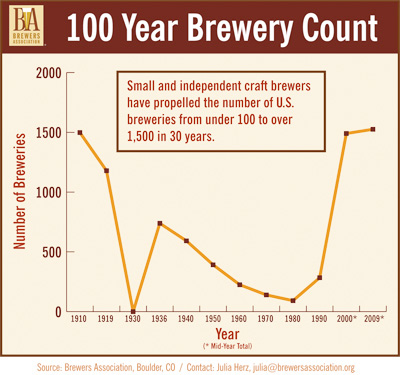
The U.S. now boasts 1,525 breweries, the highest number in 100 years when consolidation and the run up to Prohibition reduced the number of breweries to 1,498 in 1910. “The U.S. has more breweries than any other nation and produces a greater diversity of beer styles than anywhere else, thanks to craft brewer innovation,” Gatza added.

100-yr-count

Some other interesting tidbits:

  • Growth of the craft brewing industry in the first half of 2009 was 5% by volume and 9% by dollars.
  • Craft brewers sold an estimated 4.2 million barrels of beer in the first half of 2009, up from 4 million barrels in the first half of 2008.
  • Overall US beer sales are down 1.3% in the first 6 months of 2009.
  • Imported beer sales are down 9.5% in the first 6 months.
  • Growth of the craft brewing industry in 2008 was 5.9% by volume and 10.1% by dollars.
  • The craft brewing industry produced nearly 8.6 million barrels of craft beer in the US in 2008.
  • The craft brewing sales share as of December ’08 was 4% by volume and 6.3% by dollars.
  • Total US craft brewing industry annual dollar volume is $6.3 billion.

Filed Under: Breweries, News Tagged With: Statistics

Asheron’s Call Brewing

August 16, 2009 By Jay Brooks

dice-2
Now don’t get me wrong. I am a geek of many stripes. So I mean no disrespect to my (possibly) geekier brethren who play online games in MMORPGs (which stands for Massively Multiplayer Online Role-Playing Games), the most popular of which are probably World of Warcraft, Second Life, Civilization IV and Runescape, to name but a few of the literally hundreds of them. I confess I’m no stranger to D&D, but it’s been nearly 30 years since I picked up an 8-sided die. When such games went online, they left me behind. It wasn’t that they weren’t without interest, but I recognized that I needed another time suck like a hole in the head, and simply stayed away. These online worlds have since increased exponentially in terms of detail, sophistication and complexity.

Asheron's_Call

Which brings me to Asheron’s Call, a ten-year old MMORPG. Originally created by Microsoft, since 2004 it’s been maintained and expanded by Turbine that takes place in the land of Dereth and its surrounding islands. In addition to the “official” game site, there are several fansites that add additional dimensions to the game. One of these is called Asheron’s Call Vault. Like all of these games, your character (or Avatar) needs some kind of nourishment to survive so there’s food you can find or make to eat. But Asheron’s Call added another way to nourish yourself: brewing beer. Here’s an overview:

Serious Beer Drinking
(Brews that can make you stronger)

Break out the beer mugs, open up the pubs 24 hours a day, and get ready to drink some brew that can make you smarter, healthier, more coordinated, or more focused!

Up until the invention of these brews, tinker characters relied on those brave Olthoi Queen slayers, to bring them back eggs to bake up tasty treats that increased their attributes. The downsides to these were that first, the eggs were not terribly abundant, they were heavy, and the resulting effects only lasted 15 minutes. There did not seem to be recipes for all attributes, either.

Then an intrepid hunter found some Tusker Spit one day, and brought it to his cook, who went to Sanamar to shop for goods, and happened upon some wonderful recipes for brewing! Some time later, Moarsmuck was discovered, and cooks had additional recipes at their disposal.

The advantages to these brews over Olthoi Food is obvious. They are longer lasting, which means hunters can take them into the field and use them while hunting. The core ingredients of Tusker Spit and Moarsmuck are far easier to come by, and more abundant than Olthoi Eggs, so one needn’t save the brew for “Special Occasions”.

So, whether you prefer the hearty tangy bite of the saliva from a Tusker, or the more mellow, slightly slimy taste of the Moarsman’s remains, below you will find recipes for all six of the wonderful brews that you can take along with you on a daily basis, and shower on your favorite tinker character without reservation.

To brew beer, you need to go on a Quest for the Brewmaster’s Bible, pieces of which are hidden in four separate places. Once you acquire the Brewmaster’s Bible, you can learn “the arcane secrets of that most magical craft known to all Isparian-kind as Brewing!”

Here’s an excerpt from the beginning of the bible:

There are four main ingredients in any good brew: barley, yeast, hops, and water. The color of your barley controls the color of your brew. Amber barley nets you an amber brew, dark barley gets you a nice stout, and plain barley will give you a clear lager.

Yeast is used to ferment your beer. The higher the quality of the yeast the better. Dried yeast tends to get you a much higher quality brew than liquid yeast.

As for hops, the greener the better! Hops provide that bitter taste that makes beer so deliciously delicious. But some beers can be too bitter – bordering on undrinkable (though no beer is truly undrinkable, truth be told). These beers are usually crafted from yellowish, nasty hops. Discerning beer drinkers prize only those beers made from the greenest of hops.

And the final ingredient – the one that ties it all together – is water. Many people ignore the importance that water plays in the brewing process, but those of us who have spent our lives mastering this craft truly understand that without this life-giving liquid, we would have no beer at all!

The basic process for brewing is simple: First you fill your Brew Kettle with Water. Then you add Barley to create a Wort. Once that is done, you add Hops to finish your Wort. Once the Wort is finished, you add your Yeast. At this point, you have a Fermented Brew.

Now, you can do one of two things with a Fermented Brew. You can keg it or you can add an additive. Kegging a Fermented Brew will get you a nice, tasty beer of which you can be very proud. But the truly spectacular beers obtain their unique flavors from those additives which set them apart from the rest of the pack. On Ispar, I had any number of additives in my possession that allowed me to create those beers which made my family so famous. So far, the harsh climate of these wintry islands has not allowed me to find many additives worthy of the great craft of brewing.

The process itself is nicely complex and reasonably accurate, for a RPG. Here’s a visual overview:

First, get yourself a brew kettle: kettle

Fill it with water (water) + barley (barley) = fullkettle A Full Kettle.

There are even different kinds of barley you can use, including plain, amber and roasted. If you have a baking pan, you can even roast your own barley.

Then add hops (ultra green hops) + yeast (yeast).

And depending on the recipe, you also add something called a “monster component” such as Moarsmuck or Tusker Spit: muck

There appear to be literally dozens, easily more than a hundred, different beers one could brew, such as Amber Ape Brew, Angree’s Angry Ale, Apothecary Zongo’s Stout, Distasteful Dark Wort, Duke Raoul’s Distillation, Glorious Lager or Putrid Tusker Spit Ale. Depending on the kind of beer, it can add to your character’s coordination, endurance, focus, quickness or strength; just like in real life.

These can either be put in a keg (keg) or bottles (bottles) to create the final product = beer (beer).

And that’s just one infinitesimal piece of the world of Asheron’s Call. I have enough trouble keeping up in the real world, but I can’t help but be impressed by the beer in Asheron’s Call. I have to wonder, though, just what does Tusker spit taste like?

Filed Under: Beers, Breweries, Just For Fun Tagged With: Games

The Hopfather: A Beer You Can’t Refuse

July 31, 2009 By Jay Brooks

russian-river
At the Bistro IPA Festival next Saturday, Russian River Brewing will debut their latest beer: The Hopfather. The Hopfather is a 7% IPA that’s loosely based on an IPA recipe Vinnie Cilurzo contributed to Sam Calagione’s book Extreme Brewing, though Vinnie says he’s changed things up considerably. It starts with CTZ and Magnum hops, but uses primarily Amarillo and Centennial for flavor and aroma to the tune of around 10 pounds per barrel. While Vinnie assures me it will have a big malt backbone, he also promises the flavors and aroma will be “balls to the wall hops.” As if you needed another reason to go to the Bistro IPA Festival, this should make your attendance all but mandatory if you love hops.

Filed Under: Beers, Breweries, News Tagged With: California, Russian River

« Previous Page
Next Page »

Find Something

Northern California Breweries

Please consider purchasing my latest book, California Breweries North, available from Amazon, or ask for it at your local bookstore.

Recent Comments

  • Bob Paolino on Beer Birthday: Grant Johnston
  • Gambrinus on Historic Beer Birthday: A.J. Houghton
  • Ernie Dewing on Historic Beer Birthday: Charles William Bergner 
  • Steve 'Pudgy' De Rose on Historic Beer Birthday: Jacob Schmidt
  • Jay Brooks on Beer Birthday: Bill Owens

Recent Posts

  • Historic Beer Birthday: Frederick Kirschner May 21, 2026
  • Beer Birthday: Nick Matt May 21, 2026
  • Historic Beer Birthday: Oliver Hughes May 20, 2026
  • Historic Beer Birthday: Benjamin, Lord Iveagh May 20, 2026
  • Historic Beer Birthday: Eduard Buchner May 20, 2026

BBB Archives

Feedback

Head Quarter
This site is hosted and maintained by H25Q.dev. Any questions or comments for the webmaster can be directed here.