Brookston Beer Bulletin

Jay R. Brooks on Beer

  • Home
  • About
  • Editorial
  • Birthdays
  • Art & Beer

Socialize

  • Dribbble
  • Email
  • Facebook
  • Flickr
  • GitHub
  • Instagram
  • LinkedIn
  • Pinterest
  • RSS
  • Twitter
  • YouTube

Powered by Genesis

Beer Hints From Heloise

April 15, 2019 By Jay Brooks

heloise

Today is the birthday of Ponce Kiah Marchelle Heloise Cruse Evans, better known by her pen name Heloise. She is “an American writer, author, and speaker specializing in lifestyle hints, including consumer issues, pets, travel, food, home improvement, and health.” Heloise has written over a dozen books of “household hints,” although it appears many of them have been recycled and repackaged. This is her book, “Kitchen Hints From Heloise: More Than 1,527 Time-Saving, Money-Saving, and Work-Saving Hints for Cooking, Cleaning, Shopping, and Storing,” published in 2005.

Heloise-kitchen-hints

I suspect she’s written a number of hints that had something to do with beer, but there were a few in this specific book, which are below.
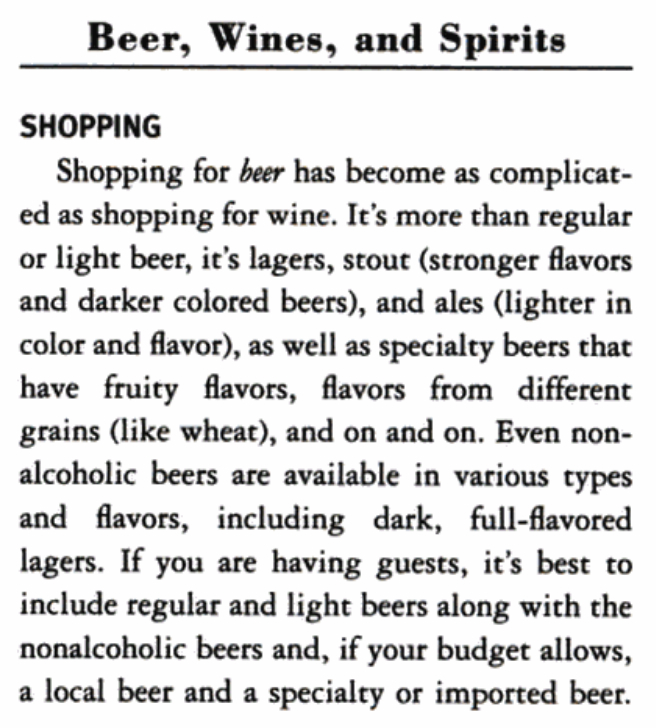
heloise-1

At least she’s acknowledging that there are different types of beer, and even mentions local ones. Since it’s meant for a very general reader, it’s very general advice, and I certainly can’t agree with having a light beer available (those beers are pure evil, in my opinion), but at least she’s suggesting some variety, and that’s a positive step, even fourteen years ago.
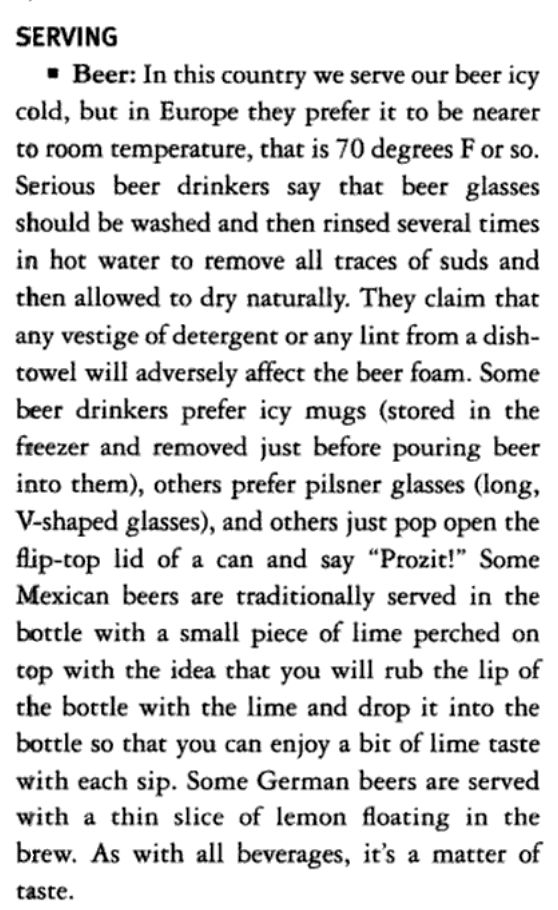
heloise-2

Her advice on clean glasses is mostly okay, but I absolutely hate that she’s saying “some beer drinkers prefer icy mugs.” I tend to think if you like your beer out of a frosted glass, then you’re not really beer drinker, you’re just drinking some ice cold liquid you don’t want to taste so you can get drunk. And what German beers does she think have a lemon slice “floating in the brew?” I know she means a Hefeweizen, but it’s not just tossed in the glass, Her advice her is pretty bad, actually, to my way of thinking. She ends with “it’s a matter of taste,” but that seems like a terrible thing to say in a book offering hints. She should be telling people what is the optimal way to enjoy their beer, instead she seems to throw up her hands and say just do whatever you want, which doesn’t strike me as great advice.
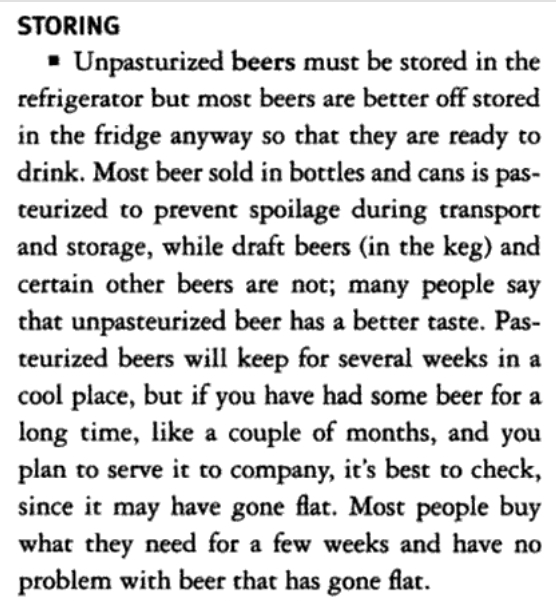
heloise-3

I guess she’s right that most beer is pasteurized if she’s referring to mainstream beers and imports, which she most likely is, but it still seems like the wrong thing to say, and should be explained better. But the funniest thing is her assertion that “most people … have no problem with beer that has gone flat.” Who did she ask for that advice?
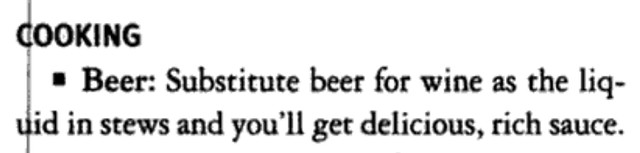
Heloise-4

Sure, but I’ve never once thought of even putting wine in my stew.

heloise

So overall, I find it odd that a woman who’s spent a lifetime supposedly giving people great advice and household hints, would so obviously do so little research in doling out advice on beer. It sounds more like she just regurgitated what she’s heard rather than asked any beer experts, or people who might actually know what they’re talking about. That’s my advice to her.

Filed Under: Beers, Editorial, Just For Fun, Related Pleasures Tagged With: Books, Mainstream Coverage

Bistro IPA Festival Winners 2019

April 13, 2019 By Jay Brooks

bistro

Today was the 22nd annual IPA Festival and the 2nd annual Hazy IPA Festival at the Bistro. The weather cooperated and it ended up being a sunny day in Hayward, making it was perfect beer-drinking weather once we emerged from judging in the basement. This year the judging was split into two groups, regular clear IPAs and hazy IPAs. There were 32 traditional American-style IPAs and 40 hazies. The full list of winners is below.

BistroIPA19-2
Final Round judging of Traditional IPAs.

Traditional IPAs

  • 1st Place: Central Coast Lucky Day IPA
  • 2nd Place: Revision IPA
  • 3rd Place: Urban Roots Like Riding a Bike IPA
BistroIPA19-1
Starting the first round with Hazy IPAs.

Hazy IPAs

  • 1st Place: Lead Dog Saturdays are for Brews IPA
  • 2nd Place: Fieldwork Dancing in the Dank IPA
  • 3rd Place: Cellarmaker Cantaloupe Island IPA

Peoples Choice Awards

  • People’s Choice Award — Traditional IPA: Altamont Mau Waui
  • People’s Choice Award — Hazy IPA: Urban Roots Lapse of Judgement

Congratulations to all the winners.

Filed Under: Beers, Events, Just For Fun Tagged With: Awards, Bay Area, Beer Festivals, IPA, Northern California

Christopher Smart’s “The Hop-Garden”

April 11, 2019 By Jay Brooks

hop-leaf
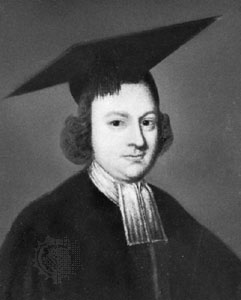
Christopher Smart was an English poet (April 11, 1722–May 21, 1771). He “was a major contributor to two popular magazines and a friend to influential cultural icons like Samuel Johnson and Henry Fielding. Smart, a high church Anglican, was widely known throughout London.” He had some goofy nicknames, such as “Kit Smart”, “Kitty Smart”, and “Jack Smart.”

Christopher_Smart

Here’s some basic info about him from Wikipedia:

Smart was infamous as the pseudonymous midwife “Mrs. Mary Midnight” and widespread accounts of his father-in-law, John Newbery, locking him away in a mental asylum for many years over Smart’s supposed religious “mania”. Even after Smart’s eventual release, a negative reputation continued to pursue him as he was known for incurring more debt than he could repay; this ultimately led to his confinement in debtors’ prison until his death.

Smart’s two most widely known works are A Song to David and Jubilate Agno, both at least partly written during his confinement in asylum. However, Jubilate Agno was not published until 1939 and A Song to David received mixed reviews until the 19th century. To his contemporaries, Smart was known mainly for his many contributions in the journals The Midwife and The Student, along with his famous Seaton Prize poems and his mock epic The Hilliad. Although he is primarily recognised as a religious poet, his poetry includes various other themes, such as his theories on nature and his promotion of English nationalism.

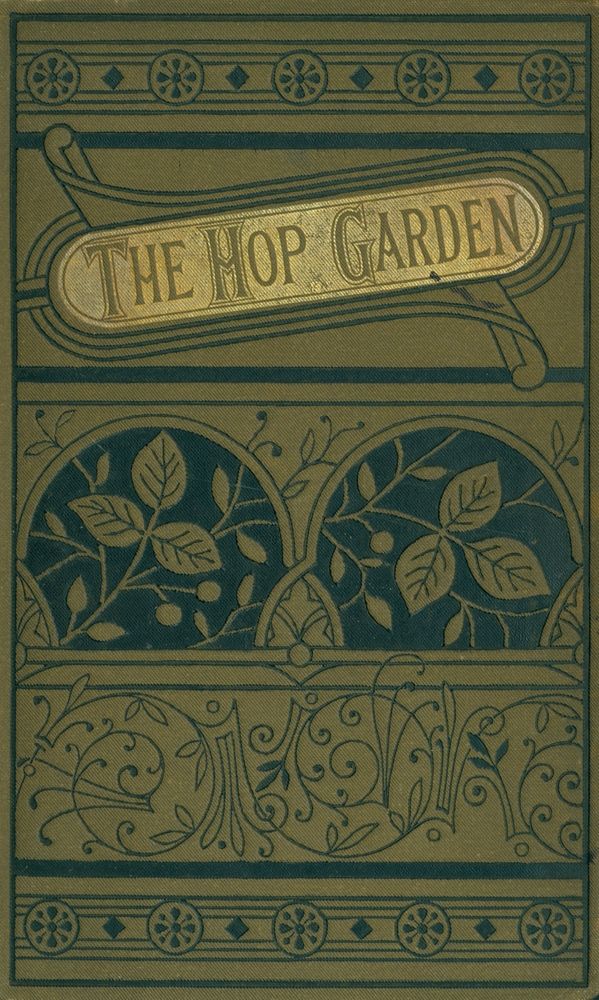
hop-garden-book

One of his longer poems was called “The Hop-Garden” and was first published in 1752. It was originally part of Poems on Several Occasions, an early collection of Smart’s poems. Here’s how Wikipedia describes it:

The poem is rooted the Virgilian georgic and Augustan literature; it is one of the first long poems published by Smart. The poem is literally about a hop garden, and, in the Virgilian tradition, attempts to instruct the audience in how to farm hops properly.

While the poem deals with natural and scientific principles, there is a strong autobiographical tendency. While the poem marks Smart’s classical and Latin influences, it also reveals Smart’s close association and influence with Miltonic poetic form, especially with the reliance on Miltonic blank verse.

The poem is divided into two books.

THE HOP-GARDEN.

A GEORGIC.

BOOK the FIRST.

THE land that answers best the farmer’s care,
And silvers to maturity the Hop:
When to inhume the plants; to turn the glebe;
And wed the tendrils to th’ aspiring poles:
Under what sign to pluck the crop, and how
To cure, and in capacious sacks infold,
I teach in verse Miltonian. Smile the muse,
And meditate an honour to that land
Where first I breath’d, and struggled into life
Impatient, Cantium, to be call’d thy son.
Oh! cou’d I emulate Dan Sydney’s muse,
Thy Sydney, Cantium—He from court retir’d
In Penshurst’s sweet elysium sung delight,
Sung transport to the soft-responding streams
Of Medway, and enliven’d all her groves:

While ever near him, goddess of the green,
Fair Pembroke [sister to Sir Philip Sydney] sat, and smil’d immense applause.
With vocal fascination charm’d the Hours
Unguarded left Heav’ns adamantine gate,
And to his lyre, swift as the winged sounds
That skim the air, danc’d unperceiv’d away.
Had I such pow’r, no peasants toil, no hops
Shou’d e’er debase my lay: far nobler themes,
The high atchievements of thy warrior kings
Shou’d raise my thoughts, and dignify my song.
But I, young rustic, dare not leave my cot,
For so enlarg’d a sphere—ah! muse beware,
Lest the loud larums of the braying trump,
Lest the deep drum shou’d drown thy tender reed,
And mar its puny joints: me, lowly swain,
Every unshaven arboret, me the lawns,
Me the voluminous Medway’s silver wave,
Content inglorious, and the hopland shades!
Yeomen, and countrymen attend my song:
Whether you shiver in the marshy Weald [commonly, but improperly call’d, the Wild],
Egregious shepherds of unnumber’d flocks,
Whose fleeces, poison’d into purple, deck

All Europe’s kings: or in fair Madum’s [Maidstone] vale
Imparadis’d, blest denizons, ye dwell;
Or Dorovernia’s [Canterbury] awful tow’rs ye love:
Or plough Tunbridgia’s salutiferous hills
Industrious, and with draughts chalybiate heal’d,
Confess divine Hygeia’s blissful seat;
The muse demands your presence, ere she tune
Her monitory voice; observe her well,
And catch the wholesome dictates as they fall.
‘Midst thy paternal acres, Farmer, say
Has gracious heav’n bestow’d one field, that basks
Its loamy bosom in the mid-day sun,
Emerging gently from the abject vale,
Nor yet obnoxious to the wind, secure
There shall thou plant thy hop. This soil, perhaps,
Thou’lt say, will fill my garners. Be it so.
But Ceres, rural goddess, at the best
Meanly supports her vot’ry’, enough for her,
If ill-persuading hunger she repell,
And keep the soul from fainting: to enlarge,
To glad the heart, to sublimate the mind,
And wing the flagging spirits to the sky,
Require th’ united influence and aid
Of Bacchus, God of hops, with Ceres join’d

‘Tis he shall gen’rate the buxom beer.
Then on one pedestal, and hand in hand,
Sculptur’d in Parian stone (so gratitude
Indites) let the divine co-part’ners rise.
Stands eastward in thy field a wood? ’tis well.
Esteem it as a bulwark of thy wealth,
And cherish all its branches; tho’ we’ll grant,
Its leaves umbrageous may intercept
The morning rays, and envy some small share
Of Sol’s beneficence to the infant germ.
Yet grutch not that: when whistling Eurus comes,
With all his worlds of insects in thy lands
To hyemate, and monarchize o’er all
Thy vegetable riches, then thy wood
Shall ope it’s arms expansive, and embrace
The storm reluctant, and divert its rage.
Armies of animalc’les urge their way
In vain: the ventilating trees oppose
Their airy march. They blacken distant plains.
This site for thy young nursery obtain’d,
Thou hast begun auspicious, if the soil
(As sung before) be loamy; this the hop
Loves above others, this is rich, is deep,
Is viscous, and tenacious of the pole.
Yet maugre all its native worth, it may
Be meliorated with warm compost. See!

Yon craggy mountain [Boxley-Hill, which extends through great part of Kent], whose fastidious head,
Divides the star-set hemisphere above,
And Cantium’s plains beneath; the Appennine
Of a free Italy, whose chalky sides
With verdant shrubs dissimilarly gay,
Still captivate the eye, while at his feet
The silver Medway glides, and in her breast
Views the reflected landskip, charm’d she views
And murmurs louder ectasy below.
Here let us rest awhile, pleas’d to behold
Th’ all-beautiful horizon’s wide expanse,
Far as the eagle’s ken. Here tow’ring spires
First catch the eye, and turn the thoughts to heav’n.
The lofty elms in humble majesty
Bend with the breeze to shade the solemn groves,
And spread an holy darkness; Ceres there
Shines in her golden vesture. Here the meads
Enrich’d by Flora’s daedal hand, with pride
Expose their spotted verdure. Nor are you
Pomona absent; you ‘midst th’ hoary leaves
Swell the vermilion cherry; and on you trees
Suspend the pippen’s palatable gold.
There old Sylvanus in that moss-grown grot
Dwells with his wood-nymphs: they with chaplets green
And russet mantles oft bedight, aloft

From yon bent oaks, in Medway’s bosom fair
Wonder at silver bleak, and prickly pearch,
That swiftly thro’ their floating forests glide.
Yet not even these—these ever-varied scenes
Of wealth and pleasure can engage my eyes
T’ o’erlook the lowly hawthorn, if from thence
The thrush, sweet warbler, chants th’ unstudied lays
Which Phoebus’ self vaulting from yonder cloud
Refulgent, with enliv’ning ray inspires.
But neither tow’ring spires, nor lofty elms,
Nor golden Ceres, nor the meadows green,
Nor orchats, nor the russet-mantled nymphs,
Which to the murmurs of the Medway dance,
Nor sweetly warbling thrush, with half those charms
Attract my eyes, as yonder hop-land close,
Joint-work of art and nature, which reminds
The muse, and to her theme the wand’rer calls.
Here then with pond’rous vehicles and teams
Thy rustics send, and from the caverns deep
Command them bring the chalk: thence to the kiln
Convey, and temper with Vulcanian fires.
Soon as ’tis form’d, thy lime with bounteous hand
O’er all thy lands disseminate; thy lands
Which first have felt the soft’ning spade, and drank
The strength’ning vapours from nutricious marl.

This done, select the choicest hop, t’ insert
Fresh in the opening glebe. Say then, my muse,
Its various kinds, and from th’ effete and vile,
The eligible separate with care.
The noblest species is by Kentish wights
The Master-hop yclep’d. Nature to him
Has giv’n a stouter stalk, patient of cold,
Or Phoebus ev’n in youth, his verdant blood
In brisk saltation circulates and flows
Indesinently vigorous: the next
Is arid, fetid, infecund, and gross
Significantly styl’d the Fryar: the last
Is call’d the Savage, who in ev’ry wood,
And ev’ry hedge unintroduc’d intrudes.
When such the merit of the candidates,
Easy is the election; but, my friend
Would’st thou ne’er fail, to Kent direct thy way,
Where no one shall be frustrated that seeks
Ought that is great or good. Hail, Cantium, hail!
Illustrious parent of the finest fruits,
Illustrious parent of the best of men!
For thee Antiquity’s thrice sacred springs

Placidly stagnant at their fountain head,
I rashly dare to trouble (if from thence,
If ought for thy util’ty I can drain)
And in thy towns adopt th’ Ascraean muse.
Hail heroes, hail invaluable gems,
Splendidly rough within your native mines,
To luxury unrefined, better far
To shake with unbought agues in your weald,
Than dwell a slave to passion and to wealth,
Politely paralytic in the town!
Fav’rites of heav’n! to whom the general doom
Is all remitted, who alone possess
Of Adam’s sons fair Eden—rest ye here,
Nor seek an earthly good above the hop;
A good! untasted by your ancient kings,
And almost to your very sires unknown.
In those blest days when great Eliza reign’d
O’er the adoring nation, when fair peace
Or spread an unstain’d olive round the land,
Or laurell’d war did teach our winged fleets
To lord it o’er the world, when our brave sires
Drank valour from uncauponated beer;
Then th’ hop (before an interdicted plant,
Shun’d like fell aconite) began to hang
Its folded floscles from the golden vine,
And bloom’d a shade to Cantium’s sunny shores

Delightsome, and in chearful goblets laught
Potent, what time Aquarius’ urn impends
To kill the dulsome day—potent to quench
The Syrian ardour, and autumnal ills
To heal with mild potations; sweeter far
Than those which erst the subtile Hengist mix’d
T’ inthral voluptuous Vortigern. He, with love
Emasculate and wine, the toils of war,
Neglected, and to dalliance vile and sloth
Emancipated, saw th’ incroaching Saxons
With unaffected eyes; his hand which ought
T’ have shook the spear of justice, soft and smooth,
Play’d ravishing divisions on the lyre:
This Hengist mark’d, and (for curs’d insolence
Soon fattens on impunity! and becomes
Briareus from a dwarf) fair Thanet gain’d.
Nor stopt he here; but to immense attempts
Ambition sky-aspiring led him on
Adventrous. He an only daughter rear’d,
Roxena, matchless maid! nor rear’d in vain.
Her eagle-ey’d callidity, grave deceit,
And fairy fiction rais’d above her sex,
And furnish’d her with thousand various wiles
Preposterous, more than female; wondrous fair

She was, and docile, which her pious nurse
Observ’d, and early in each female fraud
Her ‘gan initiate: well she knew to smile,
Whene’er vexation gall’d her; did she weep?
‘Twas not sincere, the fountains of her eyes
Play’d artificial streams, yet so well forc’d
They look’d like nature; for ev’n art to her
Was natural, and contrarieties
Seem’d in Roxena congruous and allied.
Such was she, when brisk Vortigern beheld,
Ill-fated prince! and lov’d her. She perceiv’d,
Soon she perceiv’d her conquest; soon she told,
With hasty joy transported, her old sire.
The Saxon inly smil’d, and to his isle
The willing prince invited, but first bad
The nymph prepare the potions; such as fire
The blood’s meand’ring rivulets, and depress
To love the soul. Lo! at the noon of night
Thrice Hecate invok’d the maid—and thrice
The goddess stoop’d assent; forth from a cloud
She stoop’d, and gave the philters pow’r to charm.
These in a splendid cup of burnish’d gold
The lovely sorceress mix’d, and to the prince
Health, peace, and joy propin’d, but to herself
Mutter’d dire exorcisms, and wish’d effect
To th’ love-creating draught: lowly she bow’d
Fawning insinuation bland, that might

Deceive Laertes’ son; her lucid orbs
Shed copiously the oblique rays; her face
Like modest Luna’s shone, but not so pale,
And with no borrow’d lustre; on her brow
Smil’d Fallacy, while summoning each grace,
Kneeling she gave the cup. The prince (for who!
Who cou’d have spurn’d a suppliant so divine?)
Drank eager, and in ecstasy devour’d
Th’ ambrosial perturbation; mad with love
He clasp’d her, and in Hymeneal bands
At once the nymph demanded and obtain’d.
Now Hengist, all his ample wish fulfill’d,
Exulted; and from Kent th’ uxorious prince
Exterminated, and usurp’d his seat.
Long did he reign; but all-devouring time
Has raz’d his palace walls—Perchance on them
Grows the green hop, and o’er his crumbled bust
In spiral twines ascends the scancile pole.—
But now to plant, to dig, to dung, to weed;
Tasks how indelicate? demand the muse.
Come, fair magician, sportive Fancy come,
With thy unbounded imagery; child of thought,
From thy aeriel citadel descend,
And (for thou canst) assist me. Bring with thee
Thy all-creative Talisman; with thee
The active spirits ideal, tow’ring flights,

That hover o’er the muse-resounding groves,
And all thy colourings, all thy shapes display.
Thou to be here, Experience, so shall I
My rules nor in low prose jejunely say,
Nor in smooth numbers musically err;
But vain is Fancy and Experience vain,
If thou, O Hesiod! Virgil of our land,
Or hear’st thou rather, Milton, bard divine,
Whose greatness who shall imitate, save thee?
If thou O Philips [Mr. John Philips, author of Cyder, a poem] fav’ring dost not hear
Me, inexpert of verse; with gentle hand
Uprear the unpinion’d muse, high on the top
Of that immeasurable mount, that far
Exceeds thine own Plinlimmon, where thou tun’st
With Phoebus’ self thy lyre. Give me to turn
Th’ unwieldly subject with thy graceful ease,
Extol its baseness with thy art; but chief
Illumine, and invigorate with thy fire.
When Phoebus looks thro’ Aries on the spring,
And vernal flow’rs promise the dulcet fruit,
Autumnal pride! delay not then thy setts
In Tellus’ facile bosom to depose
Timely: if thou art wise the bulkiest chuse:
To every root three joints indulge, and form

The Quincunx with well regulated hills.
Soon from the dung-enriched earth, their heads
Thy young plants will uplift their virgin arms,
They’ll stretch, and marriageable claim the pole.
Nor frustrate thou their wishes, so thou may’st
Expect an hopeful issue, jolly Mirth,
Sister of taleful Jocus, tuneful Song,
And fat Good-nature with her honest face.
But yet in the novitiate of their love,
And tenderness of youth suffice small shoots
Cut from the widow’d willow, nor provide
Poles insurmountable as yet. ‘Tis then
When twice bright Phoebus’ vivifying ray,
Twice the cold touch of winter’s icy hand,
They’ve felt; ’tis then we fell sublimer props.
‘Tis then the sturdy woodman’s axe from far
Resounds, resounds, and hark! with hollow groans
Down tumble the big trees, and rushing roll
O’er the crush’d crackling brake, while in his cave
Forlorn, dejected, ‘midst the weeping dryads
Laments Sylvanus for his verdant care.
The ash, or willow for thy use select,
Or storm-enduring chesnut; but the oak
Unfit for this employ, for nobler ends
Reserve untouch’d; she when by time matur’d,
Capacious, of fome British demi-god,
Vernon, or Warren, shall with rapid wing

Infuriate, like Jove’s armour-bearing bird,
Fly on thy foes; They, like the parted waves,
Which to the brazen beak murmuring give way
Amaz’d, and roaring from the fight recede.—
In that sweet month, when to the list’ning swains
Fair Philomel fings love, and every cot
With garlands blooms bedight, with bandage meet
The tendrils bind, and to the tall pole tie,
Else soon, too soon their meretricious arms
Round each ignoble clod they’ll fold, and leave
Averse the lordly prop. Thus, have I heard
Where there’s no mutual tye, no strong connection
Of love-conspiring hearts, oft the young bride
Has prostituted to her slaves her charms,
While the infatuated lord admires
Fresh-budding sprouts, and issue not his own.
Now turn the glebe: soon with correcting hand
When smiling June in jocund dance leads on
Long days and happy hours, from ev’ry vine
Dock the redundant branches, and once more
With the sharp spade thy numerous acres till.
The shovel next must lend its aid, enlarge
The little hillocks, and erase the weeds.
This in that month its title which derives

From great Augustus’ ever sacred name!
Sovereign of Science! master of the Muse!
Neglected Genius’ firm ally! Of worth
Best judge, and best rewarder, whose applause
To bards was fame and fortune! O! ’twas well,
Well did you too in this, all glorious heroes!
Ye Romans!—on Time’s wing you’ve stamp’d his praise,
And time shall bear it to eternity.
Now are our lab’rours crown’d with their reward,
Now bloom the florid hops, and in the stream
Shine in their floating silver, while above
T’embow’ring branches culminate, and form
A walk impervious to the sun; the poles
In comely order stand; and while you cleave
With the small skiff the Medway’s lucid wave,
In comely order still their ranks preserve,
And seem to march along th’ extensive plain.
In neat arrangement thus the men of Kent,
With native oak at once adorn’d and arm’d,
Intrepid march’d; for well they knew the cries
Of dying Liberty, and Astraea’s voice,
Who as she fled, to echoing woods complain’d
Of tyranny, and William; like a god,
Refulgent stood the conqueror, on his troops
He sent his looks enliv’ning as the sun’s,
But on his foes frown’d agony, frown’d death.

On his left side in bright emblazonry
His falchion burn’d; forth from his sevenfold shield
A basilisk shot adamant; his brow
Wore clouds of fury!—on that with plumage crown’d
Of various hue sat a tremendous cone:
Thus sits high-canopied above the clouds,
Terrific beauty of nocturnal skies,
Northern Aurora [Aurora Borealis, or lights in the air; a phoenomenon which of late years has been very frequent here, and in all the more northern countries]; she thro’ th’ azure air
Shoots, shoots her trem’lous rays in painted streaks
Continual, while waving to the wind
O’er Night’s dark veil her lucid tresses flow.
The trav’ler views th’ unseasonable day
Astound, the proud bend lowly to the earth,
The pious matrons tremble for the world.
But what can daunt th’ insuperable souls
Of Cantium’s matchless sons? On they proceed,
All innocent of fear; each face express’d
Contemptuous admiration, while they view’d
The well-fed brigades of embroider’d slaves
That drew the sword for gain. First of the van,
With an enormous bough, a shepherd swain
Whistled with rustic notes; but such as show’d
A heart magnanimous: The men of Kent

Follow the tuneful swain, while o’er their heads
The green leaves whisper, and the big boughs bend.
‘Twas thus the Thracian, whose all-quick’ning lyre
The floods inspir’d, and taught the rocks to feel,
Play’d before dancing Haemus, to the tune,
The lute’s soft tune! The flutt’ring branches wave,
The rocks enjoy it, and the rivulets hear,
The hillocks skip, emerge the humble vales,
And all the mighty mountain nods applause.
The conqueror view’d them, and as one that sees
The vast abrupt of Scylla, or as one
That from th’ oblivious Lethaean streams
Has drank eternal apathy, he stood.
His host an universal panic seiz’d
Prodigious, inopine; their armour shook,
And clatter’d to the trembling of their limbs;
Some to the walking wilderness gan run
Confus’d, and in th’ inhospitable shade
For shelter sought—Wretches! they shelter find,
Eternal shelter in the arms of death!
Thus when Aquarius pours out all his urn
Down on some lonesome heath, the traveller
That wanders o’er the wint’ry waste, accepts
The invitation of some spreading beech
Joyous; but soon the treach’rous gloom betrays
Th’ unwary visitor, while on his head
Th’ inlarging drops in double show’rs descend.

And now no longer in disguise the men
Of Kent appear; down they all drop their boughs,
And shine in brazen panoply divine.
Enough—Great William (for full well he knew
How vain would be the contest) to the sons
Of glorious Cantium, gave their lives, and laws,
And liberties secure, and to the prowess
Of Kentish wights, like Caesar, deign’d to yield.
Caesar and William! Hail immortal worthies,
Illustrious vanquish’d! Cantium, if to them,
Posterity will all her chiefs unborn,
Ought similar, ought second has to boast.
Once more (so prophecies the Muse) thy sons
Shall triumph, emulous of their sires—till then
With olive, and with hop-land garlands crown’d,
O’er all thy land reign Plenty, reign fair Peace.

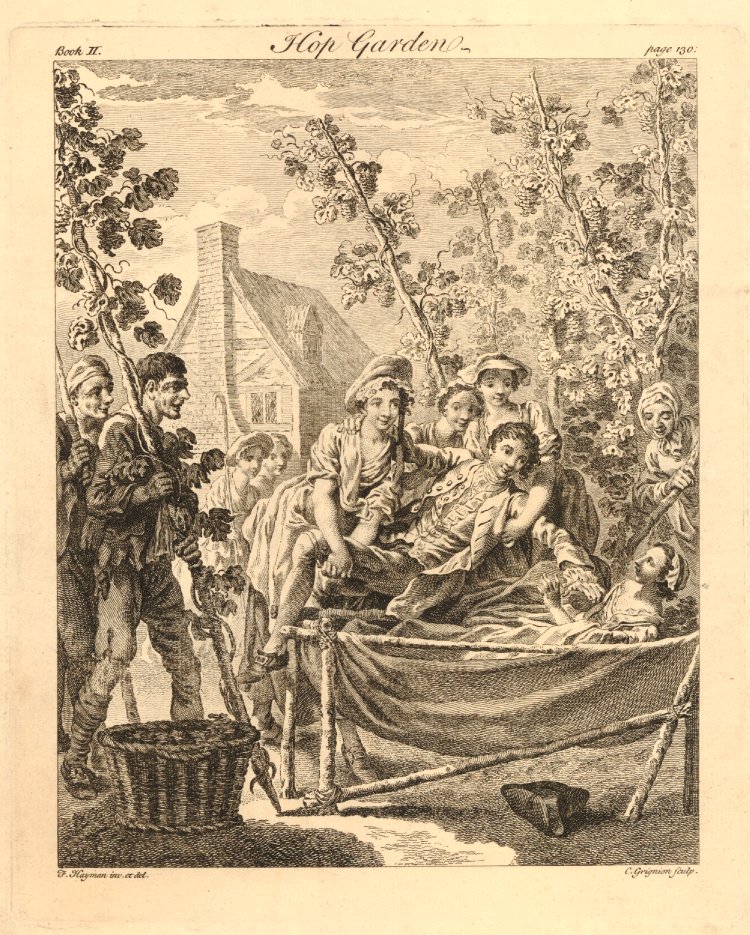
Smart-hop-garden
This illustration accompanied the second book. The British Museum has it in their collection, and they describe it as “a woman sitting in a vat, two others lifting a man in to join her, an amused crowd looking on.” Interestingly enough, the illustration appears to show an old ritual associated with hop-picking. According to the poem, it seems to involve a “festive ritual that played a part in the annual hop harvest, where a young woman, and a young man, are placed in a container of hops and covered up by it.”

Many years later, in 1931, George Orwell went hop-picking and made the following entry in his diary for September 19, 1931:

On the last morning, when we had picked the last field, there was a queer game of catching the women and putting them in the bins. Very likely there will be something about this in the Golden Bough. It is evidently an old custom, and all harvests have some custom of this kind attached to them.

The only reference I could find in the Golden Bough was this. “In hop-picking, if a well-dressed stranger passes the hop-yard, he is seized by the women, tumbled into the bin, covered with leaves, and not released till he has paid a fine.” One scholar speculates:

In any case, the ritual in the oldest version – Smart’s – seems to be some kind of fertility ritual: a male and a female hop picker are submerged together in a container of hops, which are the bounty of the harvest. It also seems to include some kind of wealth-redistribution element, where the other pickers claim a “largesse” or “fine” from those submerged. Whether it was for the honor, or just because they were the most efficient pickers, I don’t know, but it’s interesting either way. Ron Bateman notes that at least in Orwell’s day, the ritual took place on the last day of hop-picking, which I think strongly supports the idea of it being some vestige of a pagan fertility rite (or, even, the whole of the rite, with its purpose forgotten): having completed the harvest, the rite would help appease the field, its spirits, the gods, etc. to ensure the next year’s harvest would also be plentiful.

Anyway, here’s the second part of the poem.

THE HOP-GARDEN.

A GEORGIC.

BOOK the SECOND.

AT length the Muse her destin’d task resumes
With joy; agen o’er all her hop-land groves
She longs t’ expatiate free of wing. Long while
For a much-loving, much-lov’d youth she wept,
And sorrow’d silence o’er th’ untimely urn.
Hush then, effeminate sobs; and thou, my heart,
Rebel to grief no more—And yet a while,
A little while, indulge the friendly tears.
O’er the wild world, like Noah’s dove, in vain
I seek the olive peace, around me wide
See! see! the wat’ry waste—In vain, forlorn
I call the Phoenix fair Sincerity;
Alas!—extinguish’d to the skies she fled,
And left no heir behind her. Where is now
Th’ eternal smile of goodness? Where is now

That all-extensive charity of soul,
So rich in sweetness, that the classic sounds
In elegance Augustan cloath’d, the wit
That flow’d perennial, hardly were observ’d,
Or, if observ’d, set off a brighter gem.
How oft, and yet how seldom did it seem!
Have I enjoy’d his converse?—When we met,
The hours how swift they sweetly fled, and till
Agen I saw him, how they loiter’d. Oh!
THEOPHILUS [Mr. Theophilus Wheeler, of Christ-College, Cambridge], thou dear departed soul,
What flattering tales thou told’st me? How thou’dst hail
My Muse, and took’st imaginary walks
All in my hopland groves! Stay yet, oh stay!
Thou dear deluder, thou hast seen but half—
He’s gone! and ought that’s equal to his praise
Fame has not for me, tho’ she prove most kind.
Howe’er this verse be sacred to thy name,
These tears, the last sad duty of a friend.
Oft i’ll indulge the pleasurable pain
Of recollection; oft on Medway’s banks
I’ll muse on thee full pensive; while her streams
Regardful ever of my grief, shall flow
In sullen silence silverly along
The weeping shores—or else accordant with
My loud laments, shall ever and anon
Make melancholy music to the shades,

The hopland shades, that on her banks expose
Serpentine vines and flowing locks of gold.
Ye smiling nymphs, th’ inseparable train
Of saffron Ceres; ye, that gamesome dance,
And sing to jolly Autumn, while he stands
With his right hand poizing the scales of heav’n,
And with his left grasps Amalthea’s horn:
Young chorus of fair bacchanals, descend,
And leave a while the sickle; yonder hill,
Where stand the loaded hop-poles, claims your care.
There mighty Bacchus stradling cross the bin,
Waits your attendance—There he glad reviews
His paunch, approaching to immensity
Still nearer, and with pride of heart surveys
Obedient mortals, and the world his own.
See! from the great metropolis they rush,
Th’ industrious vulgar. They, like prudent bees,
In Kent’s wide garden roam, expert to crop
The flow’ry hop, and provident to work,
Ere winter numb their sunburnt hands, and winds
Engoal them, murmuring in their gloomy cells.
From these, such as appear the rest t’ excell
In strength and young agility, select.
These shall support with vigour and address
The bin-man’s weighty office; now extract
From the sequacious earth the pole, and now

Unmarry from the closely clinging vine.
O’er twice three pickers, and no more, extend
The bin-man’s sway; unless thy ears can bear
The crack of poles continual, and thine eyes
Behold unmoved the hurrying peasant tear
Thy wealth, and throw it on the thankless ground.
But first the careful planter will consult
His quantity of acres, and his crop,
How many and how large his kilns; and then
Proportion’d to his wants the hands provide.
But yet, of greater consequence and cost,
One thing remains unsung, a man of faith
And long experience, in whose thund’ring voice
Lives hoarse authority, potent to quell
The frequent frays of the tumultuous crew.
He shall preside o’er all thy hop-land store,
Severe dictator! His unerring hand,
And eye inquisitive, in heedful guise,
Shall to the brink the measure fill, and fair
On the twin registers the work record.
And yet I’ve known them own a female reign,
And gentle Marianne’s [the author’s youngest Sister] soft Orphean voice
Has hymn’d sweet lessons of humanity
To the wild brutal crew. Oft her command
Has sav’d the pillars of the hopland state,

The lofty poles from ruin, and sustain’d,
Like ANNA, or ELIZA, her domain,
With more than manly dignity. Oft I’ve seen,
Ev’n at her frown the boist’rous uproar cease,
And the mad pickers, tam’d to diligence,
Cull from the bin the sprawling sprigs, and leaves
That stain the sample, and its worth debase.
All things thus settled and prepared, what now
Can let the planters purposes? Unless
The Heav’ns frown dissent, and ominous winds
Howl thro’ the concave of the troubled sky.
And oft, alas! the long experienc’d wights
(Oh! could they too prevent them) storms foresee.
For, as the storm rides on the rising clouds,

Fly the fleet wild-geese far away, or else
The heifer towards the zeinth rears her head,
And with expanded nostrils snuffs the air:
The swallows too their airy circuits weave,
And screaming skim the brook; and fen-bred frogs
Forth from their hoarse throats their old grutch recite:
Or from her earthly coverlets the ant
Heaves her huge eggs along the narrow way:
Or bends Thaumantia’s variegated bow
Athwart the cope of heav’n: or sable crows
Obstreperous of wing, in crouds combine:
Besides, unnumber’d troops of birds marine,
And Asia’s feather’d flocks, that in the muds
Of flow’ry-edg’d Cayster wont to prey,
Now in the shallows duck their speckled heads,
And lust to lave in vain, their unctious plumes
Repulsive baffle their efforts: Next hark
How the curs’d raven, with her harmful voice,
Invokes the rain, ahd croaking to herself,
Struts on some spacious solitary shore.
Nor want thy servants and thy wife at home
Signs to presage the show’r; for in the hall
Sheds Niobe her prescious tears, and warns
Beneath thy leaden tubes to fix the vase,
And catch the falling dew-drops, which supply
Soft water and salubrious, far the best
To soak thy hops, and brew thy generous beer.

But tho’ bright Phoebus smile, and in the skies
The purple-rob’d serenity appear;
Tho’ every cloud be fled, yet if the rage
Of Boreas, or the blasting East prevail,
The planter has enough to check his hopes,
And in due bounds confine his joy; for see
The ruffian winds, in their abrupt career,
Leave not a hop behind, or at the best
Mangle the circling vine, and intercept
The juice nutricious: Fatal means, alas!
Their colour and condition to destroy.
Haste then, ye peasants; pull the poles, the hops;
Where are the bins? Run, run, ye nimble maids,
Move ev’ry muscle, ev’ry nerve extend,
To save our crop from ruin, and ourselves.
Soon as bright Chanticleer explodes the night
With flutt’ring wings, and hymns the new-born day,
The bugle-horn inspire, whose clam’rous bray
Shall rouse from sleep the rebel rout, and tune
To temper for the labours of the day.
Wisely the several stations of the bins
By lot determine. Justice this, and this
Fair Prudence does demand; for not without
A certain method cou’dst thou rule the mob
Irrational, nor every where alike
Fair hangs the hop to tempt the picker’s hand.

Now see the crew mechanic might and main
Labour with lively diligence, inspir’d
By appetie of gain and lust of praise:
What mind so petty, servile, and debas’d,
As not to know ambition? Her great sway
From Colin Clout to Emperors she exerts.
To err is human, human to be vain.
‘Tis vanity, and mock desire of fame,
That prompts the rustic, on the steeple top
Sublime, to mark the outlines of his shoe,
And in the area to engrave his name.
With pride of heart the churchwarden surveys,
High o’er the bellfry, girt with birds and flow’rs,
His story wrote in capitals: “‘Twas I
“That bought the font; and I repair’d the pews.”
With pride like this the emulating mob
Strive for the mastery—who first may fill
The bellying bin, and cleanest cull the hops.
Nor ought retards, unless invited out
By Sol’s declining, and the evening’s calm,
Leander leads Laetitia to the scene
Of shade and fragrance—Then th’ exulting band
Of pickers male and female, seize the fair
Reluctant, and with boist’rous force and brute,
By cries unmov’d, they bury her in the bin.
Nor does the youth escape—him too they seize,
And in such posture place as best may serve

To hide his charmer’s blushes. Then with shouts
They rend the echoing air, and from them both
(So custom has ordain’d) a largess claim.
Thus much be sung of picking—next succeeds
Th’ important care of curing—Quit the field,
And at the kiln th’ instructive muse attend.
On your hair-cloth eight inches deep, nor more,
Let the green hops lie lightly; next expand
The smoothest surface with the toothy rake.
Thus for is just above; but more it boots
That charcoal flames burn equably below,
The charcoal flames, which from thy corded wood,
Or antiquated poles, with wond’rous skill,
The sable priests of Vulcan shall prepare.
Constant and moderate let the heat ascend;
Which to effect, there are, who with success
Place in the kiln the ventilating fan.
Hail, learned, useful man! [Dr. Hales] whose head and heart
Conspire to make us happy, deign t’ accept
One honest verse; and if thy industry
Has serv’d the hopland cause, the Muse forebodes
This sole invention, both in use and fame,
The mystic fan of Bacchus shall exceed.

When the fourth hour expires, with careful hand
The half-bak’d hops turn over. Soon as time
Has well exhausted twice two glasses more,
They’ll leap and crackle with their bursting seeds,
For use domestic, or for sale mature.
There are, who in the choice of cloth t’enfold
Their wealthy crop, the viler, coarser sort,
With prodigal oeconomy prefer:
All that is good is cheap, all dear that’s base.
Besides, the planter shou’d a bait prepare,
T’ intrap the chapman’s notice, and divert
Shrewd Observation from her busy pry.
When in the bag thy hops the rustic treads,
Let him wear heel-less sandals; nor presume
Their fragrancy barefooted to defile:
Such filthy ways for slaves in Malaga
Leave we to practise—Whence I’ve often seen,
When beautiful Dorinda’s iv’ry hands
Had built the pastry-fabric (food divine
For Christmas gambols and the hour of mirth)
As the dry’d foreign fruit, with piercing eye,
She cull’d suspicious—lo! she starts, she frowns
With indignation at a negro’s nail.
Should’st thou thy harvest for the mart design,
Be thine own factor; nor employ those drones

Who’ve stings, but make no honey, felfish slaves!
That thrive and fatten on the planter’s toil.
What then remains unsung? unless the care
To stack thy poles oblique in comely cones,
Lest rot or rain destroy them—’Tis a sight
Most seemly to behold, and gives, O Winter!
A landskip not unpleasing ev’n to thee.
And now, ye rivals of the hopland state,
Madum and Dorovernia rejoice,
How great amidst such rivals to excel!
Let Grenovicum [Greenwich, where Queen Elizabeth was born] boast (for boast she may)
The birth of great Eliza.—Hail, my queen!
And yet I’ll call thee by a dearer name,
My countrywoman, hail! Thy worth alone
Gives fame to worlds, and makes whole ages glorious!
Let Sevenoaks vaunt the hospitable seat
Of Knoll [the seat of the Duke of Dorset] most ancient: Awefully, my Muse,
These social scenes of grandeur and delight,
Of love and veneration, let me tread.
How oft beneath you oak has amorous Prior
Awaken’d Echo with sweet Chloe’s name!
While noble Sackville heard, hearing approv’d,

Approving, greatly recompens’d. But he,
Alas! has number’d with th’ illustrious dead,
And orphan merit has no guardian now!
Next Shipbourne, tho’ her precincts are confin’d
To narrow limits, yet can shew a train
Of village beauties, pastorally sweet,
And rurally magnificent. Here Fairlawn [the seat of Lord Vane]
Opes her delightful prospects: Dear Fairlawn
There, where at once at variance and agreed,
Nature and art hold dalliance. There where rills
Kiss the green drooping herbage, there where trees,
The tall trees-tremble at th’ approach of heav’n,
And bow their salutation to the sun,
Who fosters all their foliage—These are thine,
Yes, little Shipbourne, boast that these are thine—
And if—But oh!—and if ’tis no disgrace,
The birth of him who now records thy praise.
Nor shalt thou, Mereworth, remain unsung,
Where noble Westmoreland, his country’s friend,
Bids British greatness love the silent shade,
Where piles superb, in classic elegance,
Arise, and all is Roman, like his heart.
Nor Chatham, tho’ it is not thine to shew
The lofty forest or the verdant lawns,

Yet niggard silence shall not grutch thee praise.
The lofty forests by thy sons prepar’d
Becomes the warlike navy, braves the floods,
And gives Sylvanus empire in the main.
Oh that Britannia, in the day of war,
Wou’d not alone Minerva’s valour trust,
But also hear her wisdom! Then her oaks
Shap’d by her own mechanics, wou’d alone
Her island fortify, and fix her fame;
Nor wou’d she weep, like Rachael, for her sons,
Whose glorious blood, in mad profusion,
In foreign lands is shed—and shed in vain.
Now on fair Dover’s topmost cliff I’ll stand,
And look with scorn and triumph on proud France.
Of yore an isthmus jutting from this coast,
Join’d the Britannic to the Gallic shore;
But Neptune on a day, with fury fir’d,
Rear’d his tremendous trident, smote the earth,
And broke th’ unnatural union at a blow.—
“‘Twixt you and you, my servants and my sons,
“Be there (he cried) eternal discord—France
“Shall bow the neck to Cantium’s peerless offspring,
“And as the oak reigns lordly o’er the shrub,
“So shall the hop have homage from the vine.”

Filed Under: Just For Fun, Related Pleasures Tagged With: England, Great Britain, History, Hops, Literature, Poetry

Flagship Friday #1: Lagunitas IPA

April 5, 2019 By Jay Brooks

lagunitas-ipa

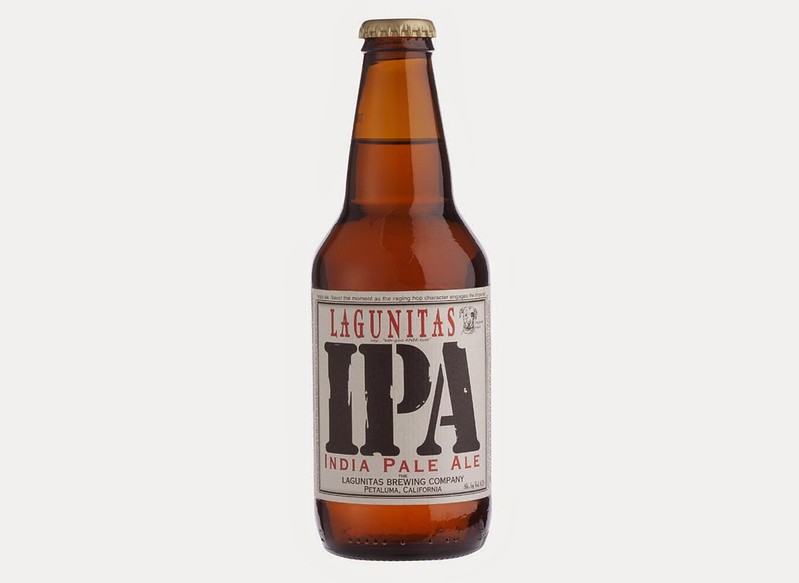
Lagunitas Brewing Co. was one of the first breweries that I got to know well, shortly after becoming the beer buyer for the chain store Beverages & more in 1996. Ron Lindenbusch, who’s still at the company, was one of their earliest employees and he called on me at BevMo, inviting me to come for a visit to the brewery, I think in Forest Knolls. This was before their present location in Petaluma, but after they stopped making beer in founder Tony Magee’s kitchen, so brewery number 2, I suppose. Somewhere, I have photos from that visit. That’s where I first met Tony, and he’s been one of my favorite people ever since. I like that he says what he’s thinking, unvarnished, even though that’s ruffled some feathers more than a few times. But he’s also one of the most fascinating people to spend any time with, because his mind races from topic to topic in a form of stream of consciousness that I very much relate to. Since I tend to think in tangents, as well, I’ve always valued any chance I get to have more than a passing conversation with him.

A few years ago, in 2012 I believe, Beer Connoisseur magazine asked me to write a profile of Tony for their Innovator’s Series. So I met him for lunch at a bar that he chose near the brewery and we ended up talking on a myriad of subjects for nearly three hours. Between that, other research and what I knew about Magee and his brewery already, I wrote a 3,500-word profile which I was quite happy with. During our conversation, he told me the story of how Lagunitas IPA came to be, and how he deliberately set about to make it his brewery’s flagship beer, and more importantly, to essentially “own the category” after a fashion. A few sentences of that made it into the final article, but because the focus was on his entire career, it was brief. Luckily, I have our whole conversation on tape, so I went back to listen to it again, or at least the relevant parts where he was explaining his rationale for making his now-iconic flagship IPA.

108_0881
Tony Magee and Ron Lindenbusch at the 10th Anniversary Party for Lagunitas in 2004.

While the article itself began, “We were somewhere around Petaluma on the edge of Sonoma when the beer began to take hold,” the interview was far less dramatic. We took a seat at a table, ordered a pair of Lagunitas IPA pints, and looked over the menus. We chatting amiably, catching up, and then I started asking questions. And this is a little background from that.

Tony Magee’s first successful homebrew effort was a pale ale, brewed with Chico yeast, which he heard was originally acquired from Ballantine, one of the few breweries still making an ale before the microbrewery revolution. He rented some space down the street from his kitchen brewery, and Lagunitas Brewery was born.

Ron Lindenbusch, who in the early 1990s worked for distributors, stopped by the brewery and was immediately hooked, becoming something like employee number four or five, but apart from Tony and his wife Carissa Brader, is the oldest Lagunitas employee, followed closely behind by Robin McClain, who today is the controller.

P1050324
Tony Magee and me at the Bistro IPA Festival in 2006.

At around an hour and forty minutes into lunch, our conversation turned to Lagunitas IPA. Not long after moving to the second brewery, they outgrew the space again in Lagunitas, and found larger quarters in nearby Petaluma, several miles east and north from West Marin, in Sonoma County. Things changed fairly rapidly after the initial move, especially after the focus on pale ale shifted to IPA.

When we moved to Petaluma, I realized we were going to have to start growing pretty quickly, because costs went up. So I figured we had to bottle. From the moment we released the pale ale, the market was starting to move with our product, I saw this path forward with the IPA. I realized then — this is 1995 — that IPA was the future of the craft category. It was the highest mark on the tree. So we would just aim for that. Sierra Nevada made a pale ale. I didn’t want to compete with Sierra Nevada, it would have seemed like bad behavior anyway, and I was selling [Dogtown Pale Ale] because I knew that there were some customers that would be willing to trade over some number, low-hanging fruit. But it wasn’t to try to prey on their business. Even so, I couldn’t have gotten a tap handle if I wanted it.

But then something happened. There was a restaurant in Sausalito (in Marin County) called Margaritaville (which is no longer in business). And for some reason, they got into an argument with one of their distributors, who at that time was Mesa Distributing. And as a result, they pulled Sierra Nevada Pale Ale from the place, even though as far as I know it wasn’t Sierra Nevada’s doing, and replaced it with Lagunitas Dogtown Ale.

Immediately, Margaritaville started going through five kegs of Dogtown Pale Ale a week, which was unheard of for it at the time. Tony thought, “this is not because of my beer,” and went there to investigate. So he sat at a table and just observed people ordering from the bar, and what he found was that people were not coming in and ordering a Sierra Nevada, or even a Sierra Nevada Pale Ale. What they were ordering was a pale ale. And it didn’t really matter if it was Dogtown Pale Ale or Sierra Nevada Pale Ale. I should qualify that. I’m sure it mattered to Sierra Nevada, but it didn’t matter to the customer. They just wanted a pale ale. Essentially, Sierra Nevada, at that time and in that place, owned pale ale.

And that was a revelation to Magee, who figured he couldn’t really compete with that, and concluded he had to figure out another way. Here was his thought process.

So I realized that was a bad way to go. That was a path without a heart, to try to prey on somebody else’s business. So I thought, you always want to be selling up, so I thought, what’s a premium pale ale? Well, an IPA. I looked around. There was BridgePort, but they were hardly down here [in the Bay Area]. There was Anderson Valley making their 100-IBU IPA [Hop Ottin’]. So I just realized there was an opportunity to move through that space — an open field run — and gain a foothold in the market. That others would have to sell around us, when they came to the market. And it worked out that way. The packaging I did with the IPA as bold as I did because I realized in that pale ale moment that Sierra Nevada brewed pale ale as a brand, while we could only brew it as a style. And so when I did IPA, I wanted to try to brand IPA in whatever way I could, given our limited resources. So that is why the packing looks like it does. [On the label], Lagunitas is actually smaller than IPA. And so it worked out, at least around here. In some circles, there’s a number of IPAs that are in people’s minds. And we’re one of them. If a guy likes drinking in a little sphere of IPA, we’re probably somewhere hovering in an orbit around that idea.

lagunitas-ipa

And it does appear that having a label that emphasized “IPA” over anything else did help people associate IPA with Lagunitas. It definitely became a huge brand here in the Bay Area and fueled their growth into numerous other states. And that was true for quite some time, at least until IPAs became ubiquitous in the mid-2000s or so. Opening other markets undoubtedly kept sales robust nationally, but eventually the market became fairly saturated with hoppy beers. And that may have helped Lagunitas for a time, as Magee explains.

I didn’t realize everybody would be pressing so hard on the IPA category. This felt like a secret thing, but I realized when I made a pale ale, people might drink my pale ale, but what they would be doing all the time in their minds was comparing it to the one they knew and loved so in a way it was an uneven contest where I was helping to promote Sierra Nevada because the comparison would not always be favorable. Alright, so I like Sierra Nevada. They make such a beautiful beer that so consistent, so elegant. So I realized that if other brewers made a pale ale they’d promote Sierra Nevada. So my hope was that if we could be successful establishing our terroir around the IPA that as other brewers inevitably made IPAs it would help us out. I think it’s true, I think it’s working.

The idea wasn’t to find a way to capitalize on other people’s efforts, but I was trying to find a way to live with what I could see coming, and I saw everybody making IPAs down the road. And so when they did I wanted to be sure that at least it carried us up. So we’ve been very diligent over the years about making sure that IPA maintains about 60% of volume of the beer we make. So all these other things we do are our pilot lights and they push the brand up and keep it exciting and interesting, and who knows, it could be that Little Sumpin’ or DayTime will overtake the IPA at some point. So we’ll continue to make the IPA in the way that Miller kept making Miller at the same time they were selling a lot of Miller Lite. Branding is as much a chess game as it is anything else. You have to try to think three or four moves out, because somebody else probably is, as well.

I think the larger takeaway is that this is a case where a brewery had a definite plan to create a flagship beer for themselves, and which they executed quite successfully for a number of years. While there were, and are, countless other IPAs being brewed, Lagunitas did manage to become one of the most popular IPAs in their home market, as well as several others. And frankly, I hadn’t had one in some time before this February, when I managed to enjoy several throughout #FlashipFebruary. And I have to say, it’s still one damn fine beer.

FF J Finale 3
Having a Lagunitas IPA to end #FlagshipFebruary earlier this year at my favorite hometown bar, the Flagship Taproom in downtown Cotati.

Filed Under: Beers, Editorial, Flagships, Just For Fun Tagged With: California, Northern California

Fastest Growing Breweries in 2018

March 28, 2019 By Jay Brooks

ba

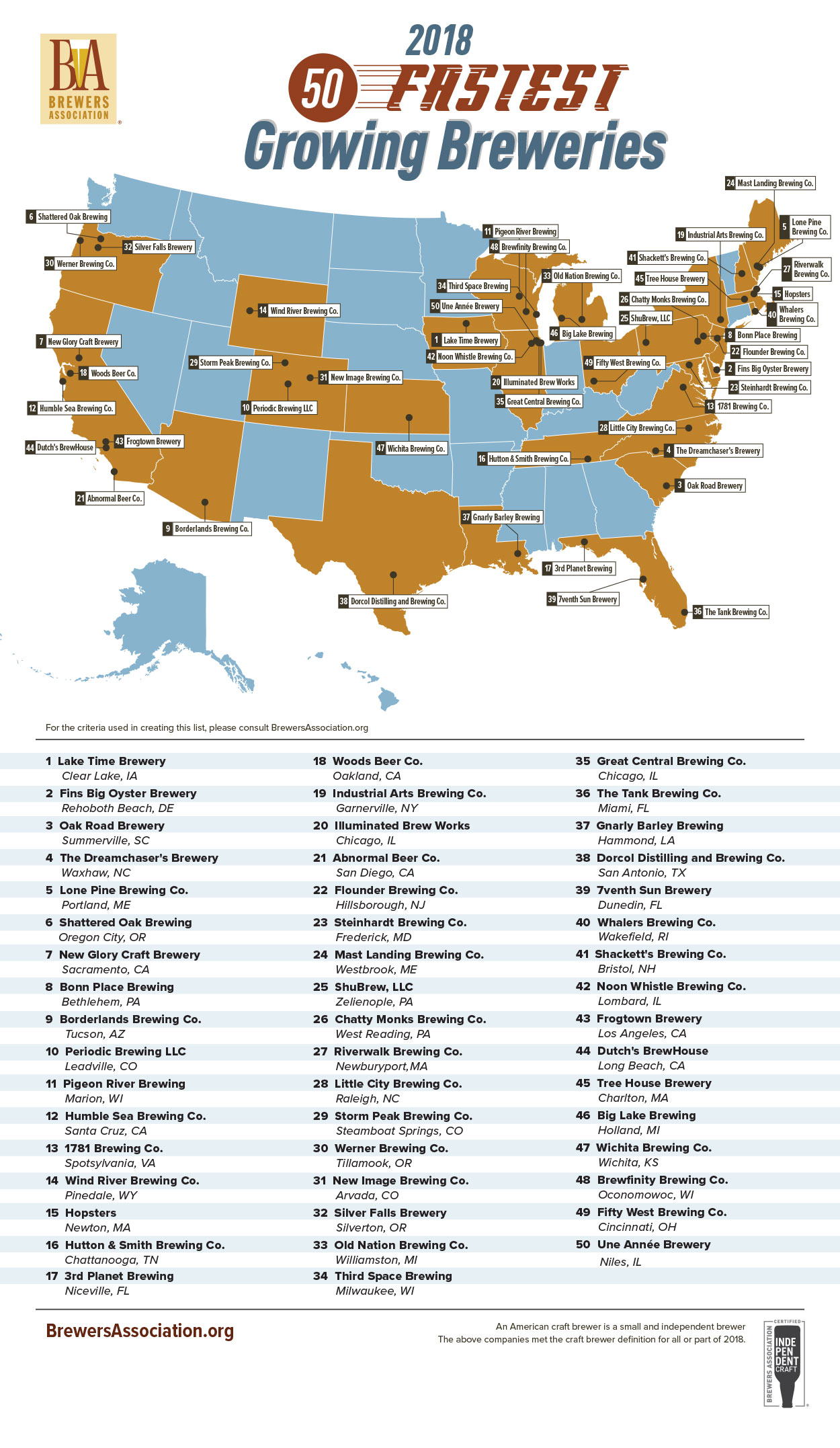
Yesterday, the Brewers Association released its list of “50 Fastest Growing U.S. Craft Breweries of 2018.” This is the second year for the list, and I’m glad they started creating it last year, because the annual Top 50 list has grown increasingly static over the years, and isn’t a good way to see who’s shaking things up anymore. Most of the movement tends to now be confined to the bottom half or even the bottom quarter of the list, with minimal changes above that. This list, on the other hand, sees new breweries on it each year (at least so far) and gives a better picture of which breweries are moving product at a faster pace than the previous year. And while it’s probably on a small base, it still shows who’s worth watching.

2018-50-Fastest-Growing-Breweries-hero

From the press release:

Representing 27 states across the U.S., these small and independent breweries experienced a median growth of 163 percent with the median size being 1,350 barrels of in-house production in 2018. Breweries on the list range from 50 barrels to more than 40,000, and grew from less than 70,000 barrels collectively in 2017 to more than 170,000 barrels in 2018. As a group, these brewing companies represent approximately 10 percent of total craft growth by volume for the year, and include 13 brewpubs, 35 microbreweries, and two regional craft breweries.

“Even as market competition continues to increase, these small and independent breweries and brewpubs demonstrate there are still growth opportunities across a diverse set of regions and business models,” said Bart Watson, chief economist, Brewers Association.

2018-50-Fastest-Growing-Breweris-(map)

In my neck of the woods — California — six breweries made the list. That represents 12% of the total. Half of the California breweries are in the Bay Area and Northern California, and they’re all in the top half of the list with one, Sacramento’s New Glory, in the Top 10. They opened in 2012. Of the other two, Woods Beer Co. has several locations now, and has been around for several years (16 brewing, 7 with their own brewery). The other one is Humble Sea Brewing, located in Santa Cruz, which just opened in early 2016. Congratulations to all the breweries who made the list.

This is a shortened version of the methodology they used, for the full write-up, see the BA’s press release.

Growth is measured based on production at their own facilities. Breweries must have opened by December 31, 2016 or earlier to be considered. It only includes breweries that reported 2018 production to the Brewers Association’s annual Beer Industry Production Survey; breweries with staff estimates or data from state excise tax reports were not considered. Breweries also needed a validated production figure for 2017, either via the production survey, or state excise tax data.

Filed Under: Beers, Breweries, Just For Fun, News Tagged With: Brewers Association, Press Release, Statistics, United States

Märzen Madness 2019

March 14, 2019 By Jay Brooks

basketball

I may not be college basketball’s biggest fan, but I do still enjoy March Madness every year. The tournament is usually a fun diversion for a few weeks each year, so for the ninth straight year, I’ve set up a fantasy game, similar to fantasy football. It’s a bracket game through Yahoo which I call “Märzen Madness.” It doesn’t look like there’s a limit to the number of people who can play, so sign up and make your picks beginning on March 17, with the first games taking place on March 21, which only gives you a short window to complete your bracket.

final-four

To join Märzen Madness and play the Yahoo! Sports Tournament Pick’em game, just follow this instructions below. You’ll also need a Yahoo ID (which is free if you don’t already have one).

To accept the invitation, just follow this invitation link. For reference, here’s the group information.

Group ID#: 44394
Password: brookston
NOTE: You may not need a password this year if you use the invitation link.

basketball-beer-glass

Good luck everybody.

Filed Under: Just For Fun, Related Pleasures Tagged With: Basketball, Fantasy, Games, Sports

Top 50 Breweries For 2018

March 12, 2019 By Jay Brooks

ba

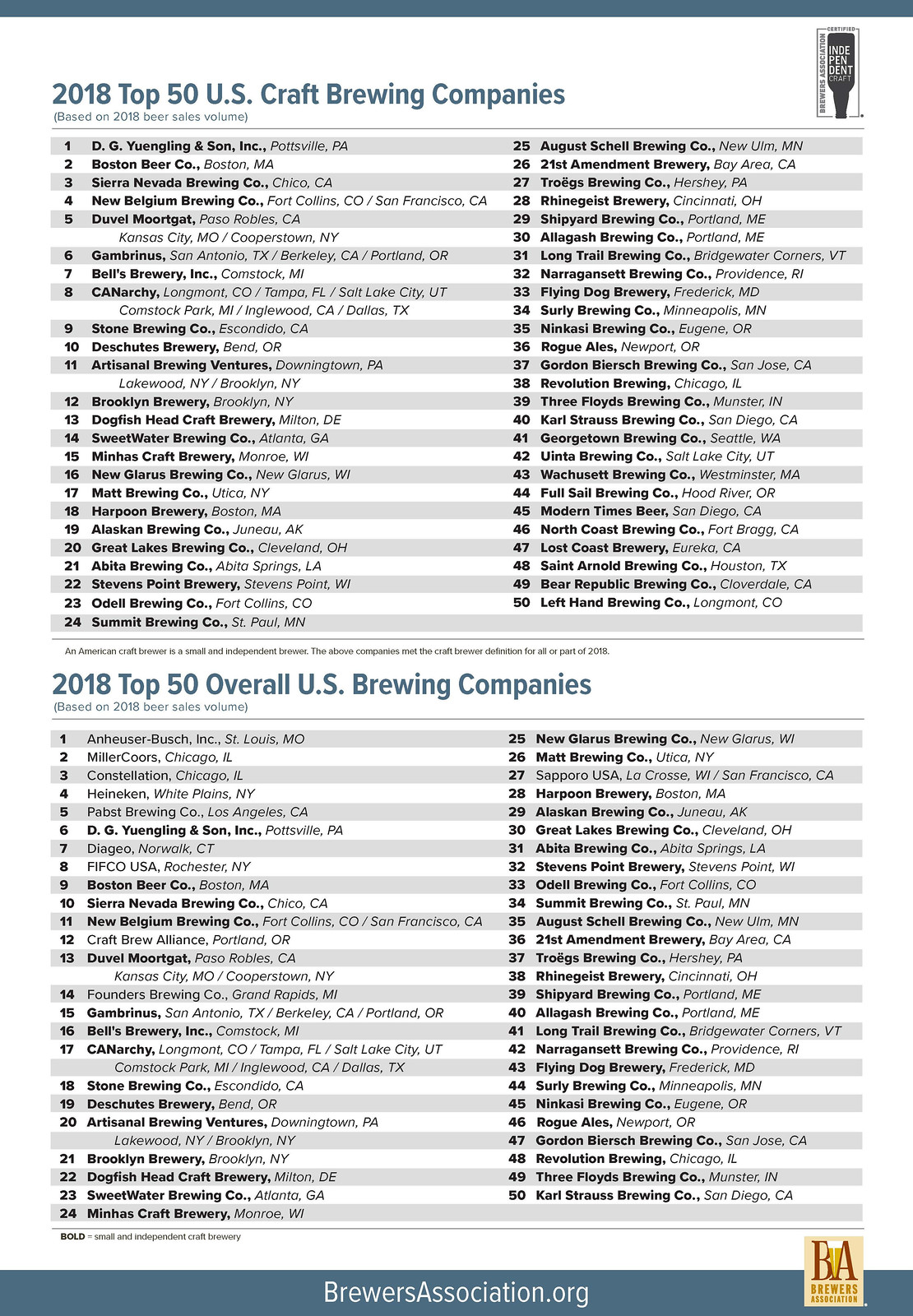
The Brewers Association just announced the top 50 breweries and craft breweries in the U.S. based on sales, by volume, for 2018, which is listed below here. I should also mention that this represents “craft breweries” according to the BA’s membership definition, and not necessarily how most of us would define them, as there’s no universally agreed upon way to differentiate the two. For the eleventh year, they’ve also released a list of the top 50 breweries, which includes all breweries. In the past I’ve posted the two lists separately, but have decided going forward to present them together since the two are getting increasingly intermingled. I confess I used to look more forward to this list every year as it represented greater and wider acceptance of craft in the marketplace, but it doesn’t seem to hold the same thrill for me anymore, perhaps I’m getting jaded. Here is this year’s craft brewery list and overall breweries, too:

Top50_both_2018
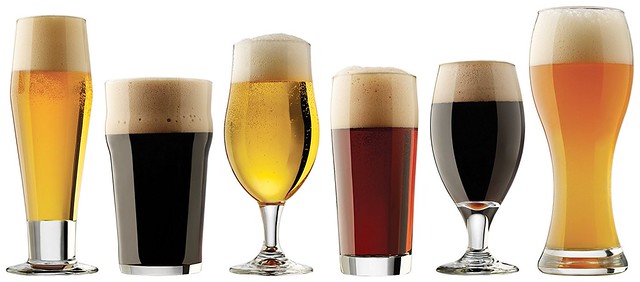
six-glasses

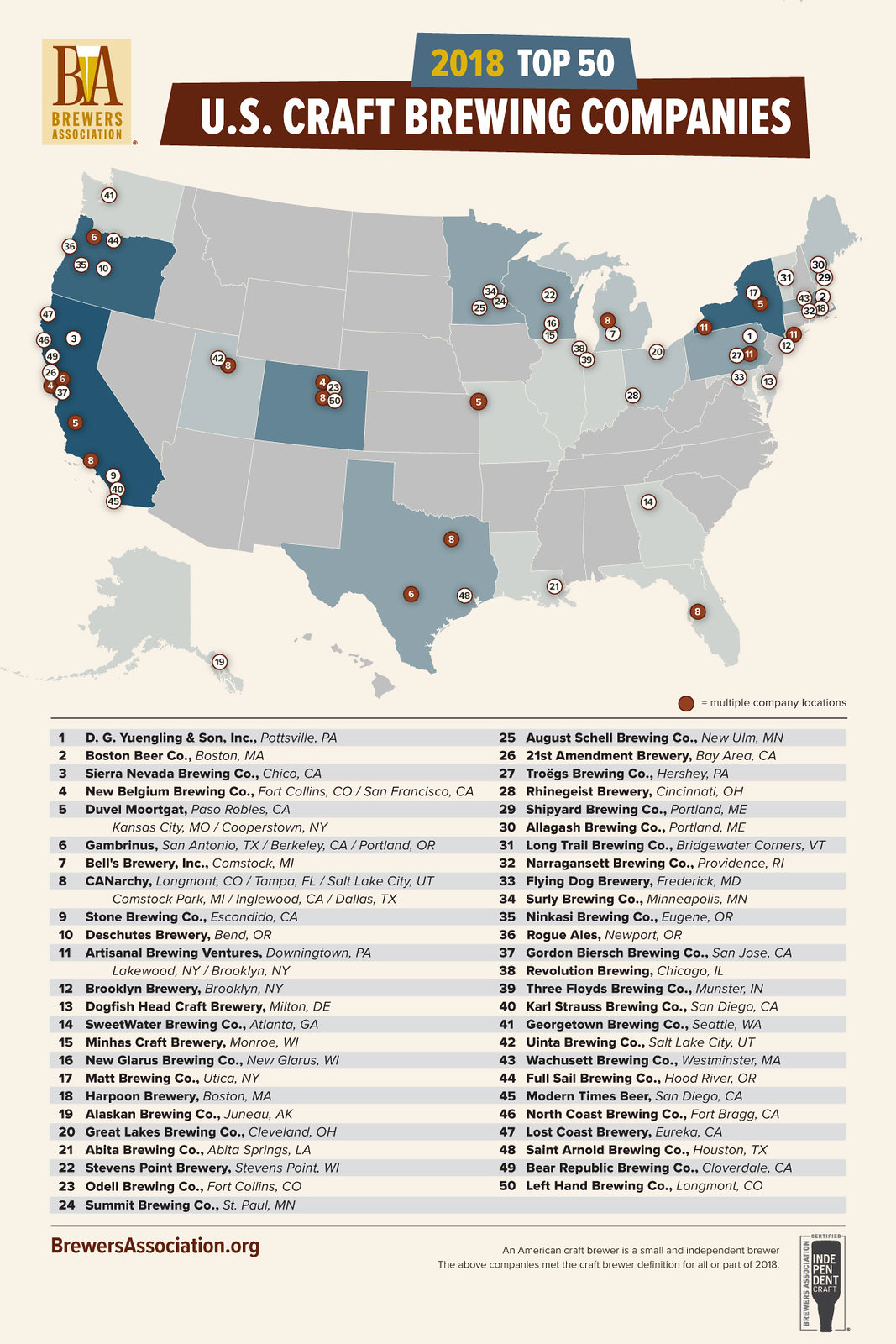
And below here is a map showing the Top 50 craft breweries, as defined by the BA, on a map. If you look at the press release itself, there are 22 footnotes of explanation for the Top 50 overall (a-v), which is one less than last year, but still seems like too many. I feel like it should be simpler. As many people predicted many years ago, the larger craft breweries seem more like the regional breweries of yesteryear, and have less in common with their smaller brethren than with the big breweries. That’s why many of them also belong to the Beer Institute, along with other organizations. I just realized I whined about this very fact last year, so it’s obvious this is not an issue that’s going away anytime soon. I don’t know what the solution is, but setting up the us vs. them dichotomy no longer feels to me like the right direction to me. I understand it up to a point, but the brewing world is not as black and white as it used to be, and I believe there needs to be a new way to look at it that isn’t so unforgiving. And it isn’t just the BA, I was disheartened to talk to a few brewers this year who were excluded from the SF Beer Week gala because they weren’t, or couldn’t be, guild members, which is not the original idea behind SF Beer Week. When we first started it, we wanted to include everybody. That was, indeed, the point. Anyway, congratulations to all the breweries in the Top 50 for another great year, and especially the few new names on this year’s list.

Top50_2018

Filed Under: Breweries, Editorial, Just For Fun, Politics & Law Tagged With: Brewers Association, Press Release, Statistics

The Hop-Picking Season By Vita Sackville-West

March 9, 2019 By Jay Brooks

hop-leaf

Today is the birthday of English poet, novelist, and garden designer Vita Sackville-West. “She was a successful novelist, poet, and journalist, as well as a prolific letter writer and diarist. She published more than a dozen collections of poetry during her lifetime and 13 novels. She was twice awarded the Hawthornden Prize for Imaginative Literature: in 1927 for her pastoral epic, The Land, and in 1933 for her Collected Poems. She was the inspiration for the androgynous protagonist of Orlando: A Biography, by her famous friend and lover, Virginia Woolf.”

She wrote seventeen novels and a dozen collections of poetry, along with several biographies and works of non-fiction. But she was also well-known for her garden at Sissinghurst created with her husband, Sir Harold Nicolson. It was located in the Weald of Kent in England, and became one of the most famous gardens in Great Britain. It also gave her quite the vantage point to observe the hops industry in Kent, and in 1939 she wrote Country Notes, which included several entries concerned with hops and hop production. The book is a collection of small pieces she wrote for a variety of periodicals, such as the New Statesman, The Nation, Harper’s Bazaar, Vogue, Time and Tide, Travel Nation and Athenæum. The photographs were taken by Bryan or Norman Westwood. Below are the articles about hops.

The Kentish Landscape

At the moment of writing these words, Kent is looking absurdly like itself. Cherry, plum, pear, and thorn whiten the orchards and the hedgerows; lambs frolic; the banks are full of violets and primroses; the whole landscape displays itself as an epitome of everything fresh and innocent which has drawn ridicule upon the so-called school of Georgian poets. It is a simple delight which pleases everyone, from the unsophisticated to the sophisticated. Why affect to despise it? Year after year I enjoy it more, and reflect with pride that my own county offers a fair presentment of the English scene to the foreigner travelling in his Pullman between Dover and London.

He, of course, cannot know it as we know it, though on his way up to London he is accorded a generous glimpse of the valleys of the Beult and the Medway. He sees the orchards and the hop-gardens; orchards he has seen before in his own Normandy, but the hop-gardens strike him as very peculiar and individual, opening and shutting as they do while the train flashes past. If he does not already know what they are, he is reduced to asking an obliging stranger for the explanation. Those tall bare poles, that elaborately knotted string, those ploughed acres—what does it all mean? The explanation is forthcoming: it is English beer. Of course: this is Kent. He looks out again with renewed interest, he remembers that this is called the garden of England.

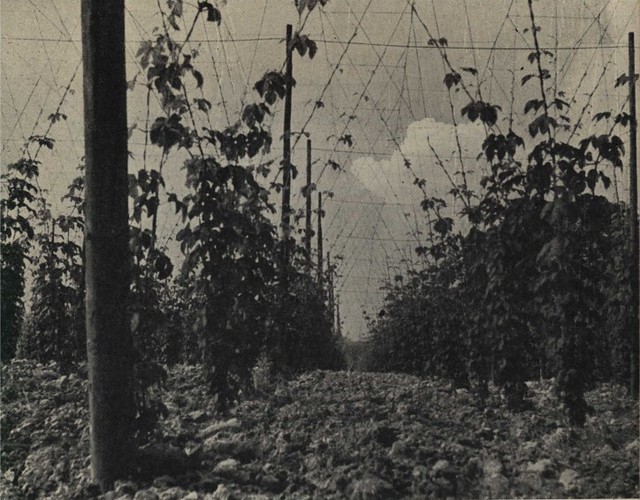
hop-picking-season-6
Hop garden.

Orchidaceæ

I went on such an expedition recently with two friends. We did not find much, it is true; or, rather, we found none of the real rarities. That, however, never matters, for the compensations are so rich: the small, lost, down-land churches, miles from the villages they are supposed to serve; the wide windy skies, the grassy slopes, the deep valleys with farm-buildings exquisitely composed into the group of barns, house, and oasts with steep brown roofs. I heard someone say the other day that when he saw or read about such things, nothing else seemed to matter, neither European complications, nor wars, nor threats of wars—they were all forgotten. I felt the same myself, when eventually we found the Bee orchis growing beside a partridge’s nest.

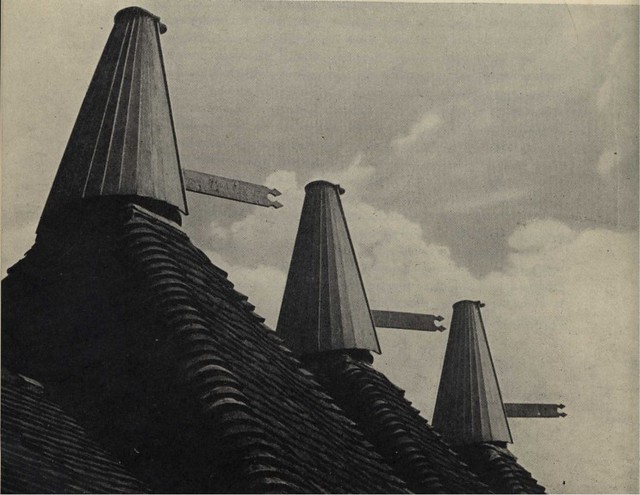
hop-picking-season-7
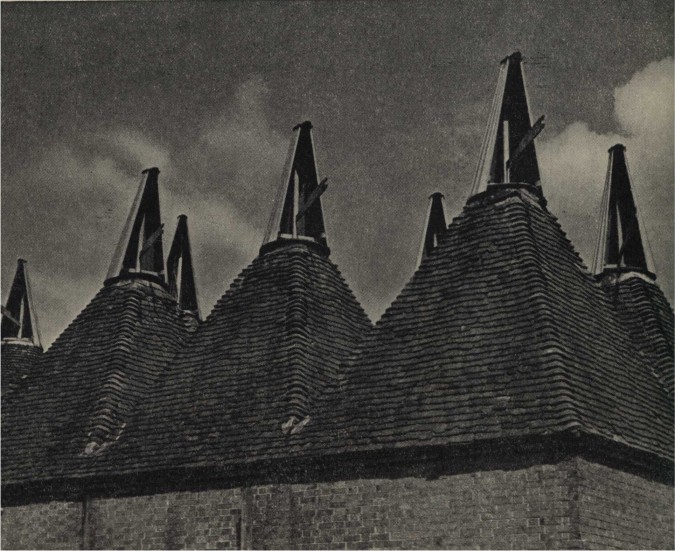
Oast cowls.

The Hop-picking Season

The hoppers are arriving in Kent. It is curious to observe that the moment the East-ender leaves his slum in Bermondsey or Rotherhithe for this annual expedition, he starts to cut quite a different figure in the public mind, ceases to be a mere and rather vulgar Cockney, and is instantly invested with all the attributes of romance. For three weeks in his drab year he is allowed to rank in picturesqueness with the gipsy. Why this should be so is a little difficult to explain. He dresses in the same way as he does in London, yet there is a difference between the Cockney and the hopper; perhaps the red handkerchief knotted round the throat looks better in a field than in the slum. The tawdry muslins of his women make a bright and oddly foreign effect among the bines. The presence of many children turns the serious business of picking into something like a pagan festival, reminding me of the Neopolitan celebration when the local little boys spray their naked sunburnt bodies with the copper-sulphate used for the prevention of Phylloxera and prance about stained in turquoise blue between the olives and the vines at dawn, a scene which Leonardo might have found it in his taste to record in paint. The Londoners’ children are neither so gay nor so pagan, but still a certain light-heartedness descends on all. It is very un-English in spite of being so essentially English. The hop-garden is a fair substitute for the vineyard, with its swags of green bunches so like the white muscat, its long leafy tunnels dappled with light, its brown canvas troughs filled with the pale flowers. Colour and gaiety reign in a way they never do at the other great country events such as hay-making or harvest.

This gaiety is reflected also in the trouble that the Cockney family takes to make its temporary home as lively as possible. The sleeping quarters provided are usually no better than a range of wooden huts—sometimes even an old railway coach—lime-washed inside, and supplied with a wooden bench and a couple of trusses of straw for bedding. Nothing more. It is all very clean, bare, and hard. Little can be said for it save that it is clean and (one hopes) weather-proof. Fortunately the families who have descended yearly upon the same hop-garden for several generations, grandmother, mother, and child, know exactly what to bring with them in order to turn the hut into a home. They bring coloured lithographs and lace curtains; bedspreads and china ornaments, and by the time they have set out their treasures their little hovel looks as attractive as a Dutch interior. Then when the working day is over they gather round bonfires and rouse the quiet night with songs and piano-accordions.

In damp sunless weather the picture is different. We remember then that perhaps thanks to our climate we are a glum race. A peddler comes round crying mackerel at five a shilling; alive they were, and swimming, this morning at sunrise, for the sea is not so very far away, but now the dead protruding eyes of fish stare at the pickers over the edge of the basket; this has to do duty for song and sunburnt mirth. The pickers then contribute nothing of jollity. Sordid, pasty bundles, sitting on camp stools or wooden boxes, their muslins hidden away beneath their mackintoshes, their babies uncomfortably asleep in go-carts beside them, they strip the bines in gloomy silence, preoccupied solely with the completion of their tally. A tally to a family; a big thing to fill, and only 1s. 5d. when you have done it. No wonder they are sometimes gloomy, especially when it rains. The grape is a fruit, the hop only a flower; perhaps that makes all the difference.

It appears also that they do not wholly like being in the country. So long as the weather is fine they make the best of it, regarding it as a holiday to be enjoyed, almost an obligation, but then as day dies a certain alarm disquiets their souls. Away from traffic and street lights, they are frightened. The silence and the darkness of the fields perplexes them. They will not go about after dusk except in little bands. Toughs though they may be at home, they are not tough enough to stand the desolation of the darkened country-side. On the whole they feel rather relieved when the moment comes for them to climb into their charabancs or cars again and return to a mode of life they understand.

Perhaps, however, they will not much longer be called upon to add their picturesque touch to the country year. The bines, it is said, will soon be stripped by machinery. Oh, brave new world!

hop-picking-season-1
Oasts.

The Garden and the Oast

It is the annual outing of the East End, but the East End cannot be expected to take any affectionate interest in our peculiarly local crops. These acres, representing several thousands of pounds, tended all the year by expert, almost instinctive, country hands, from the first training of the bine to the last fingering of the swollen flower, are turned over in the height of their fulfilment to the unskilled, unsympathetic mercies of the Cockney. Consider for a moment the care and vigilance which throughout the months of winter, spring, and summer have brought the gardens to their autumn state of fecundity. First, after the harvesting, the old bines must be cleared away; then the pruning-knife must sever and select; then, with the shooting of the new bine, up go the strings—strings reckoned by the ton; six hundred miles of string, fixed to the ground at the bottom by women and boys, and to the permanent wires overhead by men on stilts, giant figures stalking between the poles in the bleak spring day. The bine begins to grow; heavily fed, it will grow as much as two feet in a night, twining round the strings from right to left, for the hop cannot be persuaded to grow widdershins. You may think that a plant with so much energy might now be left for a little to its own devices. Make no such mistake. It has its enemies: mould and insects; it has its remedies: wash and powder; the enemy must be looked for, and the remedy applied unsparingly, even though the men with knapsacks blow hundreds of pounds sterling in fine sulphur dust into the air. The wind, too—a proper gale will do grand damage in the hop-garden. But the garden survives these dangers, and towards the end of August you are rewarded by the pale, imponderable clusters, well grown out, as you walk down the green, lovely aisles or mount your fixed ladders for a final inspection. It is then, when your expert judgment decides that the flower is ripe for picking, that London lets loose its hordes and the garden is profaned by the presence of these philistines, and the fish-peddler cries his mackerel at five a shilling.

The profanation, however, marks but a brief stage in the history of the hop from bine to bottle. At the sole moment of its picking is the hop subjected to the hands that neither love, hate, nor understand it. Once picked into the pokes, when the garden begins to assume a dirty, dejected air, with the cut bines withering in their fallen heaps, the poles sticking up gaunt and useless, the wires overhead fluffy with the fringe of cut strings—once picked, the flower is hurried to the oasts, where skilled driers receive it. These are men who have been for thirty, forty, fifty years at their job. They handle their material and their implements as though they knew what they were about. Indeed, they disregard some of their implements, with a sort of contempt, such as the thermometer and the weighing-machine, referring to them only as a concession to convention, to corroborate their human judgment, or to satisfy the overseer, when their instinct is rarely proved at fault. This is pleasing, and as it should be. The hop is once more in hands that have the mastery over it.

hop-picking-season-2
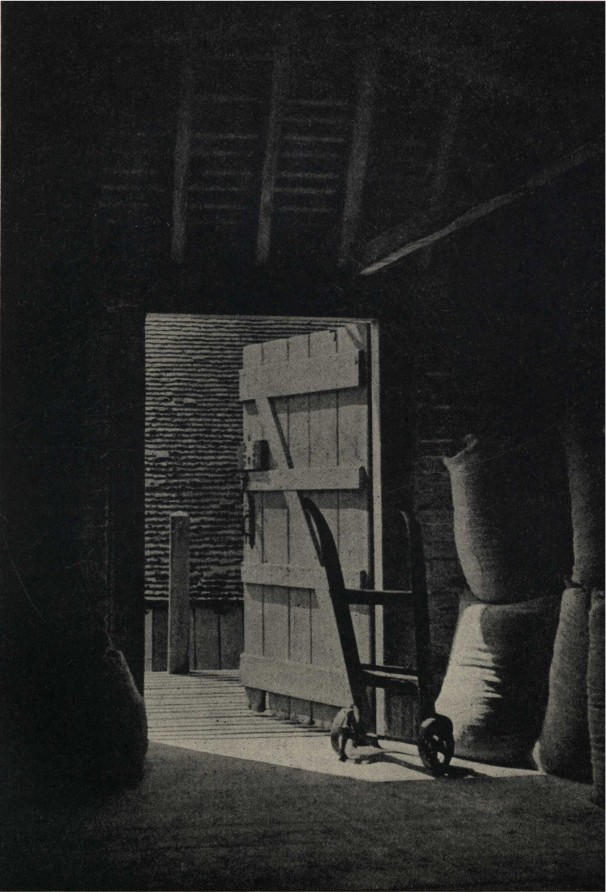
The barn door.

All day the chimneys of the kilns have been smoking blue, but the life of the kiln does not slacken with dusk, when the pickers go home to their camp; all night the process of drying goes on, to keep pace with the supply that has been pouring in from the garden. Inside the oast, we choke and cough with the sulphur; the doors of the furnaces stand open for a fresh stoking, like the entrails of a ship, the pan of sulphur blue in the midst of the fire; the men, demoniacal figures redly lit, shovel on the coal, slam the doors, throw down their shovels with horrible clang; this ground-level of the oast is a place of violence. Propped against the wall, too, are brutal shapes, sacks as big as bullocks, with the white horse of Kent prancing painted across them, and their corners tied into ears like the ears of killed beasts.


But on the upper story the hop reassumes its character of pale colour and feather weight. In the long, low, raftered loft, where everything is whitewashed, the lanterns swing from the beams above mountains of dried flowers on the floor, billowing heaps of a ghostly pallor, an exquisite imponderability. Impossible to give a name to their colour. It is a cross between ash and gold; the colour of dust-motes, of corn in moonlight, of fair hair under a lamp. All the green has been taken from them in the drying; they are crisp and airy; everything you touch is sticky with resin, even the bristles of the brooms are knobby with resin gathered in sweeping up the floor; the pungent smell is in the air. The lanterns throw the shadows of the rafters in sharp designs on roof and floor. The men, dressed in white overalls, pile the heaps higher with rake and scupper—huge scoops made of white canvas. In one corner, where a hole gapes in the boards, two men shovel the hops down the hole into the mouth of the sack which hangs below, out of sight; a great wheel spins round, the shadow of its spokes whirling over the whitewashed wall, and the weight descends into the sack, pressing, packing, till the flowers are squeezed into solidity, and one believes at last what had always seemed so unconvincing, that a ton of feathers weighs as much as a ton of lead.

hop-picking-season-3
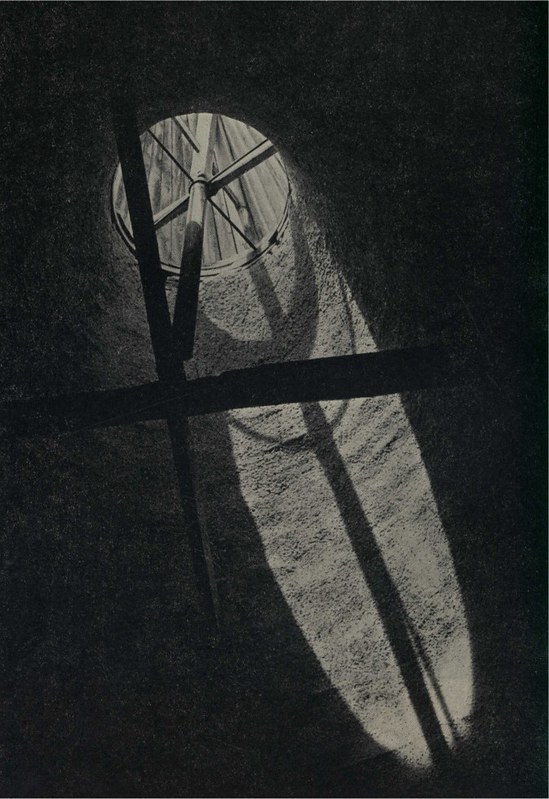
Inside the oast.

This is all activity; but the hops at their drying are quiet and private. Doors along one side of the loft open on to the upper chambers of the kilns, white, circular, the roof rising to a point. The hops are spread knee-deep upon the floor. They are green still, and a faint blue smoke rises through them. It is very quiet in there, with a quality of solitude and vigil; very warm too, and heavily scented, inside the circular oast. The drier steps into the sea of hops, and slouches through them, kicking them up. Especially on the outside edges is it necessary to see that they shall be evenly dried; so he slouches round the wall, an old man in white corduroys, travelling against the white wall, stealthily as it seems, kicking up the pale green sea that faintly rustles, disturbing the smoke into little wreaths and eddies. There is a medieval flavour about it: the round chamber, the roof pointed like a witch’s hat, the white and green, the warmth, the smoke, the ancient man, the smell that creeps so soporifically over the senses. Out in the yard, as you come away, the shafts of the waggons stick up at the stars, and the cowled chimneys point in a blacker darkness at the darkness of the sky. To the left lies the ruined garden, with aisles of bare poles waiting for next year’s bine. You stumble down the lane, and at the corner turn to throw a glance at the group of kilns. A light appears in a little window, high up. You know then that the old drier has taken his lantern into the oast, and is slouching the hops, round and round the wall, in that furtive way, a mysterious rite, while in the loft the weight sinks rhythmically into the filling sack, and the overseer scribbles another ton upon his slate. There is no sleep for the men, and to-morrow the carts will come creaking up the lane with new loads from the gardens.

hop-picking-season-4
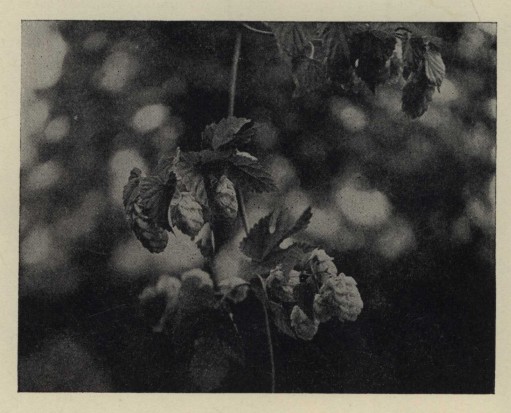
Hops.

Humulus Lupulus

The history of the hop is not uninteresting. Guinness is good for you; but in the reign of Henry VI popular opinion took a different view, and the hop was condemned as ‘a wicked weed’. By the time of Henry VIII the wicked weed had attained quite another status, having been officially introduced from Flanders for cultivation in Kent and two or three other counties. Even so, Henry VIII ruled that the brewer should not put any hops into the ale, since this addition would ‘dry up the body and increase melancholy’. This ruling of an autocratic King did not prevent an irreverent subject of the Crown from writing, perhaps rather inaccurately,

Hops, Reformation, Bays, and Beer
Came into England all in one year.

The overwhelming proportion of those hops which came into England, never to depart, is grown in Kent, and has had its effect upon the landscape of the county in those characteristic pointed oast-houses, with their white vanes swinging to the wind. Most people must be strangely incurious. Nearly everybody must surely have seen oasts dozens of time, if only from the window of a train, yet if one lives near a group of them one is constantly asked what ‘those odd-looking buildings’ are for. During the first weeks of September, anyone can see for himself what they are for. He can climb up into the upper loft and glance into the round turret where the deep green carpet of cones is spread drying in the hot fumes. He can watch the men shovelling the dried heaps through a hole in the floor, packing them tightly into the great sacks called pockets in which they are to be driven away to the brewer—the last stage in the endlessly complicated process of the hop-grower’s year.

Departure

The pickers have nearly finished their job and will be leaving us at the end of this week. No longer shall we see the red light of their fires burning in the distance, nor, on a Saturday night, shall I be able to walk down to their huts, sit with them round the brushwood fire, and listen to their jokes and their songs. It is a scene which, with a difference, always carries me back to a ranch in California, where under the shelter of a great rock the cowboys would light their bonfire and sit round chanting endless sagas of the trail. There is no great rock here, and the stars are less enormous, but even in the lameness of my own familiar fields the sole illumination of the flames casts a wild beauty over the rough faces and the coloured scarves. The doors of the huts stand open, a little oil-lamp revealing each miniature interior; the head of a sleepy child droops suddenly; an armful of fresh brushwood makes the embers flare; the plaintive notes of the accordion continue to rise and fall. It is nearly two o’clock in the morning; the jokes, the dancing, and the ribald songs have ceased; they have stopped dancing the Lambeth Walk; the songs are all sentimental now—eternal Sehnsucht and eternal pain.

I shall miss the hoppers.

hop-picking-season-5
The oast loft.

Filed Under: Just For Fun, Related Pleasures Tagged With: England, Great Britain, History, Hops, Literature

Beers Of Joy

February 20, 2019 By Jay Brooks

beersofjoy

So this looks like it should be fun. There’s a new beer film being released on March 1, which is called Beers of Joy. It apparently follows the journey of four individuals in beer, but two of them are good friends of mine, Tonya Cornett and Sean Paxton.

Beers-of-Joy-poster

Below is the press release from yesterday, announcing the film’s release:

Beer. It’s what you reach for after a long day and how you celebrate with friends – and now, it’s the focus of a new feature-length documentary – “Beers of Joy” – debuting worldwide on March 1, 2019. Written and Directed by David Swift and Scott Owen of One-Eleven Entertainment, the film examines the rich history, detailed science and unique personalities of the beer world, and encourages viewers to consider the stories behind their favorite pints. Beer lovers everywhere are invited to celebrate the film when it makes its theatrical debut at select theater locations across the country, as well as on-demand on iTunes, Comcast, Spectrum and more.

From medieval monasteries to historic German villages and all the breweries in between, “Beers of Joy” follows the fascinating journey of four distinctly different characters and how they ultimately converge over a shared enjoyment of the beloved brew, including:

  • Tonya Cornett, Gold-medal-winning Innovation Brewmaster at 10 Barrel Brewing Co., embarks on a quest across Germany and Italy to discover the ancient, cutting edge traditions and secrets to brewing a true Berliner Weisse, while finding masters of their craft along the way.
  • Beer educator Ryan Daley and Joe Vogelbacher, CEO and Co-founder of Sugar Creek Brewing Co., attempt to pass the prestigious Master Cicerone® exam, beer’s equivalent to wine’s Master Sommelier, known as one of the most difficult tests ever created.
  • Sean Z. Paxton, a self-taught chef and accomplished home brewer goes back centuries in time to discover the roots of culinary and brewing techniques and how they inspire modern day appreciation and pairings, culminating in his undertaking of an actual, 16th-century feast that may prove to be the most difficult thing he’s ever attempted.

“It’s incredible just how vast the world of beer is. Through all of my studying and experiences, I still feel as though I’ve barely scratched the surface,” said Ryan Daley. “To me, the magic of beer is how it brings people together regardless of how much you know. If you’re sitting with a pint of beer in front of you and enjoying the flavor and the company, then you’re usually in a good spot.”

The concept of what became “Beers of Joy” was first born out of Anheuser-Busch’s desire to create an entertaining film that not only celebrated the beer industry, but told the inspiring stories of the people behind it in a way that would resonate far beyond the world of beer. Producer Jonathan Hack partnered with Popular Mechanics and the award-winning filmmakers at One-Eleven Entertainment, who both shared a passion to create a true love letter to the world’s most popular and oldest fermented beverage. “Beers of Joy” is being distributed worldwide by Gravitas Ventures.

“As Directors and beer enthusiasts, it was an incredible experience for us to discover and document the amazing and compelling stories of the characters in ‘Beers of Joy,'” said David Swift, Writer-Director with Scott Owen, and CEO of One-Eleven Entertainment. “In the film, we are fortunate to have some of the biggest luminaries in the world of beer and brewing from across the globe share their passion, their knowledge and their perspective on this special beverage. We hope ‘Beers of Joy’ and its characters make you love more, laugh more, and learn more than you ever thought you might about humanity’s connection to beer… which you should always ‘Pour with Vigor!‘”

If you read through the press release, you’ll no doubt notice that Anheuser-Busch InBev provided some of the financing for the film, as did Popular Mechanics, too. But even in their own press release, their involvement seems to be downplayed, and they’re the last of the five company’s listed that were part of the making of the documentary. I’m sure there will be some hand-wringing over that, but I’m still keen to see Tonya and Sean and want to give is a fair shake. Neither of them is going to be involved in anything if they’re not comfortable with how it’s being done.

The film will make its theatrical debut during an exclusive showing at Alamo Drafthouse Cinema in Brooklyn, N.Y. on March 1st featuring a Q&A with the cast and filmmakers.

So at least Sean has a good excuse for missing my birthday party the next day, since he’ll be in New York for the premiere. Here is the trailer for the film, which gives a good flavor as to what we can expect from it:

Beers of Joy – Trailer from One-Eleven Entertainment on Vimeo.

Filed Under: Beers, Breweries, Events, Just For Fun, News Tagged With: Documentary, Film, Movies

Song In Praise Of Ale

February 10, 2019 By Jay Brooks

lamb

Today is the birthday of Charles Lamb, who “was an English essayist, poet, and antiquarian, best known for his Essays of Elia and for the children’s book Tales from Shakespeare, co-authored with his sister, Mary Lamb.” In addition to his own works, and adapting others, he also collected works of earlier authors. One such work was entitled “Specimens of English Dramatic Poets, Selected by Charles Lamb,” published in 1803.

One of his choices has an anonymous author, and is ascribed to the London Chanticleers, and is characterized as “a rude sketch of a play, printed 1659, but evidently much older.” It’s entitled “Song in praise of Ale.”

Song in praise of Ale

I.

Submit, bunch of Grapes,
To the strong Barley ear;
The weak Vine no longer,
The Laurel shall wear.

II.

Sack and drinks else,
Desist from the strife,
Ale’s th’ only Aqua vitae,
And liquor of life.

III.

Then come my boon fellows,
Let’s drink it around;
It keeps us from th’ grave,
Though it lays us o’ th’ ground.

IV.

Ale’s a Physcian,
No Mountebank bragger,
Can cure the chill ague,
Though ’t be with the stagger.

V.

Ale’s a strong wrestler,
Flings all it hath met;
And makes the ground slippery,
Though ’t be not wet.

VI.

Ale is both Ceres,
And good Neptune too,
Ale’s froth was the Sea,
From whence Venus grew.

VII.

Ale is immortal:
And be there no stops,
In bonny Lads’ quaffing,
Can live without hops.

VIII.

Then come my boon fellows,
Let’s drink it around;
It keeps us from the grave,
Though it lays us o’ th’ ground.

Charles_Lamb_by_William_Hazlitt
Charles Lamb (February 10, 1775 – 27 December 27, 1834)

Filed Under: Birthdays, Just For Fun Tagged With: England, Great Britain, Literature

« Previous Page
Next Page »

Find Something

Northern California Breweries

Please consider purchasing my latest book, California Breweries North, available from Amazon, or ask for it at your local bookstore.

Recent Comments

  • Bob Paolino on Beer Birthday: Grant Johnston
  • Gambrinus on Historic Beer Birthday: A.J. Houghton
  • Ernie Dewing on Historic Beer Birthday: Charles William Bergner 
  • Steve 'Pudgy' De Rose on Historic Beer Birthday: Jacob Schmidt
  • Jay Brooks on Beer Birthday: Bill Owens

Recent Posts

  • Beer In Ads #5389: Point & Brunswick Bock Beer November 10, 2026
  • Historic Beer Birthday: Edward Cecil Guinness November 10, 2026
  • Historic Beer Birthday: Jacob Betz November 10, 2026
  • Beer In Ads #5388: Bock Beer Vats In The Brewers Hall November 9, 2026
  • Historic Beer Birthday: Peter Barbey November 9, 2026

BBB Archives

Feedback

Head Quarter
This site is hosted and maintained by H25Q.dev. Any questions or comments for the webmaster can be directed here.