Brookston Beer Bulletin

Jay R. Brooks on Beer

  • Home
  • About
  • Editorial
  • Birthdays
  • Art & Beer

Socialize

  • Dribbble
  • Email
  • Facebook
  • Flickr
  • GitHub
  • Instagram
  • LinkedIn
  • Pinterest
  • RSS
  • Twitter
  • YouTube

Powered by Genesis

Historic Beer Birthday: Adam Eulberg

August 15, 2025 By Jay Brooks

eulberg-bros

Today is the birthday of Adam Eulberg (August 15, 1835-May 20, 1901). He was born in Nassau, Germany but moved to Portage, Wisconsin with his family when he was 19, in 1854. In 1884 he and his brother Peter bought the City Brewery, which had been founded in 1852 by Carl Haertel. His brother Peter passed away suddenly shortly thereafter and Adam carried on the business alone, at least until his two sons were old enough to join him. Adam and Peter renamed the brewery Eulberg Bros. Brewery, but Adam’s family changed it to the Eulberg Brewing Co. in 1907. They survived prohibition making soda, and resumed beer production after repeal, but the Eulbergs sold the business in 1944. It closed for good in 1958.

Adam-Eulberg

This is Eulberg’s obituary from the American Brewers’ Review:

Adam-Eulberg-obit
Eulberg-brewery-1880
The Eulberg Brewery before he bought it, in 1880.

This short history of the brewery is from the Wisconsin Historical Society:

Milwaukee dominated Wisconsin’s early brewing industry, but successful breweries were found in communities throughout the state. In 1852, German immigrant Carl Haertel began producing beer in Portage, Wisconsin. In 1884, brothers Adam and Peter Eulberg, also originally from Germany, acquired the Haertel Brewery. The Eulberg Brewing Company remained in the family until 1944 and shut its doors permanently in 1958.

Eulberg-crown-select

And here’s another history of the brewery building itself, which is still standing in downtown Portage, Wisconsin.

Eulberg-building
Eulberg-picnic-beer

As far as I can tell, he’s not related to Caspar Eulberg, who was born in roughly the same area of Germany, and started a brewery in Galena, Illinois called C. Eulberg & Sons.

Eulberg-old-portage
Eulberg-can

Filed Under: Birthdays, Breweries, Just For Fun Tagged With: Germany, Wisconsin

Historic Beer Birthday: Christian Benjamin Feigenspan

August 15, 2025 By Jay Brooks

feigenspan
Today is the birthday of Christian Benjamin Feigenspan (August 15, 1844-April 10, 1899). He was born in Thuringia, Germany but moved his family to New Jersey and founded the C. Feigenspan Brewing Company of Newark in 1875, though at least one source says 1868. When he died in 1899, his son Christian William Feigenspan took over management of the brewery, which remained in business through prohibition, but was bought by Ballantine in 1943.

Christian-Benjamin-Feigenspan

There’s surprisingly little biographical information about Christian Benjamin Feigenspan, but here’s some history of his brewery:

In 1875 the Christian Feigenspan Brewing Company was founded at 49 Charlton St., at the former Laible brewery where he had previously been a superintendent. He would also marry Rachel Laible.

In 1878, he reportedly built a brewery on Belmont Street, and as late as 1886 a facility at 54 Belmont would be listed as the “Feigenspan Bottling Establishment”.

In 1880, Christian Feiganspan took over the Charles Kolb lager beer brewery (founded 1866) on Freeman Street. (Altho’, an 1873 map of Newark shows the property owned by a “Lenz Geyer Company”. There was a “Geyer” who was another Newark brewer who owned an “Enterprise Brewery” on Orange St.)

An 1884 fire would, reportedly, burn the brewery to the ground for a loss of $300,000.

By 1909, the firm would be advertising that “…Feigenspan Breweries are the largest producers of Ale in the United States!” (click on barrel above for text of ad) in an apparent dig at their much larger next door neighbor, P. Ballantine & Sons. Ballantine’s Lager Beer sales having by then accounted for 3/4 of their total production.

Possibly because of WWI era restrictions on the allowable alcohol level of beer (set at a mere 2.75%), Feigenspan entered into Prohibition with 4,000 barrels of aging ale in its cellar. In 1927, the ale would make the news as they tried to sell it. One story in July had it going to Heinz in Pittsburgh to be made into malt vinegar, but follow up articles say that in early November the ale was simply dumped into the sewer “…and thence into the Passaic River”.

Sadly, it would not be the first beer dumped by Feigenspan, which had one of the first four licenses to brew “medicinal beer” at the start of Prohibition. “Medicinal beer” was soon outlawed by the “Anti-Beer” law, and the brewery had to dump 600 cases of “real beer” (4.5% alcohol) in March of 1922.

Feigenspan-bock-1900

Christian-Feigenspan-Breweries-Tip-Trays-3-6-inches-Christian-Feigenspan-Inc--Pre-Prohibition

Filed Under: Birthdays, Breweries, Just For Fun Tagged With: Germany, History, New Jersey

Beer In Ads #5053: Stiegl Golden Bock Beer

August 14, 2025 By Jay Brooks

Last year I decided to concentrate on Bock ads. Bock, of course, may have originated in Germany, in the town of Einbeck. Because many 19th century American breweries were founded by German immigrants, they offered a bock at certain times of the year, be it Spring, Easter, Lent, Christmas, or what have you. In a sense they were some of the first seasonal beers. “The style was later adopted in Bavaria by Munich brewers in the 17th century. Due to their Bavarian accent, citizens of Munich pronounced ‘Einbeck’ as ‘ein Bock’ (a billy goat), and thus the beer became known as ‘Bock.’ A goat often appears on bottle labels.” And presumably because they were special releases, many breweries went all out promoting them with beautiful artwork on posters and other advertising.

Thursday’s ad is for Stiegl Golden Bock Beer, which was published on August 14, 1982. This one is for the Stiegl Brauerei of Salzburg, Austria, which was originally founded in 1492. This ad for the imported beer ran in The Chicago Tribune, of Chicago, Illinois.

Filed Under: Art & Beer, Beers, Breweries, Just For Fun Tagged With: Advertising, Austria, Bock, Chicago, History, Illinois

Historic Beer Birthday: Eugene L. Husting

August 14, 2025 By Jay Brooks

eugene-husting

Today is the birthday of Eugene Louis Husting (August 14, 1848-November 27, 1916). He was born in Luxembourg, Germany, but came to the U.S. when he was only five, and settled with his family in Wisconsin. In 1877, he founded the Eugene L. Husting Brewery. In 1900, they changed its name to the E. L. Husting Co. Brewery, but it was closed due to prohibition in 1918. They appear to have concentrated on Weiss beer, and may have also been known as the E.L. Husting Weiss Beer Brewery. After repeal, the brewery never returned to brewing beer, instead concentrating on soda. The soda company closed in 1970.

Eugene-Husting-Brewery
The Eugene Husting Brewery in 1893.

This obituary of Husting is from the American Brewers’ Review:

Eugene-Husting-obit
husting-brewery-montage

This account of the brewery’s history is from the Blog, The Distant Mirror:

One other historic Milwaukee brewery that focused primarily on brewing wheat-based beer was Eugene Louis Husting.  Like many brewers before and after him, Eugene began as a brewer at the Northwestern Brewery, which was owned by Phillip Altpeter.  After marrying Phillip’s daughter Bertha in 1872, E.L. Husting opened his own weiss beer brewery and soda factory on the east side of 5th St. between Cherry St. and Vliet St. in 1877.  By 1884 Husting was brewing weiss beer in an 8 barrel brew kettle and selling the product in stoneware bottles.  In 1897 the Husting Brewery expanded inventory to include ginger ale, soda water, cream and orange soda, raspberry wine, and cider. As a result of prohibition (1920-1933), brewing beer discontinued and instead soda was exclusively produced.  Following prohibition the company evolved into a beer and soda distributor until 1970 when the plant shut down.  Today, the main building is still intact and is now considered the oldest standing complete brewery in Milwaukee.

Husting-bottle-ceramic

And this account of the brewery is by Kevin M Cullen in an article in Brewery History entitled “Rediscovering Milwaukee’s historic breweries: Part I: Milwaukee’s downtown breweries.”

Soon it was on to the oldest complete standing brewery structure in Milwaukee, the EL. Husting Brewery, whose name is still embossed along an upper cornice of the cream city brick building, which inci- dentally is now home to Great Lakes Archaeological Research Center, a former employer of mine. This brewery and soda factory was established by Eugene Louis Husting in 1877 on the eastside of 5th Street between Cheery Street and Vliet Street In 1884 EL Husting was brewing weiss beer in an eight-barrel brew kettle and bottling in stoneware bottles. He continued to brew sodas and beer here until he died in 1916, after which sodas became the primary bever- age of production during prohibition. Following Prohibition in 1933 the facility became a distribution plant for beer and liquor until it shut down in 1970.

Husting-bottle-clear

Filed Under: Birthdays, Breweries, Just For Fun Tagged With: Luxembourg, Milwaukee, Wisconsin

Beer Birthday: Brandon Hernández

August 14, 2025 By Jay Brooks


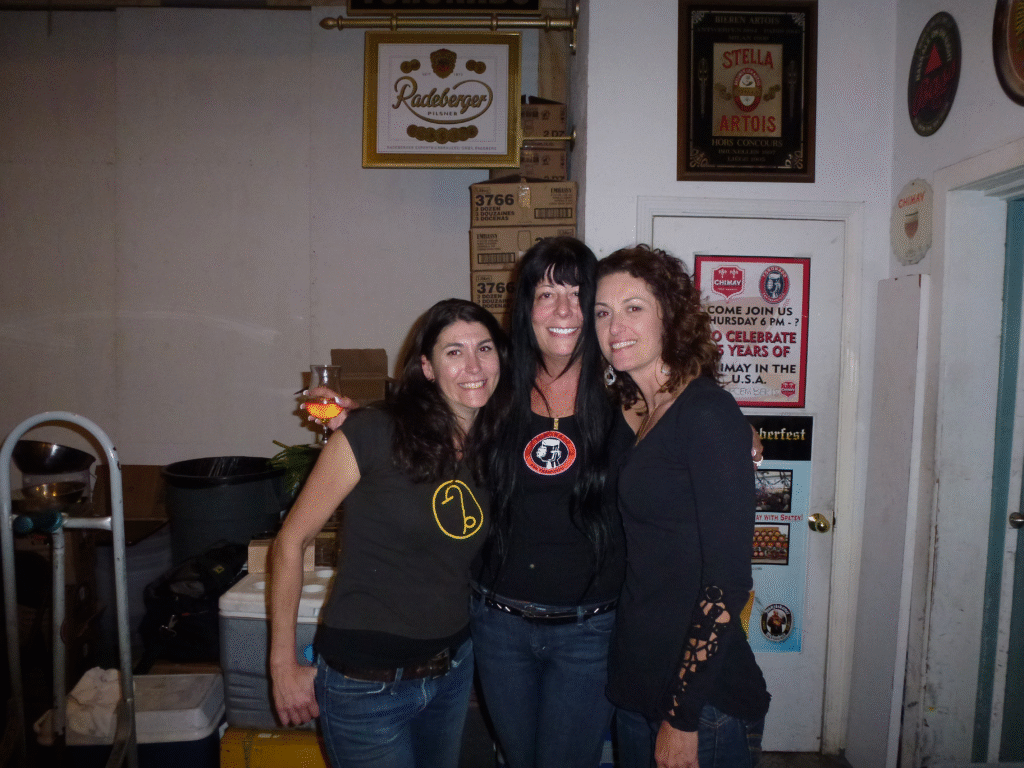
Today is the 49th (maybe) birthday of Brandon Hernández, who is a Brewing Industry Contributor at The San Diego Union-Tribune and also stays busy with the San Diego Beer News, as a Craft Beer Correspondent at FOX 5 San Diego, Co-Host at The Indie Beer Show, Beer To The Rescue, and Food & Beverage Editor / San Diego On-Tap Host at Ranch & Coast Magazine. He also used to bethe Chief Marketing Officer for Societe Brewing, and before that AleSmith and Stone Brewing. And he’s published the Complete Guide to San Diego Breweries in 2015. Until recently, I used to run into Brandon fairly regularly at beer functions and he’s become one of my favorite people to hang out with. Join me in wishing Brandon a very happy birthday.

Brandon and me at the Firestone Walker Invitational Beer Festival earlier this year.
Brandon and me at Bell’s a few years back.
brandon-hernandez-1
Nice towering press photo of Brandon.
With fellow writers at the opening event for the CBC in Washington, DC in 2013. From left, Stephen Beaumont, me, Steve Shapiro, Gail Williams, Brandon and Chuck Cook.
brandon-hernandez-2
At Churchill’s in San Diego with Tomme Arthur in 2012.
beer-camp-brandon
With a bevy of Celebrator writers in Chico for Beer Camp #93 in late 2012, to make a beer celebrating the 25th anniversary of the Celebrator Beer News. That’s Brandon sporting blond hair fourth from the left.

[Note: photos 3 and 5 were purloined from Facebook.]

Filed Under: Birthdays, Just For Fun Tagged With: California, San Diego

Beer In Ads #5052: New South Brewery Bock Beer

August 13, 2025 By Jay Brooks

Last year I decided to concentrate on Bock ads. Bock, of course, may have originated in Germany, in the town of Einbeck. Because many 19th century American breweries were founded by German immigrants, they offered a bock at certain times of the year, be it Spring, Easter, Lent, Christmas, or what have you. In a sense they were some of the first seasonal beers. “The style was later adopted in Bavaria by Munich brewers in the 17th century. Due to their Bavarian accent, citizens of Munich pronounced ‘Einbeck’ as ‘ein Bock’ (a billy goat), and thus the beer became known as ‘Bock.’ A goat often appears on bottle labels.” And presumably because they were special releases, many breweries went all out promoting them with beautiful artwork on posters and other advertising.

Wednesday’s ad is for New South Bock Beer, which was published on August 13, 1914. This one is for the New South Brewery & Ice Co. of Middlesboro, Kentucky, which was originally founded in 1891. They also had a second brewery located in Atlanta, Georgia, which is undoubtedly why this ad ran in The Atlanta Journal, also of Atlanta, Georgia.

Filed Under: Art & Beer, Beers, Breweries, Just For Fun Tagged With: Advertising, Bock, History

Historic Beer Birthday: Anders Jöns Ångström

August 13, 2025 By Jay Brooks

dark-side-of-moon
Today is the birthday of Anders Jöns Ångström (August 13, 1814–June 21, 1874). He “was a Swedish physicist and one of the founders of the science of spectroscopy.” The Ångström unit (1 Å = 10−10 m) in which the wavelengths of light and interatomic spacings in condensed matter are sometimes measured are named after him. Various types of spectroscopy are employed in the brewing industry.

Anders-Angstrom

Here’s a partial biography of Ångström from Wikipedia:

Anders Jonas Ångström was born in Medelpad to Johan Ångström, and schooled in Härnösand. He moved to Uppsala in 1833 and was educated at Uppsala University, where in 1839 he became docent in physics. In 1842 he went to the Stockholm Observatory to gain experience in practical astronomical work, and the following year he was appointed keeper of the Uppsala Astronomical Observatory.

Intrigued by terrestrial magnetism he recorded observations of fluctuations in magnetic intensity in various parts of Sweden, and was charged by the Stockholm Academy of Sciences with the task, not completed until shortly before his death, of working out the magnetic data obtained by HSwMS Eugenie on her voyage around the world in 1851 to 1853.

In 1858, he succeeded Adolph Ferdinand Svanberg in the chair of physics at Uppsala. His most important work was concerned with heat conduction and spectroscopy. In his optical researches, Optiska Undersökningar, presented to the Royal Swedish Academy of Sciences in 1853, he not only pointed out that the electric spark yields two superposed spectra, one from the metal of the electrode and the other from the gas in which it passes, but deduced from Leonhard Euler’s theory of resonance that an incandescent gas emits luminous rays of the same refrangibility as those it can absorb. This statement, as Sir Edward Sabine remarked when awarding him the Rumford medal of the Royal Society in 1872, contains a fundamental principle of spectrum analysis, and though overlooked for a number of years it entitles him to rank as one of the founders of spectroscopy.

Anders_Ångström_painting

This is the general definition of spectroscopy from Wikipedia:

Spectroscopy is the study of the interaction between matter and electromagnetic radiation. Historically, spectroscopy originated through the study of visible light dispersed according to its wavelength, by a prism. Later the concept was expanded greatly to include any interaction with radiative energy as a function of its wavelength or frequency. Spectroscopic data are often represented by an emission spectrum, a plot of the response of interest as a function of wavelength or frequency.

This abstract from the 2006 paper “Applications of Vibrational Spectroscopy in Brewing” gives an overview of their use by brewers.

The purpose of this chapter is to compile the literature concerning the applications of near‐infrared (NIR), mid‐infrared and Raman spectroscopy in the brewing industry. All these three techniques share the advantages that they are rapid, can be noninvasive and allow direct observation of specific molecular species. As for barley, many researchers have used the NIR reflectance on whole grains in malt evaluation. The NIR determination of α/β‐acids and hop storage index in baled hop samples is reported. NIR spectrophotometric methods have been developed for the determination of yeast concentration and activity in beer making. In addition to the applications in the laboratory of quality control, the overview concerns also the applications of infrared and Raman spectroscopy in monitoring of operation and process control at the essential steps of mashing and wort fermentation in brewery. The results obtained with a short wave NIR spectrophotometer are presented in comparison with long wave NIR spectrophotometers.

Brewers use spectrometers to measure a number of QC items throughout the brewing process.

Cover_Table1

To get a sense of how much spectrometers are used, this article promoting StellarNet, a company selling them, entitled Spectroscopy Prospects Brewing, is pretty thorough.

NIR-spectrometer-Beer

Filed Under: Birthdays, Just For Fun, Related Pleasures Tagged With: History, Science, Science of Brewing, Sweden

Historic Beer Birthday: Lilly Anheuser

August 13, 2025 By Jay Brooks

a-b
Today is the birthday of Lilly Anheuser (August 13, 1844-February 25, 1928). She was born in Mainz-Bingener Landkreis, in Rheinland-Pfalz, Germany, one of three daughters of Eberhard Anheuser. Eberhard was originally a soap and candle maker, but had had also invested in the Bavarian Brewery Company, in St. Louis, Missouri. When it went through financial troubles in 1860, he took over control of it, buying out the other creditors, and renaming it Eberhard Anheuser and Company. “Lilly married Adolphus Busch, a brewery supply salesman, in a double wedding with Anna Anheuser (Lilly’s older sister) and Ulrich Busch (Adolphus’ brother) in 1861.” Her husband was running the brewery even before her father died in 1880, and the year before, 1879, the corporation was renamed the Anheuser-Busch Brewing Association to reflect the reality of Busch’s leadership role.

lily-anheuser

Here’s a short biography from Find-a-Grave:

Lilly was one of six children of Eberhard and Dorothea Anheuser. She and her family lived in Cincinnati, Ohio for a time before moving to St Louis, Missouri.

Lilly, who was blonde and called “curly Head” was courted by and married to Adolphus Busch, who sold brewery supplies at the time, to her father at the E. Anheuser Brewing Company. She was married to Adolphus in a double wedding; her sister Anna married Ulrich Busch on March 11, 1861. Anna was dark and known for her sophistication.
Lilly was the mother of thirteen children. Nine lived to adulthood. Along with her social life, Lilly cooked for her husband and to an extent remained a “house wife.”

With the success of the Brewery, She and her husband and children traveled extensively. They owned Villas in Germany. Both were confiscated by Hitler. They traveled by private train car. A favorite group of homes for them was Ivy Wall, and The Blossoms, Busch Gardens in Pasadena,CA. They had an estate in Cooperstown, NY, and Germany.

Upon reaching their fiftieth wedding anniversary, Lilly and Adolphus presented a home to each of their children.
One was given a French chateau manner on a farm near St. Louis once owned by General U.S. Grant. It is now known as Grant’s Farm and is open to the public. Other Children were given homes in St Louis, New York, Berlin, Germany, Chicago,IL,and Stuttgart, Germany.

It was reported Lilly was given a gold Crown by her husband to commemorate their golden Anniversary. Amidst the celebration was sadness because the health of her husband was failing. He passed away at Villa Lilly, in Germany with Lilly at his side.

lilly-anheuser-mid

The Anheuser-Busch website gives this account:

Eberhard Anheuser, who left Germany in 1843, settling first in Cincinnati and before moving to St. Louis. Trained as a soap manufacturer, he eventually went on to own the largest soap and candle company in St. Louis. Although he had no brewing experience, he became part owner of the Bavarian Brewery, which had first opened its doors in 1852. By 1860, Anheuser had bought out the other investors and the brewery’s name was changed to E. Anheuser & Co.

Adolphus Busch was born in 1839, the second youngest of 22 children. At age 18, he made his way to St. Louis via New Orleans and the Mississippi River. Adolphus began working as a clerk on the riverfront and by the time he was 21, he had a partnership in a brewing supply business.

It was through this enterprise that Adolphus Busch met Eberhard Anheuser, and soon Adolphus was introduced to Eberhard’s daughter, Lilly. In 1861, Adolphus Busch and Lilly Anheuser were married, and shortly after that, Adolphus went to work for his father-in-law. He later purchased half ownership in the brewery, becoming a partner.

lilly-anheuser-photo
Lilly Anheuser later in life.

In 1897, famed Swedish artist Anders Zorn painted portraits of Lilly Anheuser and her husband Adolphus Busch. They were recently sold through the auction house Christie’s. The winning bid for Busch’s portrait was $207,750 and Lilly’s went for $123,750.

Zorn-lilly-anheuser-1897
A portrait of Lily Anheuser, painted by Anders Zorn in 1897.

Filed Under: Birthdays, Just For Fun Tagged With: Anheuser-Busch, Germany, History, Missouri

Historic Beer Birthday: William J. Lemp, Jr.

August 13, 2025 By Jay Brooks

lemp
Today is the birthday of William Jacob Lemp, Jr. (August 13, 1867-December 29, 1922). He was born in St. Louis, Missouri, and was the son of William J. Lemp and the grandson of Adam Lemp, who founded the Lemp Brewery in 1840. When his grandfather died in 1862, his father inherited the brewery, and it was renamed the William J. Lemp Brewing Co. When he committed suicide, most likely from depression after his favorite son Frederick died at age 28. His other son, William J. Lemp Jr., ran the brewery thereafter, until it was closed by prohibition in 1920.

This account of Lemp Jr.’s time running the brewery is from the Wikipedia page about the Lemp Mansion:

On November 7, 1904, William J. “Billy” Lemp, Jr., took over the brewing company as president. Billy had married Lillian Handlan five years earlier, and they moved to a new home at 3343 South 13th Street.

Lillian Handlan Lemp was, allegedly, nicknamed the “Lavender Lady” for her lavender-colored wardrobe and carriages. She filed for divorce in 1908, charging Billy with desertion, cruel treatment and other indignities. Their divorce proceedings lasted 11 days and ended in Lillian being granted her divorce and custody of William III – their only child – with Billy given only visitation rights.

After the trial, Billy built “Alswel” – his country home overlooking the Meramec River. The home was located in what is now the western edge of Kirkwood. By 1914, he lived at Alswel full-time.

The Lemp Brewery suffered in the 1910s when Prohibition began. The brewery was shut down and the Falstaff trademark was sold to Lemp’s friend, “Papa Joe” Griesedieck. The brewery itself was eventually sold at auction to International Shoe Company for $588,500. On December 29, 1922, Billy Lemp shot himself in his office — a room that today is the front left dining room.

This history of the Lemp Family is from Monstrosity, a paranormal convention offering stays in the supposedly haunted Lemp Mansion:

America’s First Lager Beer Brewers

When John Adam Lemp arrived in St. Louis from Eschwege, Germany in 1838, he seemed no different from the thousands of other immigrants who poured into the Gateway to the West during the first half of the 19th century. Lemp originally sought his fortune as a grocer. But his store was unique for its ability to supply an item sold by none of his competitors – lager beer. Lemp had learned the art of brewing the effervescent beverage under the tutelage of his father in Eschwege, and the natural cave system under St. Louis provided the perfect temperature for aging beer. Lemp soon realized that the future of lager beer in America was as golden as the brew itself, and in 1840 he abandoned the grocery business to build a modest brewery at 112 S. Second Street. A St. Louis industry was born. The brewery enjoyed marvelous success and John Adam Lemp died a millionaire.

William J. Lemp succeeded his father as the head of the brewery and he soon built it into an industrial giant. In 1864 a new plant was erected at Cherokee Street and Carondolet Avenue. The size of the brewery grew with the demand for its product and it soon covered five city blocks.

In 1870 Lemp was by far the largest brewery in St. Louis and the Lemp family symbolized the city’s wealth and power. Lemp beer controlled the lion’s share of the St. Louis market, a position it held until Prohibition. In 1892 the brewery was incorporated as the William J. Lemp Brewing Co. In 1897 two of the brewing industry’s titans toasted each other when William Lemp’s daughter, Hilda, married Gustav Pabst of the noted Milwaukee brewing family.

The Lemp Family

The demise of the Lemp empire is one of the great mercantile mysteries of St. Louis. The first major fissure in the Lemp dynasty occurred when Frederick Lemp, William’s favorite son and the heir apparent to the brewery presidency, died under mysterious circumstances in 1901. Three years later, William J. Lemp shot himself in the head in a bedroom at the family mansion, apparently still grieving the loss of his beloved Frederick. William J. Lemp, Jr. succeeded his father as president.

Tragedy continued to stalk the Lemps with startling ardor. The brewery’s fortunes continued to decline until Prohibition (1919) closed the plant permanently. William Jr.’s sister Elsa, who was considered the wealthiest heiress in St. Louis, committed suicide in 1920. On June 28, 1922, the magnificent Lemp brewery, which had once been valued at $7 million and covered ten city blocks, was sold at auction to International Shoe Co. for $588,500. Although most of the company’s assets were liquidated, the Lemps continued to have an almost morbid attachment for the family mansion. After presiding over the sale of the brewery, William J. Lemp, Jr. shot himself in the same building where his father died eighteen years earlier. His son, William Lemp III, was forty-two when he died of a heart attack in 1943. William Jr.’s brother, Charles, continued to reside at the house after his brother’s suicide. An extremely bitter man, Charles led a reclusive existence until he too died of a self-inflicted gunshot wound. The body was discovered by his brother, Edwin.

In 1970, Edwin Lemp died of natural causes at the age of ninety.

lemp-brewery-plant

Not everyone is convinced that Junior’s death was a suicide, but may have been murder, as explained in All Things Lemp:

On December 28th, 1922 William Lemp Jr. was found shot to death in his office on the first floor of the Lemp Mansion. William Lemp Jr. was not a very well liked person. Junior’s personality was rather crass and abrupt. Most people who knew him would avoid him if all possible. Junior was not the first pick by his father to inherit the Lemp Brewery Presidency. This had to be embarrassing considering Junior was the oldest and by tradition the heir apparent. This honor was to be reserved for his youngest brother Fredrick. The reason why Junior was to be passed over to run the family’s brewing empire was the standing animosity between Junior and his father. Many think Senior despised his oldest son because he thought William Lemp Junior didn’t deserve to bear his name. Very few people at the time knew that William Lemp Jr. had an older brother that died shortly after birth. It pained his father deeply that the child died before it could be named. His father thought his first deceased son should have been given his name, not his second surviving son. This is believed to be the initial cause of their life long feud. Fredrick died in 1901 due to heart failure. If Fredrick would have survived, many think that we would have a Lemp Brewery today.

According to police reports, William Lemp Jr. was shot twice directly into the heart with a .38 caliber single action revolver. In order for someone to pull off a feat such as this, one would have to be able to pull the trigger twice. With a single action revolver, that would mean that he would have to cock the pistol, place it to his chest, and pull the trigger. Then he would have to repeat the process of cocking the revolver again, placing it to his chest, and pulling the trigger. I doubt seriously that anyone would have the ability to be able to shot themselves twice in the chest with this style of weapon. Especially after the initial shot would leave a rather large wound in your back and in shock. The police also found two rounds missing from the revolver’s cylinder. If he was shot twice, it there is a very good chance William Lemp Jr. was murdered.

The Coroner’s report states he was shot only once. If the Coroner is right it could have very well been a suicide. Since the findings of a Coroner’s inquiry outweighs the evidence presented by the police, the death of William Lemp Jr. was ruled a suicide, and the case was closed.

billy-lemp

This is a slideshow of Lemp breweriana and photos.

Filed Under: Birthdays, Breweries, Just For Fun Tagged With: History, Missouri

Historic Beer Birthday: St. Arnulf of Metz

August 13, 2025 By Jay Brooks

halo
While records going back this far in time are notoriously unreliable, some sources put the birthday of St. Arnulf of Metz at August 13, 583 C.E., such as Find-a-Grave, among others. He’s also known as Anou, Arnould, Arnold of Metz, and his feast day is July 18. Although even the year is not settled, and some sources give it as 580 or 582 C.E., so the actual likelihood that any of this is correct is pretty low.

“Saint Arnulf of Metz (c. 582 – 640) was a Frankish bishop of Metz and advisor to the Merovingian court of Austrasia, who retired to the Abbey of Remiremont. In French he is also known as Arnoul or Arnoulf. In English he is also known as Arnold.” Metz is located in northeastern France.

arnulf-of-metz

Also, Arnulf is one of at least three patron saints of brewers with similar names, although he is the oldest, and essentially first one. That’s one of the reasons I chose his feast day, July 18, for the holiday I created in 2008, International Brewers Day.

The Saint Arnold most people are familiar with is Arnold of Soissons, and he’s from much later, almost 500 years, and is thought to have been born around 1040 C.E. Less is known about the third, St. Arnou of Oudenaarde (or Arnouldus), and he’s also a patron saint of beer and specifically Belgian brewers, because Oudenaarde is in Flanders. His story takes place in the 11th century.

Here’s his bio from Find-a-Grave:

Saint Arnulf of Metz (c 582 — 640) was a Frankish bishop of Metz and advisor to the Merovingian court of Austrasia, who retired to the Abbey of Remiremont.

Saint Arnulf of Metz was born of an important Frankish family at an uncertain date around 582. In his younger years he was called to the Merovingian court to serve king Theudebert II (595-612) of Austrasia and as dux at the Schelde. Later he became bishop of Metz. During his life he was attracted to religious life and he retired as a monk. After his death he was canonized as a saint. In the French language he is also known as Arnoul or Arnoulf. Arnulf was married ca 596 to a woman who later sources give the name of Dode or Doda, (whose great grandmother was Saint Dode of Reims), and had children. Chlodulf of Metz was his oldest son, but more important is his second son Ansegisen, who married Saint Begga daughter of Pepin I of Landen.

Arnulf was canonized as a saint by the Roman Catholic Church. In iconography, he is portrayed with a rake in his hand.

He was the third great grandfather of Charlemagne.

Metz_Cathedral_002
St. Arnulf in the Metz Cathedral.

The Legend of the Beer Mug

It was July 642 and very hot when the parishioners of Metz went to Remiremont to recover the remains of their former bishop. They had little to drink and the terrain was inhospitable. At the point when the exhausted procession was about to leave Champigneulles, one of the parishioners, Duc Notto, prayed “By his powerful intercession the Blessed Arnold will bring us what we lack.” Immediately the small remnant of beer at the bottom of a pot multiplied in such amounts that the pilgrims’ thirst was quenched and they had enough to enjoy the next evening when they arrived in Metz.

And here’s another account from Nobility and Analogous Traditional Elites:

During an outbreak of the plague a monk named Arnold, who had established a monastery in Oudenburg, persuaded people to drink beer in place of water and when they did, the plague disappeared.

Arnold spent his holy life warning people about the dangers of drinking water. Beer was safe, and “from man’s sweat and God’s love, beer came into the world,” he would say.

The small country of Belgium calls itself the ‘Beer Paradise’ with over 300 different styles of beer to choose from. Belgium boasts of centuries old tradition in the art of brewing. In the early Middle Ages monasteries were numerous in that part of Europe, being the centers of culture, pilgrimage and brewing. Belgium still has a lot of monasteries and five of these are Trappist, a strict offshoot of the Cis­tercian order, which still brews beer inside the monastery.

During one outbreak of the plague St. Arnold, who had established a monastery in Oudenburg, convinced people to drink beer instead of the water and the plague disappeared as a result. Saint Arnold (also known as St. Arnoldus), is recognized by the Catholic Church as the Patron Saint of Brewers.

St. Arnold was born to a prominent Austrian family in 580 in the Chateau of Lay-Saint-Christophe in the old French diocese of Toul, north of Nancy. He married Doda with whom he had many sons, two of whom were to become famous: Clodulphe, later called Saint Cloud, and Ansegis who married Begga, daughter of Pépin de Landen. Ansegis and Begga are the great-great-grandparents of Charlemagne, and as such, St. Arnold is the oldest known ancestor of the Carolin­gian dynasty.

St. Arnold was acclaimed bishop of Metz, France, in 612 and spent his holy life warning people about the dangers of drinking water. Beer was safe, and “from man’s sweat and God’s love, beer came into the world,” he would say. The people revered St. Arnold. In 627, St. Arnold retired to a monastery near Remiremont, France, where he died on August 16, 640.

In 641, the citizens of Metz requested that Saint Arnold’s body be exhumed and ceremoniously carried to Metz for reburial in their Church of the Holy Apostles. During this voyage a miracle happened in the town of Champignuelles. The tired porters and followers stopped for a rest and walked into a tavern for a drink of their favorite beverage. Regretfully, there was only one mug of beer to be shared, but that mug never ran dry and all of the thirsty pilgrims were satisfied.

A modern portrait of St. Arnulf by American artist Donna Haupt.

Filed Under: Birthdays, Just For Fun, Related Pleasures Tagged With: Austria, Belgium, France, History, Religion & Beer

« Previous Page
Next Page »

Find Something

Northern California Breweries

Please consider purchasing my latest book, California Breweries North, available from Amazon, or ask for it at your local bookstore.

Recent Comments

  • Ernie Dewing on Historic Beer Birthday: Charles William Bergner 
  • Steve 'Pudgy' De Rose on Historic Beer Birthday: Jacob Schmidt
  • Jay Brooks on Beer Birthday: Bill Owens
  • Steve 'Pudgy' De Rose on Beer Birthday: Charles Finkel
  • Steve 'Pudgy' De Rose on Beer Birthday: Bill Owens

Recent Posts

  • Beer In Ads #5184: The “B”s Are Here, Bruton Bock Beer January 27, 2026
  • Beer Birthday: Logan Plant January 27, 2026
  • Historic Beer Birthday: William Tunis Ryerson January 27, 2026
  • Historic Beer Birthday: Henry Hubach January 27, 2026
  • Beer Birthday: Peter Kruger January 27, 2026

BBB Archives

Feedback

Head Quarter
This site is hosted and maintained by H25Q.dev. Any questions or comments for the webmaster can be directed here.