Brookston Beer Bulletin

Jay R. Brooks on Beer

  • Home
  • About
  • Editorial
  • Birthdays
  • Art & Beer

Socialize

  • Dribbble
  • Email
  • Facebook
  • Flickr
  • GitHub
  • Instagram
  • LinkedIn
  • Pinterest
  • RSS
  • Twitter
  • YouTube

Powered by Genesis

KVIE On Tap

November 28, 2008 By Jay Brooks

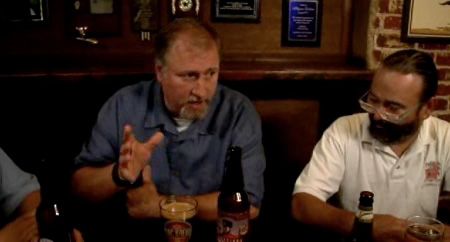
I keep forgetting to share this, but as it’s a slow news day, I figured today would be a good time. The PBS station in Sacramento, California, KVIE, created a show they called “On Tap” all about beer, and specifically beer in Sacramento. It was hosted by local sports announcer and television host Gary Gelfand. He interviewed Fritz Maytag, Charlie Bamforth (Professor at U.C. Davis), Ken Grossman (Founder of Sierra Nevada) and Don Barkley (founder of Mendocino Brewing and currently brewmaster at Napa Smith Brewing), along with presiding over a tasting of Sacramento beers with Rick Sellers (Draft magazine and Pacific Brew News), J.J. Jackson (owner of the Original Homebrew Outlet) and myself. The show aired in August (I think) and you can order the show on DVD online. You can also watch the full tasting that we did online, only a portion of which was used in the show that aired. Click on “Bonus Video” and then “Extended Beer Reviews” at the KVIE Viewfinder.
ontap-1
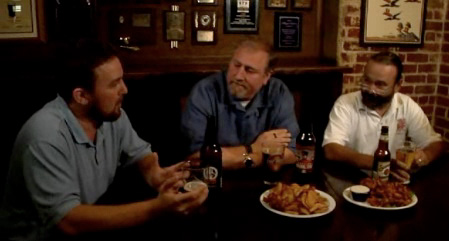
Rick Sellers, me and J.J. Jackson tasting beer at the Fox & Goose Public House in Sacramento.
on-tap
This is the logo they created for the show.
ontap-2
I’m sure I was making some point here. That or practicing my goofy hand gestures.

Filed Under: Beers, Breweries Tagged With: California, Northern California, Sacramento, Television, Video

Beer in the Time of Recession

November 24, 2008 By Jay Brooks

money
Conventional wisdom is that during an economic downturn, recession or — let’s just say it out loud — depression, that certain businesses are not as challenged, usually ones that provide things that are either absolute necessities (food comes to mind) or make products people have decided for one reason or another that they’re reluctant to give up. Beer is traditionally one of these businesses that is generally thought to be recession-proof because people turn to it as a salve or an inexpensive way to relax, spend time with friends and loved ones and have a good time.

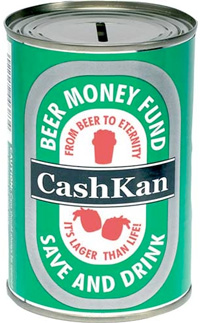
cashkan

Craft beer, though more expensive than the mass-produced beer churned out by the big two, can still be characterized as an “affordable luxury.” Even the more expensive single bottles are cheaper than high-end wine or spirits yet I’d argue that they’re just as much of a special treat. Even when strapped for cash, everyone — me included — wants to splurge on themselves, even if only once in a while. It’s sad, but those are the moments we live for. Our economic system is so rigged to favor those at the top of the pyramid that almost everybody else is struggling most of the time. As the rich have gotten richer over the past few decades, real wages of a majority of Americans have fallen precipitously — thank you, Neocons — and the young in their twenties, thirties and even forties are among the first generations to be worse off then their parents.

Just consider that when I was a kid, most people I knew were in families where only one of their parents worked, usually their fathers. That my own mother worked — she was a nurse — was somewhat unusual in my neighborhood, which was by no means affluent. It was just a normal middle-class suburb, and a lower middle-class one at that. I can’t think of a single other person on my block where both parents worked full-time. There were one or two wives who worked part-time a few hours a week at local charities, but that was about it.

In 1960, when I was one, only 25% of married couples with children had both parents employed. By 1976, when I was junior in high school, only 33% of married couples with children had both parents employed, and only 31% of all women with babies younger than a year old worked. Today, how many families can boast that only one parent works outside the home? As of 2007 (according to the Bureau of Labor Statistics) the number of families in which both parents work is 62.2%, nearly double the number from the mid-1970s and far more than the 1960s. While I realize that some economists think that’s a choice that women make and that it’s not indicative of anything sinister, I also think they’re full of it. If it currently takes two salaries — each one of which takes 69 hours per week to earn what 40 hours got you just a few decades ago — to keep up with the Joneses, then something is seriously wrong with our society and the way we look at things. It’s not that I think that we should return to the 1950s — I really don’t, trust me on this one — but two salaries should mean twice as much prosperity as it did when only one spouse worked, but it clearly doesn’t.

Ever since the housing bubble exploded — surprising no one who was paying attention — things have been snowballing down prosperity mountain and all our proposed fixes merely trickle. From the housing market, the credit market and Wall Street took a nose dive, with several high-profile financial institutions finally revealing they’ve been out in the business world without any clothes on for quite some time. It’s only now that anyone appeared to notice. Our government, of course, threw money at the problem (as they always do) but only at the banks and financial institutions. Small businesses were allowed to fail, homeowners continue to lose their homes and personal bankruptcies continue to climb. Next, the big three American automakers jetted down to DC to beg for billions while corporation after corporation announced massive layoffs. The unemployment figures for October were just released, and at 6.5% it was the highest since 1990. Even the normally sunny Time Magazine has to admit that things look worse than in previous downturns and many economists think we’re in for hard times.

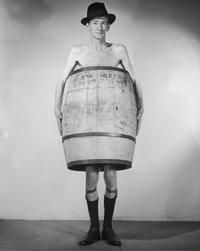
barrel-hat

So if they’re right, are we in for another depression? And what exactly is the difference between a recession and a depression? There’s a not terribly funny joke among economists that a recession is when your neighbor loses their job and a depression is when you lose yours. But the truth is there is no hard and fast rule about the difference between the two. The media tends to define a recession as two or more consecutive quarters where there’s a decline in the Gross Domestic Product (GDP). By and large, economists don’t like that definition because it ignores many other variables, such as the unemployment rate or consumer confidence. Also, by pinning it to a quarterly figure, it makes it more difficult to determine the exact beginning or end and a short recession may go undetected altogether.

What I find frustrating about this lack of precision in defining our economic condition — no small thing considering how much it effects all of us — is that because of that imprecision it’s almost impossible to say anything with certainty except in hindsight. How that manifests itself is that every talking head claiming some sort of divine financial insight always errs on the side of caution, saying things look great, don’t worry, everything will be fine and other mostly bullshit sunny predictions. They do this for at least two reasons, one benign, the other not so much. First, they try to be reassuring because they’re afraid that people might panic and things that might look only a little bad would turn really bad simply as a result of their telling the truth. So they lie, though in this case it’s somewhat understandable why. Secondly, most of the people who we rely on for financial expertise have a stake in the game and stand to lose personally if things go south, so their advice tends to be very self-serving, like telling everyone not to sell while they’re privately unloading everything they own. This is also why in my opinion the system is rigged and it’s only the people on the outside that lose, the wealthy insiders almost always get to keep their money no matter how much they screw up. Senator Christopher Dodd, chair of the Banking Committee, recently fumed in a PBS interview about how many banks have taken the $300 billion you and I ponied up to “bail out” the credit markets and are hoarding it, buying up healthy companies and paying egregiously high bonuses to themselves — essentially everything but trying to jumpstart the economy by loosening up the availability of credit.

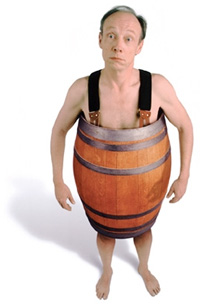
barrel-man

What’s this got to do with beer, apart from driving us all to drink more of it? Well, that’s really the question. Will this economic downturn, if it keeps spiraling downward like the cynic in me believes it will, also effect beer, even though it’s been largely recession-proof in the recent past? If the situation continues to worsen and we enter a full-fledged depression, will that change the game? During the great depression, beer was essentially out of the equation — at least legally — though it did help bring us out of it when FDR urged the repeal of Prohibition to boost morale and stimulate the economy. As the 75th anniversary of its repeal is less than three weeks away, it’s worth noting that it was economics that got us into prohibition and economics that got us out again. See, for example, page 438 if the Encyclopedia of Public Choice in Google Books. There’s also a nice overview of this in Reason magazine, from July 2007, entitled the Politics of Prohibition.

Prior to the creation in 1913 of the national income tax, about a third of Uncle Sam’s annual revenue came from liquor taxes. (The bulk of Uncle Sam’s revenues came from customs duties.) Not so after 1913. Especially after the income tax surprised politicians during World War I with its incredible ability to rake in tax revenue, the importance of liquor taxation fell precipitously.

By 1920, the income tax supplied two-thirds of Uncle Sam’s revenues and nine times more revenue than was then supplied by liquor taxes and customs duties combined. In research that I did with University of Michigan law professor Adam Pritchard, we found that bulging income-tax revenues made it possible for Congress finally to give in to the decades-old movement for alcohol prohibition.

Before the income tax, Congress effectively ignored such calls because to prohibit alcohol sales then would have hit Congress hard in the place it guards most zealously: its purse. But once a new and much more intoxicating source of revenue was discovered, the cost to politicians of pandering to the puritans and other anti-liquor lobbies dramatically fell.

Prohibition was launched.

But then a little thing called the Great Depression came along and lots and lots of people lost their jobs, meaning that the amount of income tax the federal government could collect also fell, initially about 15%. Three years into the Great Depression, income tax revenue dropped another 37% to 46% below pre-depression revenues and by 1933 they were 60% lower.

And so Congress (with the urging of anti-prohibitionists) was able to float the 21st Amendment successfully because they needed the money that alcohol taxes provided to their bottom line. One leading member of of the House of Representatives said at the time that he believed that without the economic necessity brought about the Great Depression that it would likely have taken at least another 10 years to repeal Prohibition, despite its obvious failure and unintended negative consequences.

Two things that bear watching in the present, as the weeks and months unfold, is what the economy does and what happens to the taxes on beer. Keeping in mind what’s happened in the past and especially with excise taxes, it seems to me these will be the most important factors that will affect how beer does through this recession. It may be that people do indeed keeping buying and drinking beer at the same rate, which would mean essentially that beer is indeed not affected at all by the economy (and it’s possibly even enhanced by a dip, such as if consumers forgo more expensive pleasures and instead choose beer when they “treat” themselves).

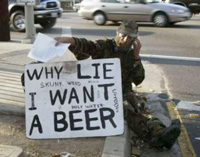
why-lie

Or it could come to pass that the macro beers’ sales remain flat and craft beer sales begin to slow because people have less money and the price has gone up, due to a rise in energy costs and raw ingredients. It’s not happened yet, but there are signs that such a scenario may be on the horizon.

If the tax assault on the alcohol industry is successful in California, it will almost certainly spread to at least 38 other states. That will raise the price of beer across the board, further depressing the beer economy, if the not the whole shebang. It seems a little bit odd to me that politicians are entertaining budget fixes that essentially target specific industries that are already experiencing difficulties. What good does it do to extract another pound of flesh if the body then dies and you can’t get anything from it anymore? Not only are other segments of the economy not having higher taxes levied on them, but they’re actually being given money to insure that they don’t go out of business and more jobs aren’t lost. Not so with the alcohol industry. At a time when any sustainable industry should be seen as a positive in our very fragile economy, politicians (with neo-prohibitionists whispering in their ear) are doing just that; trying to make it more difficult for the alcohol industry to function. To say that seems short-sighted is an understatement.

The beer industry alone (again not including wine and spirits) supports over 1.7 million jobs and pumps around $189 billion into our economy, generating $25 billion in business and personal taxes and another $11.5 billion in consumption taxes. If history is any guide, that should mean politicians should respect our contribution.

And while less tangible and quantifiable, the contributions small breweries make is not just economic, but they are also good citizens of their communities, giving charitably back into them, spending much of their money locally (where possible) and running their businesses in a green, sustainable fashion. Harm them, and you harm the communities that support them, too.

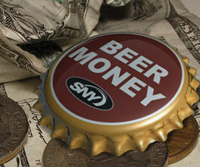
beer-money-crown

Our economy today is arguably more complicated than before and during the Great Depression, so it’s obviously very hard to predict what might happen in the future. After the last depression, many social nets were put in place in an effort to prevent such a widespread economic situation from ever occurring again and to protect citizens from feeling its effects as acutely. FDR’s New Deal included programs to both help people out of their condition and also to keep it from happening again. There was opposition from conservative fronts while it was going on, but the problems were too great to ignore. In fact, the backlash of the New Deal is probably the neo-conservative movement of today, which has done so much to harm to our society lately.

For an excellent account of the politics of it, read Nobel prize-winning economist Paul Krugman’s The Conscious of a Liberal. In it he discusses conservative opposition to the New Deal programs and how many of them have been effectively chipped away at or removed completely by neo-cons — what he calls “movement conservatism” — beginning in the late 1970s, though the seeds were being sewn as far back as the 1950s.

I vividly recall growing up that all of my grandparents — and people of their same generation — were still very much effected by their experiences during the Great Depression. The notions of frugality, saving and near miserliness that meant survival back then continued to be factors they considered in making decisions some fifty years later. I had two dotty great aunts (sisters of my maternal grandmother) that always embarrassed me whenever we’d go out for a meal. One would steal as many sugar packets and other condiments as she could fit in her purse unseen and the other would carefully take as many as had been unused by our group. In other words, if there were five for lunch and one used a sugar packet in their coffee, she would take four sugar packets believing she was entitled to them since they went unused by the lunch party. That these otherwise normal, and by all accounts pretty well-off, people were so frugal to the point of being cheap was not anomalous to my family. I saw this behavior all the time. Ask me the next time you see me about the orange juice in my wife’s grandmother’s refrigerator when we visited her during our honeymoon. The difficulties of the Great Depression left a deep impression on an entire generation.

Is the beer industry’s glass half full or half empty? I admit that the prospect of another protracted depression is something that keeps me up at night. That so many of the protections that were intended to protect the economy and its citizens have been weakened or are gone altogether is a further source of concern. So is the fact that we may already be in one but not know it because we can’t define it and talking heads don’t want us to panic doesn’t help, either. Even if I don’t accept Morris Berman’s assertion (though I do — sigh) that we’ve entered a new Dark Ages (in his mesmerizingly depressing Twilight of American Culture) it’s hard to ignore that as a bully and the lone remaining Superpower that most nations view us less charitably than they did eight years ago. I’d like to believe our new President will be able to reverse our course, but I’m not sure the ship of state can be turned in time to miss the iceberg (that’s what happens to your metaphors when you have a 7-year old obsessed by the Titanic). While I’m cautiously “hopeful,” I’m also enough of a realist to know that he won’t be ale to walk into the oval office January 20 and make everything all better.

half-full

The Republicans will undoubtedly fight tooth and nail every step of the way and the Democrats in Congress continue to show what pussies they really are (as evidenced by their abject failure to remove Touché Turtle … er, Joe Lieberman, from his committee chair or the Democratic Caucus). So in my mind that’s a lot to overcome and very little in the way of seeing how to do it. That’s for the economy at large. What about the micro-economy that is beer? On the one hand, the industry’s been recession-proof for quite some time. But the game appears to be changing, possibly worsening, so that may not hold true if the economy continues to fall like a snowball rolling down a hill. Politicians should respect beers’ contribution to the economy in terms of jobs, tax revenue and just generating cash, but there are also neo-prohibitionist agendas that are seizing this moment in history as an opportunity to kick us while we’re down. These interests are pressing hard to raise the state excise tax and state by state promote other damaging legislation. Now is not the time to be apathetic or ignorant of how their efforts might effect all of us. Now more than ever, we have to be as vigilant as they are unceasing in their attacks. I don’t know what Beer in the Time of Recession will be like, but it’s probably going to be a bumpy ride. Strap in. Grab a beer. Pay attention. And perhaps most importantly, continue to support your local brewery as long as you can.

Filed Under: Beers, Editorial, Politics & Law Tagged With: Economics

Traditional Anchor Christmas Ale Day

November 24, 2008 By Jay Brooks

Every year since 1975 the brewers at Anchor Brewery have brewed a distinctive and unique Christmas Ale, which is now available from early November to mid-January.

From Anchor’s website:

The Ale’s recipe is different every year—as is the tree on the label—but the intent with which we offer it remains the same: joy and celebration of the newness of life. Since ancient times, trees have symbolized the winter solstice when the earth, with its seasons, appears born anew.

Until recently, Anchor’s Christmas Ale was not released until the Monday before Thanksgiving each year. A few years ago they bowed to pressure from their distributors, who wanted to have it earlier to compete against all of the other holiday beers that are released much earlier. So while I can’t argue it’s a bad thing to have this wonderful beer both earlier and for a longer period of time each year, I do actually miss it coming later on a very specific date. There was something I really liked about having to wait for it — admittedly vague and unspecific, but the feeling was there all the same. And there was something I admired about their stubbornly refusing to release it until they were damn well ready. I think it added something intangible to the beer’s mystique, making it more special somehow.

I realize I sound like a sentimental fool, but beer (and many other things) used to be ruled by the seasons and their availability was something that created anticipation and deep satisfactions, too. To me fruit is a great example. Wait, hear me out. There was a time when you couldn’t get almost every fruit year round, but now thanks to agreements with growers in the Southern Hemisphere, we can get most of them all year long. But the very fact that they’re around all the time makes them less desirable. How much better did a strawberry taste when you couldn’t eat one all winter and they suddenly appeared each spring?

Of course, I don’t really think Anchor’s Christmas Ale will lose much — or any — of its specialness by being released a couple weeks sooner each year. I know I still wait eagerly to try the new one each year. But I really think there is something to building up demand and the perceived value that artificial scarcity brings. And there are beers that have suffered for going from a seasonal to a year-round beer. Mendocino’s Eye of the Hawk comes to mind. Back in the early 1980s they only brewed it three times a year (for the 4th of July, their annual anniversary and Oktoberfest). They released the strong ale in 22 oz. bottles in limited quantities and it sold out quickly like clockwork every time it was released. That went on for years until around 1999, when they made it available all the time and in unlimited quantities. Sales fell and although it sold steadily, we sold more in three bursts than when it was always there. Let’s also not forget that seasonals are now the number one craft category at mainstream outlets like grocery and liquor stores. It’s clear people like picking up something different. I don’t think we’ll see popular everyday beers going away, but it should be remembered that limited and seasonal releases can have their own cache and sell better in direct proportion to the difficulty in obtaining them.

Today I’m celebrating “Anchor Christmas Ale Day” and picking up some more today, I’ll drink some tonight, and also save some for my Thanksgiving Day meal on Thursday. This holiday will continue to be the Monday before Thanksgiving, to honor the idea that some things are worth waiting for.

But back to Anchor’s “Our Special Ale.”

Each year our Christmas Ale gets a unique label and a unique recipe for the Ale itself. Although our recipes must remain a secret, many enthusiasts save a few bottles from year to year—stored in a cool dark place—to taste later and compare with other vintages. Properly refrigerated, the beer remains intriguing and drinkable for years, with different nuances slowly emerging as the flavor mellows slightly.

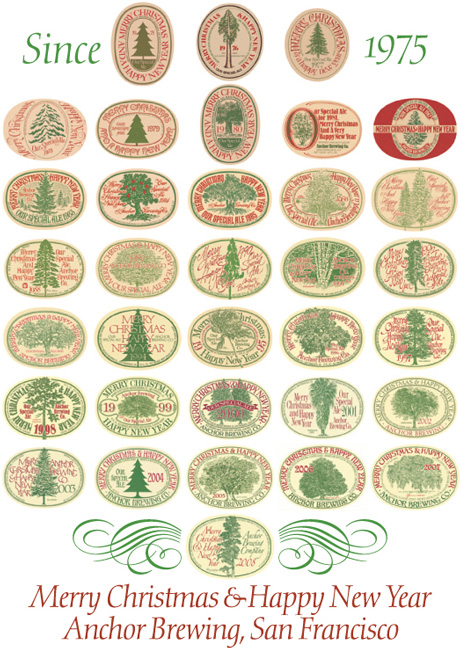
Over the years, there have been 34 different labels and each year Anchor prints a beautiful poster with all of the past labels plus the current years’ label.

Anchor-Xmas-poster08

Filed Under: Art & Beer, Beers, Editorial, Reviews Tagged With: California, Northern California, San Francisco

Abe Lincoln on Beer & Politics

October 28, 2008 By Jay Brooks

lincoln-logo
With a week to go before the U.S. Presidential election November 4, I thought I’d share one of my favorite quotes by our 16th President: Abraham Lincoln.

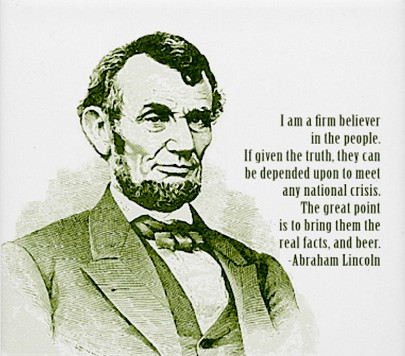
“I am a firm believer in the people. If given the truth, they can be depended upon to meet any national crisis. The great point is to bring them the real facts, and beer.”

          — Abraham Lincoln

Unless I hear otherwise from Bob Skilnik, I’m going to assume this is a quote that Honest Abe actually either uttered or wrote down on the back of an envelope. Though Lincoln is now generally reputed to have been a teetotaler, in his time some accounts do contradict that and say that on occasion he did drink in moderation. “Reliable testimony indicates that Lincoln was a light user of beverage alcohol.”

He was certainly pragmatic enough to understand beer’s importance to the economy, especially when during his first term he turned to the beer industry, among others, to help finance the Civil War. In Brewing Battles, by Amy Mittleman, she details how in July of 1861, the US Congress (or a least what was left of it in the north) levied the first income tax on the remaining states in order to raise money to fight the war with the southern states. By the end of the year, Congress realized it wasn’t enough and they needed a way to raise more funds for the war. In a special session in December 1861, Congress reviewed a request by the Secretary of the Treasury, Salmon P. Chase, to raise the percentage of income tax slightly and levy excise taxes on a number of goods, including beer, distilled spirits, cotton, tobacco, carriages (the automobiles of the day), yachts, pool tables and even playing cards, to name a few. The amendments passed, and Lincoln signed them into law July 1, 1862. They took effect September 1. Several weeks later, the first trade organization of brewers, the United States Brewers Association (USBA), was founded in New York. They held their first national convention in 1863 and elected Frederick Lauer as their first president. Lauer owned a brewery in Reading, Pennsylvania, my home town, and I remember the statue of him in City Park as a child. It was the first statue erected in Reading. But I digress.

lincoln-quote

Excise taxes are a “type of tax charged on goods produced within the country (as opposed to customs duties, charged on goods from outside the country).” The excise taxes were intended to be “temporary” but it was the beginning of temperance sentiments in the nation, and many people objected to alcohol on moral grounds. In the decade following the war, most were rescinded, but the taxes on alcohol and tobacco were the only two to remain in force, and in fact are still in effect today.

The only reason these excise taxes remained after the Civil War was primarily on moral grounds, coming from prohibitionist organizations. And I think that’s still relevant in 2008 because today’s neo-prohibitionists are also trying to use a moral sledgehammer to raise taxes on alcohol in an effort to put beer companies out of business and/or bring about another national prohibition. In state legislatures in many states, neo-prohibitionist groups are trying a variety of tactics to further their agenda. Usually it’s couched in propaganda that pretends they’re concerned for the children, or people’s health or some other hollow claim that hides their true aims.

I still find the argument strange that there should be higher taxes on products some people find morally objectionable. I find soda morally objectionable because it’s so unhealthy that it’s contributing to a nation of obese kids (and adults) — not to mention that beer in moderation is much healthier for you. But I wouldn’t argue pop should have an excise tax. The very concept of a so-called “sin” tax seems antithetical to the separation of church and state. Sin is a religious concept, and should play no role whatsoever in our government. Making people pay a higher price for goods that other people don’t like seems not only a little cruel, but also contrary to freedom of religion, because those are the morals people are using to deny people getting (or making prohibitively expensive) certain goods that not everyone agrees are sins. By using one set of morals as the basis for a particular law (in this case an excise tax) it ignores other sets of morals that differ from the prevailing one. That’s how a theocracy works, and we’re not one yet, despite recent efforts to make religion a central issue in government.

What would Abe Lincoln have thought about all this? Well, first I think he’d be horrified that for the most part the “truth” he felt the people needed to “meet any national crisis” is not much a part of our mainstream media nor of the political process in particular. There are very few “real facts” in play. What there is, is propaganda and the manipulation of quasi-factual information distorted to suit an agenda. All that’s left, really, is the beer.

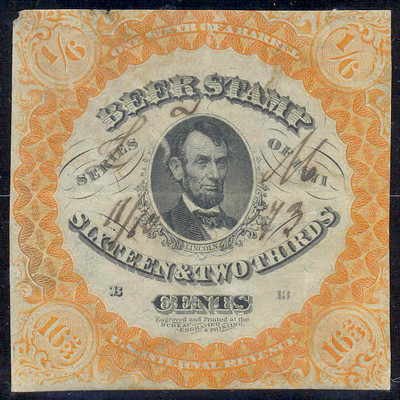
lincoln-beer-stamp

This beer stamp for 16 2/3 cents, to pay the tax on a 1/6 barrel of beer, depicting Abraham Lincoln, is believed to be from 1871.

Filed Under: Beers, Editorial, Politics & Law Tagged With: Prohibitionists, Taxes

Halloween Beer Costumes, Pt. 1: Superheroes

October 25, 2008 By Jay Brooks

halloween
A couple of days ago while searching for an image to use, I noticed a number of odd beer-themed Halloween costumes and became curious about what beer-themed costumes were out there. There are a lot of them and, not surprisingly, they’re for adults. Halloween has become more of an adult holiday than when I was a kid, when it was almost exclusively a child’s holiday.

Halloween weekend has become the biggest keg sale period for most, if not all, retailers. It certainly was when I was the beer buyer at Beverages & more just a few years ago, and I’ve seen nothing to suggest that’s changing.

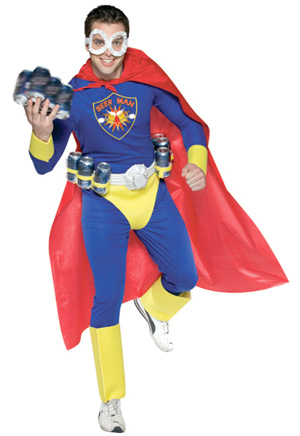
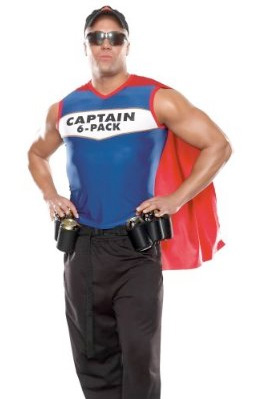
So for the next seven days, leading up to Halloween day I’ll be posting some of the costumes I found, with a different theme for each day. Below is part one of seven and the theme is superheroes. Enjoy.

 
Beer Man
costume-beerman
 

Beer Girl
 
costume-beergirl

 
Captain Six-Pack
costume-capt-6pk

 
Super Six-Pack
costume-super-6pk

Filed Under: Beers, Just For Fun, Related Pleasures Tagged With: Halloween, Holidays

Liquidated Liquid Lauded

September 4, 2008 By Jay Brooks

farmhouse-bc
I try not to pick on my fellow beer writers too much, especially as I’m acutely aware of my own imperfections and ability to make mistakes. I’m human, too, just like everyone else. But I make an exception for Todd Haefer, who writes the syndicated column “The Beer Man” for Gannett News Service. He took over for the original — and now Real Beer Man — Jim Lundstrom, when he left his position in 2005. You can read Jim’s account in a comment from a previous post I did about one of Haefer’s articles. I’ve written twice about Haefer spreading information I considered, um … unhelpful … back in the fall of 2006. One was about declaring barrel-aged beer dead and the other trashing Lagunitas’ labels.

Since then, I’ve pretty much ignored him. Whenever I see his byline come up in the wires, I just don’t look at it, figuring it’s not really worth my time. Maybe that’s unfair, but a Bulletin reader sent me his latest missive (thanks Doug) and I see I haven’t been missing much. It’s titled Farewell to Farmhouse Kolsch and sings the praises of a Kolsch brewed at least nine months ago, and probably even longer than that. Farmhouse Brewing was the brainchild of my friend Jeff Moses. He created the brand when he took over as GM of Coast Range Brewing in Gilroy, California several years ago. The Coast Range brand inexplicably didn’t sell well and so he figured a new brand name wouldn’t carry the same baggage. Coast Range’s brewer, Peter Licht, was quite talented and came up with some tasty beers under the Farmhouse label. Farmhouse beers did reasonably well, but it wasn’t enough to stave off the inevitable and Coast Range filed a Chapter 11 Reorganization bankruptcy in December of 2007, shuttering their doors at the same time. Having looked at the filing (I used to be in the bankruptcy business, believe it or not) it did not look good for their eventual successful reorganization owing primarily to some outstanding tax burdens accumulated over the years. Something like only one out of every ten Chapter 11 filings results in a successful reorganization. Most are converted to liquidation bankruptcies, with assets sold off to pay creditors.

Given their dire outlook, I stopped paying attention and right now don’t know where their case is at this point. It’s probably not over yet. These things tend to take a while. But in the meantime, whatever beer had been bottled before (or possibly just after) the filing is, according to the Beer Man, now being sold in Wisconsin, and he’s heard it’s also in Minnesota and New York, too. Undoubtedly, the Trustee got whatever he could for the beer and sold it at fire sale prices, probably cents on the dollar, just to get rid of it and get at least something for creditors.

Haefer speculates about their curious marketing of a Kolsch as a farmhouse ale — dude, there is no marketing for this beer, the company no longer exists. And when there was it was a brand name, a label, they never intended that anyone think all the beers were trying to be authentic farmhouse beers. All of the labels featured a crude folk-style painting of a barn from the area where the style of beer was originally brewed. Nobody was pretending that Kolsch or Porter or IPA was a farmhouse beer in terms of its style.

farmhouse-kolsch

Haefer goes on to give us his tasting notes on the beer, finding no fault with it whatsoever, and expressing his sadness in knowing that “it will no longer be made.” He finishes the article with some helpful hints to guide his readers on how they might find this elusive, all but extinct beer.

Since the brewery is no longer producing, the availability of Farmhouse Kolsch depends on whether local distributors took advantage of the liquidation sale. The brewery’s other beers that may pop up include a porter, saison, pale ale, imperial pale ale and a pilsner. It’s sad to have a beer like this and know it will no longer be made.

Many beers are available only regionally. Check the brewer’s Web site, which often contains information on product availability by mail.

Haefer knows they’re in bankruptcy and no longer brewing. What makes him think someone is updating the website with who’s carrying the liquidated beer outside of their home market? And couldn’t he have checked first? That way he would have discovered for himself that there’s almost no information about their availability on the website.

I guess I’m baffled by why any writer would choose to champion a beer that almost no one reading his work could find and even if they could, would be well past its prime, having been out-of-code for at least five months. Coast Range, like most craft breweries, did not pasteurize their beers, giving them a shelf life of roughly 3-4 months. That it’s so good to the Beer Man’s taste is either a testament to the craftsmanship and longevity of the beer itself, beating the odds and presumably having been handled spectacularly well every step of its long journey from brewery to warehouse to cross-country discount store, or to something else entirely — which decorum prevents me from saying. But I think you can figure it out. Beer man indeed.

Filed Under: Beers, Breweries, Editorial Tagged With: California, Writing

Dinosaur Beer

September 2, 2008 By Jay Brooks

t-rex
No, I don’t been those lumbering giants making flavorless beer-like industrial beverages which we all hope might one day become extinct, I’m talking about a beer made with roughly 45-million-year old yeast found in a bug entombed in amber, and extracted just like the plot of Michael Crichton’s Jurassic Park. This time around, the story involves Fossil Fuels Brewing Co., whose owners include Dr. Raul J. Cano, the Emeritus Professor at Cal. Poly in San Luis Obispo who originally made the discovery. According to the story in today’s Washington Post, the breakthrough came last month.

“I was going through my collection, going, ‘Gee whiz — this is pretty nifty. Maybe we could use it to make beer,’ ” says Cano, 63, now the director of the Environmental Biotechnology Institute at California Polytechnic State University in San Luis Obispo.

Last month? Hold on just a second. First of all the article mentions the following:

In April, at the World Beer Cup in San Diego, “we had one judge give us the highest marks, one just below and one who didn’t like it,” says Chip Lambert, 63, the company’s other second microbiologist. “We learned that the issue was that in these competitions, you brew to match the traditional concept of the style, which these yeast just don’t do.”

Ignoring for the moment that the World Beer Cup isn’t judged like that (there are no “highest marks” or anything similar), the Washington Post published this article yesterday, September 1. That would mean the World Beer Cup took place five months ago, not to mention that to enter that competition you have to register and submit your beer well in advance of the actual judging. I’m not trying to quibble with the story, a least that wasn’t my original intent, but this just doesn’t add up. Last month? Setting all that aside for the moment, I wrote about this two years ago, when Stumptown Brewing, in Guernville, California, made a beer called Tyrannosaurus-Rat, also using Dr. Cano’s ancient yeast.

This is part of what I wrote in Fall of 2006 in the Celebrator Beer News, reviewing a beer and barbecue festival held along the Guernville River at Stumptown:

But as good as the barbecue was, I was there for the beer. I was particularly keen to try what Stumptown was billing as a beer made with the world’s oldest yeast. Their “Tyrannosaurus-Rat” — or T-Rat for short — was essentially their popular “Rat Bastard,” but brewed using yeast that was 30 million years-old, give or take a few million years! How it got to be in Stumptown’s beer is nearly as interesting as the beer itself. It was discovered in the Dominican Republic trapped inside of a bee that was also trapped inside of a piece of amber, a terrific preservative. And the bee had been there for somewhere between 25 and 40 million years. Dr. Raul J. Cano, Emeritus Professor at Cal. Poly in San Luis Obispo, made the discovery in 1995 and managed to extract living bacterium, including a few strains of yeast, directly from the bee’s stomach. The ancient microorganisms were patented and also inspired the movie “Jurassic Park II.” It fell into Stumptown’s lap during a ski trip where the Hackett’s met a friend of Dr. Cano, and the rest, as they say, is literally ancient history.

I tried the T-Rat alongside of its modern counterpart, Rat Bastard, as they were the same in all respects except for the yeast. The Rat Bastard is a well-made pale ale, with good aromas and a crisp, clean palate. It has a generous hop bite that finishes bitter, then drops off sharply in the end. The T-Rat was much smoother, with softer, fruity flavor characteristics and just a touch of lemony sweetness that wasn’t tart. The finish is quite clean, with just a quiet hop presence lingering. While they’re both good beers, I think the T-Rat has a more complex, developed taste profile but its smoothness makes it great. The fact that it was made with such an old yeast is fascinating and given how good the beer is, no mere novelty.

There are also other anomalies. In my story, which relied primarily on Stumptown’s information, the yeast was found in a bee from the Dominican Republic. The Washington Post account, however, lists the Lebanese weevil as the yeast carrier. On top of that Dr. George Poinar, who was also involved in finding and extracting the DNA from amber, says on his biography web page that its age was 125 million-years old.

And here is the original press release for Stumptown’s version of the beer, from June 27, 2006:

For the first time, 25-40 million year old yeast has been used to brew a commercial batch of beer (“Tyrannosaurus Rat”) to be made available to the public on July 8th at Stumptown Brewery (15045 River Rd. Guerneville, Ca.). Dr. Raul Cano, Lewis “Chip” Lambert, and Peter Hackett will be celebrating this historic event and available for questions from 11:00A.M. on Saturday July 8th.

The public tasting of the T-Rat is the culmination of coincidences that involved a 20-40 million-year old bee trapped in amber and discovered in the Dominican Republic, a pair of renowned scientists, a ski weekend and an award winning microbrewery.

Amber is nature’s perfect preservative. It desiccates its specimens and protects them from damaging radiation of all types. Man has successfully used it to preserve their dead for thousands of years; Nature has preserved many of its inhabitants, including the recently identified spider web, in their elegant tombs for tens of millions of years.

Dr. Raul J. Cano, Emeritus Professor at California Polytechnic State University, San Luis Obispo, reported in Science (Volume 268, May 19, 1995) that he extracted a living bacterium from the gut of a stingless bee entombed in amber 25 – 40 million years ago. Independently, Lewis (Chip) Lambert, Fremont, CA, at the time Director of Pre-Clinical Research at a Bay Area biotech company, confirmed his work in a very skeptical scientific environment that has, for the most part, accepted its validity. In addition, Raul’s work became the underlying premise for the movie Jurassic Park.

The patented ancient microorganisms (USPO#5,593,883) became the focus of a new company based on the potential use of these microbial isolates for industrial and medical applications, and the hunt began. From the ancient-amber library came a few yeast strains and with them, the question, could they be used to make beer? The answer was a resounding yes as very good beer was brewed for the Jurassic Park II cast party and Raul’s daughter’s wedding reception.

After this initial success, Fossil Fuels Brewing Company was born with the motto “We bring good things back to life.” Using ancient yeasts that had all been thoroughly tested and selected for their beer-making properties, Fossil Fuels Brewing Co. planned to produce high quality distinctive beers with yeasts that had been isolated from amber.

The partners then proposed trials of these ancient yeasts to numerous microbreweries. Much to their surprise, in an industry that thrives on innovation, found a lack of enthusiasm among commercial breweries.

Fast forward a few years to the snowy slopes of Alpine Meadows where Carla Hackett was taking a ski lesson from Raul’s now friend and business partner, Chip. Carla had all the attributes of a great skier that her husband, an Aussie who owns the Stumptown Brewery in Guerneville, lacks. On the second, never the first, ride up the chair lift, an important relationship was established when the question was raised, “would you like to make some beer with some patented, 35-million year-old yeast?” The affirmative response started a brewing relationship between Stumptown Brewery and Environmental Diagnostics, Inc.

This random path led the ancient yeast to Stumptown Brewery on May 6th where Peter, Owner/Brewer, put the yeast to work. On June 21st came the news that “T-Rat” had finished fermenting and was conditioning. Perhaps most importantly, that it’s “very good, very unique. The yeast character is unusual, exotic, and very pronounced”.

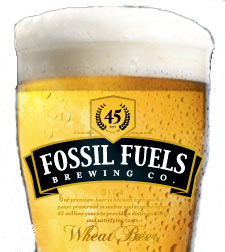
fossil-fuels

On page two of the Post piece they finally do mention Stumptown’s involvement. The new versions, which include a wheat beer and a pale ale, are made at Kelley Bros. Brewing, which is in Manteca, California. I really enjoyed the pale ale version that Stumptown brewed and will eagerly try these two new versions. But I’m still a bit bewildered by the discrepancies that seem to accompany this story. But I guess history itself is a lot like that, so maybe it’s fitting after all. I wonder what “Cheers” is in dinosaur-speak? “Here’s tar in your eye?”

Filed Under: Beers, Just For Fun, News Tagged With: History

Bistro IPA Festival Winners 2008

August 9, 2008 By Jay Brooks


Hop 15 was chosen best in show at the 11th annual IPA Festival earlier today at the Bistro in Hayward, California. The full list of winners is below.


  • 1st Place: Hop 15 (Pizza Port Solana Beach)
  • 2nd Place: Brew Free Or Die IPA (21st Amendment)
  • 3rd Place: Gold Digger IPA (Auburn Alehouse)

Filed Under: Beers, Events Tagged With: Awards, Bay Area, Beer Festivals, California, Northern California

More Beer Cake

July 11, 2008 By Jay Brooks

cake
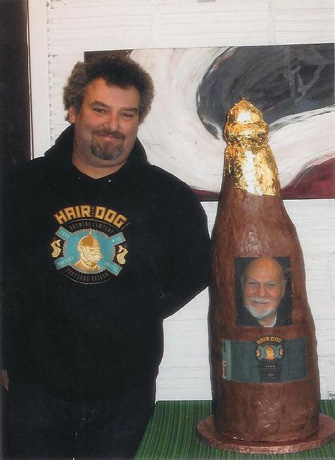
Alan Sprints, who owns the wonderful Hair of the Dog Brewery in Portland, Oregon, was inspired by the recently posted beer cake recipe to share his mother’s amazing beer cake, which she made for FredFest. According to Alan, “it [was] not made with Beer, but it tasted great with Beer.” Although there’s no recipe, he did share the secret of its construction. “It was made out of 20 chocolate and lemon cakes stacked over a wooden dowel.” Yum. Thanks, Alan.

fredfest-cake

Filed Under: Beers, Food & Beer, Just For Fun Tagged With: Food, Portland

Session #17: Drinking Anti-Seasonally

July 4, 2008 By Jay Brooks

This is now our 17th Session, and the topic is another thoughtful one, albeit a little rebellious. Our host, Rob DeNunzio, from Pfifft, titled the Session theme Going Against the Grain Bill. In his announcement, Rob described what he means thusly.

Drinking anti-seasonally. Think of this as the unorthodox cousin of such topics as “beer and food” and “beer and music”. Beer and weather, perhaps? More like beer despite the weather, I guess. Cracking open a Guinness on the beach, finishing a day of yardwork with a Speedway Stout, or whatever else you do that raises an eyebrow, do us all a favor an take a few moments to share your non-conformist tale.

Hmm, seasons out of time. Beers out of season. How often do I drink a beer better, or at least traditionally thought to be better, suited to a particular season? All the time. When I reflect on my own drinking patterns, I discover that I give almost no thought to seasonality.

Beer followed the seasons out of necessity for centuries, perhaps millennia, prior to the age of refrigeration and air conditioning. Because it was difficult — or in some cases impossible — to get cool enough temperatures during certain warmer times of the year to brew. So brewing cycles evolved to follow rising and falling temperatures throughout the year and became traditions. As a result, various beers became available only at specific times of the year. These were in effect the first seasonal beers, driven not by marketing, but by the limitations of technology. But this was obviously not a bad thing. Anticipation created excitement and celebrations were held to mark the return of these beers throughout the year. The beers themselves were also well-suited for their time of the season, with heavier stronger beers to warm those hearty cockles and lighter ones to beat the heat of a sweltering summer.

Over a century ago, in 1859 to be exact, refrigeration was invented, and by 1876 the relatively portable refrigerator was created by a German inventor, Carl Paul Gottfried von Linde. He received a U.S. patent for his process on May 12, 1903. But earlier than that, brewers were trying to figure out how to apply the scientific learning commercially to keep their breweries cooler. In 1856, for example, “James Harrison was commissioned by a brewery to build a machine that cooled beer.” That brewers were so far ahead of the technology and in fact were instrumental in providing motivation to solve the cooling problem illustrates just how important they thought it was to the modernization of brewing techniques.

But even after the problem was largely solved, the traditions held sway for decades. Even today, there are many beers which are released only seasonally. Usually this is for marketing reasons rather than technological ones. With only one exception I can think of — fresh hop beers — every known beer style can be brewed year-round. For example, some breweries release a marzen (a.k.a. Oktoberfest) beer in the fall while many others make the style throughout the year.

Christmas or holiday beer, to take another example, are often styles suited to winter but there is no reason they could not be made at any other time of the year. Holiday beers are an interesting example of marketing in modern times. There have been, of course, beers released to celebrate the holidays nearly as long as there have been breweries. But the modern era of Christmas beers undoubtedly begins — as so many new beers inevitably do — with Anchor Brewing. Their Christmas Ale, Our Special Ale, was first released in 1975. As recently as 10-15 years ago, what breweries there were who then made a holiday beer called it a Christmas beer, but a curious thing began happening.

With the exception of Anchor’s Christmas Ale, along with Sierra Nevada’s Celebration and Noche Buena (which Modelo has since stopped importing), holiday beers with the word “Christmas” on the label would literally stop selling on December 26. Like fireworks on July 5 or Halloween candy on the first of November, fickle consumers would shun these beers like they’d suddenly become poisonous. So many breweries removed the word “Christmas” and started referring to them as “holiday” beers or even “winter seasonals” in order to extend their shelf life. And remarkably, it worked. After that, many savvy breweries began having a year-round seasonal program with four or six seasonals — one after the other — such that there was always at least one seasonal beer at any given time. The seasonal segment, as tracked by IRI and Nielsen is now the number one category, even in grocery stores.

But that’s seasonal beers, what about anti-seasonal. At the same time seasonal beers are on the rise, for every seasonal release you could probably find dozens of examples of that same style available from other breweries all year long. So the reality of seasonality is that it’s largely market-driven, any bows to tradition are now mostly coincidental or at best a convenient story to sell the beer. With the original reason that created the traditions of certain beers at specific times of the year gone for a century or more, only the romance of those bygone days remain.

We live in a time when seasonality has lost its meaning, and not just with respect to beer. Any fruit, regardless of its growing season is available at the average supermarket, flown from around the world so that our every whim not go unfulfilled. Let no sales opportunity go to waste. Convenience is king. As consumers we believe that whatever we want should be available whenever we want it, because that’s the bill of goods we’ve been sold. Remember those bothersome watermelon seeds. Gone. Strawberries in the winter? Thank you Guatemala. We don’t like to wait for anything anymore. And usually we don’t have to, because there’s someone willing to sell us whatever we fancy, regardless of the season.

Philosophically, I may not like this fact, but I’m as guilty as anyone. Pandora’s box is wide open and hope is cowering in the corner hoping greed doesn’t beat her to a bloody pulp again. I drink whatever I want, whenever I want. And thanks to air-conditioning, fans and refrigeration, that means any beer, any time. I rarely even think about seasonality when I choose a beer. I rarely even consider the weather, because unless I’m in the woods camping, I can control my environment, at least to some degree.

seasons-tree

The only factors I use are mood, food and ‘tude. Food is obvious, I’ll select a beer I think will go with what I’m eating, regardless of the season. If an imperial stout works, so be it. That leaves mood and attitude. They’re similar states, but different in a crucial way. My mood is how I’m feeling at a particular moment in time, whereas my attitude is how I feel toward the people around me, where I’m at, what I’m doing, etc. Mood is inward, attitude is outward.

But put a gun to my head, and the beers I’ll choose time and time again, regardless of the weather, are the complex ones: barley wines, sour beers, saisons and biere de gardes. I’m usually keen to try anything preceded by the designation “Imperial.” But I also love a delicate Mild or a refreshing Dunkelweiss. I like a good unfiltered Zwickel anything, but especially pilsners. The point is, I think, that without realizing it, I haven’t been drinking seasonally for a long time, if indeed I ever did. Do any of us, I wonder? Certainly I’m pleased when new seasonal releases arrive on my doorstep, but mostly because I’m always keen to try something new or different.

Clearly — as usual — my finger is nowhere near the pulse of America. Because lighter beers definitely do experience spikes in sales during the summer and darker, stronger beers sell better in cooler weather. But most sell well enough at all the other times of the year to justify them being on stores shelves year-round. So perhaps it’s simply driven by the bigger beer companies and retailers who create endless promotions based on holidays, backyard barbecues and what they believe people want. Consumers, of course, do react to products on sale, on endcaps or as a part of specific promotions and thus buy those beers at the times of year that they’re offered to them, perhaps putting no more thought into it than I do. Could seasonality be simply a self-fulfilling prophecy perpetuated by marketing? It seems likely, at a minimum. Because for everyone I know who chooses their beer carefully, weather is only occasionally a factor. Only when we can’t control it — at the beach, on the golf course, camping, places like that — are beers chosen because of the prevailing weather. And notice those are specific places, suggesting that may be the more important factor than weather or seasonality. Even as I sit here typing this, I’ve got a nice glass of Anchor Porter next to me, even though the thermometer is tipping 90°. I peered inside the refrigerator, and pulled it out without a moment’s hesitation. It just looked tasty. And so it is.

Filed Under: Beers, Editorial, Related Pleasures, The Session Tagged With: Seasonality

« Previous Page
Next Page »

Find Something

Northern California Breweries

Please consider purchasing my latest book, California Breweries North, available from Amazon, or ask for it at your local bookstore.

Recent Comments

  • Bob Paolino on Beer Birthday: Grant Johnston
  • Gambrinus on Historic Beer Birthday: A.J. Houghton
  • Ernie Dewing on Historic Beer Birthday: Charles William Bergner 
  • Steve 'Pudgy' De Rose on Historic Beer Birthday: Jacob Schmidt
  • Jay Brooks on Beer Birthday: Bill Owens

Recent Posts

  • Beer In Ads #5371: Miller Bock Beer October 11, 2026
  • Beer Birthday: Kirby Shyer October 11, 2026
  • Beer Birthday: Kushal Hall October 11, 2026
  • Beer Birthday: Jaime Ojeda Selamé October 11, 2026
  • Beer In Ads #5370: Salmon Bock October 10, 2026

BBB Archives

Feedback

Head Quarter
This site is hosted and maintained by H25Q.dev. Any questions or comments for the webmaster can be directed here.