Brookston Beer Bulletin

Jay R. Brooks on Beer

  • Home
  • About
  • Editorial
  • Birthdays
  • Art & Beer

Socialize

  • Dribbble
  • Email
  • Facebook
  • Flickr
  • GitHub
  • Instagram
  • LinkedIn
  • Pinterest
  • RSS
  • Twitter
  • YouTube

Powered by Genesis

Patent No. 395468A: Apparatus For Making Malt

January 1, 2015 By Jay Brooks

patent-logo
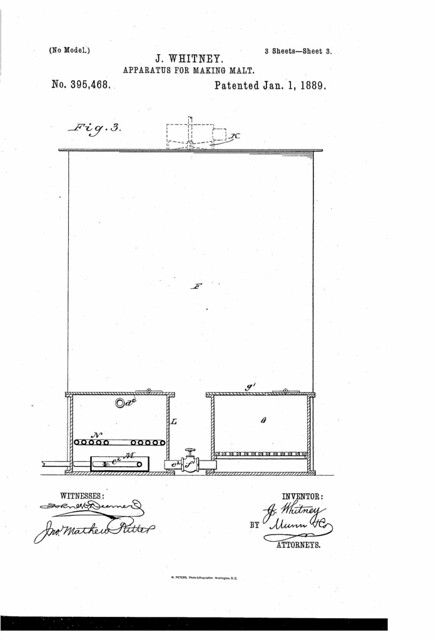
Today in 1889, US Patent 395468 A was issued, an invention of Justin Whitney, for an “Apparatus For Making Malt.” There’s no Abstract for this one, but you can read the full description about his “novel means and apparatus for making malt” at the patent page.
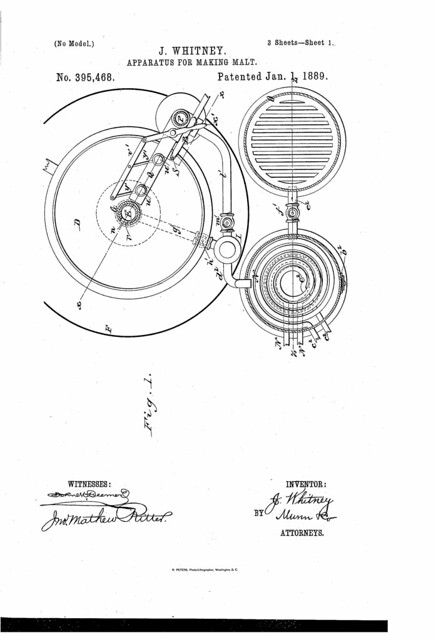
US395468-0

US395468-1

US395468-2

Filed Under: Beers, Just For Fun, Politics & Law, Related Pleasures Tagged With: Malt, Patent

The Drunkometer

December 31, 2014 By Jay Brooks

balloon-blowing
Here’s an interesting piece of history. Today, New Year’s Eve, in 1938, police in Indianapolis, Indiana used the first commercial test to discover scientifically if a person had been drinking alcohol and if so, how much. December 31, 1938 saw the debut of the Drunkometer, designed by Rolla Neil Harger, a chemistry professor at Indiana University. He began working on the device in the 1930s, and patented it in 1936.

The drunkometer collected a motorist’s breath sample directly into a balloon inside the machine. The breath sample was then pumped through an acidified potassium permanganate solution. If there was alcohol in the breath sample, the solution changed color. The greater the color change, the more alcohol there was present in the breath. The drunkometer was manufactured and sold by Stephenson Corporation of Red Bank, New Jersey.

drunkometer-1
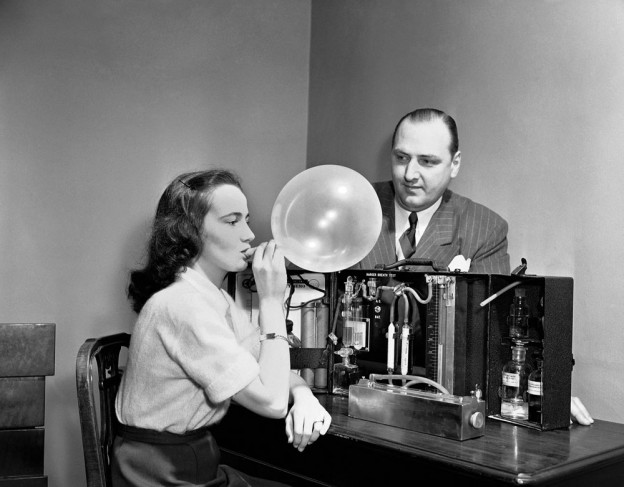
Dorothy Brengel helps W.D. Foden, Chairman of Statler Safety Committee, demonstrate the “Drunkometer”, a breath tests for alcohol, on display at the Greater New York Safety Council, Hotel Statler, March 28, 1950. For the preliminary test, the breath of the suspect is collected in a balloon and passed through a purple fluid (potassium permanganate and sulphuric acid) to see if it changes color. The breath of a non-drinking person will cause no change. If the purple color disappears, the amount of breath required to accomplish this indicates the approximate accumulation of alcohol in the blood. (AP/Carl Nesensohn)

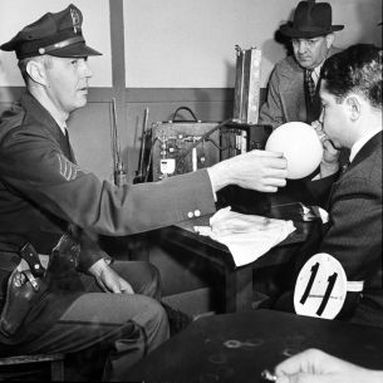
In 1938, on New Year’s Eve, police in Indianapolis put a new piece of technology through its first practical test.

They used a breath analyzer to determine if someone had been drinking. What was then called the “Drunkometer” was based on the same idea as modern breathalyzers: a person blows into a bag, which contains chemicals that react according to how much alcohol is on a person’s breath.

drunkometer-4

The Daily Dose gives a good account of its early use:

Thanks to the end of Prohibition and a boom in car sales, drunk driving had become a fast-growing problem in America in the 1930s. But on this New Year’s Eve, police in Indianapolis, Indiana went out armed with a new weapon to fight against people who had gotten behind the wheel after having too much to drink.

It’s a contraption called a “drunkometer” and it’s the invention of an Indiana University chemist named Rolla Harger. He had been working on the device since the early 1930s and had patented it two years earlier. The concept behind the drunkometer was pretty basic. Drivers suspected of being drunk were asked to breathe into a rubber balloon, which was attached to a tube of purple liquid—a weak solution of potassium permanganate in sulphuric acid.

If there was alcohol on their breath, the chemical solution changed color–the darker it got, the more alcohol they had in their system. From the shade of the liquid, the cops could use a simple equation to estimate the alcohol level in a person’s bloodstream. Previously, the only way police could check a driver’s alcohol level was to get a blood or urine sample; Neither was a very practical option on the roadside. While the drunkometer looked a bit like a mini chemistry set, it was portable, able to fit into a small suitcase.

Harger made the device as simple as possible so that judges and juries would understand how it worked and police officers could easily be trained to use it. He also made the drunkometer hard to beat. Experiments showed that no illness affected the result, and that nothing a person might eat – garlic, cloves, strong onions – would make any difference. Once police started using it, the drunkometer was found to have another advantage. A dramatic change in the color of the liquid could often make people admit how much they had drunk.

Sometimes Harger would ride along with the police to see how his invention was being used. What he discovered was that a lot more people were driving drunk than he ever imagined.

The drunkometer was used by police departments all over the country until the 1950s when it was replaced by the breathalyzer, invented by another Indiana University professor, Robert Borkenstein. The breathalyzer is a much smaller and more sophisticated device that uses infrared spectroscopy to measure blood alcohol levels.

drunkometer-3
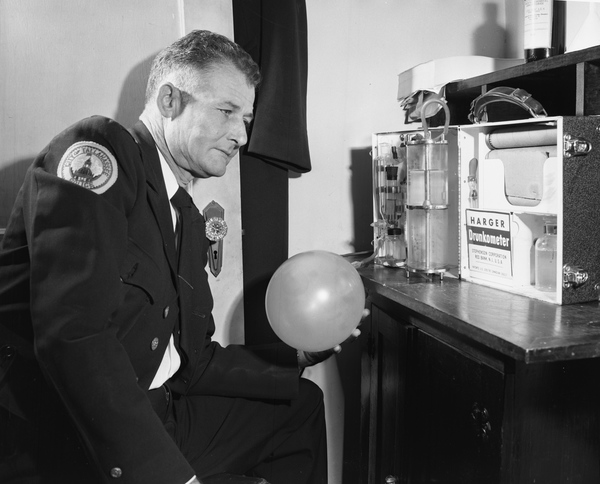
Tallahassee police officer with a Harger “Drunkometer” breathalyzer machine, photo taken in 1953.

The Drunkometer was replaced by the Breathalyzer in 1954, but for sixteen years was the way police nabbed drunk drivers. But who came up with that name? Happy New Year! Be careful out there.

Filed Under: Beers, Just For Fun, Politics & Law Tagged With: Science

Diocletian’s Edict On Beer Prices

December 22, 2014 By Jay Brooks

denarius
Today is the birthday of Diocletian, who was born in the year 244 C.E. He was a Roman Emperor, whose reign lasted from 284 to 305. During his time in charge and before, runaway inflation was a growing problem, which caused him to put a cap on prices in 301 C.E. Known as the “Ēdictum Dē Pretiīs Rērum Vēnālium” or Edict on Maximum Prices or occasionally the Edict of Diocletian, it set the maximum prices allowed on a variety of commodities, goods and services.

For example, a sextarius (roughly 500 ml, or about a pint) of Egyptian Beer had a maximum price of 2 Denarii. A Denarius was a common coin in Ancient Rome, beginning around 211 B.C. E. during the Second Punic War, becoming “the most common coin produced for circulation. The word denarius is derived from the Latin dēnī “containing ten”, as its value was 10 asses (later “retarrifed at sixteen asses”). It is the origin of several modern words such as the currency name dinar and the Italian common noun for money: denaro.”

Prsumably because it was better, the same amount of Gallic or Pannonian Beer had a maximum price set of 4 Denarii. Pannonia was a Roman province in the northern part of the empire, and was located in “present-day western Hungary, eastern Austria, northern Croatia, north-western Serbia, northern Slovenia, western Slovakia and northern Bosnia and Herzegovina.” Gaul was the area that is modern-day France.

Egyptian beer was sometimes translated as “Zythus” and at least another translation lists the Gallic or Pannonian Beer as “beer called Camus.” These other translations also list something called “Barley wine of Attica” with a hefty maximum price of 24 Denarii. Attica was the area around and including Athens in Greece. I have no idea if that was anything like our modern barley wine, and I can find no other mention of it in a quick search.

Another translation done in 1876 by an Edward Young, entitled “Labor in Europe and America: A Special Report on the Rates of Wages, the Cost of Subsistence and the Condition of the Working Classes” converted the Denarii prices to the then nearest American equivalent, which the author supposed was one-half cent to the Denarius. Using that scheme, the Egyptian beer would have been 7 cents, the Zythus, or Gallic or Pannonian Beer would have been 14 cents, and the barley wine of Attica 84 cents. Adjusting for inflation 138 years, in 2014 prices the maximum prices for a pint of our three beers would be $1.56, $3.11 and $18.67, which would be pretty expensive, even for 16 oz. of barley wine. But overall, those prices seem pretty decent. Salutaria!

Edict_on_Maximum_Prices_Diocletian
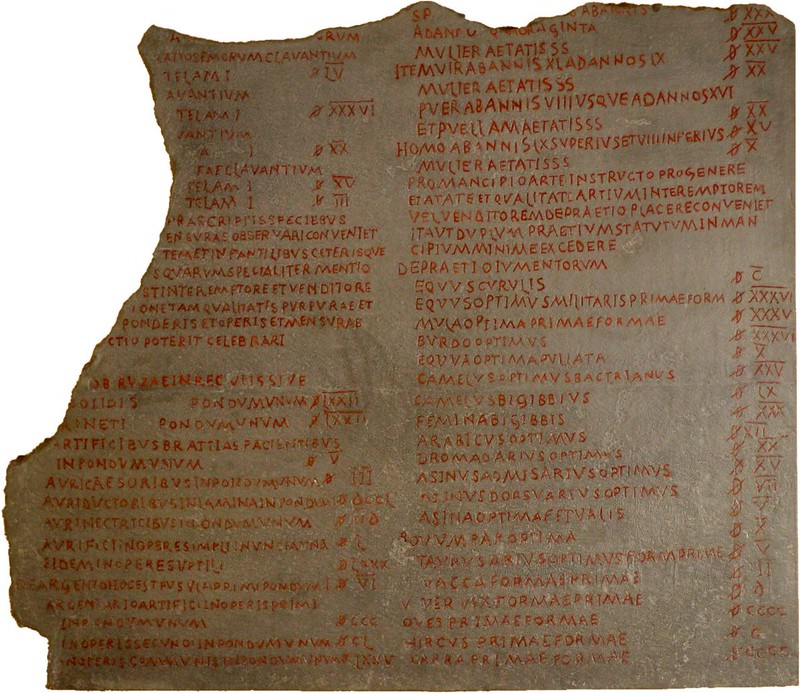
A fragment of the Edict on Maximum Prices, on display in Berlin.

Filed Under: Beers, Just For Fun, Politics & Law Tagged With: Business, History, Politics

CCBA Celebrates 25 Years

November 5, 2014 By Jay Brooks

CCBA-logo
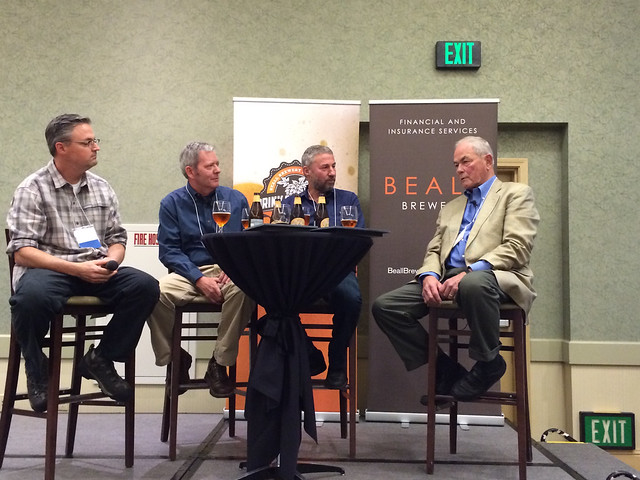
This year the California Craft Brewers Association (CCBA) celebrates its 25th anniversary, and they just concluded a two-day conference in Santa Rosa. I missed the first day (traveling home from Belgium) but gave a talk yesterday morning on the history of craft beer in California. But the highlight of day two was a panel discussion with three craft beer pioneers, John Martin (Triple Rock), Ken Grossman (Sierra Nevada) and Fritz Maytag (Anchor), moderated by Vinnie Cilurzo (Russian River).

IMG_0596

The trio spoke for around an hour, then the audience asked a few questions. I captured the main part of the talk (not the Q&A) in two parts (due to limitations of my camera) which you can watch below. There’s a short gap in between the two videos, only a few seconds. It’s a fun and fascinating talk. Enjoy.

And here’s Pt. 2.

DSCN2321
After the talk, John Martin, CCBA executive director Tom McCormick, Vinnie Cilurzo, Fritz Maytag and Ken Grossman.

Filed Under: Breweries, Events, Just For Fun, News, Politics & Law Tagged With: California, CCBA, Video

The Unintended Consequences Of Prohibitionist Propaganda

October 16, 2014 By Jay Brooks

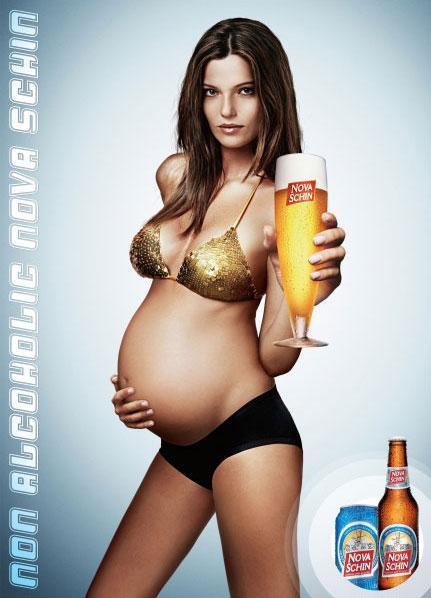
pregnant
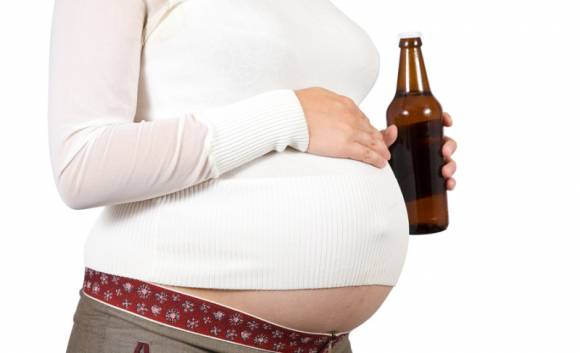
So I know this is one of those thorny issues that tends to fire people up and argue from an emotional point of view. That being said, the issue of a woman drinking when pregnant is a tough one, especially because the science is not exactly as settled as people believe. My understanding is that it’s not clear how drinking effects an unborn fetus, though a significant amount of drinking has been shown to have potentially disastrous consequences. Generally speaking, a modest amount of drinking probably won’t do any lasting damage, especially in the very early stages of pregnancy. But since when and how much are fairly unknown with any precision, doctors, and the medical community as a whole, have tended to recommend that a woman abstain from drinking during pregnancy. And that seems almost reasonable, except for the fact that prohibitionist and anti-alcohol groups have taken that advice as sacrosanct without really examining the science behind it and have done their best to shame women who might have an occasional drink and make them feel as guilty as humanly possible.

For example, WebMd says. “For decades, researchers have known that heavy drinking during pregnancy can cause birth defects. But the potential effects of small amounts of alcohol on a developing baby are not well understood. Because there are so many unknowns, the CDC, the U.S. Surgeon General, the American College of Obstetricians and Gynecologists, and the American Academy of Pediatrics advise pregnant women not to drink alcohol at all.” But again, that’s just because they don’t really know, not because it’s proven that any amount of alcohol is harmful. If you do a quick search, you’ll find that a lot of websites claim that pregnant women should never drink because, as most of them put it, “[t]here is no known safe amount of alcohol that you can consume if you are pregnant.” But that’s misleading. It’s not so much that no amount is safe so much as the amount that is safe is not known with precision, and for every person. I know that sounds like I’m splitting hairs, but I think it’s an important distinction. There are safe levels of drinking alcohol that would have no effect on a woman’s pregnancy, and for any given woman that amount would differ, but so far we don’t know how to calculate that amount, so instead doctors recommend abstaining. But that’s very different from hounding women who might have the occasional drink or acting as if they’re actively or willfully harming their unborn fetus.

It’s quite easy to find this scaremongering in all sorts of places. Not surprisingly, Alcohol Justice, who is a leading propagandist, regularly tweets “Save Babies From Birth Defects: Don’t Drink While Pregnant,” with a link to International Fetal Alcohol Spectrum Disorders Awareness Day Aims To Help Save Babies From Birth Defects: Don’t Drink While You’re Pregnant. Which would be reasonable, except for the fact that the Medical Daily piece is littered with exactly the sort of absolutist misinformation I’m talking about.

There’s a common misconception that it’s safe to drink during certain points in the pregnancy, or that one glass of wine or beer is harmless. It has been almost 30 years since the medical community recognized mothers who drank alcohol while pregnant could result in a wide range of physical and mental disabilities, but still, one in 13 pregnant women reports drinking in the past 30 days and one in six reports binge drinking. Fetal alcohol syndrome can be devastating, which is why a day [September 9] has been dedicated to spreading the awareness and clearing up the truth for mothers to understand that anything they eat and drink affects the baby.

The NIH’s Alcohol Abuse and Alcoholism branch has supported years of research to reveal the dangers and understand when developmental problems within the womb begin. Babies who are born with fetal alcohol syndrome have been born small and premature, develop problems eating, sleeping, seeing, hearing, learning, paying attention in school, controlling their behavior, and may even need medical care through their life. The severity of drinking alcohol while pregnant cannot be underplayed because of the profound confirmed health effects that could follow a child throughout their life.

Every pregnancy is different and unique to the mother’s health, genetic composition, and the baby. According to the NIH, drinking alcohol the first or second month of pregnancy can hurt the baby with irreversible health consequences. The Centers for Disease Control and Prevention backs up the NIH by saying there is no safe level of alcohol to use during pregnancy. If drinking continues throughout the pregnancy, babies are likely to develop fetal alcohol syndrome with characteristic facial features such as a wide set of eyes, smooth ride on the upper lip, and a thin upper lip border. But that’s only the surface, because within the brain lies the possibility of intellectual disabilities, speech and language delays, and poor social skills.

Unfortunately, the “truth” as they put it is not exactly the whole truth, nor is it the same advice given universally by the medical community, despite the fact that both the NIH and the CDC take the absolutist point of view just to be safe. That these government agencies here, and in other places, take this position without actually explaining why, or even how they arrived at it and the uncertainty about it, seems to me a condescending way to treat people. I know, or hope, they mean well, and the goal is to bring healthy babies into the world. Everyone agrees that frequent drinking or drinking large quantities of alcohol while pregnant is a terrible idea, but not giving women all of the facts is yet another example of the medical community talking down to people and treating them with condescension. And it’s taking its toll on some women in unexpected ways, as I’ll explain later.

pregnant-beer-bottle

More recent studies are beginning to show that in fact the occasional drink is not only harmless, but in some cases beneficial. For example, a 2013 study at Harvard found “no connection between drinking alcohol early in pregnancy and birth problems” and at the University College London, they found “Light drinking in pregnancy not bad for children.” Others found A Drink A Day While Pregnant Is OK and Moms Who Drink Wine While Pregnant Have Better Behaved Kids. Yet another recent New study shows no harm from moderate drinking in pregnancy. Likewise, Moderate drinking during pregnancy may not harm baby’s neurodevelopment and the Parenting Squad says that Yes, You Can Drink While Pregnant.

In Is It OK to Drink While Pregnant? Why Scientists Really Don’t Know, the author details why it is that the science is so difficult to pin down, and as such many doctors advise abstaining altogether. One of the problems with this contrary advice is that some people who are convinced that any alcohol represents a danger to an unborn fetus and they make life difficult for anyone who’s received different advice, or who has looked at the issue and come to a different conclusion. Despite it being unsettled, some states have, or are considering, passing laws to punish women who have the temerity to have a drink while pregnant. Both of my wife’s baby doctors advised her the occasional drink was not a problem, and even told her that if it helped her relax was a positive. She tended to have a drink only every so often, rarely even, and I certainly enjoyed the months of having a designated driver. But many other women report having been publicly shamed, ridiculed and punished for drinking while pregnant in public. At least one person reports being accosted for simply buying alcohol (it was for a party and she had no intention of drinking it) and I suspect that’s not an isolated incident. The clerk at the liquor store acted like it was against the law for her to simply purchase it.

Many have written about their experiences with alcohol during pregnancy and are worth reading. See, for example, Take Back Your Pregnancy, by an economist writing for the Wall Street Journal. And for Slate, Emily Oster explains herself in “I Wrote That It’s OK to Drink While Pregnant. Everyone Freaked Out. Here’s Why I’m Right.” In addition, Dr. Peggy Drexler, a research psychologist and gender scholar, examined the history and psychology of shaming such women in A Loaded Question: On Drinking While Pregnant. Not surprisingly, it’s only been since 1981 that the U.S. Surgeon General’s took the official position pregnant women should completely abstain from drinking alcohol. And for a while, drinking among pregnant women declined, but since 2002 has been on the rise again, though it’s the “‘every now and then’ glass of wine or two” rather than binge drinking and the biggest demographic to see this increase is “college-educated women between 35 and 44.” Her answer to why “as a whole we continue to judge women who opt to have that occasional glass of wine,” is that “[w]e’re so fully entrenched in the age of over-parenting — having opinions, and voicing them, about how other people raise their kids — that, it seems, we can’t help but start in before the baby is actually born.”

Similarly, in a lengthy piece for Boston Magazine, Pregnant Pause?, author Alyssa Giacobbe details this explanation.

“As soon as you’re pregnant, or have a baby, it’s like all bets are off,” says Kara Baskin, a 33-year-old mother of a two-year-old boy. “People can say whatever they want, touch whatever they want, make whatever comments they want.” A few years back, she was at a Starbucks when the barista asked her, “Are you supposed to be having any caffeine when you’re pregnant?” She wasn’t pregnant — it was just the shirt — but of course that didn’t matter. She ran out crying.

Of course, it wasn’t always that way. My mother drank, and most likely smoked, while she was pregnant with me. If you’re close to my age, or older, your Mom probably did, too. Entire generations did, and while it would be hard to argue that children today aren’t better off thanks to their mothers watching what they consumed or what they did while pregnant, our species made it pretty far before 1981 just by being sensible.

But back to Dr. Drexler, who concluded with these words of wisdom.

This is not a call to drink while pregnant, or to be careless in any way. We know much more now than our own mothers did, and that’s an advantage. But years of experience studying gender and working with families have shown me, time and again, that mothers get a bad rap. This can create needless fear, anxiety, and self-doubt. Perhaps it’s time to rethink the tendency to assign blame, constantly monitor, and voice our every opinion about the choices other mothers make. After all, isn’t the prospect of having a baby daunting enough?

Indeed, I think we can all agree that over-indulging during pregnancy is not a good idea. But making hard and fast rules, giving people a hard time about it, or even punishing them socially, or legally, is going too far. Which brings me back to my statement earlier that this is “taking its toll on some women in unexpected ways.” An article last week in London’s Telegraph, Pre-pregnancy test binge-drinking: 5 myths busted, detailed the darker side of humiliating pregnant women with the abstinence only propaganda so commonly employed by prohibitionist groups.

Most women try and follow the existing guidelines, or avoid alcohol altogether.

But what about those who don’t know they’re pregnant? What about the women who have spent the first few weeks of their pregnancy binge drinking, because they had no idea they were unexpectedly expecting?

Today, the British Pregnancy Advisory Service (BPAS) said that many women are so shocked to discover they’ve been binge drinking through the early stages of pregnancy, that they consider having an abortion.

The organisation reports an increase in women who are so worried about having unknowingly harmed their baby that they’re enquiring about ending what would otherwise have been a wanted pregnancy. BPAS is now trying to reassure pregnant women that this is not necessary.

That’s right, some women have been so traumatized by the scaremongering propaganda out there about binge drinking that they’re considering terminating their pregnancy, that is having an abortion rather than risk giving birth. The BPAS is now scrambling to reassure women that they don’t need to go to such extreme measures, and author Radhika Sanghani takes on five common myths which lead women to consider an abortion, and in the process contradicts much of the absolutist rhetoric and rationale for advising women to completely abstain from alcohol during pregnancy.

What struck me about this story is that it’s a real example of harm being perpetrated on women — not to mention their unborn children — through prohibitionist propaganda. I want to believe that the healthcare community has been giving the abstaining advice in an abundance of caution and with a greatest good sort of mentality to protect women and children. But I have no such illusions about the motives of prohibitionists, who have shown they’ll use any tactic to promote their agenda, and will exaggerate any claim that shows alcohol in a negative light. This is what can happen when propaganda goes unchecked. This suggests that there may be children who were terminated and not given a chance to live full lives thanks to exaggerated propaganda by prohibitionist groups and other anti-alcohol organizations. As my British colleague Pete Brown tweeted when this article first appeared; “Proud of yourselves, Alcohol Concern? These are the, hopefully, unintended consequences of prohibitionist propaganda.

na-pregnant

Filed Under: Beers, Editorial, News, Politics & Law Tagged With: Health & Beer, Prohibition, Science, Women

A Link-Bait Manifesto

October 15, 2014 By Jay Brooks

link
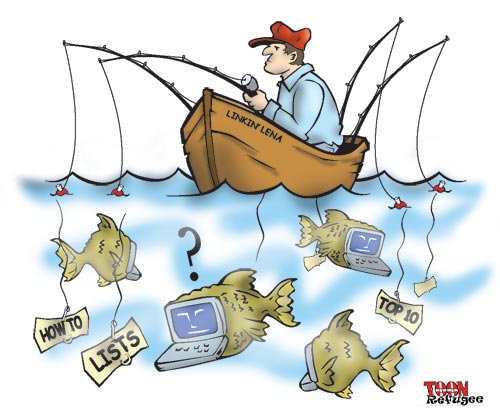
This morning I got a press release from the P.R. Firm for a well-known men’s magazine that was so obviously link-bait, that I almost didn’t even want to read it. I won’t say who or what, mostly because I’m tired of playing into their hands, but most of you will no doubt be able to figure it out.

It’s something I’ve been guilty of time and time again. When I see something that annoys me, or strikes me as being wrong on some level, I often feel compelled to intercede. I’m seeking help.

A few years ago, I definitely would have penned an angry response, pointing out the flawed reasoning, or what have you. But I think I’m done, at least I hope so. I was bcc’d (thankfully) so I have no way of knowing just how many people the P.R. firm was trying to bait with their e-mail, but I suspect it was a lot of people. The e-mail itself used the most incendiary quotes from the piece, obviously designed to raise the hackles of the beer community and rally support against the piece, all in an effort to get thousands of people to visit the website and get their hit count going through the roof.

types-of-Linkbaits

Essentially, this has become a strategy on the internet. Say something incendiary, and reap the rewards. Maybe some of the people actually believe what they’re writing, but I get the sense that even if that’s the case, they do it in such a way as to maximize the outrage, and thus insure a greater number of responses. Often, I think, the extreme position taken is done precisely to get a rise out of people. I think it’s become a variation of the old saw about there being no such thing as bad publicity, in this case more along the lines of as long as people are clicking on the link, it doesn’t matter what they say or whether it’s even true or not. All that matters is the hit count. Oscar Wilde was saying something similar in the 19th century. “The only thing worse than being talked about is not being talked about.”

Sadly, there are all sorts of helpful websites explaining just how to accomplish this. See, for example, the SEO Guide to Creating Viral Linkbait, The Marketer’s Ultimate Guide to Link Bait, or SEO Advice: linkbait and linkbaiting. There’s even a helpful infographic and a link bait title generator. While most of them insist that not all link bait is bad, in our little part of the interwebs, that hasn’t been my experience.

I think I’ve just grown weary of hearing why the bubble is about to burst, or why you hate hops or beer with flavor, or that you drink your beer out of a plastic cup as god intended. Please, stop. Okay, I’m certain that won’t work. No plea for sanity every has. So instead I’d like to propose that we all agree to ignore them. That’s really the only way to make them stop. If we all ignore the link bait, and they don’t get the expected backlash they’re hoping for, then they’ll have no choice but to stop trying.

Having a different opinion or wanting to spark a meaningful discussion about it will remain an excellent reason to pen a thoughtful blog post or article. But taking an opinion that’s designed to provoke outrage with inflammatory language, fringe positions, or by insulting entire swaths of people has no place in the marketplace of ideas that the beer blogosphere should aspire to. Just say know.

ElBaitShopLogo

Don’t take the bait

Filed Under: Beers, Editorial, Politics & Law Tagged With: Blogging, Mainstream Coverage, Websites

The Drunkard’s Cloak

October 13, 2014 By Jay Brooks

barrel
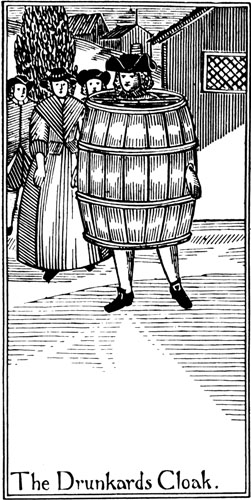
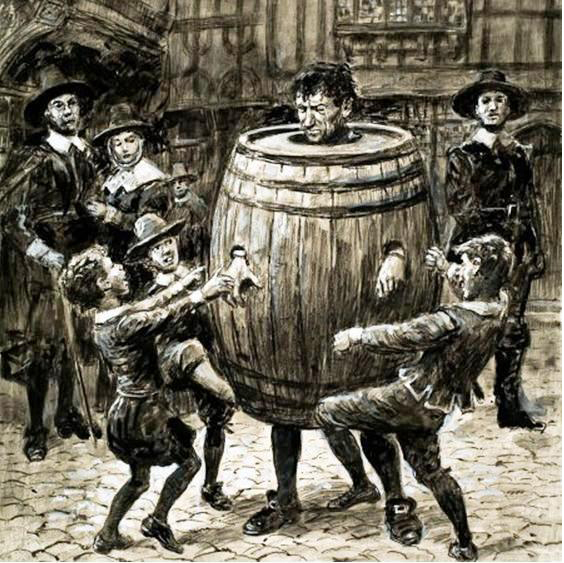
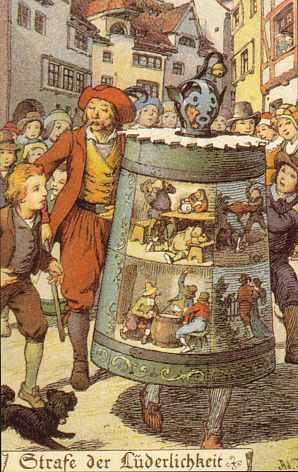
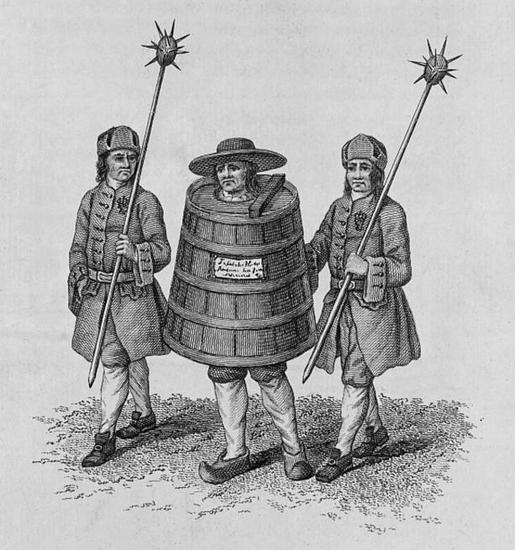
Once upon a time, society kept everybody in line through social pressure, and if that didn’t work, public humiliation. The pillory was a common punishment, and you’re undoubtedly familiar with the main type, a wooden stake with two perpendicular pieces of wood that fit together, with holes for a person’s head and both hands, so that once all three were secured, you were stuck in the public square for a period of time depending on the severity of your crime. But that was only the most common type, and there were several others, such as the scold’s bridle or the jougs. But there was also a specific pillory used in the case of public drunkenness. In England, it was known as a Drunkard’s Cloak.

According to one source, “Drunkenness was first made a civil offence in England by the Ale Houses Act 1551 and the drunkard’s cloak became a common method of punishing recidivists, especially during the Commonwealth of England. From 1655 Oliver Cromwell suppressed many of England’s alehouses, particularly in Royalist areas, and the authorities made regular use of the cloak.”

The 1655 publication England’s Grievance Discovered, by Ralph Gardiner, describes the Drunkard’s Cloak like this.

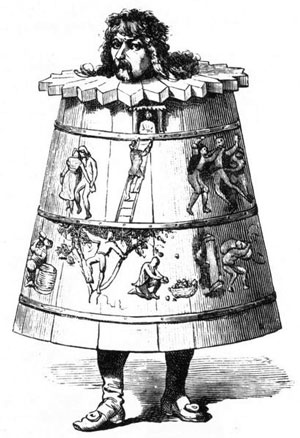
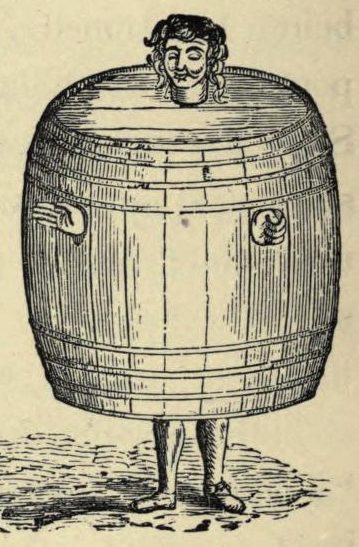
Men drove up and down the streets, with a great tub, or barrel, opened in the sides, with a hole in one end, to put through their heads, and to cover their shoulders and bodies, down to the small of their legs, and then close the same, called the new fashioned cloak, and so make them march to the view of all beholders; and this is their punishment for drunkards, or the like.

“Drunkards are to pay a fine of five shillings to the poor, to be paid within one week, or be set in.”

drunkards-cloak

In 1655, John Willis claimed that in Newcastle-upon-Tyne, England, “he hath seen men drove up and down the streets with a great tub or barrel opened in the sides, with a hole in one end to put through their heads, and so cover their shoulders and bodies, down to the small of their legs, and then close the same, called the newfangled cloak, and so make them march to the view of all beholders; and this is their punishments for drunkards and the like.”

1655-barrel-for-drunk

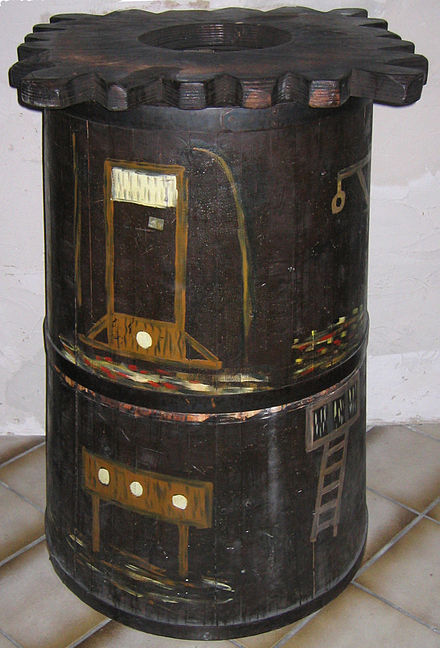
It was also used in other parts of Europe, though often called by different names, such as the Spanish Mantle or the Barrel Pillory. In Germany, it was called a Schandmantel, which means “coat of shame” or “barrel of shame.”

schandmantel

And there’s actual one in the torture museum in Freiburg im Breisgau, Germany.

Fomfr_schandmantel

By some accounts, the Spanish Mantle may have been a more serious torture device, intended to inflict more than just humiliation.

spanish-mantle

A 1641 diary entry by John Evelyn described one in Delft, Holland as “a weighty vessel of wood, not unlike a butter churn, which the adventurous woman that hath two husbands at one time is to wear on her shoulders, her head peeping out at the top only, and so led about the town, as a penance for her incontinence.”

1655-barrel-or-drunkard's-cloak

Apparently this type of punishment was not confined to Europe, and also made its way to the American colonies.

Massachusetts Bay Governor John Winthrop, in 1634, noted that Robert Cole (1598-1655), who had come to Massachusetts with the Winthrop Fleet in 1630, “having been oft punished for drunkenness, was now ordered to wear a red D about his neck for a year.” Some literature professors suggest that this was the origin of the story written by Nathaniel Hawthorne, The Scarlet Letter.

“Robert Cole was living in Roxbury, Massachusetts, when he petitioned to be made a “freeman” on 19 Oct 1630, and was granted that status by the General Court on 18 May 1631, along with 113 other men. He was disfranchised 4 Mar 1634, for a short time on account of his problem with drinking too much wine, when he was also ordered to wear a red letter “D” on his clothing for a year; however, his freeman status was reinstated about two months later on 14 May 1634, and the requirement to wear the letter ‘D’ was also revoked at that time.”

barrel05

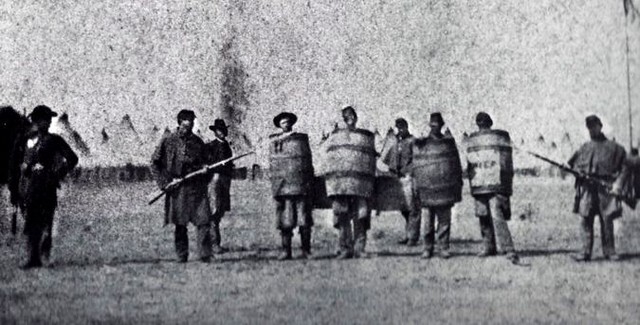
And according to Curious Punishments of Bygone Days, published in 1896 by Alice Morse Earle, it was used during the American Civil War, as well.

Another Union soldier, a member of Company B, Thirteenth Massachusetts Volunteers, writes that while with General Banks at Darnstown, Virginia, he saw a man thus punished who had been found guilty of stealing: With his head in one hole, and his arms in smaller holes on either side of the barrel, placarded “I am a thief,” he was under a corporal’s guard marched with a drum beating the rogue’s march through all the streets of the brigade to which his regiment was attached. Another officer tells me of thus punishing a man who stole liquor. His barrel was ornamented with bottles on either side simulating epaulets, and was labelled “I stole whiskey.” Many other instances might be given. There was usually no military authority for these punishments, but they were simply ordered in cases which seemed too petty for the formality of a court-martial.

This “barrel-shirt,” which was evidently so frequently used in our Civil War, was known as the Drunkard’s Cloak, and it was largely employed in past centuries on the Continent.

Barrel_Shirt_Punishment

Another eyewitness account from 1862 described the scene as follows. “One wretched delinquent was gratuitously framed in oak, his head being thrust through a hole cut in one end of a barrel, the other end of which had been removed; and the poor fellow loafed about in the most disconsolate manner, looking for all the world like a half-hatched chicken.”

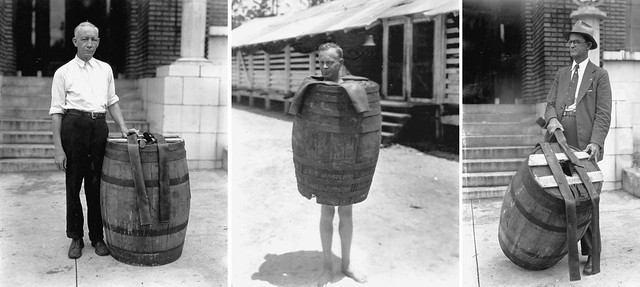
Surprisingly, the most recent example I found for the Drunkard’s Cloak was in 1932, when it was still in use in American prisons, such as the Sunbeam Prison Camp, in Florida, which is where the photo below was taken.

Sunbeam-Prison-Camp_Florida-1932

I’m certainly glad that public shaming has, for the most part, been removed from our justice system. Although I’ve never been arrested for public drunkenness, I’ve certainly made a fool of myself in private or with friends, and this certainly seems a bit excessive. Clearly, it was ineffective at controlling peoples’ behavior, but I wonder what it was in the end that finally stopped it being used as a punishment?

Filed Under: Beers, Just For Fun, Politics & Law Tagged With: History, Law

Misusing Data

October 8, 2014 By Jay Brooks

data
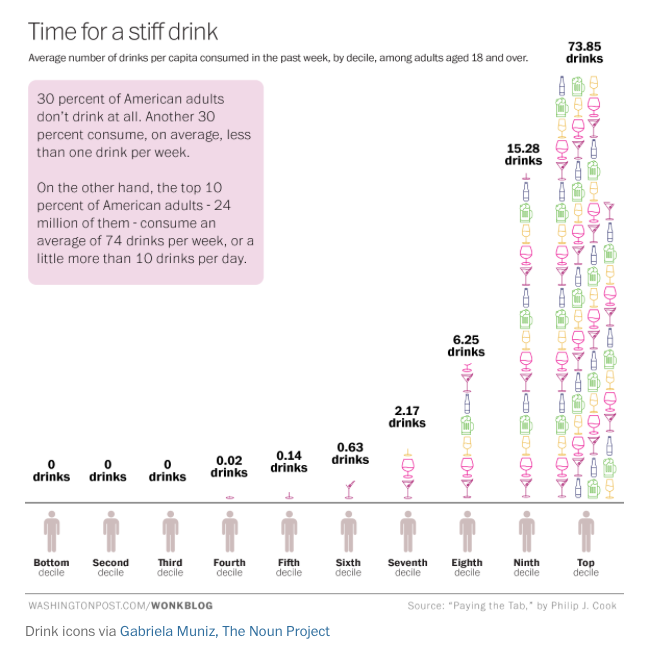
As I’ve written time and time again, lying with statistics may not be the oldest profession, but it’s got to be pretty close. Alright, I may be exaggerating slightly. Modern propaganda and the P.R. machine got going around the time of the First World War, with many of the profession’s leading lights coming out of that time period — Edward Bernays, Walter Lippmann, Ivy Lee. But it’s a powerful tool of the propagandist today, especially the numerous prohibitionist groups and anti-alcohol organizations. So when I saw Think you drink a lot? This chart will tell you last month on the Washington Post’s Wonkblog, I noted it with suspicion and made a note to look at it closer when I had the time. What got my spidey senses tingling was the idea that “the top 10 percent of drinkers account for well over half of the alcohol consumed in any given year.” Here’s the chart the article ran, showing the data for that conclusion.

wonkblogchart

Although it shows the common Pareto Principle, it just didn’t ring true. That many people can’t, and don’t, drink that heavily. I knew there had to be another explanation for this data. And there is. Trevor Butterworth, writing for Forbes, did the heavy lifting on this one with his wonderful expose, When Data Journalism Goes Wrong. It turns out that when you drill down the data, looking at its source and analysis, things begin to unravel. Apparently the results of the original poll had the data manipulated by nearly doubling them to account for a perceived problem with under-reporting. To put that another way, the data was “fixed.” One of the problems with that (there are many, many, I’d say) is that people looking for data to support an agenda tend to seize on such manipulated data and pass it on, using it in their propaganda, and the mainstream media tends to fall for it uncritically, rarely looking at where the original information came from or how it was gathered. Happily, Butterworth does a good job of demonstrating where it all went wrong, and I urge you to read his entire When Data Journalism Goes Wrong. And a h/t to Maureen Ogle for sending me this. She knows me all too well.

Filed Under: Beers, Editorial, News, Politics & Law Tagged With: Anti-Alcohol, Economics, Prohibitionists, Statistics

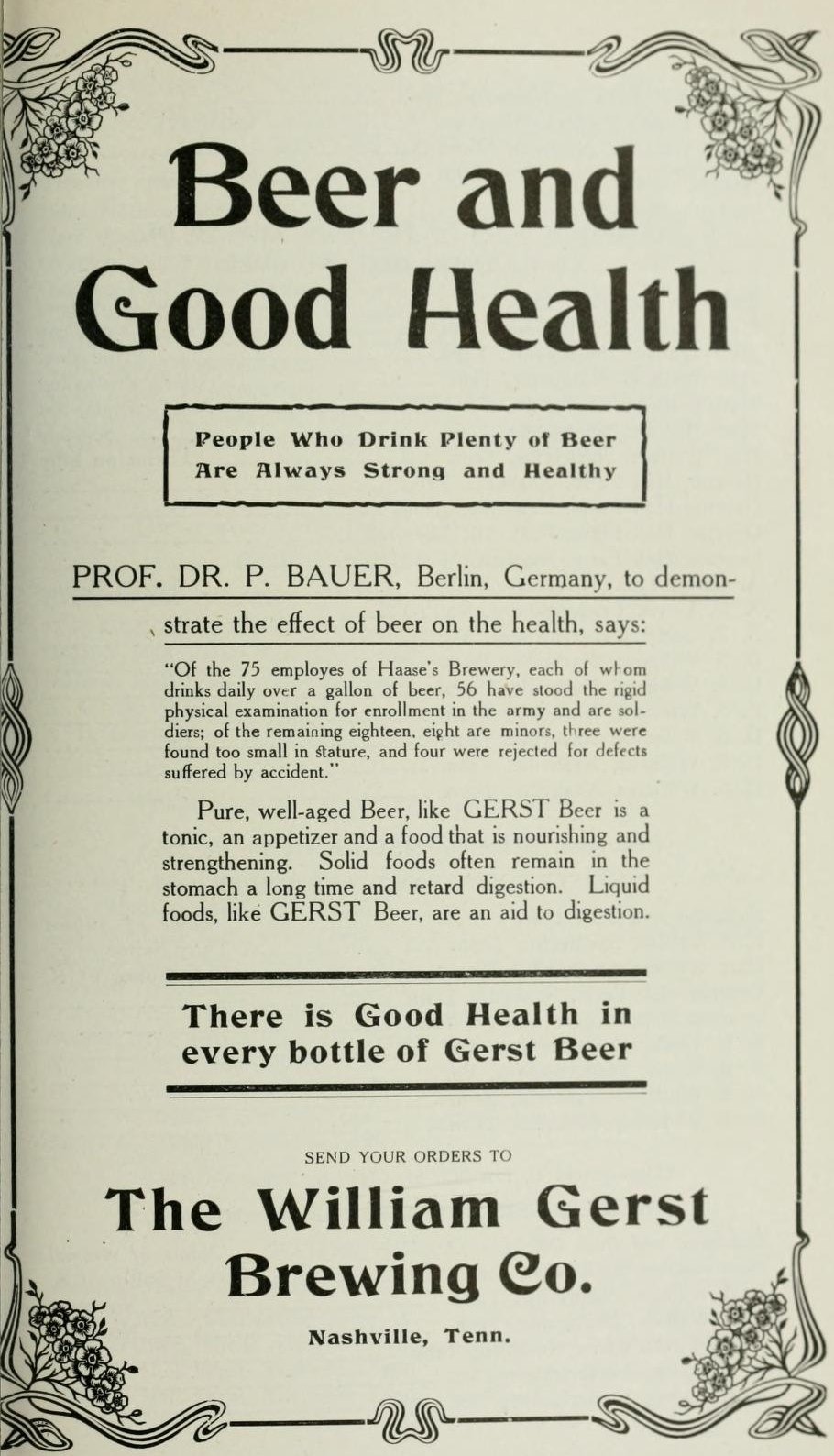
Beer And Good Health, Circa 1907

October 6, 2014 By Jay Brooks

health
Here’s another interesting historical artifact on beer and good health. This is from the Tennessee State Fair Official Souvenir Program and Guide, from 1907, advertising a talk by a German professor, Dr. P. Bauer, “demonstrating the effect of beer on the health.” It looks like his appearance was sponsored by the William Gerst Brewing Co. of Nashville, Tennessee. One insight he could be expected to give: “Solid foods often remain in the stomach a long time and retard digestion. Liquid foods, like GERST Beer, are an aid to digestion.” Oh, and there’s this subtitle. “People Who Drink Plenty of Beer Are Always Strong and Healthy.” The ad then ends with this branded tagline: “There is Good Health in every bottle of Gerst Beer.”

Good-Health-1907

Filed Under: Beers, Just For Fun, Politics & Law Tagged With: Germany, Health & Beer, History, Tennessee

Where Can You Buy Beer In Grocery Stores?

September 24, 2014 By Jay Brooks

grocery-cart
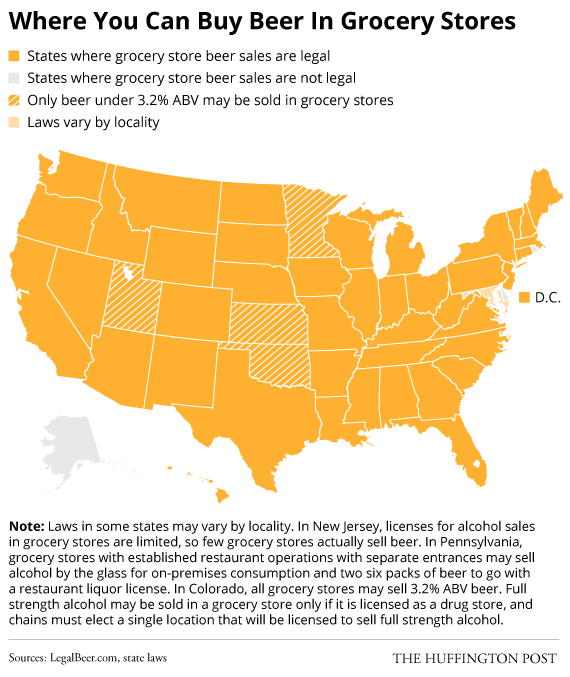
Late last month, the Huffington Post, of all place, actually had an interesting series of charts detailing the availability of different kinds of alcohol in each state. In Here Are The Rules To Buying Alcohol In Each State’s Grocery Stores they have charts for beer, wine, spirits and where you can but alcohol on Sundays. Check out the post for all of the charts, although the beer chart is below, which used data provided by Legal Beer.

where-you-can-buy-beer

Filed Under: Beers, Just For Fun, Politics & Law Tagged With: Infographics, Law, Statistics, United States

« Previous Page
Next Page »

Find Something

Northern California Breweries

Please consider purchasing my latest book, California Breweries North, available from Amazon, or ask for it at your local bookstore.

Recent Comments

  • Bob Paolino on Beer Birthday: Grant Johnston
  • Gambrinus on Historic Beer Birthday: A.J. Houghton
  • Ernie Dewing on Historic Beer Birthday: Charles William Bergner 
  • Steve 'Pudgy' De Rose on Historic Beer Birthday: Jacob Schmidt
  • Jay Brooks on Beer Birthday: Bill Owens

Recent Posts

  • Beer In Ads #5213: Bock Beer Cascade Quality April 9, 2026
  • Historic Beer Birthday: Otto Schinkel Jr. April 9, 2026
  • Historic Beer Birthday: Johann Sedlmayr April 9, 2026
  • Beer In Ads #5212: Metz Bock Beer April 9, 2026
  • Historic Beer Birthday: Ralph Thrale April 9, 2026

BBB Archives

Feedback

Head Quarter
This site is hosted and maintained by H25Q.dev. Any questions or comments for the webmaster can be directed here.