Wednesday’s ad is for Bass Ale, from 1967. Showing some antique chess pieces with a cool photograph, trying to assert that they’ll appeal to people who “appreciate the best,” suggesting those are also Bass drinkers. Hmm.
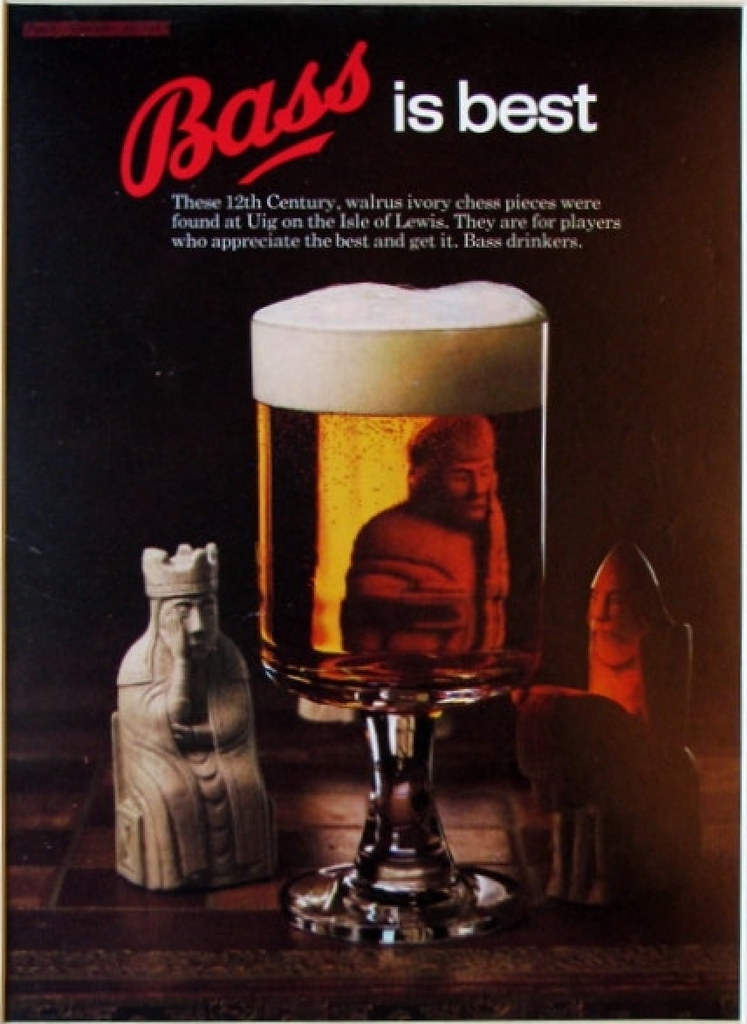

Wednesday’s ad is for Bass Ale, from 1967. Showing some antique chess pieces with a cool photograph, trying to assert that they’ll appeal to people who “appreciate the best,” suggesting those are also Bass drinkers. Hmm.

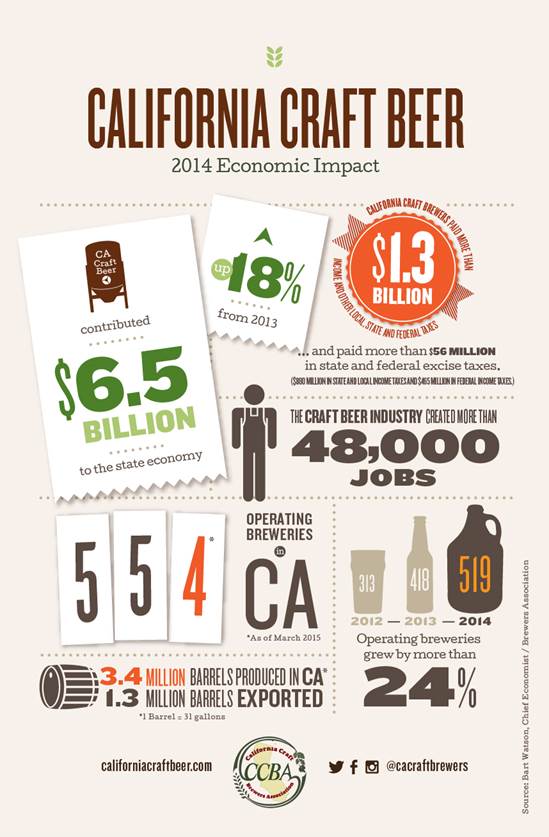
The California Craft Brewers Association (CCBA) recently commissioned an economic impact study of the state’s brewing industry for last year. And the news is pretty great. Here’s some of the highlights:
Economic Impact: In 2014 craft beer contributed more than $6.5 billion to the economy of California. That’s up 18% from 2013. That’s a fairly conservative number and they’ll have a more accurate and most likely higher numbers in June when the full report is finished. The craft beer industry in California has a higher economic impact than any other state in the US.
Employment: In 2014 Craft Brewers employed more than 48,000 Californians.
Growth: During 2014 the number of operating breweries grew by over 24% giving us a total of 520 operating breweries in California.
Taxes: In 2014 California craft brewers paid over $56 million in State and federal excise taxes and paid more than $1.3 billion in income and other local, state and federal taxes ($880 million in state and local income taxes and $465 in federal income taxes).
Production Volume: 3.5 Million Barrels
Exports: 1.3 million barrels. (That’s still higher than the total production of all but two other states (PA and CO)).

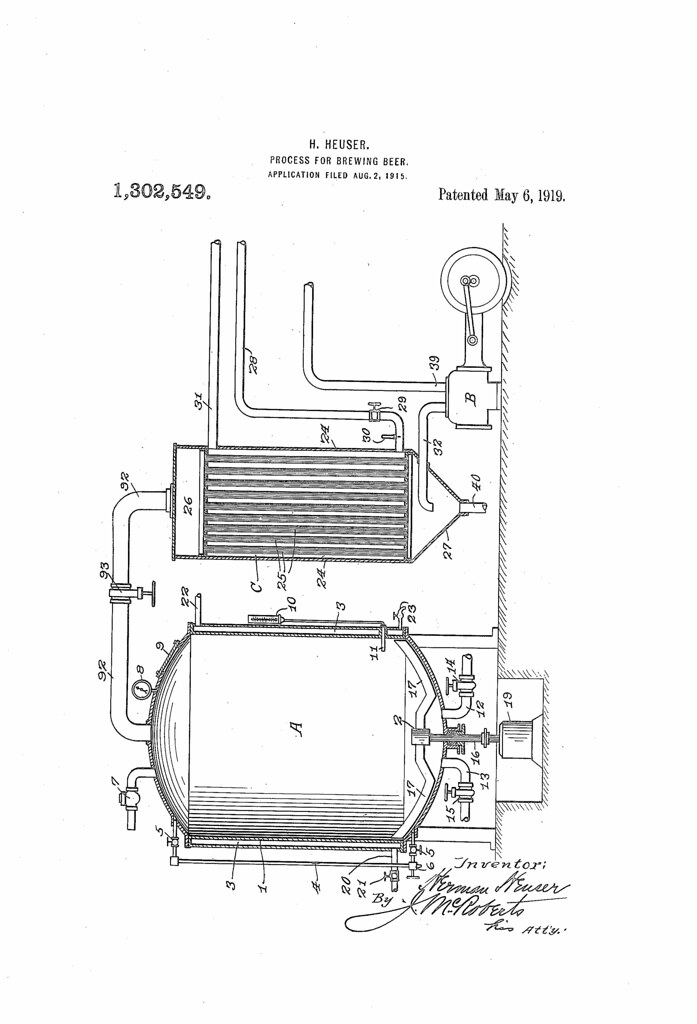
Today in 1919, US Patent 1302549 A was issued, an invention of Herman Hausen, for his “Process For Brewing Beer.” There’s no Abstract, but as Prohibition began, the invention was specifically for non-alcoholic beer to satisfy demand for at least the taste of beer once the regular kind was outlawed. Here’s a fuller explanation.
My invention relates to the manufacture of non-alcoholic beer, of beer containing less than one-half of one percent of alcohol, and of temperance beer. In the processes heretofore employed for making such beverages, the de-alcoholizing occurs by distillation of the alcohol after the liquid vis fermented or the beer brewed. These old processes involve certain disadvantages which are obviated by my invention, which, generally speaking, consists in simultaneously boiling and fermenting the beer wort in a vacuum and within the range of beer fermentation temperatures at which the activity of the yeast is not destroyed to evaporate the alcohol and preserve live yeast in In the accompanying drawing I show more or less diagrammatically and mostly in sectional view all the apparatus required to carry out my new process.
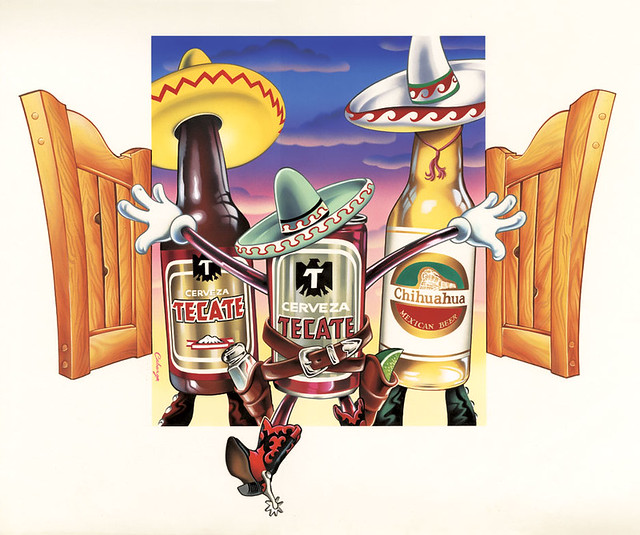
Tuesday’s ad, for Cinco de Mayo, is for Tecate beer, from 1988. The cartoon art was created by Leslie Cabarga and used by Tecate in a series of ads that summer, and was even made into a poster. Showing two Tecates, a bottle and a can, though the can is clearly the leader, along with a bottle of Chihuahua (which I recall selling at BevMo for $2.99 per six-pack), making an entrance into a wild west saloon. Notice the can has a bottle of salt and a lime in his holsters. It’s a pretty cheesy ad, but this was also the same time 7-Up was advertising using a spot with arms and legs, and California raisins were similarly animated, so maybe it was popular.
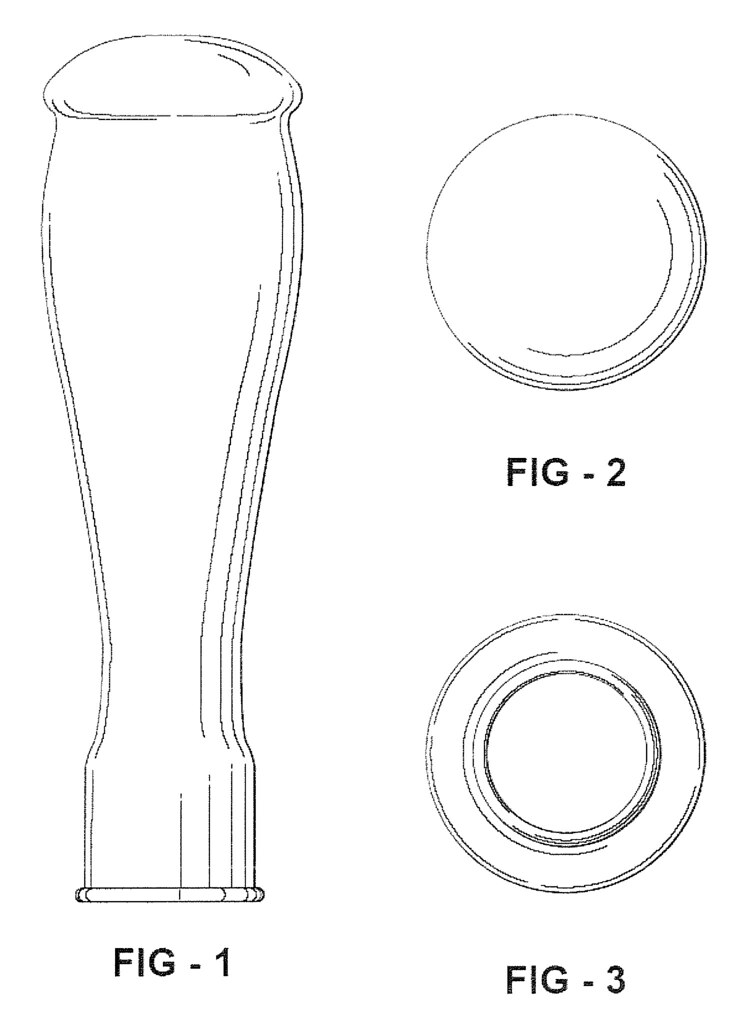
Today in 2009, US Patent D591850 S1 was issued, an invention of Brian Osterberg, for his “Filled Beer Glass Shaped Condom.” There’s no Abstract, and there’s not much to say about it, other than his invention is the “ornamental design for a filled beer glass shaped condom.” I probably should have waited until after dark to post this one. Seeing it reminded me of a passage from a book I read when I was a kid: Summer of ’42, by Herman Raucher. There’s a scene in the book where the 15-year old protagonist, Hermie, goes to the drug store to buy condoms. Looking over the packaging, in his head he’s imagining that the color of the box matches the condom itself, and thinks to himself. “Plaid, that’s enough to send a young girl screaming into the night!” I can’t imagine one that look like a full glass of beer, that just seems weird.
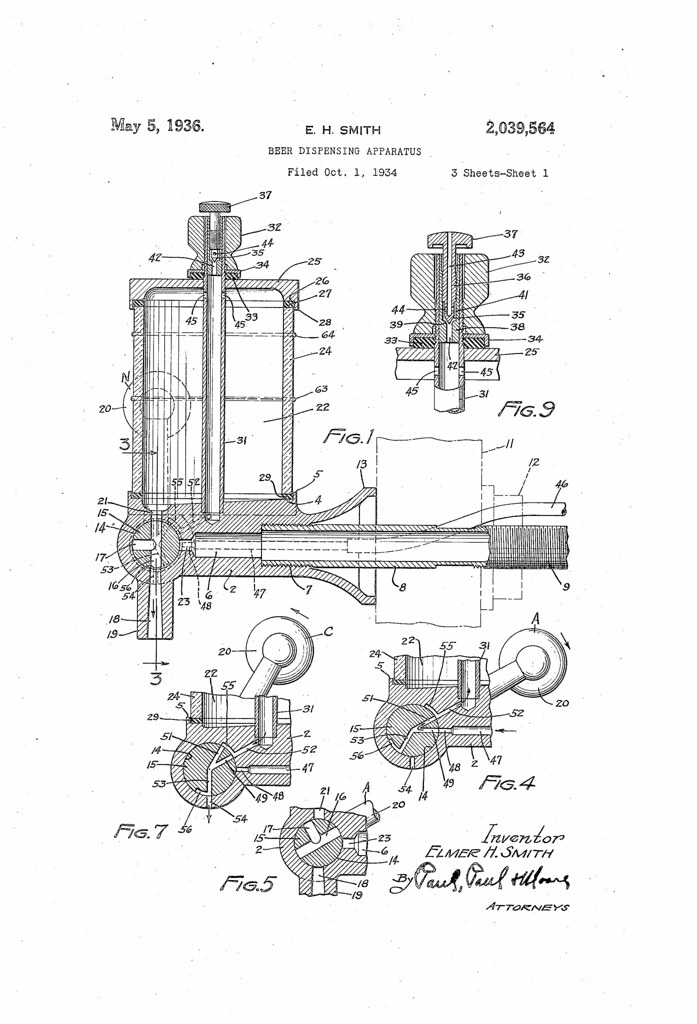
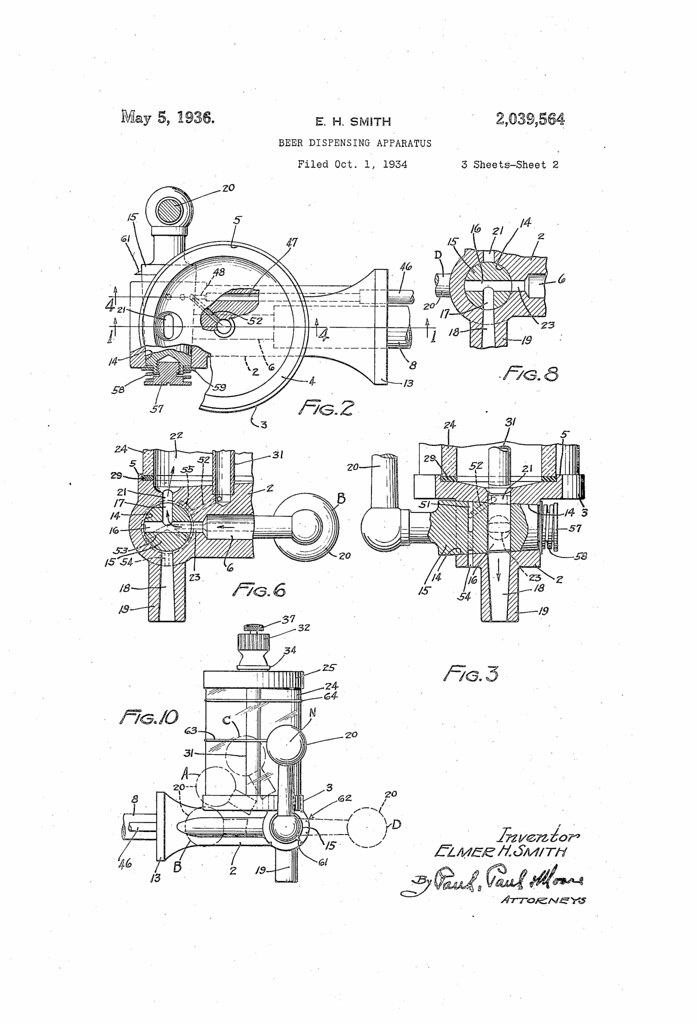
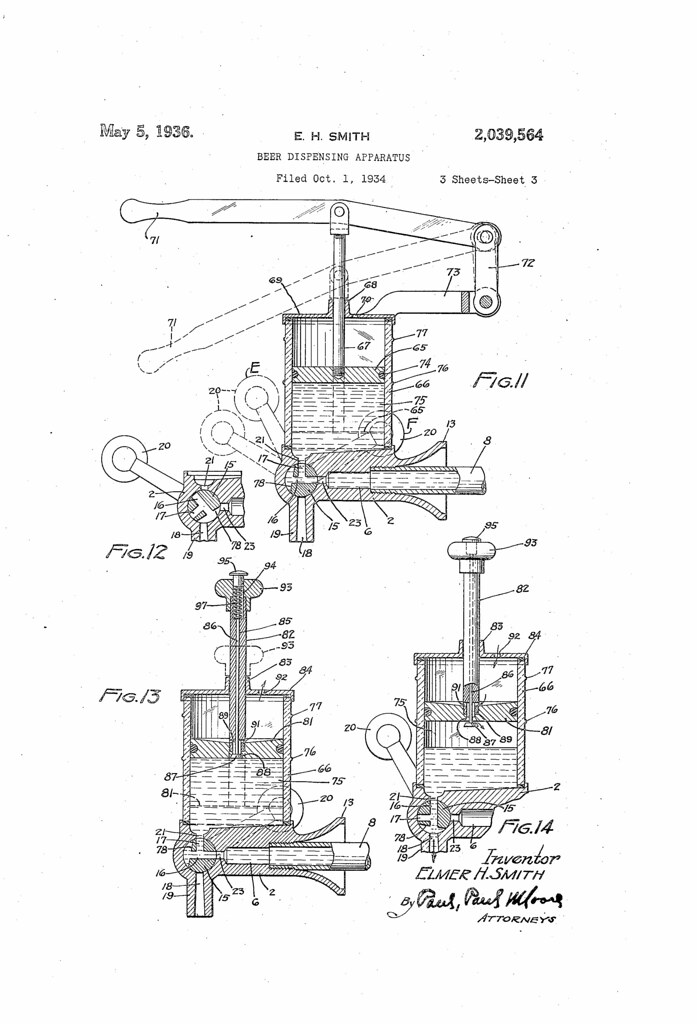
Today in 1936, US Patent 2039564 A was issued, an invention of Elmer H. Smith, for his “Beer Dispensing Apparatus.” There’s no Abstract, but in the description it states that his “invention relates to new and useful improvements in beer dispensing apparatus, and more particularly to a beer dispensing faucet having means embodied in the construction thereof, whereby the beer, regardless of the pressure on, the beer at its source, may be dispensed into, a glass or suitable container without excessive foam.”
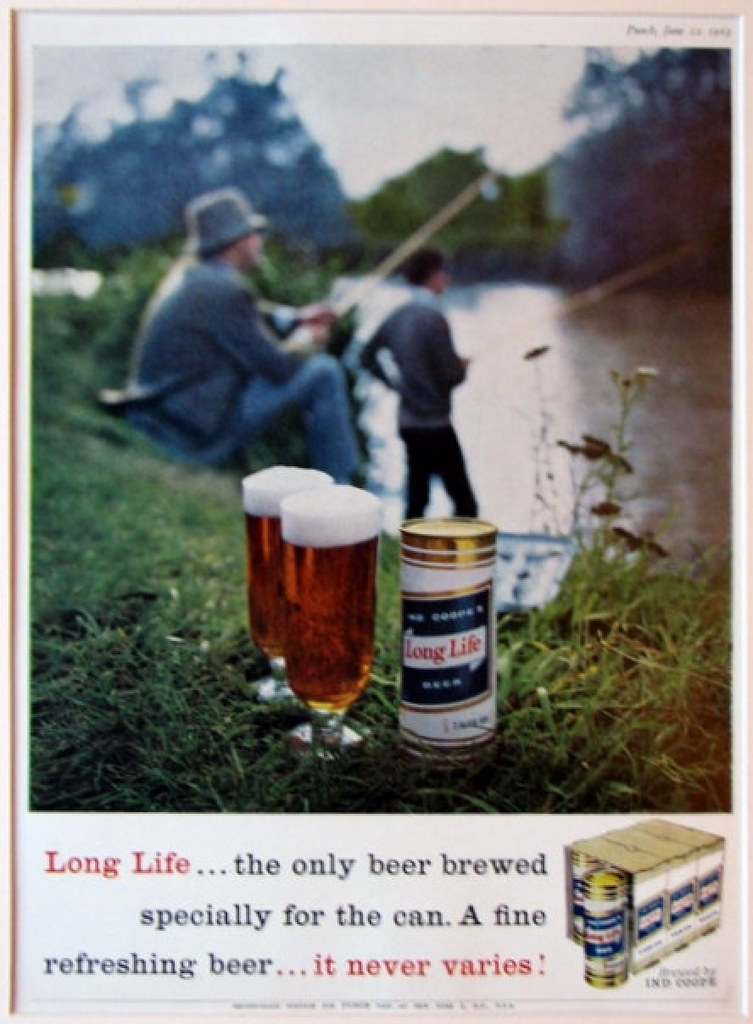
Monday’s ad is for Long Life, from 1963. The canned beer Long Life Beer was made by Ind Coope beginning in the 1950s, making it one of the early beers in cans in the UK. They launched a series of ads claiming that the recipe was formulated specifically for the can, and as a result “it never varies!” But it certainly looks good for out-of-focus fishing.

For some reason I really got caught up in the hoopla of Star Wars Day today. But what about beer and Star Wars, you might ask? Believe it or not, I found something. It’s an interesting fan film made in Australia, entitled Star Wars Downunder. It’s shot in 35mm and took 10 years to make, directed and co-written by Michael Cox. And because it’s Australian, it’s also about beer. The creators describe it by asking “what would happen if you crossed Star Wars with an Australian beer commercial?” And their answer was “Star Wars Downunder: an epic tale of the good the bad and the thirsty, described as “half an hour of action, special effects and lovable Aussie larakins.” On the film’s website, they recount the plot as follows:
The film tells the story of a lone Jedi: Merve Bushwacker (David Nicoll), returning home after a long absence. His mission? To partake in a refreshing beverage, known locally as amber fluid. On his arrival, he is dismayed to discover the planet has become as dry as a dead dingo′s donger, thanks to the tyrannical rule of Darth Drongo. Drongo has hoarded all the amber fluid in his impenetrable fortress “Dunny’s Deep” for reasons unknown. Can Merve, and a motley collection of unlikely allies band together to topple Drongo’s evil regime? Will liberty and amber fluid flow freely once more?
As many reporting on the film lament, there’s no scene in which the character says: “That’s not a loightsabah! THAT’S a loightsabah!” And while that would have been hilarious, there are, however, lightsaber boomerangs, because … well, why wouldn’t there be? Here’s the trailer:
Star Wars Downunder Trailer from Michael Cox on Vimeo.

Intrigued? You’re in luck, because you can watch the entire 30-minute film on YouTube, or below.
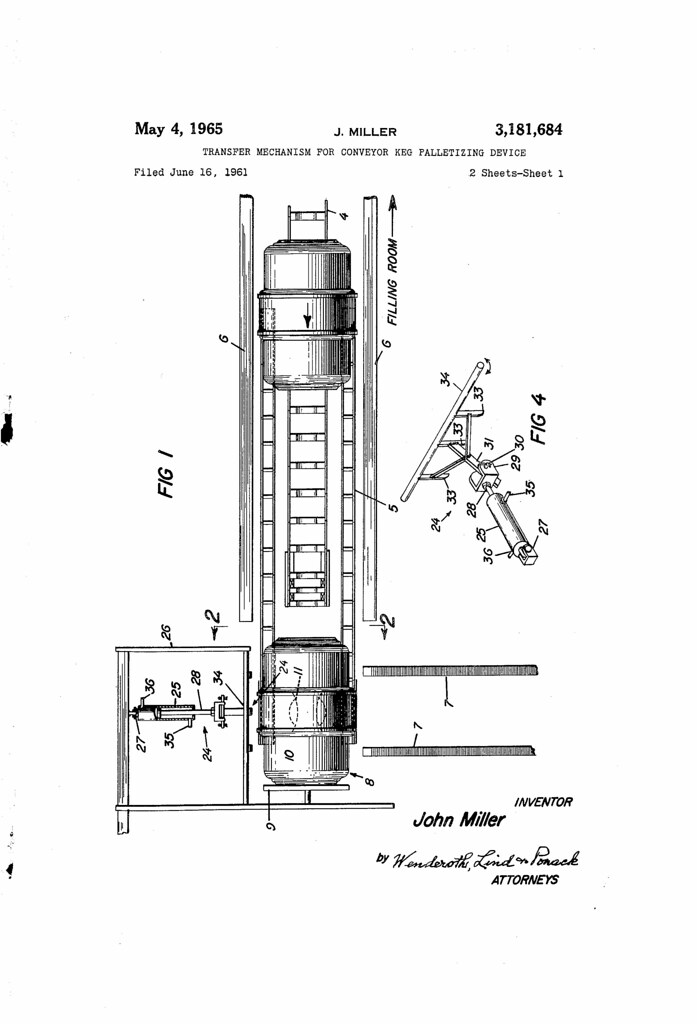
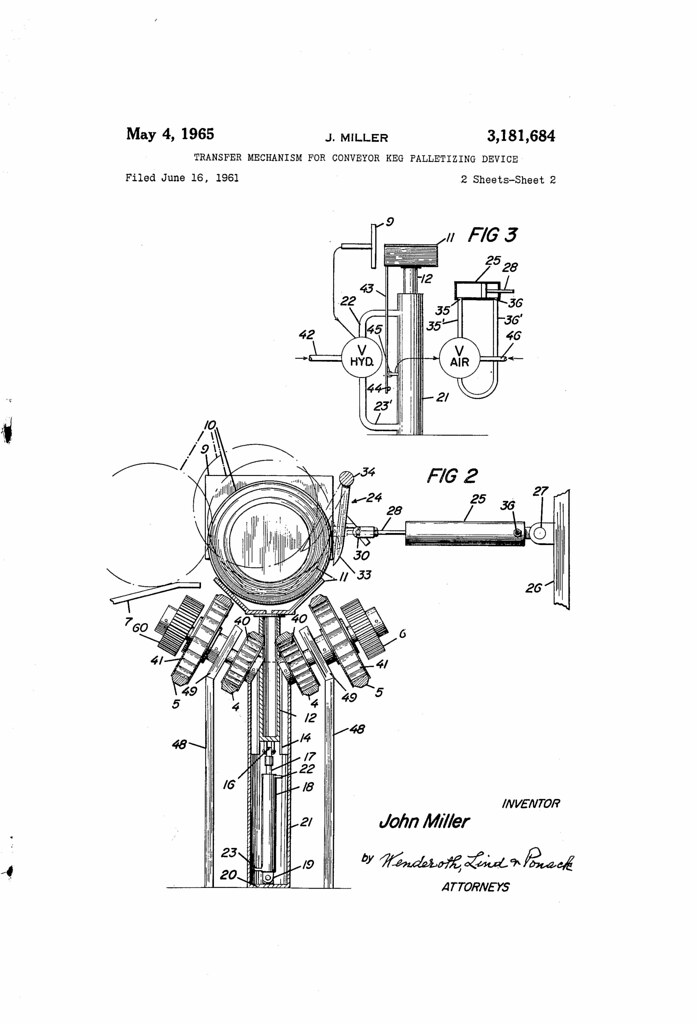
Today in 1965, US Patent 3181684 A was issued, an invention of John Miller, assigned to Schaefer Brewing Co., for his “Transfer Mechanism For Conveyor Keg Palletizing Device.” There’s no Abstract, but in the description it states that his “invention is to provide a more efficient transfer mechanism for the barrels or kegs and particularly such a transfer mechanism which is more reliable and sure in operation in transferring the barrels or kegs from the conveyor to the skids which convey such barrels or kegs to the palletizing position.”
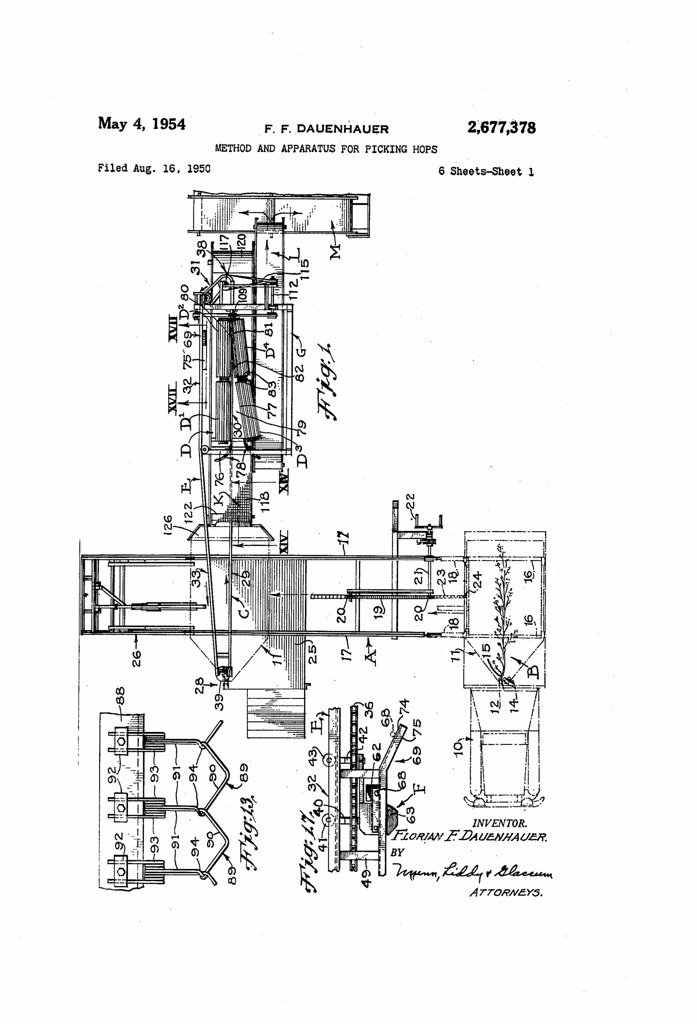
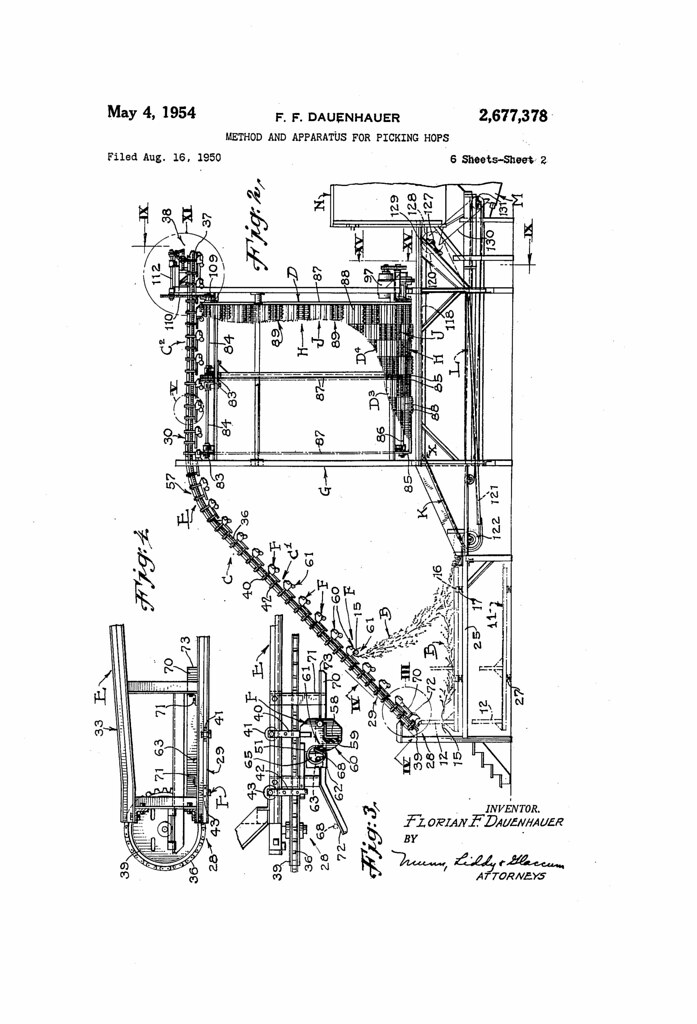
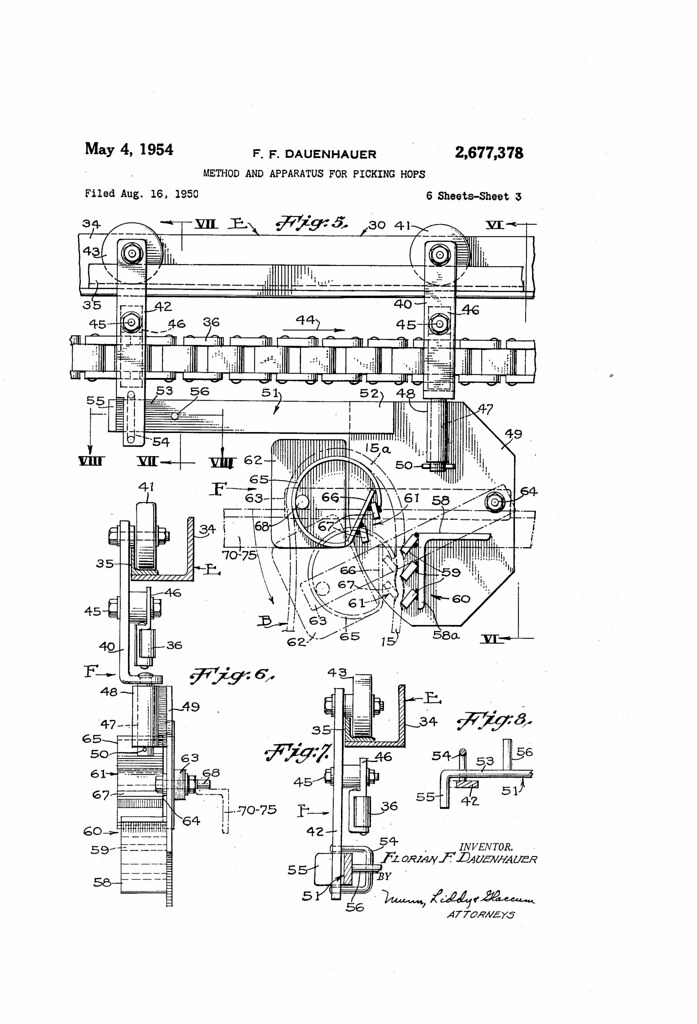
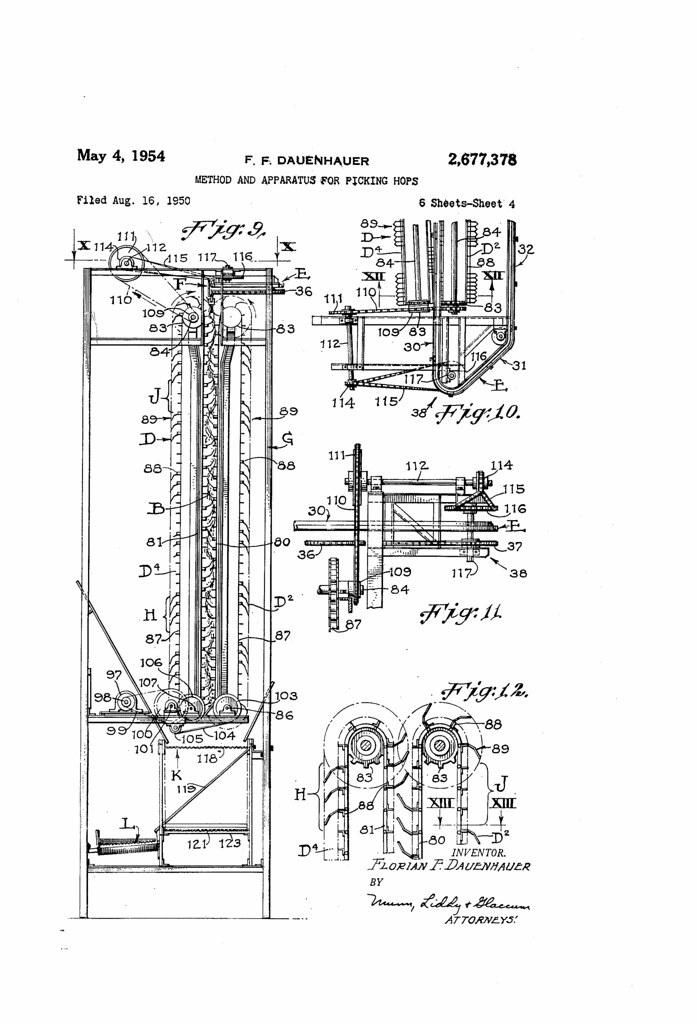
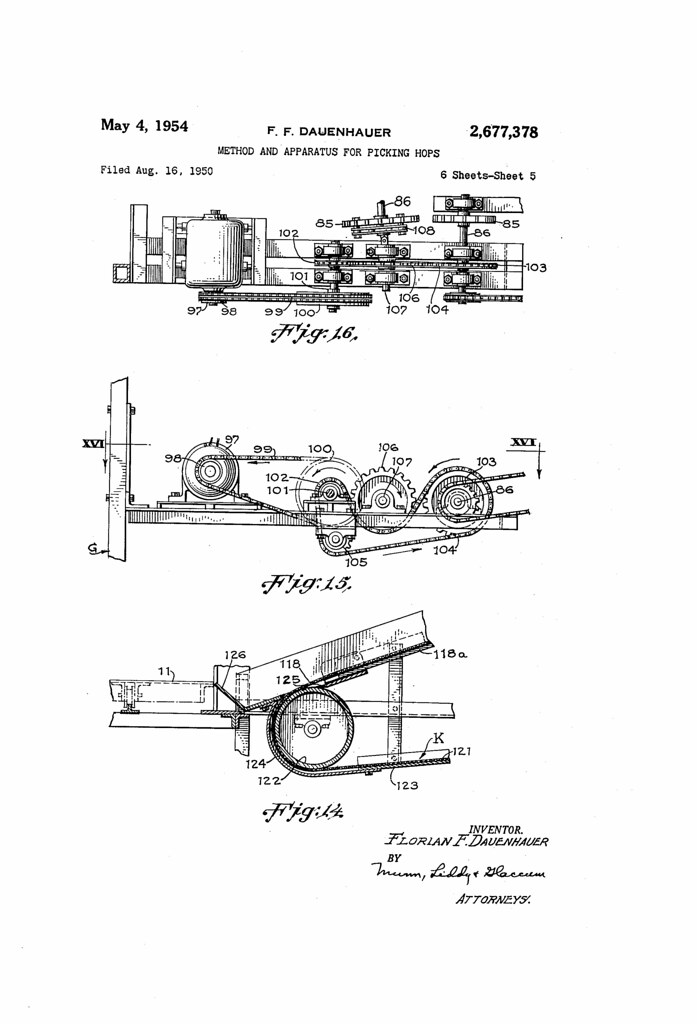
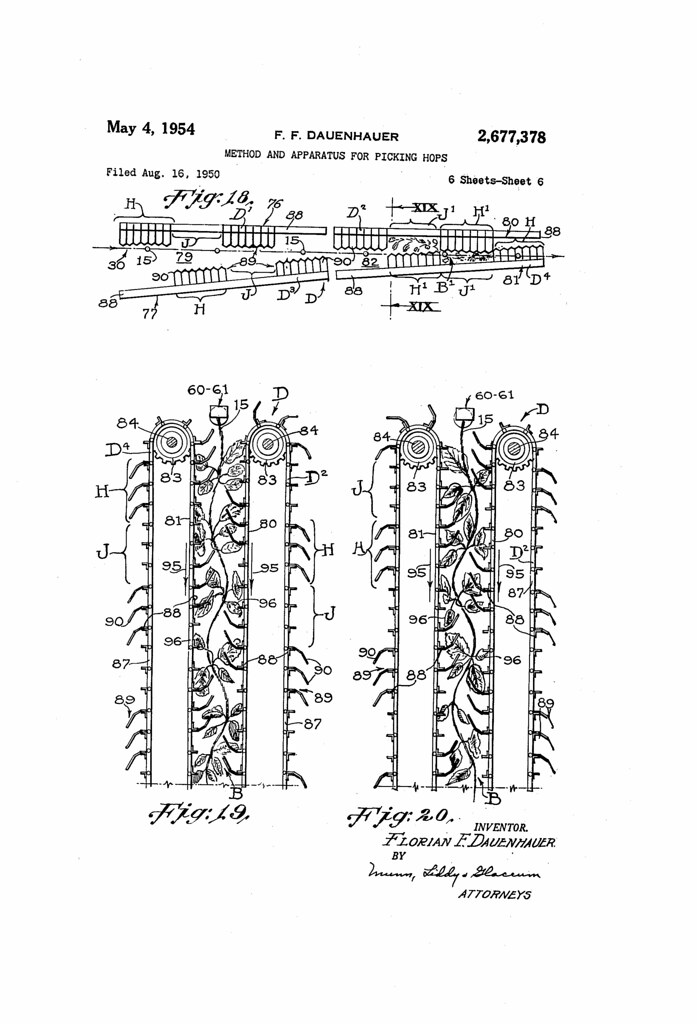
Today in 1954, US Patent 2677378 A was issued, an invention of Florian F. Dauenhauer, for his “Method and Apparatus for Picking Hops.” There’s no Abstract, but in the description it states that his “present invention relates to improvements in a method and apparatus for picking hops.”
An object of this invention is to provide an improved method of picking hops from vines, assuring a thorough removal of the hops, with out damaging the hops. More specifically stated, the vines are formed into wave-like configurations, defining alternate crests and valleys extending lengthwise of the vines.
The waves thus formed are advanced lengthwise of the vines to continually replace crests by valleys and vice versa, thereby undulating the vines in first one direction and then the other for causing pendulum-like movements and exposure of the hops by the continual weaving of the vines. The hops are removed during the undulating of the vines.
Moreover, the method employs the progressive increasing of the amplitudes of the waves as the hops are picked. Also, crests and valleys of the waves are interchanged abruptly as the picking of the hops continue, and the branches of the vines are spread out laterally to expose hops and preclude the vines from matting.