
Today’s comic strip Pearls Before Swine, written by former San Francisco attorney Stephan Pastis, took a funny swipe at Anheuser-Busch InBev. [Thanks to Motor for sending me the strip.]
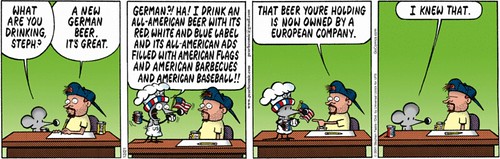

Today’s comic strip Pearls Before Swine, written by former San Francisco attorney Stephan Pastis, took a funny swipe at Anheuser-Busch InBev. [Thanks to Motor for sending me the strip.]

Business Week had an interesting article in the beginning of the month on New Belgium Brewing entitled New Belgium and the Battle of the Microbrews. It’s lengthy — at four online pages — and features an in depth interview with Kim Jordan and the future of her brewery and the craft beer industry as a whole. [And thanks to Michael O. for sending me the link.]

Tuesday’s holiday ad is for the Canadian beer Dow Ale, which until around 1966, was the most popular beer in Quebec. This ad looks to be a little earlier, probably in the 1950s. Given that red is he only color (apart from black, of course) in the ad, it’s curious that they didn’t make Santa’s suit red, too, but I suppose they wanted to keep the focus on the beer. “Look what they’ve left me me!” I hope every home didn’t leave Santa a case. He’d never get to all the houses in one night, or he’d probably get pulled over by the air force for flying erratically.


You may recall that in late October Jester King Sued Texas Over Antiquated Beer Regulations. I just got a press release from Jester King Craft Brewery that the judge in the case has ruled in their favor on their first amendment claims, though he did reject their claims under the Equal Protection Clause and the Commerce Clause. Here’s the news:
Yesterday afternoon, Judge Sam Sparks of the United States District Court for the Western District of Texas issued his final judgment on the case that Jester King Brewery and our two co-plaintiffs, Authentic Beverage Company and Zax Restaurant & Bar, filed against the Texas Alcoholic Beverage Commission. With respect to all of the First Amendment challenges to the current state law, he ruled in our favor, declaring the statutes and TABC rules in question unconstitutional and therefore invalid. Congratulations and many thanks to our attorneys, Jim Houchins of Houchins Law and Pete Kennedy of Graves Dougherty Hearon & Moody for taking on this case and for all of the hard work that they put in. Thanks also to Pete’s firm for supporting his efforts and to Jim’s associate, Rachel Fisher, for all of her hard work and diligent research.
As of result of yesterday’s ruling, beer in Texas may now be labeled as “beer” and ale may now be labeled as “ale”, regardless of alcohol content. Breweries and distributors are also no longer prohibited from independently telling consumers where their products may be purchased, or from communicating truthful and accurate information about their alcohol content. That means Jester King will now be able to add a “Where to Buy” section to our website, as will all other breweries selling beer in Texas.
“In a remarkable (though logically dubious) demonstration of circular reasoning” Judge Sparks writes in his ruling, “TABC attempts to defend the constitutional legitimacy of the Code through an appeal to the statutory authority of the Code itself.” Referring to the required use of the terms “beer”, “ale”, and “malt liquor”, he writes “TABC’s argument, combined with artful legislative drafting, could be used to justify any restrictions on commercial speech. For instance, Texas would likely face no (legal) obstacle if it wished to pass a law defining the word ‘milk’ to mean ‘a nocturnal flying mammal that eats insects and employs echolocation.’ Under TABC’s logic, Texas would then be authorized to prohibit use of the word ‘milk’ by producers of a certain liquid dairy product, but also to require Austin promoters to advertise the famous annual ‘Milk Festival’ on the Congress Avenue Bridge.’”
We were disappointed, but not too surprised, that Judge Sparks ruled against our claims that Texas’s disparate treatment of breweries and brewpubs violated the Equal Protection Clause and that its treatment of foreign breweries violated both the Equal Protection Clause and the Commerce Clause. The TABC never gave any reason why Texas should be able to prohibit craft brewers from selling beer to customers on-site, while allowing wineries to do so, or why Texas should be able to favor foreign wineries over foreign breweries, and Judge Sparks did not speculate on why that might be. But the legal standards are different and more demanding for challenges brought under the Equal Protection Clause than the First Amendment, and we were unable to persuade Judge Sparks to strike down these discriminatory laws. We were encouraged, however, by Judge Sparks’s observation that “The State of Texas is lucky the burden of proof was on [the Plaintiffs] for many of its claims, or else the Alcoholic Beverage Code might have fared even worse than it has.”
We’re pleased to have helped to bring about at least a few long overdue changes in the antiquated and often inconsistent Texas Alcoholic Beverage Code, but small brewers still face many unjust and unnecessary obstacles that need to be removed before we can stand on equal footing with Texas winemakers and brewers in other states. Measurable progress was made with yesterday’s decision, but much more is still needed. We don’t yet know what, if anything, will happen next on the legal front. That’s something that we’ll need to discuss with our attorneys. In the meantime, though, it’s not too early to start thinking about the 2013 legislative session, with the hope that this case will help to bring some momentum for further change. For the first time, Texas consumers finally have a well-organized grassroots organization that’s working to modernize the Beverage Code. We, at Jester King Craft Brewery, will continue to do everything we can to support the efforts of Open the Taps and we encourage everyone who is reading this to do the same.
It’s a start. Congratulations to Jester King.

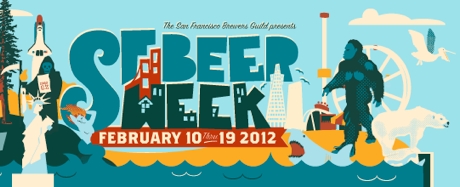
The opening celebration to kick-off SF Beer Week for 2012 has been announced. Having outgrown our space last year, this year it’s been moved to a new, larger location at the Concourse pavilion at the Concourse Exhibition Center in SOMA. Here are the details:
On February 10, 2012, over 50 Northern California breweries will converge on the Concourse in San Francisco for the Opening Celebration of SF Beer Week, which kicks off a ten day marathon of beer tastings, small festivals and food pairing dinners across the Bay Area. From 6-10pm, beer lovers will discover newly minted nanobrewers pouring alongside legendary craft brewing pioneers.
Early bird tickets are now available for $55. Each attendee will receive a commemorative glass and enjoy unlimited samples of new, rare and classic beers. Tickets are expected to go quickly. The event is one of the largest and most anticipated gatherings of the region’s beer community. A complete list of attending breweries will be published in mid January.
This year the Opening Celebration has moved to a larger venue in San Francisco’s SOMA district. The Concourse pavilion will provide a more spacious experience, easier access to the breweries and more food options will be available. Artisan producers from around the Bay will serve up a range of delicious choices for purchase, while live music fills the air.
Tickets are available online, the early bird price is $55. See you there.
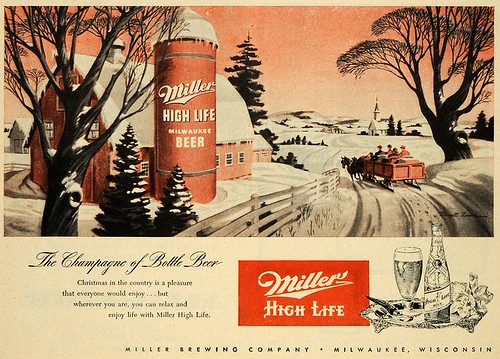
Monday’s holiday ad is for Miller High Life showing an idyllic country scene complete with newly fallen snow, a barn and silo, with a small chapel in the distance, as a horse and sleigh pulls two couples through the white landscape. Ah, Christmas like it never was.

This week’s work of art is by John Lewis Krimmel. He was born in Germany, but emigrated to the U.S. in 1809 to join his brother in Philadelphia. Instead of joining the family business, he took up painting and became well-known for his genre paintings depicting everyday life in the city of brotherly love. One of his most well-known paintings was “The Village Tavern,” painted between 1813-14.
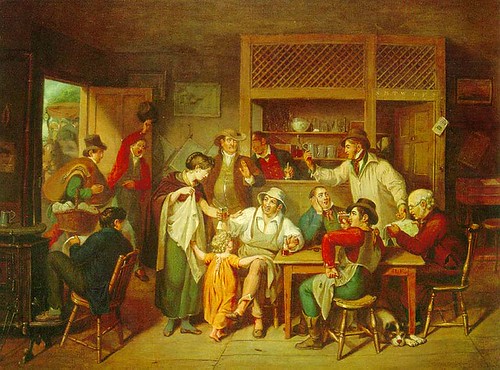
The painting is also sometimes called “In An American Inn,” and just from searching around, it appears their may be more than one of them, as there seem to be various references to both that are very, very similar, but not quite exactly the same, with slightly different colors and with the size of what’s depicted more or less, as if Krimmel painted the exact same scene more than once.
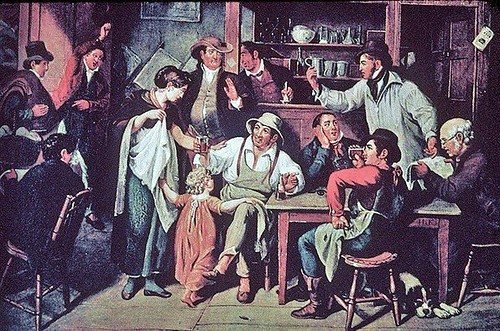
Perhaps most curiously, apparently the painting was used by prohibitionists as propaganda. “The depiction of a mother and daughter trying to persuade the drunken father to come home has caused historians of the temperance movement to praise In an American Inn as the first work of an American artist to illustrate this issue.” But that interpretation does not seem obvious to me. Nothing in the woman or the child’s demeanor suggests to me that they’re trying to persuade the man of anything. And the man is raising his glass to her with a smile on his face. And nobody else around them seems particularly alarmed by them being there. In fact, many people in the tavern don’t seem to be paying them any mind whatsoever, as if their presence is not so unusual. It just looks an old-fashioned scene from the TV show Cheers, with several groups in the inn.
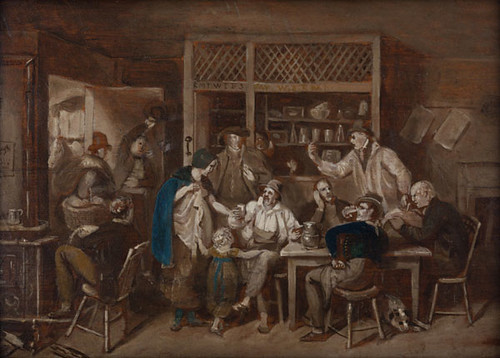
The Woodmere Art Museum has in its collection the “Study for ‘Village Tavern,'” oil on wood panel, also done in 1814.
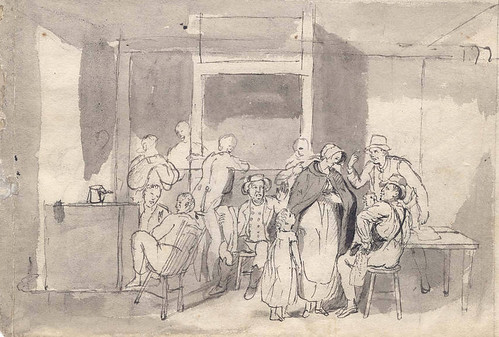
And the Winterthur Library has two early drawings that would eventually become the painting, done in ink and ink wash over pencil.
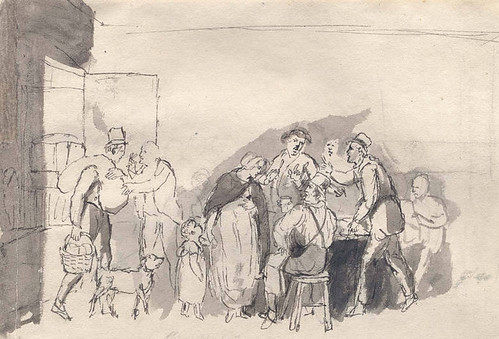
They contain all the elements of the finished work, but you can see the artist trying out different placements for the characters in the painting.
You can read Krimmel’s biography at Wikipedia or at Terra. There are links to more Krimmel resources at the ArtCyclopedia. You can also see more of his work at the Art Renewal Center, Scholar’s Resource, the Philadelphia Academy and the American Gallery.

A couple of years ago, shortly after Anat Baron released her film Beer Wars, people kept asking her which big beer companies owned which beer brands. In December 2009, she put together a list of Who owns what? That inspired to me took take a closer look myself, and that produced my own list, The Bigs Brewers’ Brands. At the time, I had hoped to keep it current, but that’s proved too time-consuming a task and it hasn’t been updated since December 4, 2009.
Now Philip H. Howard, an assistant professor at Michigan State University, in the Department of Community, Agriculture, Recreation and Resource Studies, has created an infographic on the Concentration in the US Beer Industry. The bubble chart seeks to show the major companies selling beer in the U.S. — domestic and imports — and also uses different lines to show arrangements of distribution and partial ownership, where applicable.
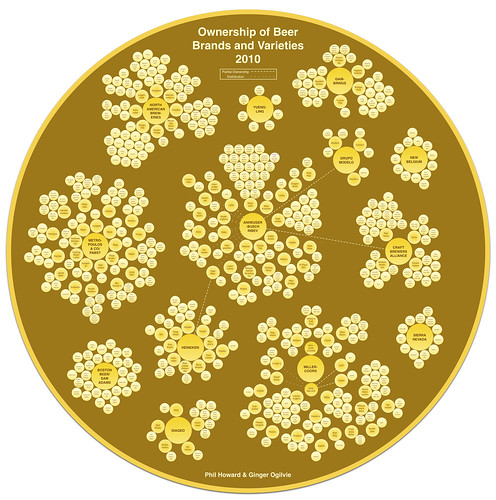
You can see more detail on the full size image, which can be seen here. You can also zoom in using Zoom.It. Howards also notes “that the graphic above focuses on the top 13 firms, and excludes varieties of malt liquor and non-alcoholic beers.”
His write-up also includes the following:
AB InBev owns, co-owns or distributes more than 36 brands, for example, while MillerCoors controls at least 24 more. MillerCoors also brews Metropoulos & Company’s products under contract (thus the company that controls Pabst and 21 other brands is a “virtual” beer company).
Increasing Concentration after World War II
In 1959 the 10th largest brewery in the country (Pabst) acquired the 18th largest brewery (Blatz), resulting in a combined national market share of 4.5%. Seven years later the US Supreme Court reversed the merger, noting that:
If not stopped, this decline in the number of separate competitors and this rise in the share of the market controlled by the larger beer manufacturers are bound to lead to greater and greater concentration of the beer industry into fewer and fewer hands. [Justice Hugo Black in U.S. v. PABST BREWING CO., 384 U.S. 546 (1966)].
Today, just two firms control more than three-quarters of all sales.

Howard also quotes Stephen G. Hannaford, writing in 2007, in Market Domination!: The Impact of Industry Consolidation on Competition, Innovation and Consumer Choice. “The beer industry is not only dominated by two firms, it is dominated by a small number of varieties — just six account for more than half of all sales. The result is an ‘oligopoly within the oligopoly'” Howard demonstrates this relationship with another chart.

You can also explore this one better by using Zoom.It.

The Economist has an interesting article in their latest issue on Belgian beer entitled Brewed Force, How a small, unremarkable country came to dominate the world of beermaking.

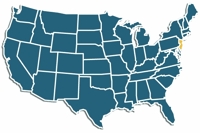
Today in 1787, New Jersey became the 3rd state.
New Jersey

New Jersey Breweries
New Jersey Brewery Guides
Guild: Garden State Craft Brewers Guild
State Agency: New Jersey Division of Alcoholic Beverage Control


Package Mix:
Beer Taxes:
Economic Impact (2010):
Legal Restrictions:
Though there is not a ban on selling alcoholic beverages at grocery stores, New Jersey limits each chain to two licenses, so except for a few exceptions, most supermarkets/convenience stores/gas stations/pharmacies do not sell alcoholic beverages. In addition, liquor sales are only permitted in a separate department or attached sister store. Bars are allowed to off-sale packaged goods.
With the exception of Jersey City and Newark, all municipalities MUST allow off-sales of beer and wine at any time on-sales are permitted. However, since alcoholic beverages are generally only found in package stores, this right is rarely exercised. Alcoholic beverages by the drink as well as off-sales of beer and wine are permitted 24 hours a day in Atlantic City and Brigantine.
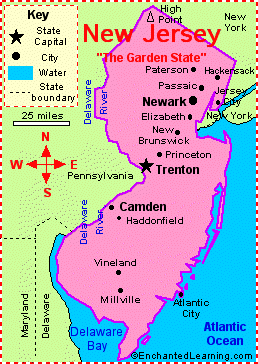
Data complied, in part, from the Beer Institute’s Brewer’s Almanac 2010, Beer Serves America, the Brewers Association, Wikipedia and my World Factbook. If you see I’m missing a brewery link, please be so kind as to drop me a note or simply comment on this post. Thanks.
For the remaining states, see Brewing Links: United States.