Brookston Beer Bulletin

Jay R. Brooks on Beer

  • Home
  • About
  • Editorial
  • Birthdays
  • Art & Beer

Socialize

  • Dribbble
  • Email
  • Facebook
  • Flickr
  • GitHub
  • Instagram
  • LinkedIn
  • Pinterest
  • RSS
  • Twitter
  • YouTube

Powered by Genesis

Beer Birthday: Roger Lind

May 16, 2026 By Jay Brooks

Today is the 65th birthday of Roger Lind, a Bay Area pioneer who founded Lind Brewing in 1989 in an old Dodge factory, which later became known as Drake’s Brewing. Lind sold the brewery to the Rogers family (who made coffee for Costco) in 1998, who in turn sold it to the current owners, John Martin and Roy Kirkorian, in 2008. Lind started as a brewer at Triple Rock before striking out on his own. After selling the brewery, he became a teacher, but has remained active in the local brewing scene to this day. Join me in wishing Roger a very happy birthday.

Roger Lind at his grand opening in 1989.
Marc Cohn, Roger, Chuck Fross from Bay Area Distributing, Josh Charlton, and brewer Don Gortemiller at the 19th Celebrator Anniversary Party in 2007.
Jack Weldon, Josh Charlton, Judy Ashworth, and Roger at Danville Brewing earlier this month. (Photo by Mike Condie)
Roger and Steve Altimari.
And finally, Roger from the 2004 Celebrator Beer News annual Swimsuit Issue.

Filed Under: Birthdays, Breweries Tagged With: California, History, Northern California

Historic Beer Birthday: Louis Hemrich

May 15, 2026 By Jay Brooks

hemrich
Today is the birthday of Louis Hemrich (May 15, 1873-September 26, 1941). He was born in Wisconsin, and was the brother of Alvin M. Hemrich. Alvin bought the old Slorah Brewery in 1897 and operated it as the Alvin Hemrich Brewing Co. for six months, after which two of his brothers — Julius and Louis — joined him in the business and it became known as the Hemrich Brothers Brewing Co.

Louis-Hemrich

Here’s a short biography from Find-a-Grave:

Louis Hemrich was born to John and Katherine Anna (Koeppel) Hemrich on May 15, 1873, although some records say May 20, 1872.

His father and brothers began operating breweries in Seattle in 1878. Louis began his career as a bookkeeper for Bay View Brewing in Seattle. By 1900 he was partnered with his brothers Senator Andrew Hemrich and Alvin Hemrich in owning and running the Hemrich Brother’s Brewing Co. and the brewing operations it controlled. It was successful enough to send his wife on a trip to Europe in 1902, and join her on trips to Europe and Hong Kong in 1907 and 1908. In 1914 he was President of the Brewers’ Association of the Northwest, and active in lobbying against prohibition of alcohol in Washington. When it passed, the breweries moved to California and British Columbia.

Louis was president of the family brewing company from 1910 until about 3 years before his death.
He married Lizzie Hanna on May 10, 1897 in Seattle, WA, and was widowed in Oct. of 1918. It appears they did not have children. He married Mrs. Maude Etta Engel before Dec. 1923.

Louis-Hemrich-cartoon

And here’s a fuller account of Hemrich from “A Volume of Memoirs and Genealogy of Representative Citizens of the City of Seattle and County of King, Washington,” published in 1903, as posted on Brewery Gems:

A Biographical record of the representative men of Seattle and King county would be incomplete and unsatisfactory without a personal and somewhat detailed mention of those whose lives are interwoven so closely with the industrial activities of this section. In the subject of this review, who is secretary and treasurer of the Hemrich Brothers Brewing Company, we find a young man of that progressive, alert and discriminating type through which has been brought about the magnificent commercial and material development of the Pacific northwest, and it is with satisfaction that we here note the more salient points in his honorable and useful career.

Louis Hemrich was born in the town of Alma, Buffalo county, Wisconsin, on the 20th of May, 1872, a son of John and Catherine (Koeppel) Hemrich, the former of whom was born in Baden, Germany, and the latter in Bavaria. They came to America and resided in Wisconsin for a number of years, removing thence to Seattle when the subject of this sketch was a lad of about fourteen years, his rudimentary educational training having been secured in the public schools of his native state, while he continued his studies thereafter in the public schools of Seattle, where he prepared himself for college. At the age of eighteen years he matriculated in the University of Washington, where he completed a commercial course. After leaving school Mr. Hemrich took a position as bookkeeper for the Seattle Brewing & Malting Company, where he remained for a period of three years and was then elected secretary and treasurer of the company, in which capacity he rendered most effective service for the ensuing two years. He then resigned this office and forthwith became associated with his brothers in the organization of the Hemrich Brothers Brewing Co., which was duly incorporated under the laws of the state. They erected a fine plant, where is produced a lager of the most excellent order, the purity, fine flavor and general attractiveness of the product giving it a high reputation, while the business is conducted upon the highest principles of honor and fidelity, so that its rapid expansion in scope and importance came as a natural sequel.

As a business man Mr. Hemrich has shown marked acumen and mature judgment, and his progressive ideas and his confidence in the future of his home city have been signalized by the investments which he has made in local realty and by the enterprise he has shown in the improving of his various properties. In 1901 he erected in the village of Ballard, a suburb of Seattle, a fine brick business block, located at the corner of First Avenue and Charles Street, and he has also erected a number of substantial business buildings in the city of Seattle, together with a number of dwellings. He is the owner of valuable timber lands in the state and has well selected realty in other towns and cities aside from those already mentioned. He has recently accumulated a tract of land on Beacon Hill, and this will be platted for residence purposed and is destined to become one of the most desirable sections of the city. Mr. Hemrich erected his own beautiful residence, one of the finest in the city, in 1901, the same being located on the southwest corner of Belmont Avenue and Republican Street. It is substantial and commodious, of effective architectural design, having the most modern equipments and accessories and is a home which would do credit to any metropolitan community.

While Mr. Hemrich takes an abiding interest in all that concerns the advancement and material upbuilding of his home city and state, he has never taken an active part in political affairs, maintaining an independent attitude in this regard and giving his support to men and measures. Fraternally he is a popular member of the Ancient Order of United Workmen and the Fraternal Order of Eagles, and he is most highly esteemed in both business and social circles. On the 20th of May, 1897, in the city of Seattle, Mr. Hemrich was united in marriage to Miss Eliza Hanna, daughter of Nicholas and Mary Hanna, who were numbered among the early settlers of this city, where Mrs. Hemrich was born and reared and where she has been prominent in the best social life.”

Hemrich-tray
To that, Gary Flynn on Brewery Gems continued Hemrich’s story:

Less than a year after the article was published, Elizabeth, his wife of 10 years suddenly died. And on 2 May, 1910, his brother, Andrew, president of Seattle Brewing & Malting – succumbed to an illness and passed away. Louis then assumed his brother’s position as president of the company and continued to oversee its phenomenal growth. By 1914 the brewery was the largest west of the Mississippi and 6th largest in the world. Additionally, it was the largest industrial enterprise in the state of Washington. But this too was to pass.

But that’s just the beginning, read the rest at Gary Flynn’s Brewery Gems, who also concludes Hemrich’s story with this:

In July 1938, Louis Hemrich retired from active involvement, but remained on the Rainier Brewing Co. board of directors. A little over three years later, on 26 September 1941, Louis succumbed after battling a three month illness. He was survived by his spouse, Etta Maude, and two daughters.

Seattle_-_Hemrich_Bro's_Brewing_Co_-_1900
Hemrich Brothers Brewing around 1900.

louis-hemrich-beer

Filed Under: Birthdays, Breweries, Just For Fun Tagged With: History, Washington, Wisconsin

Historic Beer Birthday: Joseph Schlitz

May 15, 2026 By Jay Brooks

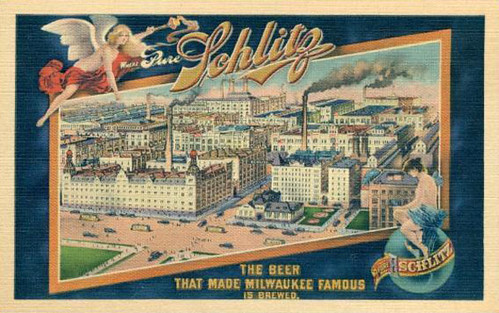
Today is the birthday of Joseph Schlitz (May 15, 1831-May 7, 1875). “A native of Mainz, Germany, Schlitz emigrated to the U.S. in 1850. In 1856 he assumed management of the Krug Brewery in Milwaukee, Wisconsin. In 1858 he married Krug’s widow and changed the name of the company to the Joseph Schlitz Brewing Company. He became more successful after the Great Chicago Fire of 1871, when he donated hundreds of barrels of beer as part of the relief effort. Many of Chicago’s breweries that had burnt were never to reopen; Schlitz established a distribution point there and acquired a large portion of the Chicago market.”

schlitz-joseph

Here’s a biography from Find a Grave:

Businessman, Beer magnate. He propelled the tiny Krug brewery of Milwaukee, Wisconsin, into the giant Joseph Schlitz Brewing Co. Born in Mainz, Rheinhessen, Germany, he had a fair education with a four-year course in bookkeeping and had already acquired some practical business experience when he arrived in Milwaukee, Wisconsin, in 1850. There he landed a position as bookkeeper for August Krug’s brewery and became a valuable asset and close friend. The same year, August Uihlein, age 8, accompanied by his grandfather, Georg Krug, a 68 year old innkeeper from Miltenberg, Bavaria, came to Milwaukee to see his uncle August. The brewery’s total production in 1850 was about 250 barrels annually and by 1855 it was up to 1,500. Upon Krug’s death in 1856 Schlitz assumed management of the Krug Brewery and in 1858 he married Krug’s widow, invested his own savings and changed the name of the company to the Joseph Schlitz Brewing Company. Capable of storing 2,000 barrels in 1858 he had increased production to 5,578 barrels of beer in 1867 when the brewery ranked as the number 4 brewery in Milwaukee behind Valentine Blatz and two others. He enjoyed further success after the Great Chicago Fire of 1871, when he donated thousands of barrels of beer to that city, which had lost most of its breweries, thereby making Schlitz “the beer that made Milwaukee famous.” He quickly opened a distribution point there and began a national expansion. Schlitz returned to visit Germany in 1875 and died when his ship hit a rock near Land’s End, England, and sank. He was one of Milwaukee’s richest men and his company was brewing almost 70,000 barrels a year. Despite the loss of Schlitz the company remained viable through a lesson he had learned from August Krug’s death. Wisely inserted into his will, two provisions ensured the company’s health after his passing: one stipulated the business could never remove “Joseph Schlitz” from its name; the other appointed Krug’s nephew, the same one Krug brought over from Germany as an eight year old in 1850, to be head of the brewery. Schlitz’s choice of then 33 year old August Uihlein couldn’t have been better as he, along with his brothers Henry and Edward, continued the business strategies initiated by Schlitz. The company developed a system of agencies across the United States to sell beer, and developed its own vast rail distribution system taking it from tenth largest US brewer in 1877 to third by 1895. Being among the top three breweries was little comfort when prohibition came about. But the company met the challenge as did others, restructuring the brewery as Joseph Schlitz Beverage Co. to produce near beer, yeast, soft drinks, malt syrup and a chocolate candy named “Eline” (a phonetic play on Uihlein). Returning to brewing in 1933, the company moved ahead on expansion plans that led them to second and finally first place in US beer production. For the next 40 the years the company would remain near the top and at one point was ranked as the largest in the world until its purchase by Stroh Brewing of Detroit, Michigan (now owned by Pabst Brewing Co.). The Schlitz name remains prominent even today in Milwaukee through a number of prominent city landmarks in Milwaukee including Schlitz Park, the Schlitz Hotel, and the famous Schlitz Palm Garden that were funded by his brewery.

This account is from the Milwaukee Independent as if Schlitz was a young businessman worthy of recognition as one of “Forty under 40:”

Probably one of the most famous names associated with Milwaukee beer history. Schlitz was born in Mainz, Germany where he received his education and also a four year program in bookkeeping. He arrived in Milwaukee in 1850 and shortly thereafter was hired by August Krug to be the bookkeeper for his growing brewery. From 1850 up to 1855 the brewery grew from 250 barrels to 1500 barrels a year. Following a German practice Schlitz and other brewery employees lived with their employer. Work was generally 10 hours a day six days a week.

In the same year that Schlitz arrived in Milwaukee another arrival was 8 year old August Uihlien, a future head of the brewery, whose uncle was August Krug. Krug was injured in a brewery accident in 1856 and died as a result of his injuries. It is reported that Krug, realizing he was dying, told Anna Marie, his wife, that she could depend on Schlitz to help run the brewery. Whether this is true or not, Schlitz began to play a major role in running the brewery and in 1858, two years after Krug’s death, Joseph and Anna Marie were married. Schlitz invested in the brewery and then changed the name of the brewery to Schlitz Brewery.

Under Schlitz the brewery was growing and by 1867 brewing 5,775 barrels a year, making it the 4th largest brewery in Milwaukee just behind Blatz brewery. In 1871the great Chicago fire destroyed the local breweries and Schlitz and others saw an opportunity to gain market share by offering free beer for short period and then building distribution capacity in Chicago. This was also the beginning of Schlitz starting a national distribution effort to expand the business eventually becoming the largest brewery in the U.S. Schlitz, Pabst and Budweiser would vie for this number one distinction with Budweiser the eventual winner.

Schlitz was also an avid marksman and took a trip back to Germany in 1875 to participate in a sporting event as well as visiting family. Upon his return to Milwaukee his ship, the Schiller, sank off of Land’s End, England. His body was never recovered; his wife even offered a $25,000 prize for recovery. The Schlitz monument at Forest Home is a cenotaph, term for monument for someone who is not actually buried at that location. The monument also has a rendering of the ship the Schiller at its base.

Schlitz and his wife had no children and thus Anna Marie turned to the nephews of August Krug, the Uihlien brothers, to help run the brewing business. Once the brothers gained control of the brewery they did consider changing the name of the brewery, but they determined that the brand name Schlitz was too well established to change. The famous brewer marketing phrase, “The beer that made Milwaukee famous” came into being in the early 1900s.

And this part of longer article on Immigrant Entrepreneurship entitled “Political Revolution, Emigration, and Establishing a Regional Player in Brewing: August Krug and Joseph Schlitz.” This is whereSchlitz entered the story:

Joseph Schlitz (born May 15, 1831 in Mainz, Rhenish Hesse, Kingdom of Prussia; died: May 7, 1875 at sea), the namesake of the Schlitz brand, has often been presented as a successful visionary whose career as an American industrial titan was tragically cut short before accomplishing his greatest potential achievements. In this narrative, August Krug is often relegated to the role of an unimportant precursor. It is difficult to push back against such narratives that have been critical in shaping perceptions of nineteenth-century U.S. business history as a saga of intrepid leadership. Joseph Schlitz was indeed an important brewer and entrepreneur. But in fact the nationwide fame of his name owes more to the development of the brewing business under his successors, the Uihlein brothers, rather than his own accomplishments.

Schlitz was born on May 31, 1831, in Mayence (Mainz), as the son of Johann Schlitz, a cooper and wine trader, and his wife Louisa. He was trained as a bookkeeper but also learned the basics of brewing in his parents’ milieu. With this he surely had good preparatory skills for a business career but it is highly doubtful that he received “an excellent mercantile education and decided financial ability.” Joseph Schlitz arrived on June 15, 1849 in New York after a journey from Le Havre on the Charleston-based 600-ton sailing vessel Noemie. He described himself as already a merchant and told the officials that he planned to stay in New York.

Instead, he went to Harrisburg, Pa., where he was probably engaged in managing a brewery. He moved to Milwaukee and joined the Krug brewery in 1850. After his marriage to Anna Maria Krug in 1858, he renamed the brewery after himself in 1858. Well-known and respected as a shrewd businessman, he was able to enlarge his company and his private fortune. In 1860, with real estate valued at $25,000 and additional assets of $50,000 (roughly $675,000 and $1.35 million, respectively, in 2010 dollars), Schlitz was already one of the richest men in Milwaukee. At that time, his household included his wife, two 26-year-old servants from Austria, and four young male immigrants from Bavaria, Hesse, and Baden, working as barkeeper, bookkeeper, brewer and in a beer hall. This was not a typical upper-middle-class household. Instead, Schlitz maintained the traditional German model of the Ganze Haus, in which an artisan and his apprentices lived under the same roof. However, the success story was not a linear one. The 1870 census valued Schlitz’s real estate at $34,000 ($626,000 in 2010 dollars), while his additional assets had declined to $28,000 ($586,000 and $483,000, respectively, in 2010 dollars). The Schlitz home now accommodated no fewer than sixteen people, fifteen of them of German descent, with only one U.S.-born servant. August Uihlein, at that time bookkeeper of the brewery, also lived under the Schiltzes’ roof.

Schlitz lived a scandal-free life. He tended to support the Democratic Party but was never a party man. He was a Catholic, a Mason, and a member of various lodges and associations, but these connections were apparently more important for business than for individual enlightenment. Schlitz registered for military service at the beginning of the Civil War, but never saw active duty.

His growing wealth, together with his reputation as a trustworthy businessman, was crucial for attaining business positions that both aided his core brewing business but also provided opportunities for investing his profits. When Milwaukee’s Second Ward Bank was reorganized in 1866, Joseph Schlitz became a director alongside other brewers like Philip Best and Valentine Blatz, and it became known as “the Brewers Bank.” The directorship carried innate prestige; indeed, in the first reports of Schlitz’s death he was described as “the President of a Banking Association in Milwaukee.” Other business endeavors were closely related to his German-American community. Schlitz was a director of the “Northwestern gegenseitige Kranken-Unterstützungs-Gesellschaft,” a life insurance company initiated by some of the city’s most prominent German-American businessmen. Such business endeavors were necessary as a civic answer to the severe lack of social insurance and public social subventions in nineteenth-century America. Citizens had to take care of their own risks, and ethnic communities and businesses strove to provide responses to such concerns. Schlitz was also secretary of the Brewer’s Protective Insurance Company of the West, which eventually became the Brewers’ Fire Insurance Co. of America. Realizing the immense number of fires in general and in the brewing business in particular, this was a self-help solution that was necessary for both risk management and to protect a company’s capacity to grow.

Schlitz died in one of the largest shipping disasters of the late nineteenth century. After an absence of 26 years, he was planning to visit his town of birth, Mayence. The loss of the steam ship Schiller on May 7, 1875, off the coast of Cornwall, caused 335 casualties, including several prominent Milwaukee residents, and it was “painfully interesting to thousands of Milwaukee people.” The Milwaukee Board of Trade passed resolutions out of respect in memory of Joseph Schlitz and German-immigrant merchant Hermann Zinkeisen, head of the commission house Zinkeisen, Bartlett & Co. His body was never recovered, but a cenotaph was nonetheless erected at Milwaukee’s Forest Home Cemetery. His wife offered a $25,000 reward for the corpse, but it was never found. In 1880, a rumor that the remains had been discovered caused a sensation but in the end, it was discovered to be a hoax. Schlitz had a life insurance policy of $50,000 (just over $1 million in 2010 dollars), a sum helpful for the further expansion of his brewery.

schlitz-1900-top-of-the-world

Filed Under: Birthdays, Just For Fun Tagged With: History, Wisconsin

Beer In Ads #5251: Gesundheit Beer

May 14, 2026 By Jay Brooks

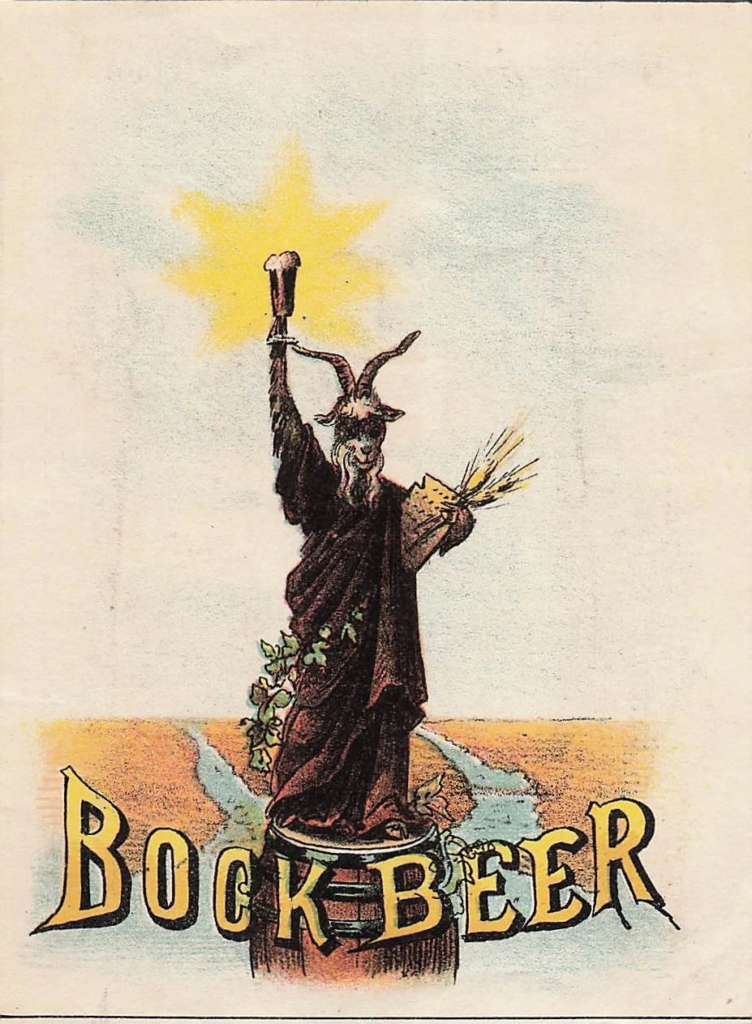
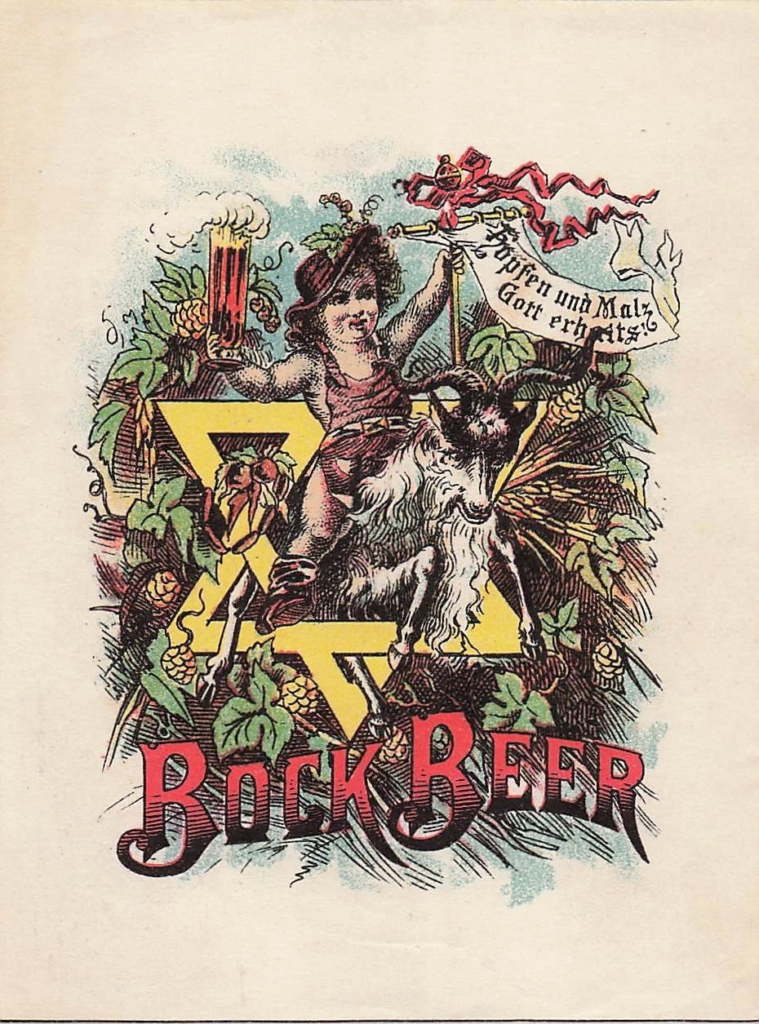
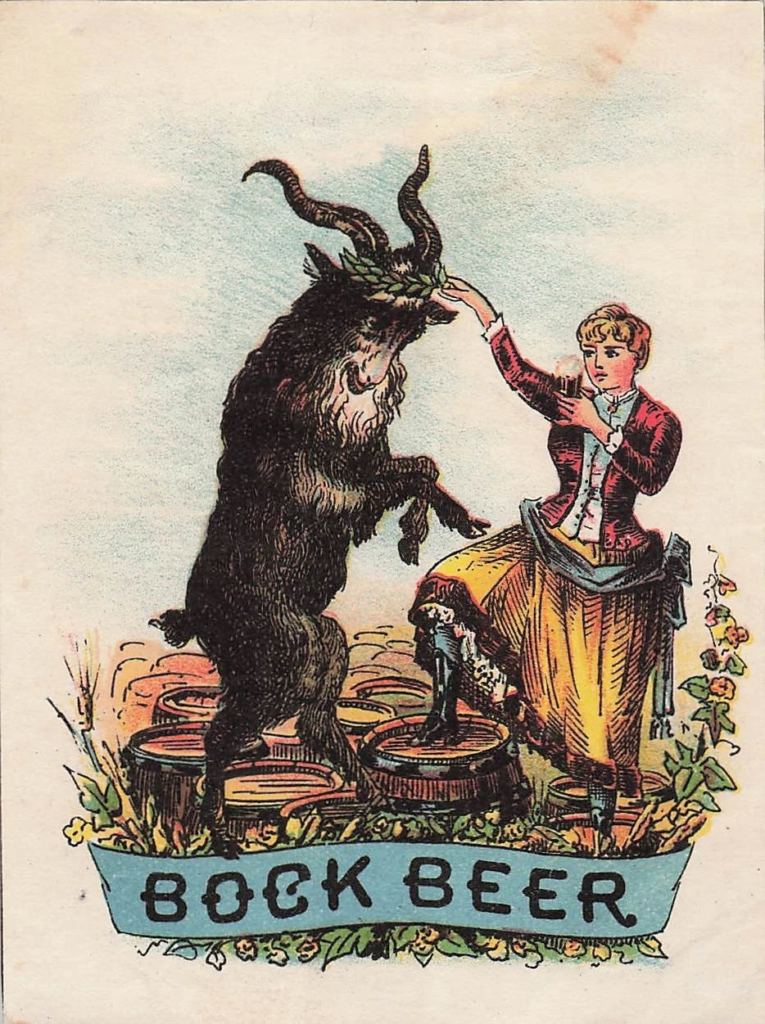
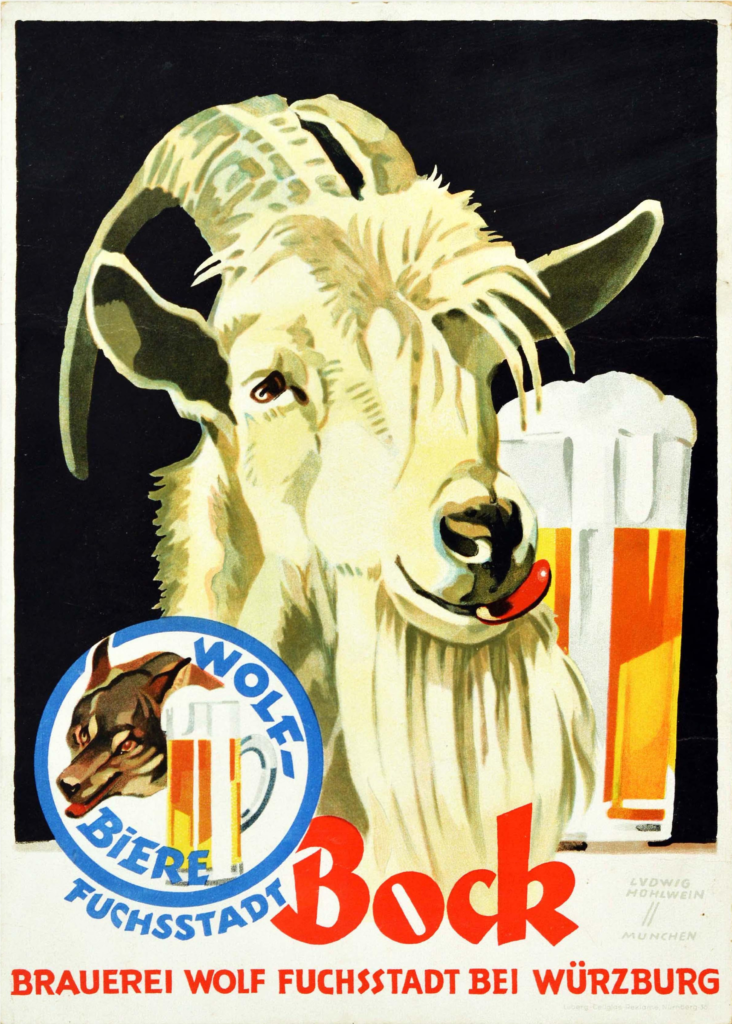
Two years ago I decided to concentrate on Bock ads for awhile. Bock, of course, may have originated in Germany, in the town of Einbeck. Because many 19th century American breweries were founded by German immigrants, they offered a bock at certain times of the year, be it Spring, Easter, Lent, Christmas, or what have you. In a sense they were some of the first seasonal beers. “The style was later adopted in Bavaria by Munich brewers in the 17th century. Due to their Bavarian accent, citizens of Munich pronounced ‘Einbeck’ as ‘ein Bock’ (a billy goat), and thus the beer became known as ‘Bock.’ A goat often appears on bottle labels.” And presumably because they were special releases, many breweries went all out promoting them with beautiful artwork on posters and other advertising. With Spring approaching, there are so many great examples that I’m going to post two a day for a few months.

Thursday’s ad is for Leidiger Bock Beer, which was published on May 14, 1915. This ad was for  the Leidiger Brewing Co., which was founded in 1884. This ad ran in The Merrill Star Advocate, also of Merrill, Wisconsin. I’m going to guess that “Gesundheit Beer” or “Some Beer” is meant to be joke, and neither actually existed, but who knows. There was a beer called “Gesundheit” that was brewed by the Neustadtl Brewing Co. of Stroudsburg, Pennsylvania from 1933 to 1935

Filed Under: Art & Beer, Beers, Breweries, Just For Fun Tagged With: Advertising, Bock, History, Wisconsin

Beer In Ads #5250: Pacific Bock Beer

May 13, 2026 By Jay Brooks

Two years ago I decided to concentrate on Bock ads for awhile. Bock, of course, may have originated in Germany, in the town of Einbeck. Because many 19th century American breweries were founded by German immigrants, they offered a bock at certain times of the year, be it Spring, Easter, Lent, Christmas, or what have you. In a sense they were some of the first seasonal beers. “The style was later adopted in Bavaria by Munich brewers in the 17th century. Due to their Bavarian accent, citizens of Munich pronounced ‘Einbeck’ as ‘ein Bock’ (a billy goat), and thus the beer became known as ‘Bock.’ A goat often appears on bottle labels.” And presumably because they were special releases, many breweries went all out promoting them with beautiful artwork on posters and other advertising. With Spring approaching, there are so many great examples that I’m going to post two a day for a few months.

Wednesday’s ad is for Pacific Bock Beer, which was published on May 13, 1900. This ad was for  the Pacific Brewing & Malting Co., which was founded in 1897 in Tacoma, Washington. This ad ran in The Tacoma Daily Ledger, also of Tacoma, Washington.

Filed Under: Art & Beer, Beers, Breweries, Just For Fun Tagged With: Advertising, Bock, History, Washington

Historic Beer Birthday: Jacob Adams

May 13, 2026 By Jay Brooks

Today is the birthday of Jacob Adams (May 13, 1837-July 21, 1909). Born Jacob Adami, in Germany, he moved with his family to San Francisco in 1860. He bought the San Francisco Brewery in 1874, renaming it the Broadway Brewery.

Here’s a short biography from Find a Grave:

Johanas Adami [Adams] and family emigrated from Germany in 1860 to San Francisco and formed a brewery partnership. Johanas’ son, Jacob Adams, formally established the Broadway Brewery at 637 Broadway and Stockton St. in 1874. The brewery burned down in 1885, but was rebuilt at a new location on the corner of Treat Ave. & 19th St. Jacob died in 1909 and his son George C. Adams became president of the brewery. In 1916 another son, William F. Adams, became one of the directors of the newly formed California Brewing Association. During Prohibition William was working at Acme’s Fulton plant, (dba) the Cereal Products Refining Corporation, with JP Rettenmayer and Karl Schuster. In the 30’s & 40’s William held the position of Secretary for Acme Breweries in both SF and LA. He and his brother Edward J. Adams were Acme shareholders and also ran Acme’s Oakland distribution depot.

This account is from Bill Yenne’s “San Francisco Beer: A History of Brewing by the Bay:”

From Page 23.
From Page 41.

This story about a potential crime by one of the brewery employees, a family member no less, is from the San Francisco Call on February 5, 1898.

Brewery Gems also has a more thorough history of both Jacob Adams and the Broadway Brewery in San Francisco from 1862 to 1917, when it closed.

Filed Under: Birthdays, Breweries, Just For Fun Tagged With: California, History, San Francisco

Historic Beer Birthday: Henry Uihlein

May 13, 2026 By Jay Brooks

schlitz-globe
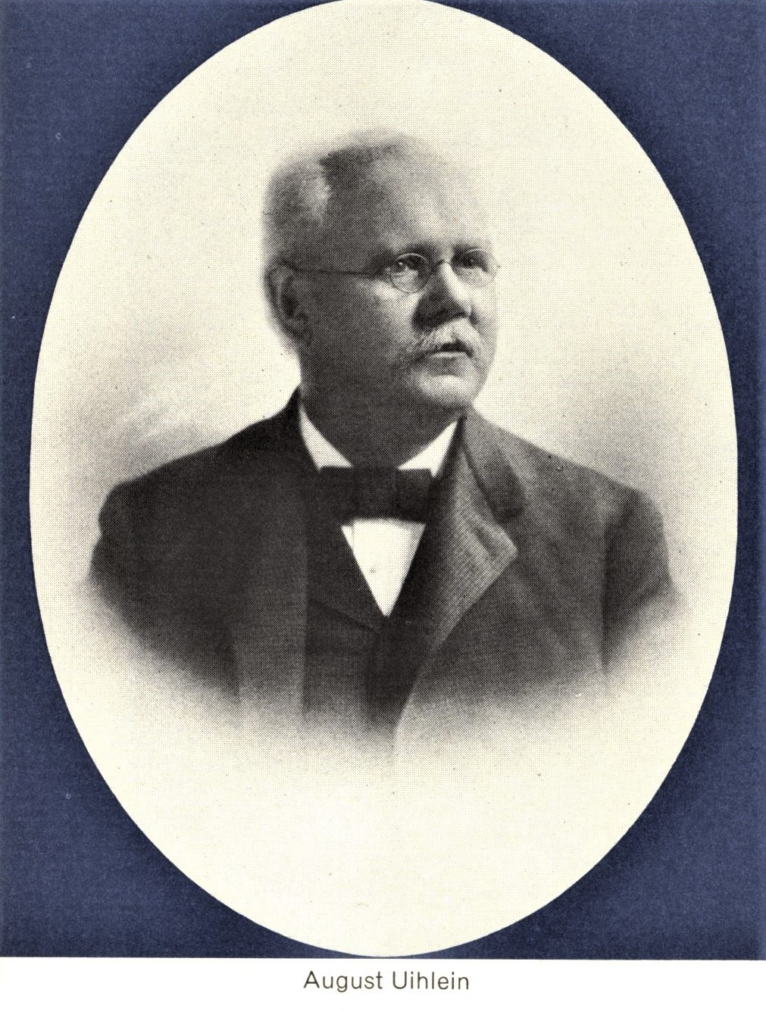
Today is the birthday of Henry Heinrich Johann Uihlein (May 13, 1844-April 22, 1922). He was born in Bavaria, but moved to the U.S. when he was eighteen, in 1862, having learned the brewing trade in Germany. He joined his uncle, August Krug, and his brothers, working for the Joseph Schlitz Brewing Company. He was president of Schlitz from 1875 until he retired in 1916.

This is one of the few photos I could find of Henry, in this Uihlein family photo from the early 1880’s.

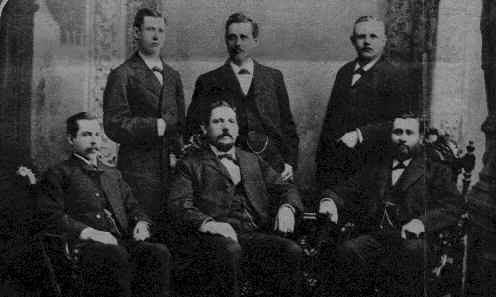
Bottom row, from left; Charles, superintendent of the bottling works; Edward, vice president in charge of developing the Chicago markets; Henry, president. Top row, from left; William J., assistant superintendent of the brewery; Alfred, superintendent and brewmaster; August, secretary and chief operating officer.

Schlitz-Beer-Paper-Ads-Jos-Schlitz-Brewing-1900


This Schlitz ad is from around 1900, when Henry was president of the brewery.

This is the Google translation of his German Wikipedia page:

Henry Uihlein was the second eldest of six sons of Joseph Benedict Ühlein and his wife Katharina Krug born in Wertheim, the restaurant, the Gasthaus zur Krone operated.

In Bavaria, Henry Uihlein learned the brewing trade before emigrating to the United States in 1862. There he worked for several years for various breweries in St. Louis and for the Kunz Brewing Company in Leavenworth. In 1871 he moved to Milwaukee and began working with his brothers August, Alfred and Edward for the Joseph Schlitz Brewing Company. Henry’s brewing expertise contributed significantly to the company’s success. He led the company between 1875 and 1916 as president. He also worked in finance, real estate and other industries.

This is Uihlein’s obituary from the Beverage Journal (f.k.a. The Western Brewer) from 1922:

Filed Under: Birthdays, Breweries, Just For Fun Tagged With: Bavaria, Germany, History, Wisconsin

Historic Beer Birthday: Christian Moerlein

May 13, 2026 By Jay Brooks

Today is the birthday of Christian Moerlein (May 13, 1818-May 14, 1897). Moerlein was born in Bavaria, and came to America around 1840, establishing the Christian Moerlein Brewery in 1853.

christian-moerlein

Here’s a short biography from Find a Grave:

Brewer. Born in Truppach, Bayreuth, Oberfranken, Bayern, Germany. He immigrated to the United States in 1841 settling in Cincinnati, Ohio a year later. Christian married his first wife Sophia Adam in 1843 and had three children with her. After losing Sophia and 2 of those children to the cholera epidemics of the time, he married his second wife Barbara Oeh in 1849 and had another 9 children. In 1853 Moerlein established a brewery bearing his name in Cincinnati and became the most prominent brewer in that city. The brewery became one of the largest in the country and remained in operation until Prohibition. Today a line of beer is again being marketed under his name.

Christian-Moerlein-Beer1890

Here’s what the early 20th century book “One Hundred Years of Brewing” wrote about Christian Moerlein:

Christian-Moerlein-Brewing-Co-letterhead

Digging Cincinnati History has a nice post about where all the Moerlein buildings are today, along with some history of the brewery. In 2004, local resident Greg Hardman bought the Christian Moerlein brand and continues to operate it as Christian Moerlein lagers & Ales, and also opened the Moerlein Lager House, where they serve food and house beers.

Filed Under: Birthdays, Just For Fun Tagged With: Germany, History, Ohio

Beer In Ads #5249: Dresdner Hofbräu Bock-Bier

May 12, 2026 By Jay Brooks

Two years ago I decided to concentrate on Bock ads for awhile. Bock, of course, may have originated in Germany, in the town of Einbeck. Because many 19th century American breweries were founded by German immigrants, they offered a bock at certain times of the year, be it Spring, Easter, Lent, Christmas, or what have you. In a sense they were some of the first seasonal beers. “The style was later adopted in Bavaria by Munich brewers in the 17th century. Due to their Bavarian accent, citizens of Munich pronounced ‘Einbeck’ as ‘ein Bock’ (a billy goat), and thus the beer became known as ‘Bock.’ A goat often appears on bottle labels.” And presumably because they were special releases, many breweries went all out promoting them with beautiful artwork on posters and other advertising. With Spring approaching, there are so many great examples that I’m going to post two a day for a few months.

Tuesday’s ad is for “Dresdner Hofbräu Bock-Bier,” created in 1899. This poster was for the Dresdner Hofbräuhaus (or Dresden Court Brewery) of Dresden, Germany, which was originally founded in 1872 but closed in 1921. The poster was created by German artist Fritz Wolff. It was produced by Hollerbaum & Schmidt of Berlin.

Filed Under: Art & Beer, Beers, Breweries, Just For Fun Tagged With: Advertising, Bock, Germany, History

Beer Birthday: Homer Simpson

May 12, 2026 By Jay Brooks

duff
Today is the birthday of Homer J. Simpson (May 12, 1956- ). At least that’s the agreed upon date, which comes from episode 16 in Season 4, entitled “Duffless,” which originally aired February 18, 1993. In the episode, Homer loses his driver’s license when he gets a DUI and there’s a scene where his license is voided by a judge. Eagle-eyed fans were able to freeze the frame and see that his date of birth listed on the identification card was May 12, 1956.

homer-can

Here’s one biography of Homer, this one from the IMDb:

Homer (b.May 12, 1956) was raised on a farm by his parents, Mona and Abraham Simpson. In the mid-1960s, while Homer was between nine and twelve years old, Mona went into hiding following a run-in with the law. Homer attended Springfield High School and fell in love with Marge Bouvier in 1974. Marge became pregnant with Bart in 1979, while Homer was working at a miniature golf course. The two were wed in a small wedding chapel across the state line, From there they spent their wedding reception alone at a truck stop, and the remainder of their wedding night at Marge’s parents’ house. After failing to get a job at the Springfield Nuclear Power Plant, Homer left Marge to find a job by which he could support his family. He briefly worked at a taco restaurant called the Gulp n’ Blow, until Marge found him and convinced him to return. As a result, Homer confronted Mr. Burns and secured a job at the Plant. Marge became pregnant with Lisa in 1981, shortly before the new couple bought their first house. In 1985 and 1986, Homer saw brief success as the lead singer and songwriter for the barbershop quartet the Be Sharps, even winning a Grammy. During his time with the group, Homer was frequently absent from home, which put stress on his marriage. After the group broke up due to creative differences, Homer went back to Springfield to continue his old life. Sometime in the late 1980s, Homer and Marge carefully budgeted so Homer could have his dream job as a pin monkey in a bowling alley. Unfortunately for Homer, Marge became pregnant with Maggie shortly after he started his new job, and not being able to support his family, he went back to the Nuclear Plant. He likes martini.

Homer’s age was initially 34, but as the writers aged, they found that he seemed a bit older too, so they changed his age to 38; this is contradicted by The Homer Book which states Homer is currently 36. Homer reunites with his mother.Homer’s personality is one of frequent stupidity, laziness, and explosive anger. He suffers from a short attention span which complements his short-lived passion for hobbies, enterprises and various causes. Homer is prone to emotional outbursts; he is very envious of his neighbors, the Flanders family, and is easily enraged by Bart and strangles him frequently. He shows no compunction about this, and does not attempt to hide his actions from people outside the family, even showing disregard for his son’s well being in other ways, such as leaving Bart alone at a port. While Homer’s thoughtless antics often upset his family, he has also performed acts that reveal him to be a surprisingly caring father and husband: in “Lisa the Beauty Queen”, selling his cherished ride on the Duff blimp and using the money to enter Lisa in a beauty pageant so she could feel better about herself; in “Rosebud”, giving up his chance at wealth to allow Maggie to keep a cherished teddy bear; in “Radio Bart”, spearheading an attempt to dig Bart out after he had fallen down a well, even though Homer generally hates doing physical labor; and in “A Milhouse Divided”, arranging a surprise second wedding with Marge to make up for their lousy first ceremony, even going so far as to hire one of The Doobie Brothers as part of the wedding band and getting a divorce from Marge, essentially making their second wedding a “real” one.

Homer frequently steals things from his neighbor, Ned Flanders, including TV trays, power tools, air conditioners, and at one point, part of his house. Flanders knows about this, but Homer constantly states that he has “borrowed” the stolen items. He has also stolen golf balls from the local driving range, cable television, office supplies (including computers) from work, and beer mugs from Moe’s Tavern. Also, while ‘working the night shift’ with the rest of the employees at a local discount store (which was just them being locked in at night and forced to stay via electrocution chip) he made off with a number of Plasma Screen TVs on a forklift, while at the same time breaking out of the store.

Homer has a vacuous mind, but he is still able to retain a great amount of knowledge about specific subjects. He shows short bursts of astonishing insight, memory, creativity and fluency with many languages. Homer is also extremely confident; no matter how little skill or knowledge he has about anything he tries to do, he has no doubt that he will be successful. However, his brief periods of intelligence are overshadowed by much longer and more consistent periods of ignorance, forgetfulness and stupidity. Homer has a low IQ due to his hereditary “Simpson Gene,” his alcohol problem, exposure to radioactive waste, repetitive cranial trauma, and a crayon lodged in the frontal lobe of his brain. Homer’s intelligence was said to jump fifty points when he had the crayon removed, bringing him to an IQ of 105, slightly above that of an average person, however he had the crayon reinserted, presumably lowering his IQ back to its original 55. The amount of Homer’s brain which still functions is also questionable. At one point in the series, Homer apparently lost 5% of his brain after a coma.

Homer’s attitudes toward women, romance, and sex are occasionally explored. While Homer’s marriage with Marge is occasionally strained, it seems generally happy and faithful. Despite this, Homer usually shows no qualms with gawking at (and drooling over) attractive women. Homer successfully avoided an affair with Mindy Simmons, but has made the occasional remark denoting his attraction to other women (including the gag about coveting his neighbor’s wife), even in front of Marge.

His relationship with his children is not the best, although he loves his children deeply. His relationship with Bart is often shown as a love-hate relationship or friendship. They sometimes appear to get on very well, however, such as on the numerous occasions they jointly commit various petty crimes or “get-rich-quick”-schemes. Homer’s relationship with Lisa is usually quite good although Lisa often tires of her father’s ignorance. His relationship with Maggie is perhaps the best, due to her infant state. However, even though Maggie has saved his life a number of times, he sometimes forgets she even exists (once telling Marge the dog does not count when she told him they had three kids).

moes

So while Homer doesn’t brew beer, he does certainly drink a lot of it. And without him, the world may not have ever heard of Duff Beer. And even though there are a few real world examples of Duff being brewed, I don’t recommend them, at least not the ones I’ve tried. But do drink a toast to Springfield’s favorite beer drinker, Homer Simpsons. Below are a few of the times Homer’s mentioned beer throughout the show’s twenty-plus year run.

“Beer. Now there’s a temporary solution.”

— Homer Simpson, in “Homer’s Odyssey,” Season 1, Episode 3, 1990

homer-shark-infested-waters

“Ah, good ol’ trustworthy beer. My love for you will never die.”

— Homer Simpson, in “Bart Gets Hit by a Car,” Season 2, Episode 10, 1991

woo-hoo-duff

“Mmmm… beer.”

— Homer Simpson, “Lisa’s Pony, Season 3, Episode 8, 1991; “So It’s Come to
This: A Simpsons Clip Show,” Season 4, Episode 18, 1993; and “Whacking
Day, Season 4, Episode 20, 1993”

HomerOcko

“I would kill everyone in this room for a drop of sweet beer.”

— Homer Simpson, in “Duffless,” Season 4, Episode 16, 1993

“Ah beer, my one weakness. My Achilles heel if you will.”
— Homer Simpson, in “So It’s Come to This: A Simpsons Clip Show,” Season 4, Episode 18, 1993

homer-empty-mug

“Alright Brain, you don’t like me, and I don’t like you. But lets just get me through this, and I can get back to killing you with beer.”

— Homer Simpson, in “The Front,” Season 4, Episode 19, 1993

Homer-to-alcohol

“To alcohol! The cause of, and solution to, all of life’s problems.”

— Homer Simpson, in “Homer vs. The Eighteenth Amendment,” Season 8,
Episode 18, 1997

duff-dry-lite

Homer: “Will there be beer?”

Movementarian: “Beer is not allowed.”

Homer: “Homer no function beer well without.”

Movementarian: “Would you rather have beer or complete and utter contentment?”

Homer: “What kind of beer?”

— Homer Simpson, in “The Joy of Sect,” Season 9, Episode 13, 1998

moes-2

“I’m glad I’m back. Because the moment that sweet, sweet beer hit my tongue, I was born again!”

— Homer Simpson, in “The Joy of Sect,” Season 9, Episode 13, 1998

Duff-Beer-Simpsons

“Well, this time I’m drunk on love… and beer.”

— Homer Simpson, in “Natural Born Kissers,” Season 9, Episode 25, 1998

homer-x-files

“Expand my brain, learning juice!”

— Homer Simpson, about to drink a Duff Beer, in “See Homer Run,” Season
17, Episode 6, 2005

Homer-Simpson-and-Moe

Therapist: “And has there been any improvement in Homer’s drinking?”

Marge: “Well, he’s down to two beers in the shower.”

Homer: “They’re pale ales … please.”

— From “Specs and the City,” Season 25, Episode 11, 2014

Filed Under: Birthdays, Just For Fun, Related Pleasures Tagged With: Cartoons, History, Humor

« Previous Page
Next Page »

Find Something

Northern California Breweries

Please consider purchasing my latest book, California Breweries North, available from Amazon, or ask for it at your local bookstore.

Recent Comments

  • Bob Paolino on Beer Birthday: Grant Johnston
  • Gambrinus on Historic Beer Birthday: A.J. Houghton
  • Ernie Dewing on Historic Beer Birthday: Charles William Bergner 
  • Steve 'Pudgy' De Rose on Historic Beer Birthday: Jacob Schmidt
  • Jay Brooks on Beer Birthday: Bill Owens

Recent Posts

  • Beer Birthday: Colin Kaminski June 17, 2026
  • Beer Birthday: Ed Stoudt June 17, 2026
  • Beer In Ads #5270: Bock Beer Prima Special June 16, 2026
  • Historic Beer Birthday: Max Delbrück June 16, 2026
  • Historic Beer Birthday: Harry MacElhone June 16, 2026

BBB Archives

Feedback

Head Quarter
This site is hosted and maintained by H25Q.dev. Any questions or comments for the webmaster can be directed here.