Brookston Beer Bulletin

Jay R. Brooks on Beer

  • Home
  • About
  • Editorial
  • Birthdays
  • Art & Beer

Socialize

  • Dribbble
  • Email
  • Facebook
  • Flickr
  • GitHub
  • Instagram
  • LinkedIn
  • Pinterest
  • RSS
  • Twitter
  • YouTube

Powered by Genesis

Beer In Ads #5082: Lucerne Bockbier

September 18, 2025 By Jay Brooks

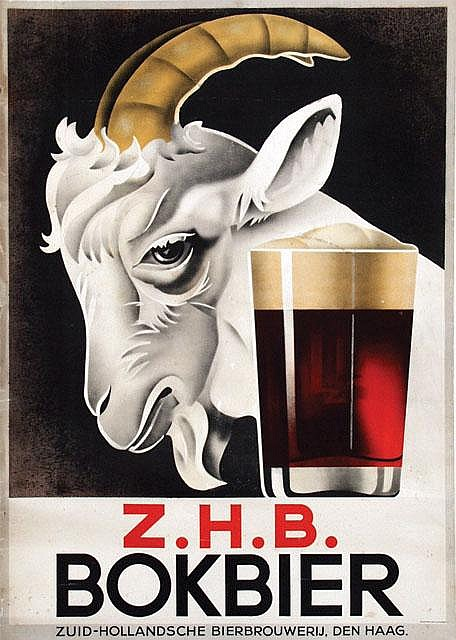
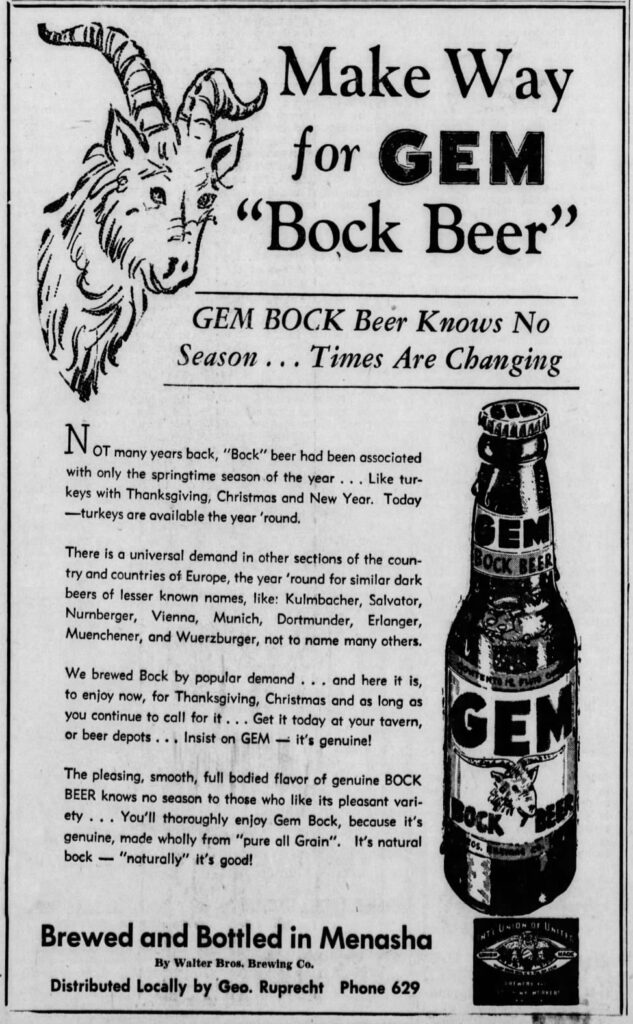
Last year I decided to concentrate on Bock ads. Bock, of course, may have originated in Germany, in the town of Einbeck. Because many 19th century American breweries were founded by German immigrants, they offered a bock at certain times of the year, be it Spring, Easter, Lent, Christmas, or what have you. In a sense they were some of the first seasonal beers. “The style was later adopted in Bavaria by Munich brewers in the 17th century. Due to their Bavarian accent, citizens of Munich pronounced ‘Einbeck’ as ‘ein Bock’ (a billy goat), and thus the beer became known as ‘Bock.’ A goat often appears on bottle labels.” And presumably because they were special releases, many breweries went all out promoting them with beautiful artwork on posters and other advertising.

Thursday’s ad is for Bockbier, which is from the 1920s and was created for the Vereinigte Brauereien Luzern (or “United Breweries Lucerne”) of Lucerne, Switzerland, which was formed in 1922 by the merger of two local breweries. In 1937, it was renamed the Lucerne Brewery Eichhof, and in 1960 shortened again to Brewery Eichhof. Since 2008, it has been part of Heineken. I don’t know who the artist was that created the poster.

Filed Under: Art & Beer, Beers, Breweries, Just For Fun Tagged With: Advertising, Bock, History, Switzerland

Historic Beer Birthday: Elmer Hemrich

September 18, 2025 By Jay Brooks

hemrich-gold-seal
Today is the birthday of Elmer E.L. Hemrich (September 18, 1890-January 20, 1937). He was raised in the Seattle, Washington area, and was the son of Alvin Hemrich, a prominent businessman and brewery owner in Seattle. His son worked for several of his businesses, before strking out on his own and founding Elmer E. Hemrich’s Brewery in 1935. Unfortunately, an unexpected heart attack killed him two years later, in 1937, and his brother Walter took over his brewery.

Here’s his father’s business history. In 1891, he moved to the Seattle, Washington area, and began working for breweries there and in Canada, including the Seattle Brewing & Malting Co. His brother Andrew (Elmer’s uncle) bought the Bay View Brewery in Seattle, and later Alvin bought the North Pacific Brewery (also known as the old Slorah brewery), and renamed it the Alvin Hemrich Brewing Co. in 1897. Two of his brothers soon joined him in the enterprise, and it was renamed again, this time to Hemrich Brothers Brewing Company. They did well enough that he began buying out other area breweries. When prohibition closed the brewery, they were ready, having retooled their plants for near-beer and also having divested into some other businesses. They reopened when prohibition was repealed, and two of Alvin’s sons went into the family business, too, including Elmer, but their father died just two years later.

There’s also a photograph of Alvin M. Hemrich and his son, Elmer E. Hemrich, taken around 1910 that can be seen at Brewery Gems’ biography of Alvin Hemrich, shared with him by the Hemrich family. As is typical for Pacific Northwest breweries, Gary Flynn has a thorough composite biography culled from numerous sources at his Brewery Gems website.

Filed Under: Birthdays, Just For Fun Tagged With: History, Washington

Historic Beer Birthday: Louis X, Duke of Bavaria

September 18, 2025 By Jay Brooks

bavaria
Today is the birthday of Louis X, Duke of Bavaria (September 18, 1495-April 22, 1545). Louis X (or in German, German Ludwig X, Herzog von Bayern), “was Duke of Bavaria (1516–1545), together with his older brother William IV, Duke of Bavaria. His parents were Albert IV and Kunigunde of Austria, a daughter of Emperor Frederick III.”

Here’s another short account of Louis X’s life:

Ludwig (Louis) X, Duke of Bavaria (Herzog von Bayern), was conjoint ruler of Bavaria with his brother Wilhelm IV (1493-1550) from 1516 to 1545. Louis was born 18 September 1495, son of Albert IV, Duke of Bavaria (1447-1508) and Kunigunde of Austria (1465-1520), a daughter of Emperor Frederick III. When his father Albert IV died in 1508, he was succeeded by his eldest son Wilhelm IV. It was Albert’s intention to not have Bavaria divided amongst his sons as had been the practice with previous successions. However, Louis became joint ruler in 1516, arguing that he had been born before his father’s edict of the everlasting succession of the firstborn prince of 1506.

Although his brother, William IV, Duke of Bavaria, wrote and signed the Reinheitsgebot, also known as the Bavarian Beer Purity Law, and later the German Beer Purity Law, Louis X as co-ruler of Bavaria also had a hand in it, and was co-signatory on the historic document.

reinheitsgebot

In the Bavarian town of Ingolstadt on April 23, 1516, William IV, Duke of Bavaria wrote and signed the law, along with his younger brother Louis X, Duke of Bavaria. That 1516 law was itself a variation of earlier laws, at least as early as 1447 and another in independent Munich in 1487. When Bavaria reunited, the new Reinheitsgebot applied to the entirety of the Bavarian duchy. It didn’t apply to all of Germany until 1906, and it wasn’t referred to as the Reinheitsgebot until 1918, when it was coined by a member of the Bavarian parliament.

Filed Under: Birthdays, Just For Fun, Politics & Law Tagged With: Bavaria, Germany, History, Law

Historic Beer Birthday: Henry Stuart Rich

September 18, 2025 By Jay Brooks

Today is he birthday of Henry Stuart Rich (September 18, 1841-March 18, 1929). He was born in upstate New York, but moved to Chicago as a young man, and co-founded The Western Brewer in 1876. By 1887, he and some partners bought the trade journal and was its president until his death.

This is his obituary from his own publication, The Western Brewer:

And this obituary appeared in Ice and Refrigeration in April of 1929.

Filed Under: Birthdays, Just For Fun Tagged With: Chicago, Writing

Beer Birthday: Jeff Lebesch

September 18, 2025 By Jay Brooks

new-belgium-glass
Today is the 68th birthday of Jeff Lebesch. Although now retired, Jeff was co-founder, and original brewer, at New Belgium Brewing in Fort Collins, Colorado. Here’s how New Belgium explains their founding:

Our historic roots started with a bicycling trip through Belgium in 1986, when our co-founder Jeff Lebesch discovered the magic of Belgian beers spending an afternoon in a little bar called Bruges Beertje. By the end of the session sampling beers and chatting with the proprietors, Jeff had committed his brewing efforts to the playful experimentation for which Belgian brewers are famous.

Upon returning home to Fort Collins, CO, Jeff and New Belgium co-founder Kim Jordan, developed two beers in their basement: Abbey, a Belgian dubbel, and Fat Tire, a Belgian ale. Belgian-style beers in the U.S. were non-existent at the time and the beers did so well in home brew competitions that they gave it a go as commercial brewers.

To read more about New Belgium’s beginnings, check out Tom Acitelli’s piece written earlier this year for their 25th anniversary in All About Beer. Join me in wishing Jeff a very happy birthday.

At a Russian River Beer Dinner at the Cathedral Hill Hotel in 2009, clockwise from bottom left: Jeff Lebesch, New Belgium founder, his girlfriend Zia, an early employee, Peter Bouckaert, New Belgium’s current head brewer, Dave Keene and Jen Smith, and Natalie and Vinnie Cilurzo.
On stage accepting an award at GABF in 2006, with, from left: Charlie Papazian, Jeff, Peter Bouckert and Lauren Salazar Woods.
jeff_lebesch_1991
Jeff in his original basement brewery in 1991.
jeff_lebesch_2
Jeff more recently, spending his time sailing.

And here you can listen to Jeff explain how the New Belgium brewery was started, in 2008, the 20 year anniversary of his bicycle trip through Belgium that inspired starting the business.

Filed Under: Birthdays, Just For Fun Tagged With: Colorado

Beer Birthday: Don Barkley

September 18, 2025 By Jay Brooks

napa-smith

Today is the birthday of legendary brewer Don Barkley. Barkley’s first brewing job was as assistant brewer at New Albion Brewing in Sonoma, California, America’s first modern microbrewery back in the late 1970s. He went on to help found Mendocino Brewing, and created most of their iconic brands, like Red Tail Ale and Eye of the Hawk. In 2008, Don became the brewmaster for Napa Smith Brewery in — you guessed it — Napa, and he was been making great beer there, too, although more recently he’s retired from brewing. Although he’s been dragged back a little, by the gentleman who bought the Mendocino Brewing labels out of bankruptcy, who last I heard had tapped Don to re-brew Red Tail Ale, but I’m not sure if that’s still going on. I also think he may be doing some brewing in, of all places, Florida, at Alcatraz Brewing. Anyway, join me in wishing Don a very happy birthday.

Don at the SF Beer Week Opening Gala in 2010.
Mark Carpenter, from Anchor Brewing, and Don at the SF Beer Week Opening Gala in 2011.
Don, me and Ed Davis each with a 1979 bottle of New Albion beer, that Ed was kind enough to donate, when we did a vintage tasting of beer that Don helped brew over thirty years ago.
Albion Don at the Toronado during the launch of the first SF Beer Week in 2009.
Me and Don at the Breastfest at Fort Mason a few years ago (photo by Mario Rubio).

Filed Under: Birthdays Tagged With: Bay Area, California, Northern California

Beer In Ads #5081: Manru Year-Round Bock

September 17, 2025 By Jay Brooks

Last year I decided to concentrate on Bock ads. Bock, of course, may have originated in Germany, in the town of Einbeck. Because many 19th century American breweries were founded by German immigrants, they offered a bock at certain times of the year, be it Spring, Easter, Lent, Christmas, or what have you. In a sense they were some of the first seasonal beers. “The style was later adopted in Bavaria by Munich brewers in the 17th century. Due to their Bavarian accent, citizens of Munich pronounced ‘Einbeck’ as ‘ein Bock’ (a billy goat), and thus the beer became known as ‘Bock.’ A goat often appears on bottle labels.” And presumably because they were special releases, many breweries went all out promoting them with beautiful artwork on posters and other advertising.

Wednesday’s ad is for Schreiber’s Manru Kloster, their year-round Bock Beer, which was published on September 17, 1936. This was for the Schreiber Brewing Co. of Buffalo, New York, which was founded in 1899. This ad ran in The Catholic Union and Times, of Buffalo, New York. The ad was part of a larger series of ads from the same year under the banner “all over town” showing different presumably well-known spots in Buffalo. For example, this one is set at the Touraine, which was a famous luxury hotel was located at

Filed Under: Art & Beer, Beers, Breweries, Just For Fun Tagged With: Advertising, Bock, History, New York

Historic Beer Birthday: John Fitzgerald

September 17, 2025 By Jay Brooks

fitzgerald-brothers
Today is the birthday of John Fitzgerald (1838-September 17, 1885). No one is sure of his actual birthdate. Not even his tombstone gives it, listing only the date he died and saying he was age 47 in 1885. So today will have to do. There isn’t much biographical information about John Fitzgerald. His brother Edmund acquired in 1866 the Troy, New York brewery that was founded in 1852 which was first known as Lundy & Ingram Brewery, but went through several name changes before it was changed to the Fitzgerald Bros. Brewery when John and their other brother Michael joined the business. Michael left the business in 1870, but Edmund and John soldiered on and the family business, although they stopped brewing in 1963. The brewery survived prohibition and continued brewing afterwards until 1963, when the family shut down the brewery and became a Pepsi bottler and distributor, among other products, and for 25 years was a Coors distributor. Today the company is known as Fitzgerald Brothers Beverages, Inc. – Glens Falls Bottler and Beverage Distributor.

This account of the brewery is from “The City of Troy and Its Vicinity,” by Arthur James Weise, published in 1886:

This is the history presented on the current company’s website:

Fitzgerald Brothers Beverages, Inc. was founded in 1857 in Troy, New York. It is currently in its 6th generation of ownership.

The Company started out distributing various liqueurs, gins, whiskeys and brandies. A decade later, it began brewing it’s own brand of beer, Fitzgerald Beer and Ale. During the next 150+ years, the Company continued to adapt and change based upon the needs of it’s customers.

In 1961, Fitzgerald Brothers Beverages, Inc. purchased the Pepsi Bottler located on Dix Avenue in Glens Falls and continues to operate out of this location.

In 1986, as Coors Brewing Company expanded east of the Mississippi River for the first time, Fitzgerald Brothers Beverages, Inc. was awarded the distribution rights in the Albany Capital District for all Coors brands, which it serviced for 25 years until 2011.

In 1996 Fitzgerald Brothers Beverages, Inc. acquired two Full-Line Vending businesses to expand its services into Full-Line Vending. After 18 years, in April 2014 Fitzgerald Brothers Beverages, Inc. divested its Full-Line Vending business.

Today, Fitzgerald Brothers Beverages, Inc. continues to provide a full portfolio of beverages to nearly 1,750 customers in Warren, Washington and northern Saratoga counties.

Fitzgeralds-Burgomaster-Beer-Labels-Fitzgerald-Bros-Brewing-Company

And this is the history of the brewery ownership, since it’s a bit complicated:

James Lundy, North River Brewery 1852-1853
Lundy & Ingram Brewery 1853-1855
Lundy & Kennedy Brewery 1855-1857
Lundy, Dunn & Co. Brewery 1857-1859
Dunn & Kennedy Brewery 1859-1866
Fitzgerald Bros. Brewery 1866-1899
Fitzgerald Bros. Brewing Co. 1899-1920
Brewery operations shut down by National Prohibition in 1920
Issued U-Permit No. NY-U-221 allowing the operation of a brewery 1933
Fitzgerald Bros. Brewing Co. 1933-1963

And this is John’s obituary:

Filed Under: Birthdays, Breweries, Just For Fun Tagged With: History, New York

Historic Beer Birthday: Theodore R. Helb

September 17, 2025 By Jay Brooks

helb-keystone
Today is the birthday of Theodore R. Helb (September 17, 1851-February 4, 1929). He was born in Pennsylvania, and bought the Andrew Schlegel Brewery in 1873, renaming it the Keystone Brewery, although it was also called Helb’s Keystone Brewery. Closing due to prohibition in 1920, it reopened after repeal in 1933 and remained open until 1950, when it closed for good.

Here’s his obituary from Find-a-Grave:

He was born the son of Frederick and Rebecca Helb. He died at his winter home in Beach Grove, North Petersburg, Florida. In Oct 1873 at the age of 22, he purchased the Schlegel Brewing Co. on King and Queen Streets in York. Nineteen years later he began to rebuild the structure and was completed 1893. Then it became Helbs Brewery. He was the director of the York Water Company, and a director of the York Co. National Bank.
His wife was Emma Louise nee Rauch. They had two sons, Louis F and Herbert T. Helb. He also had a brother Fred H. Helb, and two sisters, Mary Green and Lydia Hartenstein. He was taken ill with the hives several days before his death. He died as a result of a heart attack.

helbs-pilsner-beer

And this biography is from History of York County, Pennsylvania, published in 1886:

THEODORE R. HELB was born in York County, and is the son of Frederic and Rebecca (Henry) Helb, the former a native of Germany; and the latter a native of York County. His father, by trade, was a tanner, but subsequently engaged in the brewing business at Shrewsbury Station, York County. Theodore attended the common schools of York County, and subsequently went to Baltimore, Md., and took up a course of studies at the Knapp German and English Institute. After finishing his studies, he apprenticed himself to Jacob Seeger to learn the
brewing business at Baltimore, Md. He finished his trade and returned to Shrewsbury, York County, and assisted his father in the brewing business. In 1878 he came to York, and erected a large, commodious brewery, and engaged in the business himself, in which he is doing a large trade. He was married January 22, 1874, to Miss Louisa, daughter of John and Margaret Rausch, of Baltimore, Md. To this union were born two children: Louis F. and Herbert T. Mr. Helb is a member of the I. O. O. F., also of the K. of P., I. O. of Heptasoph and I. O. R. M.

The Keystone Brewery during a parade in the late 19th century.

And this is some information on his brewery, also from Find-a-Grave:

The brewery ran from 1873 thru 1920. Then it shut down by National Prohibition in 1920 to 1933. They resumed operations in 1933. The business closed in 1950. The products were:

  1. Helbs Beer 1933-1950
  2. Helbs Bock 1934-1936
  3. Helbs Holiday Beer 1934-1936
  4. Colonial Special Ale 1941-1949
  5. York Beer 1949-1950

The building was eventually torn down and is turned into a Gulf Service Station. That was torn down and today in 2013 it is a parking lot.

Filed Under: Birthdays, Breweries, Just For Fun Tagged With: History, Pennsylvania

Historic Beer Birthday: John Ewald Siebel

September 17, 2025 By Jay Brooks

siebel-banner
Today is the birthday of John Ewald Siebel (September 17, 1868-December 20, 1919). Siebel was born in Germany, but relocated to Chicago, Illinois as a young man. Trained as a chemist, in 1868 he founded the Zymotechnic Institute, which was later renamed the Siebel Institute of Technology.

Here’s his obituary from the Foreign Language Press Survey:

Professor John Ewald Siebel has died after an active life devoted to science. Besides his relatives, thousands of his admirers, including many men of science, mourn at the bier of the friendly old man. He died in his home at 960 Montana Avenue.

Professor Siebel was born September 18, 1845, in Hofkamp, administrative district of Dusseldorf [Germany], as the son of Peter and Lisette Siebel; he attended high school [Real-Gymnasium] at Hagen and studied chemistry at the Berlin University. He came to the United States in 1865 and shortly afterwards obtained employment as a chemist with the Belcher Sugar Refining Company in Chicago. Already in 1868, he established a laboratory of his own, and from 1869 until 1873 he was employed as official chemist for the city and county. In 1871 he also taught chemistry and physics at the German High School. From 1873 until 1880 he was official gas inspector and city chemist. During the following six years he edited the American Chemical Review, and from 1890 until 1900 he published the Original Communications of Zymotechnic Institute. He was also in charge of the Zymotechnic Institute, which he had founded in 1901. Until two years ago he belonged to its board of directors.

Among the many scientific works published by the deceased, which frequently won international reputation, and are highly valued by the entire world of chemical science are: Newton’s Axiom Developed; Preparation of Dialized Iron; New Methods of Manufacture of Soda; New Methods of Manufacture of Phosphates; Compendium of Mechanical Refrigeration; Thermo-and Electro-Dynamics of Energy Conversion; etc. The distilling industry considered him an expert of foremost achievement.

The deceased was a member of the Lincoln Club; the old Germania Club; the local Academy of Science; the Brauer and Braumeisterverein [Brewer and Brewmaster Association]; the American Institute for Brewing; and the American Society of Brewing Technology. Professor Siebel was also well known in German circles outside the city and state.

His wife Regina, whom he married in 1870….died before him. Five sons mourn his death: Gustav, Friedrich, Ewald, Emil and Dr. John Ewald Siebel, Jr. Funeral services will be held tomorrow afternoon at Graceland Cemetery.

Professor Siebel was truly a martyr of science. He overworked himself, until a year ago he suffered a nervous breakdown. About four months ago conditions became worse. His was an easy and gentle death.

postcard-chicago-zymotechnic-institute-and-siebes-brewing-academy-c1910

The Siebel Institute’s webpage tells their early history:

Dr. John Ewald Siebel founded the Zymotechnic Institute in 1868. He was born on September 17, 1845, near Wermelskirchen in the district of Dusseldorf, Germany. He studied physics and chemistry and earned his doctorate at the University of Berlin before moving to Chicago 1866. In 1868 he opened John E. Siebel’s Chemical Laboratory which soon developed into a research station and school for the brewing sciences.

In 1872, as the company moved into new facilities on Belden Avenue on the north side of Chicago, the name was changed to the Siebel Institute of Technology. During the next two decades, Dr. Siebel conducted extensive brewing research and wrote most of his over 200 books and scientific articles. He was also the editor of a number of technical publications including the scientific section of The Western Brewer, 100 Years of Brewing and Ice and Refrigeration.

In 1882 he started a scientific school for brewers with another progressive brewer but the partnership was short lived. Dr. Siebel did, however, continue brewing instruction at his laboratory. The business expanded in the 1890’s when two of Dr. Siebel’s sons joined the company.

The company was incorporated in 1901 and conducted brewing courses in both English and German. By 1907 there were five regular courses: a six-month Brewers’ Course, a two-month Post Graduate Course, a three-month Engineers’ Course, a two-month Maltsters’ Course and a two-month Bottlers’ Course. In 1910, the school’s name, Siebel Institute of Technology, was formally adopted. With the approach of prohibition, the Institute diversified and added courses in baking, refrigeration, engineering, milling, carbonated beverages and other related topics. On December 20, 1919, just twenty-seven days before prohibition became effective, Dr. J. E. Siebel passed away.

With the repeal of prohibition in 1933 the focus of the Institute returned to brewing under the leadership of F. P. Siebel Sr., the eldest son of Dr. J. E. Siebel. His sons, Fred and Ray, soon joined the business and worked to expand its scope. The Diploma Course in Brewing Technology was offered and all other non-brewing courses were soon eliminated. Then in October 1952, the Institute moved to its brand new, custom built facilities on Peterson Avenue where we have remained for almost 50 years.

Siebel-1902-04
Siebel Brewers Academy c. 1902-04.

Here’s another short account from the journal Brewery History, in an article entitled “A History of Brewing Science in the United States of America,” by Charles W. Bamforth:

Dr John Ewald Siebel (1845-1919) was born on September 17th 1845 at Hofcamp, near Düsseldorf. Upon visiting an uncle in US after the completion of his doctorate in chemistry and physics he became chief chemist at Belcher’s sugar refinery in Chicago, aged 21, but that company soon folded. Siebel stayed in Chicago to start an analytical laboratory in 1868, which metamorphosed into the Zymotechnic Institute.

With Chicago brewer Michael Brand, Siebel started in 1882 the first Scientific School for practical brewers as a division of the Zymotechnic Institute. True life was not breathed into the initiative until 1901 with Siebel’s son (one of five) Fred P. Siebel as manager. This evolved to become the Siebel Institute of Technology, which was incorporated in 1901 and conducted brewing courses in both English and German. Within 6 years five regular courses had been developed: a six-month course for brewers, a twomonth post graduate course, a threemonth course for engineers, a two-month malting course and a two-month bottling course.

Amongst Siebel’s principal contributions were work on a counter pressure racker and artificial refrigeration systems. Altogether he published more than 200 articles on brewing, notably in the Western Brewer and original Communications of the Zymotechnic Institute. Brewing wasn’t his sole focus, for instance he did significant work on blood chemistry.

Son EA Siebel founded Siebel and Co and the Bureau of Bio-technology in 1917, the year that prohibition arrived. Emil Siebel focused then on a ‘temperance beer’ that he had been working on for nine years. Courses in baking, refrigeration, engineering, milling and nonalcoholic carbonated beverages were offered.

And here’s the entry for the Siebel Institute from the Oxford Companion to Beer, written by Randy Mosher:

Filed Under: Birthdays, Just For Fun, Related Pleasures Tagged With: Chicago, Education, Germany, History, Illinois, Science

« Previous Page
Next Page »

Find Something

Northern California Breweries

Please consider purchasing my latest book, California Breweries North, available from Amazon, or ask for it at your local bookstore.

Recent Comments

  • Ernie Dewing on Historic Beer Birthday: Charles William Bergner 
  • Steve 'Pudgy' De Rose on Historic Beer Birthday: Jacob Schmidt
  • Jay Brooks on Beer Birthday: Bill Owens
  • Steve 'Pudgy' De Rose on Beer Birthday: Charles Finkel
  • Steve 'Pudgy' De Rose on Beer Birthday: Bill Owens

Recent Posts

  • Beer In Ads #5198: Back Again! Wiedemann’s Genuine Bock Beer February 10, 2026
  • Historic Beer Birthday: Jacob Hammel February 10, 2026
  • Historic Beer Birthday: John Kauffman February 10, 2026
  • Beer In Ads #5197: It’s Here! Rahr’s Bock Beer February 9, 2026
  • Historic Beer Birthday: David C. Kuntz February 9, 2026

BBB Archives

Feedback

Head Quarter
This site is hosted and maintained by H25Q.dev. Any questions or comments for the webmaster can be directed here.