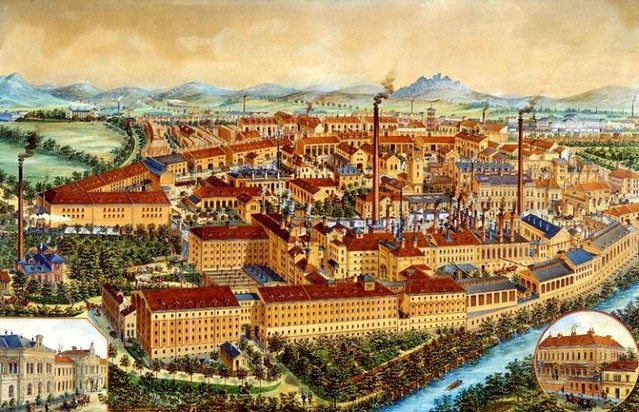
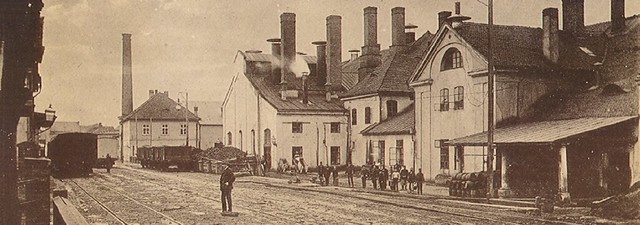
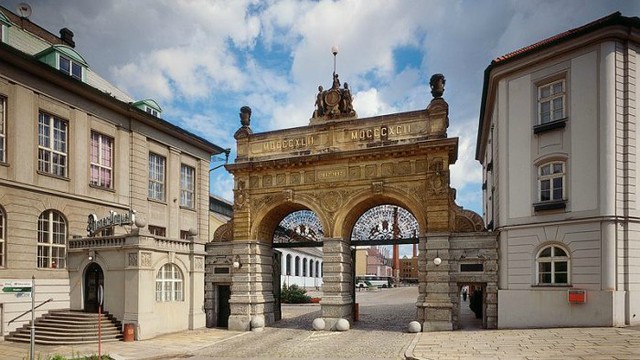
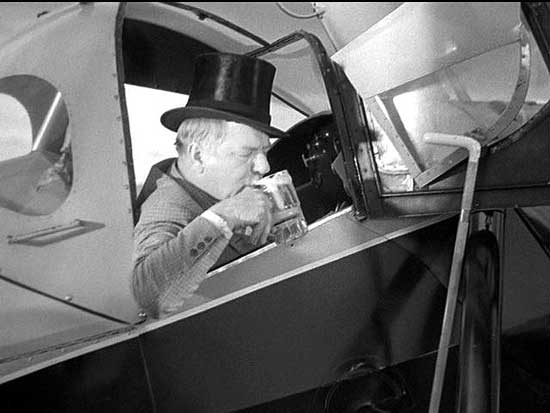
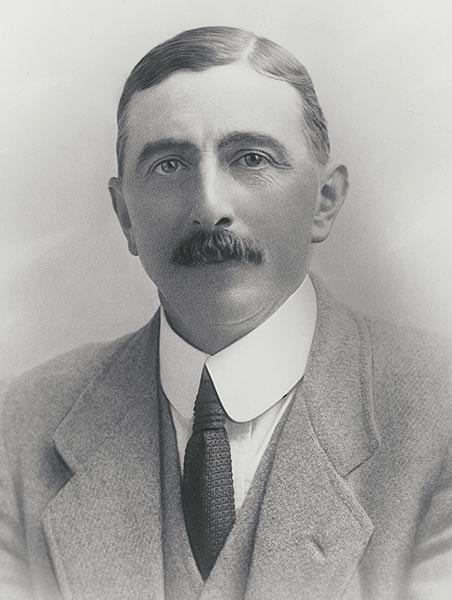
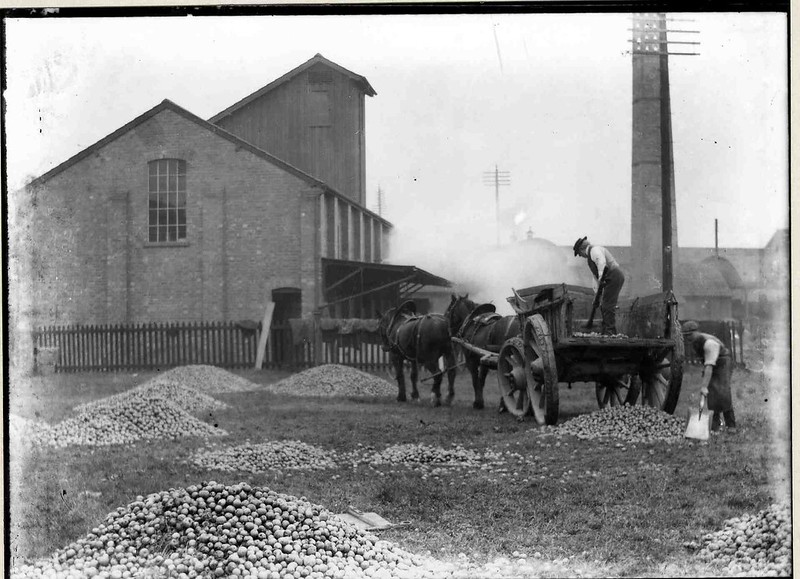
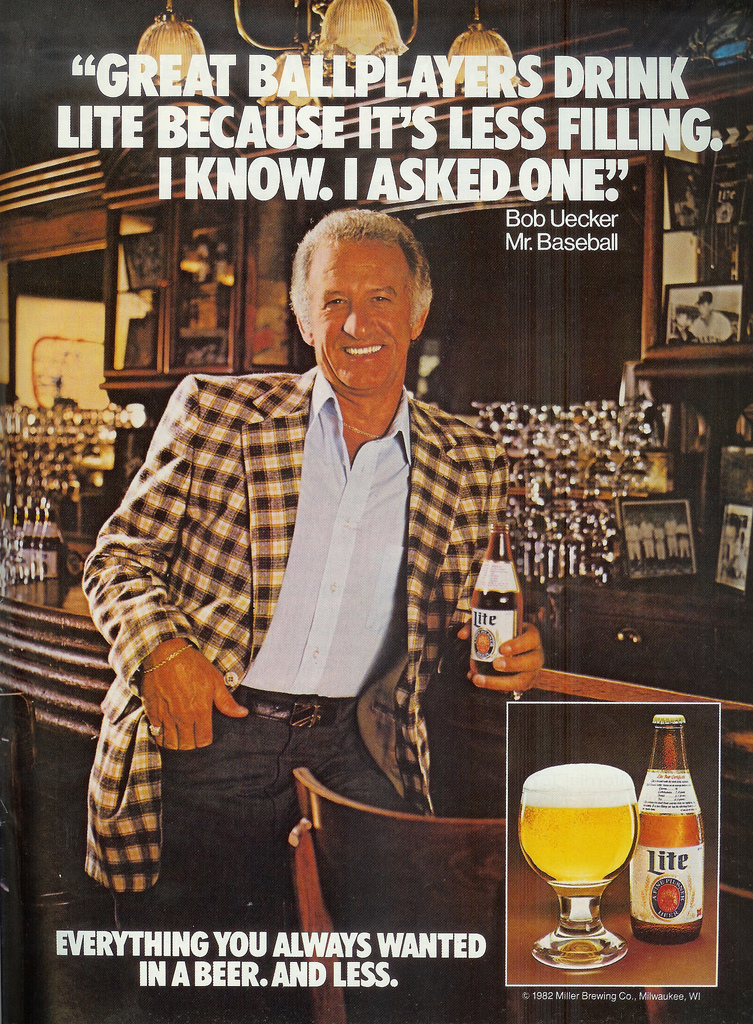
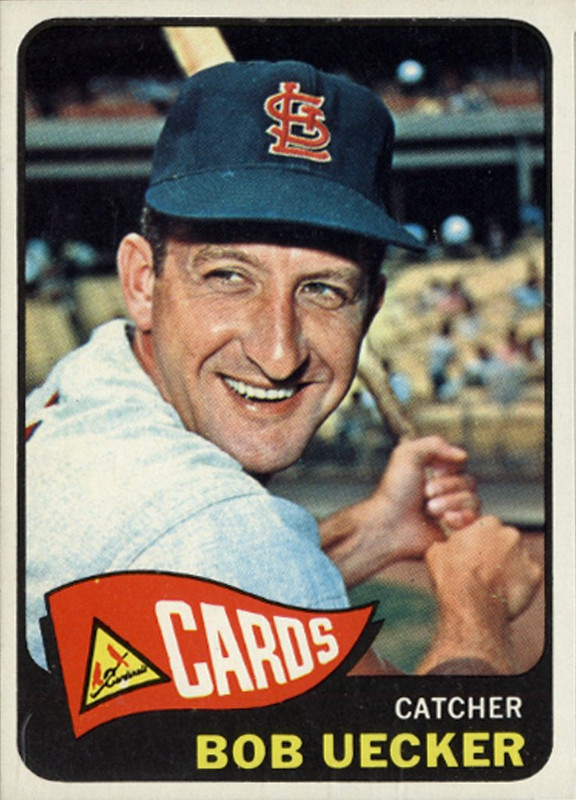
Today is the birthday of Rudolph J. Schaefer III (August 29, 1930-June 10, 2011). Also nicknamed “Rudie” — he was the great-great-grandson of Rudolph J. Schaefer, who was the son of Maximilian Schaefer, and he, along with his brother Frederick, founded the F&M Schaefer Brewing Company in 1842. Rudie’s great-grandfather Rudolph became the president of F&M Schaefer Brewing in 1912, and continued in that position until his death. He also bought out his uncles and their heirs, and controlled the entire company, which allowed his father Rudie to become president in 1927, a position he held until retiring in 1969. Rudie III then became president, and held that position until 1975. “In 1981 Schaefer was acquired by Stroh Brewing Company which, in turn, was acquired by Pabst Brewing Company in 1999.”
Rudolph J. Schaefer III, of Stonington and Key Largo, Fla., died Friday, June 10, 2011, in his home, surrounded by his loving family.
Mr. Schaefer was born on Aug. 29, 1930 in New York City to Rudolph Jay Schaefer Jr. and Lucia (Moran) Schaefer.
Rudie attended the Rye Country Day School, Choate, Washington and Lee and graduated from Hofstra University with a bachelor of business administration. Rudie also attended the Harvard Business School PMD Management Program.
After graduation, Rudie enlisted in the Navy in June, 1952. He served active duty aboard the USS MacGowen DD678 from 1953 to 1957 in the Middle East, attaining the rank of lieutenant JG. He remained in the Naval Reserves until 1969.
Rudie married Jane A. Isdale of New Rochelle, N.Y. at St. John’s Episcopal Church in Larchmont, N.Y. in 1956.
Joining the F&M Schaefer Brewing Co. in 1957, he later served as president of the brewery from 1972 to 1975. His great-grandfather founded the F&M Schaefer Brewing Company in 1842.
Mr. Schaefer was involved, and worked on many boards throughout his life. He was vice president and board member of the New York School For The Deaf, board member of the United Hospital in Port Chester N.Y., the New Rochelle Hospital as well as L&M Hospital in New London. Rudie was also a board member of the Lincoln Savings Bank and the New London Savings Bank.
A philanthropist throughout his life, Rudie was especially proud of his work with the Mystic Seaport, serving as a trustee in 1975 and later president and chairman of the board from 1983 to 1989.
His love of the sea and yachting, sparked a life long interest in marine art. He was very proactive in supporting many aspiring marine artists. Rudie was instrumental in building the Mystic Maritime Art Gallery at the Mystic Seaport in honor of his father, Rudolph J. Schaefer Jr.
Mr. Schaefer was actively involved in many clubs and organizations including the Cruising Club of America, founder of the Stonington Country Club, Stonington Harbor Yacht Club, Ocean Reef Club, member and commodore of the Key Largo Anglers Club, New York Yacht Club. Former memberships include the American Yacht Club, Larchmont Yacht Club and the Shelter Island Yacht Club.
And here’s another obituary from the Hartford Courant, published September 18, 2011:
Extraordinary Life: Rudolph J. Schaefer III of Stonington, was a successful businessman and a generous philanthropist, but the sea was his passion. He also was an heir to the F&M Schaefer Brewing Co., New York’s longest operating brewery.
Rudie Schaefer was a successful businessman and a generous philanthropist, but the sea was his passion. He enjoyed being on the water, collecting modern marine art and working for Mystic Seaport, where he served as president of the board of trustees.
He also was an heir to the F&M Schaefer Brewing Co., New York’s longest operating brewery.
Rudie Schaefer III was born Aug. 29, 1930, and grew up in Larchmont, N.Y., outside Manhattan. His mother, Lucia, was a homemaker and his father was commodore of the Larchmont Yacht Club. Rudie grew up on the water, sailing small and large boats. He graduated from Rye Country Day School and Choate, then attended Washington and Lee University for two years. He obtained his bachelor’s degree in business from Hofstra University in 1952.
After graduation, he enlisted in the Navy and served in the Middle East from 1953 to 1957. He was en route to the Suez Canal during the Middle East crisis of 1956, when many people thought war was imminent. His ship was the last to go through the canal before it closed, but the issues were resolved and he did not see combat.
In the fall of 1956, he married Jane Isdale, a fellow sailor from Larchmont. They had six children; one daughter Anne, predeceased him.
F&M Schaefer, the family beer company, was founded by Schaefer’s great-grandfather Max Schaefer and Max’s brother, Frederick Schaefer, who came to New York in the late 1830s. They worked for a small brewery, owned by Sebastian Summers, but Max introduced the formula for lager beer, popular in Germany but unknown in the United States. Lager became extremely popular, and in 1842 the brothers bought the company. It was a family company for nearly 150 years, and its memorable slogan was “Schaefer: The one beer to have when you are having more than one.”
After his Navy servicer, Schaefer joined the family company in 1957, and went first to Albany to run a plant. The family moved several times as Schaefer rose in the company, and he lived in Rye while he served as president from 1972 until 1975. He retired in 1976.
In 1981, the Stroh Brewery bought the company, and Pabst Brewery bought Stroh in 1999, but Schaefer beer continues to be brewed and distributed in the Northeast and Puerto Rico.
For about five years, Schaefer was a partner in Aquasport, a company that manufactured small fishing boats in Florida.
He also was an outdoorsman who loved trap shooting, hunting and fishing. He once hooked a “grander,” a 1,000 pound black marlin, in Australia, which took 3-1/2 hours to reel in. Broken eardrums kept him from deep sea diving, but he loved going out on his 46-foot yacht built from the hull of a lobster boat.
In the early 1980s, Schaefer became one of the founders of the Stonington Country Club. A perfectionist, he would go around the course picking up rocks, or take a dinghy out to retrieve balls lost in the pond.
The high spirits that led him to dress up in crazy costumes for clown dives at the country club as a teenager never faded. He was a storyteller and had a sense of humor about himself. He liked to tell the story of how he once took a golf swing and missed, then knocked the ball into the clubhouse on the way back.
In 1982, the Schaefers moved to Stonington.
“Mystic Seaport brought us here,” said Jane Schaefer who like her husband, became an active volunteer at the seaport. Like his father, he became a trustee and served as president and chairman of the board from 1983 to 1989.
Schaefer was one of the early Pilots, a group of seaport volunteers who spend two weekends a year doing odd jobs, including painting and maintenance at the port. Schaefer’s preferred activity was shingling, and he would suit up in his tool belt and repair roofs wherever it was needed.
Schaefer had an encyclopedic knowledge of boating.
“He just knew every boat yard up and down the East Coast,” said Russell Burgess, a sailing friend. To make sure that old-boat-building techniques and sailing yarns weren’t forgotten, Schaefer funded a position for an oral historian at Mystic who interviewed boat builders, architects and famous sailors. He supported the library and was active in finding collections and boats for the museum.
Always interested in art, Schaefer was instrumental in establishing the Maritime Gallery at Mystic Seaport, a showcase for modern, international marine art and donated a building in honor of his father. Some of the younger artists whom Schaefer collected and promoted became well-known, such as Don Demers, a Maine painter whose work he first encountered at the gallery.
“Rudie took note of the paintings, introduced himself and made a point of complimenting me,” recalled Demers. Schaefer began buying Demers’ work, and in 1988, Demers had a one-man show at Mystic that sold out.
“He had a lot of influence,” Demers said. “If you got Rudie’s stamp of approval, you were validated, and that certainly happened to me.”
Schaefer’s approach to art mirrored his approach to life: He was gregarious and effusive.
“He’d pull people over and say, look at this. We’d talk and talk and talk about it,” said Demers. “It was really a joy to show him a painting.”
“He was a rare trustee,” said Paul O’Pecko, the reference librarian. “He really did give freely of his time, talent and treasure.”
“He had a motto,” said his wife. “Make one person smile every day.”
Today is the birthday of Sandy Dvore (August 28, 1934-November 20, 2020). He was a prolific American artist, graphic designer, and title designer. This short biography from his Wikipedia page gives the highlights:
Around 1962, he met Hollywood publicist Guy McElwaine playing baseball, who represented Natalie Wood, Warren Beatty, Judy Garland and Tony Bennett and needed ads created. Through this connection, Dvore became well known for designing back cover art for Sammy Davis Jr. in Variety. Dvore then illustrated an ad for Judy Garland for Judy at Carnegie Hall which caught the attention of American theatrical agent and film producer Freddie Fields. The pair worked together for 13 years on numerous projects. Dvore would go on to illustrate hundreds of ads for stars like Frank Sinatra, Liza Minnelli, Natalie Wood, David Bowie, Mick Jagger, and Steve McQueen. His minimal but vibrant illustrated trade ads held the coveted back pages of The Hollywood Reporter and Variety for years.
Sandy Dvore is best known for his work in designing television title sequences, such as the walking partridges in The Partridge Family, and the brush-stroke logo and paintings from the long-running soap opera The Young and the Restless. His film title credits include the 1976 film Lipstick and the 1972 Blaxploitation thriller Blacula. He also designed the opening credits for selected seasons of the nighttime soap opera Knots Landing.
Dvore’s work in graphic design won him an Emmy Award in 1987 for Carol, Carl, Whoopi and Robin.
But as memorable as that work is, that’s not why I’m sharing his birthday here, as you might expect. He also worked on a more beer-related project. Robert Leo Hulseman, whose father founded the Solo Cup Company. In the 1970s, Hulseman hired Dvore to design a new plastic cup for the company. Here’s the story, from the now-defunct design blog Design-Ago:
One rainy day in early 1970’s Los Angeles…
Leo Hulesman, founder of the Solo cup company, stopped by the studio of Hollywood designer Sandy Dvore.
“I heard you’re the best commercial artist around.” Said Hulesman.
This was true. Dvore was the hottest designer in Hollywood. His work appeared everywhere from billboards to trade ads and most famously, every week in the Hollywood Reporter and Variety publications. At the time, these were the most important pieces of the Hollywood community. EVERYONE looked to these weekly magazines to see what their peers were doing.
Hulesman was looking for a design for his new venture, children’s records that would be a promotional giveaway on the Solo cup box. You see, Dora Hall, a singer who was also Mrs. Hulesman, had given up her career in Ziegfield Follies to raise their children. This was a chance for her to get back to performing again and do something her children could enjoy.
“I’m doing very well now” said Dvore. “I’ve got some major projects and I really don’t want to do small piece work. It would take up a lot of time.”
“What if I give you a retainer?” Said Hulesman.
“He was sharp”, Dvore thought.
At the time Dvore was doing big name television projects, The Partidge Family and The Waltons.
“I could send you a chunk of money…” “What kind of number are we talking?” Asked Hulseman.
“$17,500” stated Dvore.
“Why don’t we just make it a flat $25,000.” Replied Hulesman.
They shook hands and Hulesman smiled. He enjoyed the banter as he, like Dvore, was a self made man from Chicago.
“He liked that I could handle myself.” Dvore remembered. “We became friends and I enjoyed knowing him.”
Hulesman enjoyed sharing the success he had. He would pay for entire television specials for his wife Dora so she could have an opportunity perform.
When it’s time to change.
“The Solo company at the time had an old serif logo right out of a type book.” Dvore remembers.
Dvore looked at the two O’s in the SOLO logo and the idea came to him, simple as that. He hadn’t been asked to create a new logo either. He just thought,
“as a artist, we can do better.”
Hulesman had his feet propped up on Dvore’s desk when he showed him what he had come up with.
“We should change your logo, this should be the logo for your company.” Dvore slid the concept to Hulesman.
The negative space in the SOLO, O’s replaced with cups, along with a new san-serif type.
Hulesman looked at it and replied, “send it to the company.”
And, one short phone call later, it became the logo you still see everywhere today.
Sometimes, but not often, it IS that easy.
A relationship of trust formed between Dvore and Hulesman. Which is why Dvore felt comfortable proposing new ideas.
“Why are all your cups white? You should have some colored cups.”
With this idea Dvore took the colors from his recent Partridge Family art and applied the same blue, yellow and red to the cups.
And in another short phone call to the factory, the Solo cup company started producing color cups.
“I even used the same color numbers from the Partridge Family logo.” Recalls Dvore.
And so, once again, a simple yet smart idea, a phone call, and the rest is history, the red Solo cup was born.
Whoever would have thought a cup would be so famous?
It has inspired songs, drinking games, tattoo’s, merchandise and created plenty of hazy memories.
Why red became the go-to, and a cultural icon is anyone’s guess.
“It’s become the most well known and most seen thing I have ever done.” Dvore states today.
Every day, millions of people get their morning cup of coffee and before they take a sip there it is, the Solo cup logo.
Every night, people attend a party or have a game of beer pong and there it is again, the red Solo cup.
Today is the birthday of Hans Adolf Krebs (August 25, 1900-November 22, 1981). He was a German-born British physician and biochemist. He was the pioneer scientist in study of cellular respiration, a biochemical pathway in cells for production of energy. He is best known for his discoveries of two important chemical reactions in the body, namely the urea cycle and the citric acid cycle. The latter, the key sequence of metabolic reactions that produces energy in cells, often eponymously known as the “Krebs cycle,” earned him a Nobel Prize in Physiology or Medicine in 1953. And it’s the Krebs cycle that is his relation to brewing, as it’s also known as the respiratory phase, the second aerobic state of the fermentation process immediately following the lag period.
Here’s a description of the Krebs cycle from Life Fermented:
The Krebs cycle, also known as the tricarboxylic acid (TCA) cycle or the citric acid cycle, is a circular and repeating set of reactions which requires oxygen. In beer making, this would occur in the first stage of fermentation when the yeast is pitched into a well aerated wort, and carries on until all oxygen is used up.
Pyruvate (are you tired of this word yet?) is first converted to acetyl-CoA (pronounced “Co-A”) in the following reaction:
pyruvate + 2 NAD+ + CoA-SH → acetyl-CoA + CO2 + NADH, with the help of the pyruvate dehydrogenase (PDH) complex. Note that this is the first time CO2 is produced, and yet more NADH is generated.
This acetyl-CoA then enters into a cycle of reactions which nets two molecules of CO2, one GTP (guanosine triphosphate, another unit of energy equivalent to ATP), three NADH, and one FADH2 (flavin adenine dinucleotide, which functions similarly to NADH). After the cycle completes, another acetyl-CoA molecule enters and the cycle repeats itself.
But wait, this just made more NADH, and we need to regenerate NAD+ so glycolysis can continue. Both the NADH and FADH2 now donate their electrons to a process called the electron transport chain/ oxidative phosphorylation. The result is a return of NAD to the NAD+ state, and a large amount of ATP cellular energy.
Because the Krebs cycle is so efficient at producing ATP energy units, this is the yeast’s preferred pathway. But, you’ll notice a rather conspicuous absence: ethanol. This is only formed in the absence of oxygen.
Here’s a biography of Krebs, from the Nobel Prize website:
Sir Hans Adolf Krebs was born at Hildesheim, Germany, on August 25th, 1900. He is the son of Georg Krebs, M.D., an ear, nose, and throat surgeon of that city, and his wife Alma, née Davidson.
Krebs was educated at the Gymnasium Andreanum at Hildesheim and between the years 1918 and 1923 he studied medicine at the Universities of Göttingen, Freiburg-im-Breisgau, and Berlin. After one year at the Third Medical Clinic of the University of Berlin he took, in 1925, his M.D. degree at the University of Hamburg and then spent one year studying chemistry at Berlin. In 1926 he was appointed Assistant to Professor Otto Warburg at the Kaiser Wilhelm Institute for Biology at Berlin-Dahlem, where he remained until 1930.
In I930, he returned to hospital work, first at the Municipal Hospital at Altona under Professor L. Lichtwitz and later at the Medical Clinic of the University of Freiburg-im-Breisgau under Professor S. J. Thannhauser.
In June 1933, the National Socialist Government terminated his appointment and he went, at the invitation of Sir Frederick Gowland Hopkins, to the School of Biochemistry, Cambridge, where he held a Rockefeller Studentship until 1934, when he was appointed Demonstrator of Biochemistry in the University of Cambridge.
In 1935, he was appointed Lecturer in Pharmacology at the University of Sheffield, and in 1938 Lecturer-in-Charge of the Department of Biochemistry then newly founded there.
In 1945 this appointment was raised to that of Professor, and of Director of a Medical Research Council’s research unit established in his Department. In 1954 he was appointed Whitley Professor of Biochemistry in the University of Oxford and the Medical Research Council’s Unit for Research in Cell Metabolism was transferred to Oxford.
Professor Krebs’ researches have been mainly concerned with various aspects of intermediary metabolism. Among the subjects he has studied are the synthesis of urea in the mammalian liver, the synthesis of uric acid and purine bases in birds, the intermediary stages of the oxidation of foodstuffs, the mechanism of the active transport of electrolytes and the relations between cell respiration and the generation of adenosine polyphosphates.
Among his many publications is the remarkable survey of energy transformations in living matter, published in 1957, in collaboration with H. L. Kornberg, which discusses the complex chemical processes which provide living organisms with high-energy phosphate by way of what is known as the Krebs or citric acid cycle.
Krebs was elected a Fellow of the Royal Society of London in 1947. In 1954 the Royal Medal of the Royal Society, and in 1958 the Gold Medal of the Netherlands Society for Physics, Medical Science and Surgery were conferred upon him. He was knighted in 1958. He holds honorary degrees of the Universities of Chicago, Freiburg-im-Breisgau, Paris, Glasgow, London, Sheffield, Leicester, Berlin (Humboldt University), and Jerusalem.
He married Margaret Cicely Fieldhouse, of Wickersley, Yorkshire, in 1938. They have two sons, Paul and John, and one daughter, Helen.
And in the Microbe Wiki, on a page entitled “Saccharomyces cerevisiae use and function in alcohol production,” under a section called “Fermentation of alchohol,” the Krebs cycle is placed in its portion in the fermentation process:
Saccharomyces cerevisiae is able to perform both aerobic and anaerobic respiration. The process begins with the yeast breaking down the different forms of sugar in the wort. The types of sugars typically found in wort are the monosaccharides glucose and fructose. These sugars contain a single hexose, which is composed of 6 carbon atoms in the molecular formula C6H12O6. Disaccharides are formed when two monosaccharides join together. Typical disaccharides in the wort are galactose, sucrose, and maltose. The third type of fermentable sugar in the wort is a trisaccharide. This trisaccharide is formed when three monosccharides join together. Maltotriose is the trisaccharide commonly found in the wort and is composed of three glucose molecules. The wort does contain other sugars such as dextrins but it is not fermentable by yeast10. These dextrins contain four monosaccarides joined together. In order for the yeast to use the disaccharides and trisaccharides they first must be broken down to monosaccharides. The yeast does this by using different enzymes both inside and outside the cell. The enzyme invertase is used to break down sucrose into glucose and fructose. The invertase catalyzes the hydrolysis of the sucrose by breaking the O-C (fructose bond). The other enzyme used is maltase, which breaks down maltose and maltotriose into glucose inside the cell. The enzyme does this by catalyzing the hydrolysis of the sugars by breaking the glycosidic bond holding the glucose molecules together.
Once the sugars are broken down into monosaccharides the yeast can use them. The primary step is called glycolysis. In this process the glucose is converted to pyruvate using different enzymes in a series of chemical modifications. The electrons from glucose end up being transferred to energy carrying molecules like NAD+ to form NADH. ATP is also formed when phosphates are transferred from high-energy intermediates of glycolysis to ADP. In the presence of oxygen aerobic respiration can occur. This occurs in the mitochondria of the yeast. The energy of the pyruvate is extracted when it goes through metabolic processes like the Krebs cycle. The products of this type of metabolism are ATP, H2O, and CO2. However if there is no oxygen present and an abundance of sugars, as in the wort, the yeast undergo alcoholic fermentation. This type of metabolism yields much smaller amounts of energy when compared to aerobic respiration. However, because of the large supply of sugars from the different grains the wort is a very good environment for fermentative growth. The alcoholic fermentation begins with the two pyruvate acquired from glycolysis. These two pyruvate are decarboxylated by pyruvate decarboxylase to form two acetaldehydes and CO2. The CO2 is the gas that is observed during fermentation as bubbles that float to the top of the wort creating the kräusen or beer head, the foam that is very characteristic of a freshly poured beer. Pyruvate decarboxylase is a homotetramer meaning it contains four identical subunits. This also means that is has four active sites. The active sites are where the pyruvate reacts with the cofactors thiamine pyrophosphate (TPP) and magnesium to remove the carbon dioxide9. The final step to form alcohol is the addition of a hydrogen ion to the aldehyde to form ethanol. This hydrogen ion is from the NADH made during glycolysis and converts back to NAD+. The ethanol is originally believed to serve as an antibiotic against other microbes. This form of defense ensures that bacteria do not grow in the wort, thus ruining the beer with off flavors. However recently with the boom of craft beer different bacteria have been purposefully added to create what is known as sour beer. The sour taste comes from the waste products of the bacteria.
To learn more about the Krebs cycle check out this video from the University of Oklahoma’s Chemistry of Beer – Unit 7 – Chemical Concepts: Krebs Cycle:
Today is the birthday of John Taylor, who was nicknamed “The Bard of Beer,” although he apparently referred to himself as “The Water Poet.” (August 24, 1578-1653). He was born in Gloucester, and “after his waterman apprenticeship he served (1596) in Essex’s fleet, and was present at Flores in 1597 and at a siege of Cadiz.”
Here’s part of his biography from his Wikipedia page:
He spent much of his life as a Thames waterman, a member of the guild of boatmen that ferried passengers across the River Thames in London, in the days when the London Bridge was the only passage between the banks. He became a member of the ruling oligarchy of the guild, serving as its clerk; it is mainly through his writings that history is familiar with the watermen’s disputes of 1641–42, in which an attempt was made to democratize the leadership of the Company. He details the uprisings in the pamphlets Iohn Taylors Manifestation … and To the Right Honorable Assembly … (Commons Petition), and in John Taylors Last Voyage and Adventure of 1641.
He was a prolific, if rough-hewn writer (a wit rather than a poet), with over one hundred and fifty publications in his lifetime. Many were gathered into the compilation All the Workes of John Taylor the Water Poet (London, 1630; facsimile reprint Scholar Press, Menston, Yorkshire, 1973); augmented by the Spenser Society’s edition of the Works of John Taylor … not included in the Folio edition of 1630 (5 volumes, 1870–78). Although his work was not sophisticated, he was a keen observer of people and styles in the seventeenth century, and his work is often studied by social historians. An example is his 1621 work Taylor’s Motto, which included a list of then-current card games and diversions.
He achieved notoriety by a series of eccentric journeys: for example, he travelled from London to Queenborough in a paper boat with two stockfish tied to canes for oars, described in “The Praise of Hemp-Seed”,[2] which was re-enacted in 2006. From his journey to Scotland in 1618, on which he took no money, Taylor published his Pennyless Pilgrimage. (Ben Jonson walked to Scotland in the same year.)
Taylor is one of the few credited early authors of a palindrome: in 1614, he wrote “Lewd did I live, & evil I did dwel.” He wrote a poem about Thomas Parr, a man who supposedly lived to the age of 152. He was also the author of a constructed language called Barmoodan.
Many of Taylor’s works were published by subscription; i.e., he would propose a book, ask for contributors, and write it when he had enough subscribers to undertake the printing costs. He had more than sixteen hundred subscribers to The Pennylesse Pilgrimage; or, the Moneylesse Perambulation of John Taylor, alias the Kings Magesties Water-Poet; How He TRAVAILED on Foot from London to Edenborough in Scotland, Not Carrying any Money To or Fro, Neither Begging, Borrowing, or Asking Meate, Drinke, or Lodging., published in 1618.
John Taylor, (born Aug. 24, 1580, Gloucester, Gloucestershire, Eng.—died December 1653, London), minor English poet, pamphleteer, and journalist who called himself “the Water Poet.”
The son of a surgeon, Taylor was sent to a grammar school but became, as he said, “mired in Latin accidence” and was apprenticed to a Thames boatman. He served in the navy and saw action at Cádiz (1596) and Flores (1597). Returning to London, he worked as a waterman transporting passengers up and down the River Thames and also held a semiofficial post at the Tower of London for several years. Taylor won fame by making a series of whimsical journeys that he described in lively, rollicking verse and prose. For example, he journeyed from London to Queenborough, Kent, in a paper boat with two stockfish tied to canes for oars and nearly drowned in the attempt. He made other water journeys between London, York, and Salisbury, and The Pennyles Pilgrimage. . . (1618) describes a trip he made on foot from London to Edinburgh without money. In 1620 he journeyed to Prague, where he was received by the queen of Bohemia. His humorous accounts of his journeys won the patronage of Ben Jonson, among others. Taylor also amused the court and the public in his paper war with another eccentric traveler, Thomas Coryate. In 1630 he published 63 pieces in All the Works of John Taylor the Water Poet, although he continued to publish prolifically afterward.
When the English Civil Wars began Taylor moved to Oxford, where he wrote royalist pamphlets. After the city surrendered (1645), he returned to London and kept a public house, “The Crown” (later “The Poet’s Head”), until his death.
He “was a German-American poet, novelist, and short story writer. His writing was influenced by the social, cultural, and economic ambience of his adopted home city of Los Angeles. Bukowski’s work addresses the ordinary lives of poor Americans, the act of writing, alcohol, relationships with women, and the drudgery of work. The FBI kept a file on him as a result of his column Notes of a Dirty Old Man in the LA underground newspaper Open City.
Bukowski published extensively in small literary magazines and with small presses beginning in the early 1940s and continuing on through the early 1990s. He wrote thousands of poems, hundreds of short stories and six novels, eventually publishing over sixty books during the course of his career. Some of these works include his Poems Written Before Jumping Out of an 8 Story Window, published by his friend and fellow poet Charles Potts, and better-known works such as Burning in Water, Drowning in Flame. These poems and stories were later republished by John Martin’s Black Sparrow Press (now HarperCollins/Ecco Press) as collected volumes of his work. As noted by one reviewer, “Bukowski continued to be, thanks to his antics and deliberate clownish performances, the king of the underground and the epitome of the littles in the ensuing decades, stressing his loyalty to those small press editors who had first championed his work and consolidating his presence in new ventures such as the New York Quarterly, Chiron Review, or Slipstream.”
In 1986, Time called Bukowski a “laureate of American lowlife”. Regarding his enduring popular appeal, Adam Kirsch of The New Yorker wrote, “the secret of Bukowski’s appeal … [is that] he combines the confessional poet’s promise of intimacy with the larger-than-life aplomb of a pulp-fiction hero.”
During his lifetime, Bukowski received little attention from academic critics in the United States, but was better received in Europe, particularly the UK, and especially Germany, where he was born. Since his death in March 1994, Bukowski has been the subject of a number of critical articles and books about both his life and writings.
He wrote about his drinking quite a bit in poems, short stories and in legend. Below is one of his more memorable quotes:
But that’s just the tip of the iceberg, so to speak. Drinking was a favorite topic of Bukowski and his writings on the subject were collected into a single volume entitled “Charles Bukowski On Drinking” in 2019. Here’s a few gems from that volume:
From “Charles Bukowski Answers 10 Easy Questions”
“Question: What would you say is the best brand of American beer on the market today?
Bukowski: Well, that’s a bit difficult. Miller’s is the easiest on my system but each new batch of Miller’s seems to taste a bit worse. Something is going on there that I don’t like. I seem to be gradually going over to Schlitz. And I prefer beer in the bottle. Beer in the can definitely gives off a metallic taste. Cans are for the convenience of storekeepers and breweries. Whenever I see a man drinking out of a can I think, “now there is a damn fool.” Also, bottled beer should be in a brown bottle. Miller again errs in putting the stuff into a white bottle. Beer should be protected both from metal and from light.
Of course, if you have the money, it’s best to go up the scale and get the more expensive beers, imported or better-made American. Instead of a dollar 35 you have to go a dollar 75 or 2 and quarter and up. The taste is immediately noticeable. And you can drink more with less hangover. Most ordinary American beer is almost poison, especially the stuff that comes out of the spigots at racetracks. This beer actually stinks, I mean, to the nose. If you must buy a beer at the racetrack it is best to let it sit for 5 minutes before drinking it. There is something about the oxygen getting in there that removes some of the stink. The stuff is simply green.
Beer was much better before World War 2. It had tang and was filled with sharp little bubbles. It’s wash now, strictly flat. You just do the best you can with it.
Beer is better to write with and talk with than whiskey. You can go longer and make more sense. Of course, much depends upon the talker and the writer. But beer is fattening, plenty, and it lessens the sex drive, I mean, both the day you are drinking it and the day after. Heavy drinking and heavy loving seldom go hand in hand after the age of 35. I’d say a good chilled wine is the best way out and it should be drank slowly after a meal, with just perhaps a small glass before eating.
Heavy drinking is a substitute for companionship and it’s a substitute for suicide. It’s a secondary way of life. I dislike drunks but I do suppose I take a little drink now and then myself. Amen.”
brewed and filled by … (1964)
“everything in my beercan hand is sad, the dirt is even sad under my fingernails, and this hand is like the hand of a machine and yet it is not— it curves itself completely (an effort containing magic) around the beercan in a movement the same as roots pounding a gladiola up into the sun of air, and the beer goes into me.”
beerbottle (1974)
“a very miraculous thing just happened: my beerbottle flipped over backwards and landed on its bottom on the floor, and I have set it upon the table to foam down, but the photos were not so lucky today and there is a small slit along the leather of my left shoe, but it’s all very simple: we cannot acquire too much: there are laws we know nothing of, all manner of nudges set us to burning or freezing; what sets the blackbird in the cat’s mouth is not for us to say, or why some men are jailed like pet squirrels while others nuzzle in enormous breasts through endless nights—this is the task and the terror, and we are not taught why. still, it’s lucky the bottle landed straightside up, and although I have one of wine and one of whiskey, this forsooths, somehow, a good night, and perhaps tomorrow my nose will be longer: new shoes, less rain, more poems.”
The Bukowski Tapes (1985)
“I think a man can keep on drinking for centuries, he’ll never die; especially wine and beer . . . I like drunkards, because drunkards, they come out of it, and they’re sick and they spring back, they spring back and forth . . . If you gotta be anything, be an alcoholic. If I hadn’t been a drunkard, I probably would have committed suicide long ago. You know, working the factories, the eight hour job. The slums. The streets. You work a god damn lousy job. You come home at night, you’re tired. What are you gonna do, go to a movie? Turn on your radio in a three dollar a week room? Or are you gonna rest up and wait for the job the next day, for $1.75 an hour? Hell, no! You’re gonna get a bottle of whiskey and drink it. And go down to a bar and maybe get in a fist fight. And meet some bitch, something’s going on. Then you go to work the next day, and do your simple little things, right? . . . Alcohol gives you the release of the dream without the deadness of drugs. You can come back down. You have your hangover to face. That’s the tough part. You get over it, you do your job. You come back. You drink again. I’m all for alcohol. It’s the thing.”
beer (1976)
“I don’t know how many bottles of beer I have drunk while waiting for things to get better. I don’t know how much wine and whiskey and beer mostly beer I have drunk after splits with women— waiting for the phone to ring waiting for the sound of footsteps, and the phone never rings until much later and the footsteps never arrive until much later when my stomach is coming up out of my mouth they arrive as fresh as spring flowers: ‘what the hell have you done to yourself? it will be 3 days before you can fuck me!’
the female is durable she lives seven and one half years longer than a man, and she drinks very little beer because she knows it’s bad for the figure.
while we are going mad they are out dancing and laughing with horny cowboys.
well, there’s beer sacks and sacks of empty beer bottles and when you pick them up the bottles fall through the wet bottom of the paper sacks rolling clanking spilling grey wet ash and stale beer, or the sacks fall over at 4 A.M. in the morning making the only sound in your life.
beer rivers and seas of beer beer beer beer the radio singing love songs as the phone remains silent and the walls stand straight up and down the beer is all there is.”
Today is the birthday of Johan Gustav Christoffer Thorsager Kjeldahl (August 16, 1849-July 18, 1900) He was a Danish chemist who developed a method for determining the amount of nitrogen in certain organic compounds using a laboratory technique which was named the Kjeldahl method after him.
Kjeldahl worked in Copenhagen at the Carlsberg Laboratory, associated with Carlsberg Brewery, where he was head of the Chemistry department from 1876 to 1900.
He was given the job to determine the amount of protein in the grain used in the malt industry. Less protein meant more beer. Kjeldahl found the answer was in developing a technique to determine nitrogen with accuracy but existing methods in analytical chemistry related to proteins and biochemistry at the time were far from accurate.
The method consists of heating a substance with sulphuric acid, which decomposes the organic substance by oxidation to liberate the reduced nitrogen as ammonium sulphate. In this step potassium sulphate is added to increase the boiling point of the medium (from 337 °C to 373 °C) . Chemical decomposition of the sample is complete when the initially very dark-coloured medium has become clear and colourless.
The solution is then distilled with a small quantity of sodium hydroxide, which converts the ammonium salt to ammonia. The amount of ammonia present, and thus the amount of nitrogen present in the sample, is determined by back titration. The end of the condenser is dipped into a solution of boric acid. The ammonia reacts with the acid and the remainder of the acid is then titrated with a sodium carbonate solution by way of a methyl orange pH indicator.
In practice, this analysis is largely automated; specific catalysts accelerate the decomposition. Originally, the catalyst of choice was mercuric oxide. However, while it was very effective, health concerns resulted in it being replaced by cupric sulfate. Cupric sulfate was not as efficient as mercuric oxide, and yielded lower protein results. It was soon supplemented with titanium dioxide, which is currently the approved catalyst in all of the methods of analysis for protein in the Official Methods and Recommended Practices of AOAC International.
And Velp Scientifica also has an explanation of his method, which is still in use today.
Today is the birthday of Anders Jöns Ångström (August 13, 1814–June 21, 1874). He “was a Swedish physicist and one of the founders of the science of spectroscopy.” The Ångström unit (1 Å = 10−10 m) in which the wavelengths of light and interatomic spacings in condensed matter are sometimes measured are named after him. Various types of spectroscopy are employed in the brewing industry.
Here’s a partial biography of Ångström from Wikipedia:
Anders Jonas Ångström was born in Medelpad to Johan Ångström, and schooled in Härnösand. He moved to Uppsala in 1833 and was educated at Uppsala University, where in 1839 he became docent in physics. In 1842 he went to the Stockholm Observatory to gain experience in practical astronomical work, and the following year he was appointed keeper of the Uppsala Astronomical Observatory.
Intrigued by terrestrial magnetism he recorded observations of fluctuations in magnetic intensity in various parts of Sweden, and was charged by the Stockholm Academy of Sciences with the task, not completed until shortly before his death, of working out the magnetic data obtained by HSwMS Eugenie on her voyage around the world in 1851 to 1853.
In 1858, he succeeded Adolph Ferdinand Svanberg in the chair of physics at Uppsala. His most important work was concerned with heat conduction and spectroscopy. In his optical researches, Optiska Undersökningar, presented to the Royal Swedish Academy of Sciences in 1853, he not only pointed out that the electric spark yields two superposed spectra, one from the metal of the electrode and the other from the gas in which it passes, but deduced from Leonhard Euler’s theory of resonance that an incandescent gas emits luminous rays of the same refrangibility as those it can absorb. This statement, as Sir Edward Sabine remarked when awarding him the Rumford medal of the Royal Society in 1872, contains a fundamental principle of spectrum analysis, and though overlooked for a number of years it entitles him to rank as one of the founders of spectroscopy.
This is the general definition of spectroscopy from Wikipedia:
Spectroscopy is the study of the interaction between matter and electromagnetic radiation. Historically, spectroscopy originated through the study of visible light dispersed according to its wavelength, by a prism. Later the concept was expanded greatly to include any interaction with radiative energy as a function of its wavelength or frequency. Spectroscopic data are often represented by an emission spectrum, a plot of the response of interest as a function of wavelength or frequency.
This abstract from the 2006 paper “Applications of Vibrational Spectroscopy in Brewing” gives an overview of their use by brewers.
The purpose of this chapter is to compile the literature concerning the applications of near‐infrared (NIR), mid‐infrared and Raman spectroscopy in the brewing industry. All these three techniques share the advantages that they are rapid, can be noninvasive and allow direct observation of specific molecular species. As for barley, many researchers have used the NIR reflectance on whole grains in malt evaluation. The NIR determination of α/β‐acids and hop storage index in baled hop samples is reported. NIR spectrophotometric methods have been developed for the determination of yeast concentration and activity in beer making. In addition to the applications in the laboratory of quality control, the overview concerns also the applications of infrared and Raman spectroscopy in monitoring of operation and process control at the essential steps of mashing and wort fermentation in brewery. The results obtained with a short wave NIR spectrophotometer are presented in comparison with long wave NIR spectrophotometers.
Brewers use spectrometers to measure a number of QC items throughout the brewing process.
To get a sense of how much spectrometers are used, this article promoting StellarNet, a company selling them, entitled Spectroscopy Prospects Brewing, is pretty thorough.
While records going back this far in time are notoriously unreliable, some sources put the birthday of St. Arnulf of Metz at August 13, 583 C.E., such as Find-a-Grave, among others. He’s also known as Anou, Arnould, Arnold of Metz, and his feast day is July 18. Although even the year is not settled, and some sources give it as 580 or 582 C.E., so the actual likelihood that any of this is correct is pretty low.
“Saint Arnulf of Metz (c. 582 – 640) was a Frankish bishop of Metz and advisor to the Merovingian court of Austrasia, who retired to the Abbey of Remiremont. In French he is also known as Arnoul or Arnoulf. In English he is also known as Arnold.” Metz is located in northeastern France.
Also, Arnulf is one of at least three patron saints of brewers with similar names, although he is the oldest, and essentially first one. That’s one of the reasons I chose his feast day, July 18, for the holiday I created in 2008, International Brewers Day.
The Saint Arnold most people are familiar with is Arnold of Soissons, and he’s from much later, almost 500 years, and is thought to have been born around 1040 C.E. Less is known about the third, St. Arnou of Oudenaarde (or Arnouldus), and he’s also a patron saint of beer and specifically Belgian brewers, because Oudenaarde is in Flanders. His story takes place in the 11th century.
Here’s his bio from Find-a-Grave:
Saint Arnulf of Metz (c 582 — 640) was a Frankish bishop of Metz and advisor to the Merovingian court of Austrasia, who retired to the Abbey of Remiremont.
Saint Arnulf of Metz was born of an important Frankish family at an uncertain date around 582. In his younger years he was called to the Merovingian court to serve king Theudebert II (595-612) of Austrasia and as dux at the Schelde. Later he became bishop of Metz. During his life he was attracted to religious life and he retired as a monk. After his death he was canonized as a saint. In the French language he is also known as Arnoul or Arnoulf. Arnulf was married ca 596 to a woman who later sources give the name of Dode or Doda, (whose great grandmother was Saint Dode of Reims), and had children. Chlodulf of Metz was his oldest son, but more important is his second son Ansegisen, who married Saint Begga daughter of Pepin I of Landen.
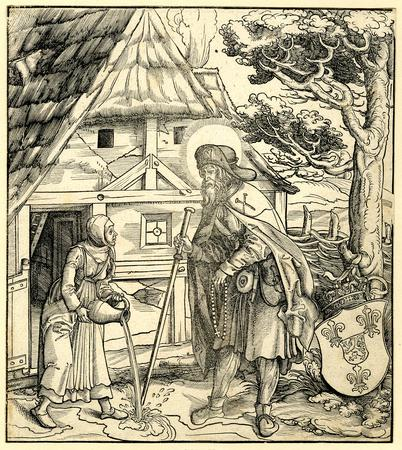
Arnulf was canonized as a saint by the Roman Catholic Church. In iconography, he is portrayed with a rake in his hand.
He was the third great grandfather of Charlemagne.
St. Arnulf in the Metz Cathedral.
The Legend of the Beer Mug
It was July 642 and very hot when the parishioners of Metz went to Remiremont to recover the remains of their former bishop. They had little to drink and the terrain was inhospitable. At the point when the exhausted procession was about to leave Champigneulles, one of the parishioners, Duc Notto, prayed “By his powerful intercession the Blessed Arnold will bring us what we lack.” Immediately the small remnant of beer at the bottom of a pot multiplied in such amounts that the pilgrims’ thirst was quenched and they had enough to enjoy the next evening when they arrived in Metz.
During an outbreak of the plague a monk named Arnold, who had established a monastery in Oudenburg, persuaded people to drink beer in place of water and when they did, the plague disappeared.
Arnold spent his holy life warning people about the dangers of drinking water. Beer was safe, and “from man’s sweat and God’s love, beer came into the world,” he would say.
The small country of Belgium calls itself the ‘Beer Paradise’ with over 300 different styles of beer to choose from. Belgium boasts of centuries old tradition in the art of brewing. In the early Middle Ages monasteries were numerous in that part of Europe, being the centers of culture, pilgrimage and brewing. Belgium still has a lot of monasteries and five of these are Trappist, a strict offshoot of the Cistercian order, which still brews beer inside the monastery.
During one outbreak of the plague St. Arnold, who had established a monastery in Oudenburg, convinced people to drink beer instead of the water and the plague disappeared as a result. Saint Arnold (also known as St. Arnoldus), is recognized by the Catholic Church as the Patron Saint of Brewers.
St. Arnold was born to a prominent Austrian family in 580 in the Chateau of Lay-Saint-Christophe in the old French diocese of Toul, north of Nancy. He married Doda with whom he had many sons, two of whom were to become famous: Clodulphe, later called Saint Cloud, and Ansegis who married Begga, daughter of Pépin de Landen. Ansegis and Begga are the great-great-grandparents of Charlemagne, and as such, St. Arnold is the oldest known ancestor of the Carolingian dynasty.
St. Arnold was acclaimed bishop of Metz, France, in 612 and spent his holy life warning people about the dangers of drinking water. Beer was safe, and “from man’s sweat and God’s love, beer came into the world,” he would say. The people revered St. Arnold. In 627, St. Arnold retired to a monastery near Remiremont, France, where he died on August 16, 640.
In 641, the citizens of Metz requested that Saint Arnold’s body be exhumed and ceremoniously carried to Metz for reburial in their Church of the Holy Apostles. During this voyage a miracle happened in the town of Champignuelles. The tired porters and followers stopped for a rest and walked into a tavern for a drink of their favorite beverage. Regretfully, there was only one mug of beer to be shared, but that mug never ran dry and all of the thirsty pilgrims were satisfied.
A modern portrait of St. Arnulf by American artist Donna Haupt.
Today is the birthday of Henry C. Ramos (August 8, 1846-September 18, 1928). Ramos was born in Indiana, but moved to New Orleans when he was 41, in 1887. There, he bought and ran several prominent bars and invented the Ramos Gin Fizz, which is named for him.
Here’s a biography of Ramos from his Find-a-Grave page:
Henry RAMOS should be listed here as “famous.” Ramos came to New Orleans in 1887 and took over the Imperial Cabinet Saloon at Gravier and Carondelet downtown. In 1907 he purchased the Stag Saloon, near Gravier and St Charles. In the city that literally invented the first American cocktails, Ramos moved things forward with his invention of the Ramos Gin Fizz. Frothy, citrusy, smooth-as-silk. Demand for it was so high he employed 35 “shaker boys” during Mardi Gras 1915. Prohibition shut him down, but the cocktail reemerged after his death in the Roosevelt Hotel in New Orleans in the 1930s. The drink is still served at places in New Orleans like the Bar UnCommon, the French 75 Bar at Arnaud’s, at Cure and at all the Brennan restaurants.
In perhaps the most ironic twist in New Orleans cocktail history, the Ramos Gin Fizz was invented by a bar owner who actually was not a fan of drinking: Mr. Henry C. Ramos, known to his friends as Carl. Ramos, originally born in Indiana, began his career in a beer saloon, called Exchange Alley, and worked the alcohol circuit in Baton Rouge for several years before deciding to invest in his own property in New Orleans with his brother as a partner. The pair purchased the Imperial Cabinet in 1887, a bar located on Gravier Street in what is now the Central Business District.
Ramos was widely respected in the community and was considered to be a gentleman of the highest quality; he ran his bar to reflect this. He closed his bar every evening at the decent hour of 8 o’clock to discourage all-night drinking binges and was open for a mere two hours on Sunday afternoons and only then because the community begged it. The Imperial Cabinet was upheld to strict standards of temperance and morality, accepting only the most well-behaved of clientele. Ramos was known to spend his time conversing with his patrons in order to keep an eye out for anyone who was toeing the line of tipsy. He hated drunkenness and ensured that any unruly patrons were pointed out to the bartenders so that no further drinks would be served. The 1928 New Orleans Item-Tribune states that “nobody could get drunk at the Ramos bar, not only because old Henry wouldn’t let them, but because drunkenness would take away their appreciation of the drinks.”
It was in this culture of quality over quantity that the Ramos Gin Fizz was created by Ramos himself in 1888. Originally called the ‘New Orleans Fizz’, the drink became an immediate hit and the Imperial Cabinet became busier than ever. Ramos’s original recipe included a sprinkling of powdered sugar and stipulated that the cocktail must be shaken for 12 minutes before serving, quite the undertaking for any skinny-armed bartender. Because of the rigorous shaking needed and the popularity of the drink, Ramos had up to 20 bartenders working at any given time. These gin fizz makers were called ‘shaker boys’ and often rotated in relay lines to share the burden of shaking the cocktail. The drink became so popular that during the Mardi Gras season of 1915 it was said Ramos had to employ 35 bartenders just to keep up with the number of New Orleans Fizzes ordered.
Ramos was said to have served his last gin fizz at midnight on October 27th 1919 as he became an avid supporter of Prohibition and firmly closed the doors of the Imperial Cabinet. Even after leaving the alcohol business, Ramos guarded the cocktail’s recipe up until his death, revealing it to the New Orleans Item-Tribune only days before he passed in 1928. He included in his recipe that “the secret in success lies in the good care you take and in your patience, and be certain to use good material.”
Today, there is even a brand of gin named for Henry Ramos, produced by the Sazerac Company.
Last year I decided to concentrate on Bock ads. Bock, of course, may have originated in Germany, in the town of Einbeck. Because many 19th century American breweries were founded by German immigrants, they offered a bock at certain times of the year, be it Spring, Easter, Lent, Christmas, or what have you. In a sense they were some of the first seasonal beers. “The style was later adopted in Bavaria by Munich brewers in the 17th century. Due to their Bavarian accent, citizens of Munich pronounced ‘Einbeck’ as ‘ein Bock’ (a billy goat), and thus the beer became known as ‘Bock.’ A goat often appears on bottle labels.” And presumably because they were special releases, many breweries went all out promoting them with beautiful artwork on posters and other advertising.
Wednesday’s ad is not for an actual beer, but instead is something Bock related. As we move increasingly past the typical bock beer season, the number of unique ads are becoming harder to find, and today only this odd little gem stood out. This ad is for films being shown in Cleveland, Ohio, and presumably the various theaters have a single owner since the one ad has listings for eight different theaters in different locations. The ad was published on July 30, 1931 in The Plain Dealer, of Cleveland, Ohio. The one that stood out was the Alhambra Theatre, which was located at 10403 Euclid Ave. This ad ran on a Thursday and was promoting a new film imported from Germany entitled “Bockbierfest,” released the previous year in Europe. Bockbierfest was about to debut in three days, on Saturday. The ad refers to the novie as a “Rollicking, Hilarious Comedy of the annual Bock Beer Festival.”
Here’s a close up of the listing from the Alhambra:
Bockbierfest was not a film I’d ever heard of before, so I did a little googling to see what I could find. Several websites give the following synopsis:
Underwear manufacturer Livius Heintze is a vehement anti-alcoholic and thus is very much against the marriage of his daughter Hedwig to the brewery owner Raumert. Heintze’s second, illegitimate daughter Emmi also wants to give her father a heart attack by marrying the hops merchant Seidl.
From what I can gather it was only shown in German and the only copy I could find for sale online had no subtitles or dubbing available. It starred Carl Boese, Ludwig Stössel, Margarete Kupfer and Margot Landa, none of whom I was familar with.
The website SIMKL also gives some information about the film:
Bock Beer Fest (1930) – A German Comedy Classic
Released in 1930, Bock Beer Fest is a German comedy film directed by Carl Boese. This early talkie is a light-hearted, entertaining movie that showcases the director’s skill in blending humor and wit.
The film follows the story of a group of friends who try to outdo each other in a series of comedic misadventures. With its witty dialogue and physical comedy, Bock Beer Fest is a hilarious portrayal of friendships and the chaos that ensues when they get together.
What makes this film stand out is its historical significance. As one of the earliest German talkies, Bock Beer Fest showcases the early days of sound in cinema. The film’s direction and cinematography are noteworthy, highlighting Boese’s expertise in capturing the essence of the era.
Interesting Facts:
Bock Beer Fest was one of the first German films to use synchronized sound, making it a milestone in the country’s cinematic history.
The film’s title, “Bockbierfest,” refers to a traditional German beer festival, which is a central theme throughout the movie.
Trude Brionne played “Emmi – ihre Tochter”
And Margot Landa starred as “Hedwig – beider Tochter”
You can also watch it in German, in two parts, on YouTube. Here are links for Part 1 and Part 2.