Brookston Beer Bulletin

Jay R. Brooks on Beer

  • Home
  • About
  • Editorial
  • Birthdays
  • Art & Beer

Socialize

  • Dribbble
  • Email
  • Facebook
  • Flickr
  • GitHub
  • Instagram
  • LinkedIn
  • Pinterest
  • RSS
  • Twitter
  • YouTube

Powered by Genesis

Historic Beer Birthday: Antonie van Leeuwenhoek

October 24, 2025 By Jay Brooks

microbiology
Today is the birthday of Antonie van Leeuwenhoek (October 24, 1632–August 26, 1723). He “was a Dutch tradesman and scientist, and is commonly known as ‘the Father of Microbiology.'” Apropos of nothing, “his mother, Margaretha (Bel van den Berch), came from a well-to-do brewer’s family.” Despite hi family ties, van Leeuwenhoek didn’t discover anything specifically useful to the brewing industry, but he did find that there was life pretty much everywhere he looked, using his microscope, including the “microscope—tiny “animalcules,” including yeast cells, which he described for the first time” in 1674-80.” But he laid the groundwork for later scientists to figure how exactly yeast worked. As Brian Hunt wrote in the entry for “infection” in the “The Oxford Companion to Beer,” that “the existence of yeast as a microbe was only discovered in 1674 by Antonie van Leeuwenhoek, the inventor of the modern microscope.” Or as Sylvie Van Zandycke, PhD, put it. “The yeast Saccharomyces cerevisiae was used for thousands of years in the fermentation of alcoholic beverages before anyone realized it! The Dutch scientist, Anton Van Leeuwenhoek observed the mighty cells for the first time under the microscope in 1680.”

Leeuwenhoek-1680

Here’s a short biography, from the Science Museum Brought to Life:

Leeuwenhoek was born in Delft in the Netherlands, to a family of brewers. He is known for his highly accurate observations using microscopes.

Leeuwenhoek worked as a draper, or fabric merchant. In his work he used magnifying glasses to look at the quality of fabric. After reading natural scientist Robert Hooke’s highly popular study of the microscopic world, called Micrographia (1665), he decided to use magnifying lenses to examine the natural world. Leeuwenhoek began to make lenses and made observations with the microscopes he produced. In total he made over 500 such microscopes, some of which allowed him to see objects magnified up to 200 times.

These were not the first microscopes, but Leeuwenhoek became famous for his ability to observe and reproduce what was seen under the microscope. He hired an illustrator who reproduced the things Leeuwenhoek saw.

In 1673 he began corresponding with the Royal Society of London, which had just formed. Leeuwenhoek made some of the first observations of blood cells, many microscopic animals, and living bacteria, which he described as ‘many very little living animalcules’. In 1680 his work was recognised with membership of the Royal Society – although he never attended a meeting, remaining all his life in Delft.

Board-Leeuwenhoek
Leeuwenhoek with His Microscope, by Ernest Board (1877–1934)

Here’s a story from Gizmodo, by Esther Inglis-Arkell, explaining Antonie van Leeuwenhoek’s role and iviting readers to Meet The First Man To Put Beer Under A Microscope:

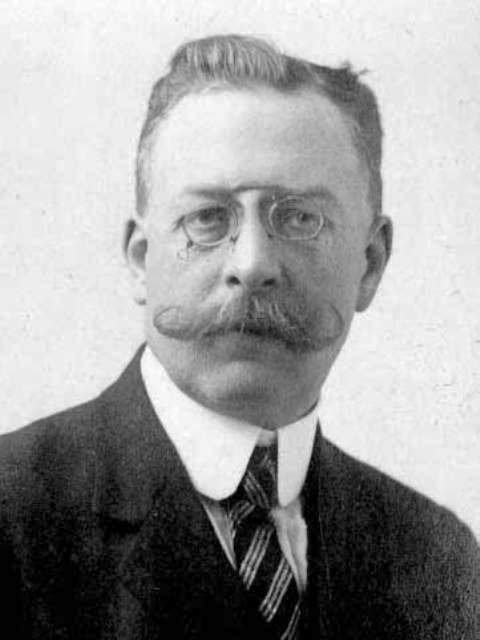
The man in the picture [the same one at the top of this post] is considered the “Father of Microbiology.” He helped to discover and sketch microorganisms. When he turned his microscope on beer, he saw some of the most useful microorganisms in the world — but he failed to recognize them.

This man above is Anton van Leeuwenhoek, and he’s wearing an absolutely bitchin’ coat because he was a draper by trade. In fact, he draped so successfully that he managed to indulge his hobbies as he got older, one of which was lens making. Anton spent his days making powerful microscopes and sketching the objects he put in front of them. He discovered many things, the most interesting of which were animalcules, things that looked like tiny little animals. His sketches and descriptions, as well as his microscopes, jumpstarted the field of microbiology.

It wasn’t long before he turned his lens on beer in the process of brewing. It was 1680 when he first trained his lens on a droplet of beer. At the time, no one knew what it was that made hops, barley, and water turn into beer. Although they knew of yeast as a cloudy substance that appeared in beer after it spent some time fermenting, they were entirely ignorant of what it did; to the point where there were laws against using anything except barley, hops, and water in the beer-making process. Naturally, as soon as Anton looked at brewing beer he saw little circular blobs. He saw the way they aggregated into larger groups. He saw the way that they produced bubbles of what he thought was “air,” and floated to the surface.

Leeuwenhoek-globs

Despite his obsession with microorganisms, he utterly failed to recognize them as life. These blobs, he believed, had come loose from flour. They aggregated into groups of six as part of a chemical process. Anton was fascinated by these groups of flour globs. He modeled them in wax, because he wanted to figure out the ways six globs could stick together while all being visible from above. This is his sketch of his models.

It took another 150 years before Charles Canard-Latour figured out that the “air” was carbon dioxide and the sextets of blobs hadn’t aggregated together, they’d grown. Archaeologists believe that beer was probably first brewed around 3000 BC. That means that we used an organism for nearly 5,000 years before we realized it even existed.

Although van Leeuwenhoek did write about the wood used in beer barrels:

Leeuwenhoek-wood

Filed Under: Birthdays, Just For Fun, Related Pleasures Tagged With: History, Science, The Netherlands

Beer Birthday: George Wendt

October 17, 2025 By Jay Brooks

cheers
Today would have been the 77th birthday of George Wendt, but he passed away in May of this year. He was “an American actor and comedian, best known for the role of Norm Peterson on the television show Cheers. He’s originally from Chicago and was an alumnus of The Second City in the mid-1970s. He began acting on television and movies, mostly in small roles, before landing the role of Norm Peterson in Cheers. “From 1982 to 1993, Wendt appeared as Norm Peterson in all 275 episodes of Cheers. For his work on Cheers, Wendt earned six Primetime Emmy Award nominations for Best Supporting Actor in a Comedy Series.” Years later he wrote, with some help, Drinking with George: A Barstool Professional’s Guide to Beer, a quasi-memior, beer book and biography of his character.

Wendt with GABF director Nancy Johnson and then-Denver mayor John Hickenlooper at the 2009 GABF.

One of my favorite running gags in Cheers was the “Normisms” and I’ve been collecting them off and on for some time now. By no means complete, here are the ones I’ve uncovered, with the season and/or episode it’s from, if known.

Cheers to Norm(isms)

The NBC sitcom “Cheers” was one of the most popular shows on television, and ran for eleven seasons from 1982 until 1993. Set in a Boston bar, it was replete with beer and drinking references, most notably a running gag between the bartenders and one of their regulars, Norm Peterson, played by George Wendt. In many of the episodes, as Norm would first enter the bar each evening, everyone would yell Norm! and whoever was behind the bar would greet him, setting him up for a memorable comeback line. These became known as Normisms and they seem to have started in the first season, possibly episode 10. Over 275 episodes, at least 100 Normisms were delivered.

Season 1 (1982-83)

Endless Slumper [1.10]
Coach: What’s the story, Norm?
Norm: A thirsty guy walks into a bar. You finish it.

Let Me Count the Ways [1.14]
Coach: What’s going on, Norm?
Norm: Science is seeking a cure for thirst and I happen to be the guinea pig.

Diane’s Perfect Date [1.17]
Coach: Beer, Norm?
Norm: That’s that sudzy amber stuff, right? Been hearing good things about it.

No Contest [1.18]
Coach: What can I do for you, Norm?
Norm: I am going to need something to kill time before my second beer. How about a first one?

Someone Single, Someone Blue [1.20]
Coach: What’ll it be Norm?
Norm: Fame, fortune, fast women.
Coach: How about a beer?
Norm: Even better.

Season 2 (1983-84)

Personal Business [2.3]
Coach: Would you like a beer, Norm?
Norm: I’d like to see something in a size 54 sudzy.
____________________
Coach: Can I draw you a beer, Norm?
Norm: No, I know what they look like. Just pour me one.

No Help Wanted [2.14]
Coach: How about a beer, Norm?
Norm: Hey I’m high on life, Coach. Of course, beer is my life.

Fortune and Men’s Weight [2.17]
Coach: What’s your most troublesome problem, Norm?
Norm: Well that’s tough to say, Coach. Let’s see I’m overweight, unemployed, separated, depressed, starting to drink too much. My problem is I’ve never been happier.

Snow Job [2.18]
Coach: Beer, Normy?
Norm: Coach, I don’t know. I’ll have one next week… what the heck I’m young.
____________________
Coach: How’s a beer sound, Norm?
Norm: I dunno. I usually finish them before they get a word in.
____________________
Coach: What’s up, Norm?
Norm: Corners of my mouth, Coach.
____________________
Coach: What’s shaking, Norm?
Norm: All four cheeks and a couple of chins, Coach.
____________________
Coach: Beer, Normie?
Norm: Uh, Coach, I dunno, I had one this week. Eh, why not, I’m still young.
____________________
[Norm comes in with an attractive woman.]
Coach: Normie, Normie, could this be Vera?
Norm: With a lot of expensive surgery, maybe.
____________________
Coach: What can I do for you, Norm?
Norm: Well, I am going to need something to kill time before my second beer. Uh, how about a first one?
____________________
Coach: Beer, Norm?
Norm: Naah, I’d probably just drink it.
____________________
Coach: What’s up, Normie?
Norm: The temperature under my collar, Coach.

Season 3 (1984-85)

Rebound – Part 1 [3.1]
Coach: What will it be, Normy?
Norm: A transfusion with a head on it.

Diane Meets Mom [3.8]
Coach: What would you say to a nice beer, Normie?
Norm: Going down?
____________________
[Norm returns from the hospital.]
Coach: What’s up, Norm?
Norm: Everything that’s supposed to be.
____________________
[Norm comes in, depressed. He just stands by the door with a sullen face.]
Norm: [mutters] Afternoon, everybody.
All: Norm? (Norman?)
____________________
Sam: What’s new, Normie?
Norm: Terrorists, Sam. They’ve taken over my stomach.
They’re demanding beer.
____________________
Coach: What’ll it be, Normie?
Norm: Just the usual, Coach. I’ll have a froth of beer and a snorkel.
____________________
Coach: What would you say to a beer, Normie?
Norm: Daddy wuvs you.
____________________
Sam: What’d you like, Normie?
Norm: A reason to live. Gimme another beer.
____________________
Norm: Afternoon, everybody.
All: Norm!
Cliff: Afternoon, everybody.
All: [silence]

The Executive’s Executioner [3.21]
Sam: What will you have, Norm?
Norm: Well, I’m in a gambling mood, Sammy. I’ll take a glass of whatever
comes out of that tap.
Sam: Oh, looks like beer, Norm.
Norm: Call me Mister Lucky.
____________________
Coach: How’s it going, Norm?
Norm: Daddy’s rich and Momma’s good lookin’.
____________________
Coach: What’s doing, Norm?
Norm: Well, science is seeking a cure for thirst. I happen to be the guinea pig.
____________________
Coach: How’s life, Norm?
Norm: Not for the squeamish, Coach
____________________
Coach: Beer, Norm?
Norm: I heard of that stuff. Better give me a tall one in case I like it.
____________________
Coach: Beer, Norm?
Norm: Does a rag doll have cloth knobs?
____________________
Coach: How are you doing, Norm?
Norm: Cut the small talk and get me a beer.
____________________
Coach: What’s going down, Normie?
Norm: My butt cheeks on that bar stool.

Season 4 (1985-86)

Birth, Death, Love and Rice [4.1]
Sam: What do you say, Norm?
Norm: Any cheap, tawdry thing that’ll get me a beer.
____________________
Sam: What do you say to a beer, Normie?
Norm: Hi ya, sailor. New in town?
____________________
Norm: [coming in from the rain] Evening, everybody.
All: Norm! (Norman!)
Sam: Still pouring, Norm?
Norm: That’s funny, I was about to ask you the same thing.
____________________
Sam: What’s the good word, Norm?
Norm: Plop, plop, fizz, fizz.
Sam: Oh no, not the Hungry Heifer…
Norm: Yeah, yeah, yeah…
Sam: One heartburn cocktail coming up.
____________________
Sam: Whaddya say, Norm?
Norm: Well, I never met a beer I didn’t drink. And down it goes.
____________________
Woody: What’s your pleasure, Mr. Peterson?
Norm: Boxer shorts and loose shoes. But I’ll settle for a beer.
____________________
Woody: What can I do for you, Mr. Peterson?
Norm: Elope with my wife.
____________________
[Norm is angry.]
Woody: What can I get you, Mr. Peterson?
Norm: Clifford Clavin’s head.
____________________
Woody: How’s life, Mr. Peterson?
Norm: Oh, I’m waiting for the movie.

The Peterson Principle [4.18]
Sam: Hey, what’s happening, Norm?
Norm: Well, it’s a dog-eat-dog world, and I’m wearing Milk-Bone underwear.

Strange Bedfellows: Part 2 [4.25]
Woody: Hey, Mr. Peterson, can I pour you a beer?
Norm: Okay Woody, but be sure to stop me at 1. Ah, make that 1:30.

Strange Bedfellows: Part 3 [4.26]
Woody: How you feeling today, Mr. Peterson?
Norm: Pour.
Woody: I’m so sorry to hear that.
Norm: [pointing to the beer tap] No, I meant pour.

Wendt with John Ratzenberger on the set of Cheers.

Season 5 (1986-87)

Knights of the Scimitar [5.8]
Woody: What’s the latest, Mr. Peterson?
Norm: Zsa Zsa marries a millionaire. Peterson drinks a beer. Film at 11.
____________________
Paul: Hey Norm, how’s the world been treating you?
Norm: Like a baby treats a diaper.
____________________
Norm: Hey, everybody.
All: [silence; everybody is mad at Norm for being rich]
Norm: [carries on both sides of the conversation himself]
Norm! (Norman.)
How are you feeling today, Mr. Peterson?
Rich and thirsty. Pour me a beer.

Season 6 (1987-88)

Norm: Hey, everybody.
Woody: Norm! [nobody else in the bar says anything]
Norm: That’s it, I’m leaving.
____________________
Norm: [comes in, pretending to be Joe Average customer, as part of operation Wayne Down the Dwain]
Customer: Norm!
Norm: [quietly] Not now!
____________________
Woody: Would you like a beer, Mr. Peterson?
Norm: No, I’d like a dead cat in a glass.

A Kiss Is Still a Kiss [6.10]
Sam: How’s life treating you?
Norm: It’s not, Sammy, but that doesn’t mean you can’t.

Let Sleeping Drakes Lie [6.18]
Woody: Can I pour you a draft, Mr. Peterson?
Norm: A little early, isn’t it Woody?
Woody: For a beer?
Norm: No, for stupid questions.
____________________
Woody: What’s the story, Mr. Peterson?
Norm: The Bobbsey twins go to the brewery. Let’s cut to the happy ending.

Season 7 (1988-89)

One Happy Chappy in a Snappy Serape [7.4]
Norm: I hate to change the subject but I don’t know if anyone recognizes, we seem to have a little problem here.
Woody: Oh you need another beer, Mr. Peterson.
Norm: Okay we have two problems here.
____________________
Woody: Hey, Mr. Peterson, there’s a cold one waiting for you.
Norm: I know, and if she calls, I’m not here.
____________________
Sam: Beer, Norm?
Norm: Have I gotten that predictable? Good.

Call Me, Irresponsible [7.20]
Woody: What’s going on, Mr. Peterson?
Norm: A flashing sign in my gut that says, Insert beer here.

Season 8 (1989-90)

Sam: What can I get you, Norm?
Norm: [scratching his beard] Got any flea powder?
Ah, just kidding. Gimme a beer; I think I’ll just drown the little suckers.
____________________
Feeble Attraction [8.11]
Woody: Hey, Mr. Peterson, Jack Frost nipping at your nose?
Norm: Yep, now let’s get Joe Beer nipping at my liver, huh?

Bar Wars III: The Return of Tecumseh [8.21]
Sam: What are you up to Norm?
Norm: My ideal weight if I were eleven feet tall.

Loverboyd [8.22]
Woody: Nice cold beer coming up, Mr. Peterson.
Norm: You mean, Nice cold beer going down Mr. Peterson.
____________________
Sam: What do you know there, Norm?
Norm: How to sit. How to drink. Want to quiz me?

Season 9 (1990-91)


Grease [9.6]

Woody: How would a beer feel, Mr. Peterson?
Norm: Pretty nervous if I was in the room.
____________________
Sam: What can I do for you, Norm?
Norm: Open up those beer taps and, oh, take the day off, Sam.
____________________
Woody: What’s going on, Mr. Peterson?
Norm: Another layer for the winter, Wood.
____________________
Sam: How’s life treating you, Norm?
Norm: Like it caught me sleeping with its’ wife.
____________________
[Gang yells Norm!]
Norm: Women. Can’t live with ’em, pass the beer nuts.

Season 10 (1991-92)

Where Have All the Floorboards Gone? [10.8]
Sam: Hey what’s going on, Normie?
Norm: It’s my birthday Sammy. Give me a beer, stick a candle in it, and I’ll blow out my liver.
____________________
Woody: How’s it going, Mr. Peterson?
Norm: Poor.
Woody: I’m sorry to hear that.
Norm: No, I mean pour.
____________________
Sam: How’s life in the fast lane?
Norm: Dunno, can’t get on the on-ramp.
____________________
Woody: Pour you a beer, Mr. Peterson.
Norm: Alright, but stop me at one…. make that one-thirty.

Season 11 (1992-93)

Sam: What’s the story, Norm?
Norm: Boy meets beer. Boy drinks beer. Boy meets another beer.
____________________
Sam: How about a beer, Norm?
Norm: That’s that amber sudsy stuff, right? I’ve heard good things about it!
____________________
Woody: What’s going on, Mr. Peterson?
Norm: The question is what’s going in Mr. Peterson? A beer please, Woody.
____________________
Sam: What’s up, Normie?
Norm: My nipples, it’s freezing out there.

From Unknown Seasons

Woody: How would a beer feel, Mr. Peterson?
Norm: Pretty nervous if I was in the room.
____________________
Woody: Hey, Mr. Peterson, what’s up?
Norm: The warranty on my liver.
____________________
Sam: Well, look at you. You look like the cat the swallowed the canary.
Norm: And I need a beer to wash him down.
____________________
Sam: What’ll you have, Norm?
Norm: Fame, fortune, and fast women.
Sam: How ’bout a beer?
Norm: Even better.
____________________
Woody: Hey, Mr. Peterson, you got room for a beer?
Norm: Nope, but I am willing to add on.
____________________
Sam: Little early in the day for a beer, isn’t it Norm?
Norm: So float a corn flake in it.
____________________
Sam: What’s going on, Normie?
Norm: My birthday, Sammy. Give me a beer, stick a candle in it, and I’ll blow out my liver.
____________________
Woody: How’s it hanging, Mr. Peterson?
Norm: Better when my butt is hanging off this bar stool with a beer in my hand.
____________________
Woody: What’s the latest, Mr. Peterson?
Norm: Zha-Zha marries a millionaire, Peterson drinks a beer. Film at eleven.
____________________
Sam: Hey, how’s life treating you there, Norm?
Norm: Beats me. … Then it kicks me and leaves me for dead.
____________________
Sam: What’s up Norm?
Norm: God’s in His Heaven, [pause] something, something, something.
____________________
Woody: Hey, Mr. Peterson, what do you say to a cold one?
Norm: See you later, Vera, I’ll be at Cheers.
____________________
Woody: How are you today, Mr. Peterson?
Norm: Never been better, Woody. … Just once I’d like to be better.
____________________
Woody: How’s it hanging Norm?
Norm: Oh, little to the left.
____________________
Sam: What’s new, Norm?
Norm: Most of my wife.
____________________
Woody: Hey, Mr. Peterson, how’s life?
Norm: Well, the plot’s okay, Woody, but it kind of falls apart at the end.
____________________
Woody: Hey, Mr. P. How goes the search for Mr. Clavin?
Norm: Not as well as the search for Mr. Donut. Found him every couple of blocks.
____________________
Woody: How are you Mr. Peterson?
Norm: Yeah…as if you care.
____________________
Woody: What’s shaking Mr. Peterson?
Norm: What isn’t?
____________________
Sam: How’s life Norm?
Norm: Ask a man who’s got one.
____________________
Sam: How’s the world treating you, Norm?
Norm: Like I just ran over its dog.
____________________
Sam: How are you today, Norm?
Norm: I’m on top of the world…It’s a dismal spot in Greenland.
____________________
Elderly Sam: What’s up, Norm?
Elderly Norm: Me, about thirty times a night.

George Wendt at a craft beer bar. ©2009 Brian Smith

Filed Under: Birthdays, Just For Fun, Related Pleasures Tagged With: Humor, Television

Historic Beer Birthday: Walter Jerome Green

October 10, 2025 By Jay Brooks

hop-leaf

Today is the birthday of Walter Jerome Green (October 10, 1842-January 27, 1885). He was the son of Charles Green, who founded an upstate New York hop merchant around 1840. After his son joined the business, it became known as Charles Green & Son. According to the Brewers’ Journal, he was “one of the earliest and most widely known hop merchants of Central New York.”

Walter-Jerome-Green-portrait

Here’s a portion of his obituary that mentions the hop business from Oneida County, NY Biographies:

Walter Jerome Green, who passed away in Utica on the 27th of January, 1885, was one of the city’s most prominent business men and respected residents. He was a leading factor in financial circles as a member of the banking house of Charles Green & Son, of Utica, and was also the president and owner of the Jacksonville, St. Augustine and Halifax River Railroad of Florida. He is survived by his widow and one son. His birth occurred in Hubbardsville, Madison county, New York, on the 10th of October, 1842, his father being Charles Green, who was born at Sangerfield, Oneida county, on the 28th of May, 1811. The latter was prominently identified with financial interests in Utica for a number of years, being one of the oldest and best known bankers and business men of this part of the state. David Green, the paternal grandfather of our subject, was born at South East, Putnam county, New York, his ancestors, John Alden and Priscilla Nolines, coming to America in the Mayflower. He was related to General Nathaniel Green of Revolutionary fame. His mother, who in her maidenhood bore the name of Deliverance Hatch, was a native of Cape Cod, Massachusetts. Her mother was a Sears, to which family David Green was likewise related.

The mother of Walter Jerome Green bore the maiden name of Mary Jane Hubbard and was a resident of Hubbardsville. Madison county, New York. She was a descendant of Lieutenant Joseph Kellogg, of Hadley, Massachusetts. Her parents, Oliver Kellogg and Mary (Meachem) Hubbard, were both natives of Connecticut, the former of Windsor and the latter of Simsbury, that state.

Walter Jerome Green received a liberal education in his youth, attending Cazenovia Seminary and Madison University. Desiring to become a member of the legal fraternity, he qualified for practice by an extensive course of study and was graduated from Albany University in 1864. At the end of two years, however, he abandoned a promising career as an attorney because the increasing importance of his father’s business made it desirable for him to come to his assistance. Soon afterward he was admitted to a partnership in the bank and the name of the firm became Charles Green & Son. Young though he was, his enterprising spirit soon made itself felt in the affairs of his father’s business, which gradually broadened its field, of operations and took a leading place among similar enterprises in the central part of the state. An important department in the business of the house was the trade in hops, which became so extensive as to place the firm among the largest dealers in this country. To meet the demand for reliable intelligence bearing on the hop trade, the firm published a journal known as Charles Green & Son’s Hop Paper, a large, handsomely printed, four page folio of twenty eight columns, of which an edition of about five thousand was issued, gratuitously, each quarter.

Charles-Green-Son-Dealers-In-Hops-Extra

And here’s another account from Michael Brown Rare Books:

Charles Green’s son, Walter Jerome Green became one of Utica, New York
‘s most prominent business men and respected residents. He was a leading factor in financial circles as a member of his family’s banking house of Charles Green & Son, of Utica, and was also the president and owner of the Jacksonville, St. Augustine and Halifax River Railroad of Florida. Walter’s birth occurred in Hubbardsville, Madison County, New York, on the 10th of October, 1842. He received a liberal education in his youth, attending Cazenovia Seminary and Madison University. Desiring to become a lawyer, he qualified for practice by an extensive course of study and was graduated from Albany University in 1864. At the end of two years, however, he abandoned a promising career as an attorney because the increasing importance of his father’s business made it desirable for him to come to his assistance. Soon afterward he was admitted to a partnership in the bank and the name of the firm became Charles Green & Son.

Young though he was, his enterprising spirit soon made itself felt in the affairs of his father’s business, which gradually broadened its field, of operations and took a leading place among similar enterprises in the central part of the state. An important department in the business of the house was the trade in hops, which became so extensive as to place the firm among the largest dealers in this country. To meet the demand for reliable intelligence bearing on the hop trade, the firm published a journal known as Charles Green & Son’s Hop Paper, a large, handsomely printed, four page folio of twenty eight columns, of which an edition of about five thousand was issued, gratuitously, each quarter.

On the 26th of June, 1867, Mr. Green was united in marriage to Miss Sarah L. Swartwout, a daughter of Henry Swartwout, of Troy, New York. They had one son Walter Jerome Green, Jr.

Seeking a new field for investment of his capital Green became interested in a railroad project in Florida. His attention was drawn to the lack of modern transportation facilities in the fruit growing section of that state. He put both energy and money into the scheme. The outcome of his effort was the Jacksonville, St. Augustine and Halifax River Railroad, of which he was president and the entire owner. This road began at Jacksonville on the St. John’s River, in the northeastern corner of the state, extended southwardly and eastwardly to St. Augustine on the Atlantic coast and was thirty seven miles in length. The road connected with the Atlantic Coast Steamship Company, running outside to New Smyrna on the Halifax coast. Mr. Green’s intentions were to extend the road a distance of one hundred and six miles to New Smyrna. This would have afforded quick and cheap transportation between Jacksonville and the Halifax and Indian River country. The rail through a fertile and rapidly developing region had shortened the time of transport between the orange country of the east coast of Florida and New York by some eight days, a most important consideration under any circumstances, but more especially so in view of the perishable nature of the delicate fruit transported. While the possibilities of this section of Florida as a fruit growing country and health resort had long been known and to some extent developed, progress had been slow and uncertain owing to the lack of railroad facilities. Among the most notable results was the laying out of new towns between St. Augustine and Jacksonville.

Returning from active labors in Florida in the winter of 1884-5, he was passing some time at his home in Utica, when he was stricken with apoplexy and died on the 27th of January, 1885. He was survived by his widow and one son. On the death of Green the property was left to trustees for his son. In 1886 it was sold to H. M. Flagler of New York, who has carried out the plans and ideas of its previous owner.

1870-Charles-Green-Son-Hops-New

The Michael Brown Rare Books site also had for sale a letter to and from Walter Jerome’s father, Charles Green, and his company which details some of the history of the company.

In 1838 Charles Green entered the store of Gideon Manchester, assignee of Hart & Hunt, Hubbardsville. He bought the stock and continued the business three years. Afterwards he got into the hop business eventually bringing into business his sons, Walter J. and Charles Germaine Green. Green first started in the hop business in 1850. In 1865 a partnership was formed with his son Walter Jerome Green, under the firm name of Charles Green & Son, with headquarters at Hubbardsville. The company later appears as Charles Green & Sons when Charles Germaine Green joined the firm.

NY-New-York-HUBBARDSVILLE-1940s
This postcard of Hubbardsville is from the 1940s.

Filed Under: Birthdays, Just For Fun, Related Pleasures Tagged With: Business, Hops, New York

Beer Birthday: Alfred Haunold

October 7, 2025 By Jay Brooks

Today is the birthday of Alfred Haunold (October 7, 1929- ). He was born in Hollabrunn, Austria and emigrated to the U.S. in the mid-1950s, eventually settling in Oregon. He worked as hop breeder for the U.S. Department of Agriculture and was in charge of a hop-breeding program in Corvallis, Oregon that was a partnership between Oregon State University and the USDA for over thirty years before he retired. He was responsible for Cascade, Willamette, Sterling, Liberty, and Mt. Hood, among at least eighteen additional hop varieties, not to mention his many other contributions to hop sciences.

Dr. Haunold in 1966.

Gary Gilman has the best summary of Dr. Haunold’s life and work with hops in an article on his Beer et seq. blog entitled Dr. Al Haunold — Craft Beer Pioneer.

He arrived from the East Coast to work on the problem of downy mildew in the Cluster hop, then a workhorse of U.S. brewing, as was the Oregon Fuggle, both primarily used for bittering beer. Aroma in beer, at the time, was the preserve of fine imported varieties, at least for premium beers. Hops such as the German Hallertau and Tettnang, Czech Saaz, and various English hops.

Haunold was an Austrian immigrant who had grown up on a farm about 60 miles from Vienna. He joined the USDA after doctoral studies in Nebraska, adding to his extensive Austrian qualifications.

Oregon State also recorded some interviews with him as a part of their Oral History Online program. Check out Al Haunold Oral History Interview #1, from November 18, 2014 and Al Haunold Oral History Interview #2, from August 1, 2017. He also sat down for two audio recordings in 1982, which you can find at the Oregon Hops & Brewing Archives. These resources are great if you want to hear firsthand accounts of the history of craft beer and the hops that made so many modern beers possible. ANd here’s a list of some of his research.

During his career, he was a Member American Society Brewing Chemists (member editorial board 1987-1995, chairman publication committee 1989-1993, board directors 1989-1993), Crop Science Society of America, and the Hop Research Council.

Filed Under: Birthdays, Just For Fun, Related Pleasures Tagged With: Austria, Hops, Oregon, Science, Science of Brewing

Historic Beer Birthday: John Gorrie

October 3, 2025 By Jay Brooks

Today is the birthday of John Gorrie (October 3, 1803-June 29, 1855). He “was a physician, scientist, inventor, and humanitarian,” and most importantly, is credited with creating one of the very first refrigerators, an important development for the brewing industry.

Here’s one brief account, from a history of refrigeration on The Sun:

The man credited with developing the first actual “fridge” was an American doctor, John Gorrie, who built an ice-maker in 1844 based on Evans’ work of decades earlier. He also pioneered air conditioning at the same time, since his idea was to blow air across the ice-making machine to cool hospital patients suffering from malaria in Florida.

Gorrie did not make the fortune he deserved. His business partner died and his leaky machines were mocked by the Press and the ice-producing firms to whom he could have been a threat. He died sick and broke aged 51.

Here’s his story from his Wikipedia page:

Since it was necessary to transport ice by boat from the northern lakes, Gorrie experimented with making artificial ice.

After 1845, he gave up his medical practice to pursue refrigeration products. On May 6, 1851, Gorrie was granted Patent No. 8080 for a machine to make ice. The original model of this machine and the scientific articles he wrote are at the Smithsonian Institution. In 1835, patents for “Apparatus and means for producing ice and in cooling fluids” had been granted in England and Scotland to American-born inventor Jacob Perkins, who became known as “the father of the refrigerator.” Impoverished, Gorrie sought to raise money to manufacture his machine, but the venture failed when his partner died. Humiliated by criticism, financially ruined, and his health broken, Gorrie died in seclusion on June 29, 1855. He is buried in Magnolia Cemetery.

Another version of Gorrie’s “cooling system” was used when President James A. Garfield was dying in 1881. Naval engineers built a box filled with cloths that had been soaked in melted ice water. Then by allowing hot air to blow on the cloths it decreased the room temperature by 20 degrees Fahrenheit. The problem with this method was essentially the same problem Gorrie had. It required an enormous amount of ice to keep the room cooled continuously. Yet it was an important event in the history of air conditioning. It proved that Dr. Gorrie had the right idea, but was unable to capitalize on it. The first practical refrigeration system in 1854, patented in 1855, was built by James Harrison in Geelong, Australia.

And this account, entitled “Dr. John Gorrie, Refrigeration Pioneer,” is by George L. Chapel of the Apalachicola Area Historical Society in Apalachicola, Florida, which is the location of the John Gorrie State Museum:

Dr. John Gorrie (1803 – 1855), an early pioneer in the invention of the artificial manufacture of ice, refrigeration, and air conditioning, was granted the first U.S. Patent for mechanical refrigeration in 1851. Dr. Gorrie’s basic principle is the one most often used in refrigeration today; namely, cooling caused by the rapid expansion of gases. Using two double acting force pumps he first condensed and then rarified air. His apparatus, initially designed to treat yellow fever patients, reduced the temperature of compressed air by interjecting a small amount of water into it. The compressed air was submerged in coils surrounded by a circulating bath of cooling water. He then allowed the interjected water to condense out in a holding tank, and released or rarified, the compressed air into a tank of lower pressure containing brine; This lowered the temperature of the brine to 26 degrees F. or below, and immersing drip-fed, brick-sized, oil coated metal containers of non-saline water, or rain water, into the brine, manufactured ice bricks. The cold air was released in an open system into the atmosphere.

The first known artificial refrigeration was scientifically demonstrated by William Cullen in a laboratory performance at the University of Glasgow in 1748, when he let ethyl ether boil into a vacuum. In 1805, Oliver Evans in the United States designed but never attempted to build, a refrigeration machine that used vapor instead of liquid. Using Evans’ refrigeration concept, Jacob Perkins of the U.S. and England, developed an experimental volatile liquid, closed-cycle compressor in 1834.

Commercial refrigeration is believed to have been initiated by an American businessman, Alexander C. Twinning using sulphuric ether in 1856. Shortly afterward, an Australian, James Harrison, examined the refrigerators used by Gorrie and Twinning, and introduced vapor (ether) compression refrigeration to the brewing and meat packing industries.

The granting of a U.S. Patent in 1860 to Ferdinand P.E. Carre of France, for his development of a closed, ammonia-absorption system, laid the foundation for widespread modern refrigeration. Unlike vapor-compression machines which used air, Carre used rapidly expanding ammonia which liquifies at a much lower temperature than water, and is thus able to absorb more heat. Carre’s refrigeration became, and still is, the most widely used method of cooling. The development of a number of synthetic refrigerants in the 1920’s, removed the need to be concerned about the toxic danger and odor of ammonia leaks.

The remaining problem for the development of modern air conditioning would not be that of lowering temperature by mechanical means, but that of controlling humidity. Although David Reid brought air into contact with a cold water spray in his modification of the heating and ventilating system of the British Parliament in 1836, and Charles Smyth experimented with air cycle cooling (1846 – 56), the problem was resolved by Willis Haviland Carrier’s U.S. Patent in 1906, in which he passed hot soggy air through a fine spray of water, condensing moisture on the droplets, leaving drier air behind. These inventions have had global implications.

Dr. Gorrie was honored by Florida, when his statue was placed in Statuary Hall in the U.S. Capitol. In 1899, a monument to Dr. Gorrie was erected by the Southern Ice Exchange in the small coastal town of Apalachicola, where he had served as mayor in 1837, and had developed his machine.

Reportedly born October 3, 1803 in Charleston, South Carolina, of Scots – Irish descent, he was raised in Columbia, S.C. He attended the College of Physicians and Surgeons of the Western District of New York, in Fairfield, New York, from 1825 to 1827. Although the school lasted only a few decades, it had a profound influence, second only to the Philadelphia Medical School, upon the scientific and medical community of the United States in the 19th century. Young Asa Gray, from Oneida County, New York, who by 1848 would be ranked as the leading botanist in the United States, and who in time would become a close friend of Dr. Alvin Wentworth Chapman of Apalachicola, the leading botanist in the South, served as an assistant in the school’s chemical department. In later years, Dr. Gray had distinct recollections of Gorrie as a “promising student.”

Dr. Gorrie initially practiced in Abbeville, South Carolina, in 1828, coming to the burgeoning cotton port of Apalachicola in 1833. He supplemented his income by becoming Assistant (1834), then Postmaster in Apalachicola. He became a Notary Public in 1835. The Apalachicola Land Company obtained clear title to the area by a U.S. Supreme Court decision in 1835, and in 1836 laid out the city’s grid-iron plat along the lines of Philadelphia, Pennsylvania. Gorrie, who served as Vice-Intendant in 1836, and Intendant (Mayor), in 1837, would be an effective advocate for the rest of his life for draining the swamps, clearing the weeds and maintaining clean food markets in the city. He first served as Secretary of the Masonic Lodge in 1835, was a partner in the Mansion House Hotel (1836), President of the Apalachicola Branch Bank of Pensacola (1836), a charter member of the Marine Insurance Bank of Apalachicola (1837), a physician for the Marine Hospital Service of the U.S. Treasury Department (1837 – 1844), and a charter incorporator and founding vestryman of Trinity Episcopal Church, Apalachicola (1837).

Dr. Gorrie married Caroline Frances Myrick Beman, of a Columbia, South Carolina family, the widowed proprietress of the Florida Hotel in Apalachicola, on May 8, 1838. Shortly thereafter, he resigned his various positions in Apalachicola, and the family left the city not to return until 1840. He was named Justice of the Peace in 1841, the same year that yellow fever struck the area.

Mal-aria, Italian, “bad air”, and yellow fever, prevailed in the hot, low-lying, tropical and sub-tropical areas where there was high humidity and rapid decomposition of vegetation. Noxious effluvium, or poisonous marsh gas was thought to be the cause. The “putrid” winds from marshy lowlands were regarded as deadly, especially at night. The specific causes were unknown, and although one had quinine for malaria, the gin and tonic of India, there was no cure nor preventive vaccine, for yellow fever. The legendary Flying Dutchman was founded on the story of a ship with yellow fever onboard.

Malaria would start with shaking and violent chills, followed by high fever, and a drenching sweat. Insidious, it could recur in the victim as well as kill. Yellow fever did not recur; one either died or survived. It came in mysterious, vicious waves, killing anywhere from 12 to 70 percent of its victims. It started with shivering, high fever, insatiable thirst, savage headaches, and severe back and leg pains. In a day or so, the restless patient would become jaundiced and turn yellow. In the terminal stages, the patient would spit up mouthfuls of dark blood, the terrifying “black vomit” (vomito negro), the body temperature would drop, the pulse fade, and the comatose patient, cold to the touch, would die in about 8 to 10 hours. So great was the terror, that the victims would be buried as quickly as possible. Areas would be quarantined, and yellow flags flown. Gauze would be hung over beds to filter air; handkerchiefs would be soaked in vinegar; garlic would be worn in shoes. Bed linens and compresses would be soaked in camphor; sulfur would be burned in outdoor smudge pots. Gunpowder would be burned, and cannons would be fired. And, later, when it was over, the cleaning and fumigating would occur.

It would not be until 1901 in Havana, Cuba, that Drs. Walter Reed, Carlos Finlay and William Crawford Gorgas, with others, would demonstrate conclusively that the Aedes Aegypti, or Stegomyia Fasciata mosquito was the carrier of the yellow fever virus. It would be about the same time that the English physician, Sir Ronald Ross in India, would correctly identify the Anopheles mosquito as the carrier of the malaria protozoa. As early as 1848, in Mobile, Alabama, however, Dr. Josiah Nott first suggested that mosquitos might be involved. The yellow fever epidemic of 1841, and the hurricane and tidal wave, known locally as the “Great Tide” of 1842, destroyed Apalachicola’s rival cotton port of St. Joseph some thirty miles to the west on the deep water sound of St. Joseph’s Bay. Using Florida’s first railway (1837) to transport cotton from the Apalachicola River, St. Joseph had hosted Florida’s Constitutional Convention in 1838.

Dr. Gorrie became convinced that cold was the healer. He noted that “Nature would terminate the fevers by changing the seasons.” Ice, cut in the winter in northern lakes, stored in underground ice houses, and shipped, packed in sawdust, around the Florida Keys by sailing vessel, in mid-summer could be purchased dockside on the Gulf Coast. In 1844, he began to write a series of articles in Apalachicola’s “Commercial Advertiser” newspaper, entitled, “On the prevention of Malarial Diseases”.

He used the Nom De Plume, “Jenner”, a tribute to Edward Jenner, (1749 – 1823), the discoverer of smallpox vaccine. According to these articles, he had constructed an imperfect refrigeration machine by May, 1844, carrying out a proposal he had advanced in 1842. All of Gorrie’s personal records were accidentally destroyed sometime around 1860.

“If the air were highly compressed, it would heat up by the energy of compression. If this compressed air were run through metal pipes cooled with water, and if this air cooled to the water temperature was expanded down to atmospheric pressure again, very low temperatures could be obtained, even low enough to freeze water in pans in a refrigerator box.” The compressor could be powered by horse, water, wind driven sails, or steampower.
Dr. Gorrie submitted his patent petition on February 27, 1848, three years after Florida became a state. In April of 1848, he was having one of his ice machines built in Cincinnati, Ohio, at the Cincinnati Iron Works, and in Octobcr, he demonstrated its operation. It was described in the Scientific American in September of 1849. On August 22, 1850, he received London Patent #13,124, and on May 6, 1851, U. S. Patent #8080. Although the mechanism produced ice in quantities, leakage and irregular performance sometimes impaired its operation. Gorrie went to New Orleans in search of venture capital to market the device, but either problems in product demand and operation, or the opposition of the ice lobby, discouraged backers. He never realized any return from his invention. Upon his death on June 29, 1855, he was survived by his wife Caroline (1805 – 1864), his son John Myrick (1838 – 1866), and his daughter, Sarah (1844 – 1908). Dr. Gorrie is buried in Gorrie Square in Apalachicola, his wife and son are buried-St. Luke’s-Episcopal Cemetery, Marianna, Florida, and his daughter, in Milton, Florida.

John Gorrie Ice Machine

Filed Under: Birthdays, Just For Fun, Related Pleasures Tagged With: Florida, History, Science, Science of Brewing, Scotland

Historic Beer Birthday: Ludwig Narziß, a.k.a. Beer Pope

September 30, 2025 By Jay Brooks

Today is the birthday of Ludwig Narziß (or Narziss), who was also known as the “Beer Pope” (September 30, 1925-November 29, 2022). He was born in Munich, and was “one of the world’s most renowned brewing scientists and educators of the 20th century. For almost thirty years, “was a leading authority in his field at the Weihenstephan Center of Life and Food Science in Freising, outside Munich. Often called the Harvard of beer, the school, part of the Technical University of Munich, is closely tied to the Bavarian state-owned brewery with which it shares its name. Following an apprenticeship at the Tucher Brewery in Nuremberg, Narziss arrived at Weihenstephan as a student in 1948. There, he received degrees in brewing science and engineering and later completed a doctorate, writing a thesis on the influence of different yeast strains on beer quality. In 1958, he became the brewmaster at Munich’s Löwenbräu Brewery. But Weihenstephan didn’t let Narziss stray for long. Only 6 years later he joined the faculty at Weihenstephan, taking over the chair of Brewing Technology I. While instructing students in the science of beer making and conducting research on methods in Weihenstephan’s test brewery, Professor Narziss at times also served as the school’s dean, once from 1968 to 1970 and again in 1990. He also made time available to be a council member of the European Brewery Convention, as well as the organization’s president from 1979 to 1983. Narziss has authored and co-authored literally hundreds of papers as well as three seminal text books, Abriss der Bierbrauerei (An Outline of Beer Brewing) in 1972, Die Technologie der Malzbereitung (Technology of Malt Preparation) in 1976, and Die Technologie der Würzebereitung (Technology of Wort Preparation) in 1985. These books have gone through many revisions and editions and are still used as standard student textbooks today. Professor Narziss retired from Weihenstephan in 1992. He still lives in Freising and serves as Professor Emeritus at his venerable alma mater.”

This was his obituary, from Brauwelt, written by Lydia Junkersfeld:

Prof. Ludwig Narziß was born in Munich on September 30, 1925 and grew up in Nuremberg. As a young adult he personally experienced the Second World War. His father was an authorized signatory at the Lederer Brewery and had planned a commercial apprenticeship at the Tucher Brewery for his son, who had returned home from captivity. Of his own accord, Ludwig Narziß soon switched to an apprenticeship as a brewer, which appealed to him more – the right decision, as it turned out. Despite the difficult conditions in the brewery after the war, he successfully completed his apprenticeship after two years in October 1947 and in 1948 switched to the Faculty of Brewing in Weihenstephan to study, where a long career began.

From 1951 he initially worked for two years as a research assistant and management consultant in the field service of the research institute for brewing at the Bavarian State Trade Institute in Nuremberg, where he also met his wife Dorle. In 1953, Prof. Weinfurtner recruited him to the State Brewery Testing and Research Institute (today the Weihenstephan Research Centre for Brewing and Food Quality) in Weihenstephan and offered him the opportunity to study for a doctorate (topic: “The influence of the yeast variety on beer quality“) which he completed in 1956.

After completing his doctorate, Prof. Narziß first went back into business: he worked at the Löwenbrauerei in Munich as first brewmaster and authorized signatory until 1964, before he returned to Weihenstephan. Between 1964 and 1992 he held the Chair for Technology at Brewery 1 of the Technical University of Munich in Weihenstephan, where he trained and shaped generations of students. Many ground-breaking innovations in brewery technology and technology occurred during this time, which Prof. Narziß initiated and managed. There was hardly an area in the brewery that could not be further developed through research from his chair: raw material issues, developments in malting, in the brewhouse, in fermentation and storage or in filtration. It was a basic need of Prof. Narziß to solve practical problems through scientific research; whilst often about optimizing production, it was of course also about improving the quality of the product. One of the most important research topics from his time was the avoidance of spoilage from oxygen in beer.

Hundreds of graduate students and over 50 doctoral students have worked on various topics under his expert guidance. He was a “doctor father” to them, with whom some of the former doctoral students have remained in close contact to this day. What distinguished Prof. Ludwig Narziß was his closeness to people. Despite the great international recognition, he maintained his humble and lovable manner towards everyone. He challenged his employees – he was strict in this matter – but he also promoted them to the best of his ability.

Hundreds of Publications

Many books, including classics of brewery technology, and hundreds of publications and lectures have emerged from his scientific work. All of this has made him a world-renowned brewing scientist whose expertise was valued by authorities, associations and breweries around the world. Prof. Narziß has not only significantly shaped the faculty for brewing in Weihenstephan, but also the reputation of German brewing science in general at home and abroad. It was always important to him to ensure dialogue between the brewing industry and brewing science, between research and brewing practice. It is only logical that a research prize, the Ludwig Narziß Award for Brewing Science from BrewingScience, bears his name.

Charlie Bamfort, Graham Stewart and Ludwig.

International Recognition

Prof. Ludwig Narziß joined the Institute of Brewing in 1965, after being nominated by the late Norman Curtis. He was elected President of the EBC Council in 1981, with the 19th EBC Congress being held in 1983 on the South Bank in London where, in collaboration with his EBC/IOB colleagues, he played a major role in the organisation of this event and 1600 delegates attended it. During the course of this Congress he had the opportunity to co-author a poster presentation (they were still very much in their infancy at that time) entitled “Composition of Worts and Beers of High Temperature Wort Boiling Systems“.

Prof. Narziß also participated in one of the Institute‘s London Section Cambridge meetings, also with Norman Curtis who was the London Section‘s Chairman at the time. In addition, he was a participant in the Master Brewer Association of the Americas Ontario District One-Day Conferences that were held in Toronto each January and he also was a participant in a number of the Association‘s National Conferences.

Prof. Narziß was awarded the IBD’s Horace Brown Medal in 1990 and the accompanying lecture, 125 Years Research At Weihenstephan, was delivered at the Royal Society in London and published in the Journal of the Institute of Brewing in 1992.

Many Awards and Honours

Commitment to voluntary work at home and abroad was also a matter of course for him, for example his 1979 election as President of the European Brewery Convention (EBC) in Brussels. To this day he is the only honorary president of the EBC. Prof. Narziß was the bearer of the Cross of Merit of the Order of Merit of the Federal Republic of Germany as well as receiving many other honours and awards.

In 1992, Prof. Narziß handed over the management of the chair to Prof. Werner Back, but retained his research spirit, which kept him very active to the end. At the age of over 90, he was still traveling the world to attend brewing industry events and give lectures.

In spring 2021 he moved from Freising and Weihenstephan, the centre of his life for many years, to his family, who live near Reutlingen. Even if things got a little quieter around him, he still worked on his books every day, kept himself up to date with telephone calls.

The contribution given by Prof. Ludwig Narziß to the brewing industry internationally has been unique and we have lost a truly remarkable icon!

And this obituary is from Weinheistephaner:

Prof. Ludwig Narziß was a true “Weihenstephaner“: he passed his degree here after his brewery apprenticeship and also completed his doctorate in 1956. After his time as brewmaster at Löwenbräu, he was appointed to the Chair of Brewery Technology I and took over management of the teaching and research brewery. Until 1992, Prof. Narziß was the man at the helm, researching the further development of brewing – teaching the craft of brewing to thousands and thousands of students. Even today, many young people benefit from his works, which are held as standard works in brewing and beverage technology. 

His professional expertise was more than appreciated by the Bavarian State Brewery Weihenstephan. Not only was great value placed here on his opinion on new beers – he was also a very welcome conversation partner at the table in the Bräustüberl. In every exchange, Prof. Narziß provided a different perspective, a further idea, a new approach: the fire for brewing was still burning in him until the very last moment. A characteristic that everyone appreciates to this day and that proved infectious to all his students.

Alongside all his professional expertise, it must never go unmentioned that with Prof. Narziß we lost a fine person. Never at a loss for a joke, always a smile on his lips – and above all he always had an open ear for every generation. Regardless of whether you were a young student or an experienced brewer: no question was left unanswered, Prof. Narziß always made time for you. He usually finished his meals in the Bräustüberl with a sip from his favorite beer, the Pils – and in the next days, people will be raising a toast to his memory and legacy everywhere in the brewing world. 

Prof. Dr. Josef Schrädler, Director of the Bavarian State Brewery Weihenstephan explained on Wednesday: ”For me, Prof. Narziß was always an important dialog partner and advisor in strategic questions.“ But not only that: “I looked forward to every beer tasting with him – he was just an extremely likeable person.“ 

And Tobias Zollo, Technical Director and First Brewmaster can only confirm this: “Prof. Narziß treated everyone with respect, he was a true brewer.“ For Zollo and the brewmaster team, the many discussions they had with him on the last product developments about three years ago were especially valuable. Passing on knowledge – that was Prof. Narziß‘ mission in life. And he fulfilled this mission brilliantly.

Filed Under: Beers, Birthdays, Breweries, Related Pleasures Tagged With: Germany, Science of Brewing

Historic Beer Birthday: John Ewald Siebel

September 17, 2025 By Jay Brooks

siebel-banner
Today is the birthday of John Ewald Siebel (September 17, 1868-December 20, 1919). Siebel was born in Germany, but relocated to Chicago, Illinois as a young man. Trained as a chemist, in 1868 he founded the Zymotechnic Institute, which was later renamed the Siebel Institute of Technology.

Here’s his obituary from the Foreign Language Press Survey:

Professor John Ewald Siebel has died after an active life devoted to science. Besides his relatives, thousands of his admirers, including many men of science, mourn at the bier of the friendly old man. He died in his home at 960 Montana Avenue.

Professor Siebel was born September 18, 1845, in Hofkamp, administrative district of Dusseldorf [Germany], as the son of Peter and Lisette Siebel; he attended high school [Real-Gymnasium] at Hagen and studied chemistry at the Berlin University. He came to the United States in 1865 and shortly afterwards obtained employment as a chemist with the Belcher Sugar Refining Company in Chicago. Already in 1868, he established a laboratory of his own, and from 1869 until 1873 he was employed as official chemist for the city and county. In 1871 he also taught chemistry and physics at the German High School. From 1873 until 1880 he was official gas inspector and city chemist. During the following six years he edited the American Chemical Review, and from 1890 until 1900 he published the Original Communications of Zymotechnic Institute. He was also in charge of the Zymotechnic Institute, which he had founded in 1901. Until two years ago he belonged to its board of directors.

Among the many scientific works published by the deceased, which frequently won international reputation, and are highly valued by the entire world of chemical science are: Newton’s Axiom Developed; Preparation of Dialized Iron; New Methods of Manufacture of Soda; New Methods of Manufacture of Phosphates; Compendium of Mechanical Refrigeration; Thermo-and Electro-Dynamics of Energy Conversion; etc. The distilling industry considered him an expert of foremost achievement.

The deceased was a member of the Lincoln Club; the old Germania Club; the local Academy of Science; the Brauer and Braumeisterverein [Brewer and Brewmaster Association]; the American Institute for Brewing; and the American Society of Brewing Technology. Professor Siebel was also well known in German circles outside the city and state.

His wife Regina, whom he married in 1870….died before him. Five sons mourn his death: Gustav, Friedrich, Ewald, Emil and Dr. John Ewald Siebel, Jr. Funeral services will be held tomorrow afternoon at Graceland Cemetery.

Professor Siebel was truly a martyr of science. He overworked himself, until a year ago he suffered a nervous breakdown. About four months ago conditions became worse. His was an easy and gentle death.

postcard-chicago-zymotechnic-institute-and-siebes-brewing-academy-c1910

The Siebel Institute’s webpage tells their early history:

Dr. John Ewald Siebel founded the Zymotechnic Institute in 1868. He was born on September 17, 1845, near Wermelskirchen in the district of Dusseldorf, Germany. He studied physics and chemistry and earned his doctorate at the University of Berlin before moving to Chicago 1866. In 1868 he opened John E. Siebel’s Chemical Laboratory which soon developed into a research station and school for the brewing sciences.

In 1872, as the company moved into new facilities on Belden Avenue on the north side of Chicago, the name was changed to the Siebel Institute of Technology. During the next two decades, Dr. Siebel conducted extensive brewing research and wrote most of his over 200 books and scientific articles. He was also the editor of a number of technical publications including the scientific section of The Western Brewer, 100 Years of Brewing and Ice and Refrigeration.

In 1882 he started a scientific school for brewers with another progressive brewer but the partnership was short lived. Dr. Siebel did, however, continue brewing instruction at his laboratory. The business expanded in the 1890’s when two of Dr. Siebel’s sons joined the company.

The company was incorporated in 1901 and conducted brewing courses in both English and German. By 1907 there were five regular courses: a six-month Brewers’ Course, a two-month Post Graduate Course, a three-month Engineers’ Course, a two-month Maltsters’ Course and a two-month Bottlers’ Course. In 1910, the school’s name, Siebel Institute of Technology, was formally adopted. With the approach of prohibition, the Institute diversified and added courses in baking, refrigeration, engineering, milling, carbonated beverages and other related topics. On December 20, 1919, just twenty-seven days before prohibition became effective, Dr. J. E. Siebel passed away.

With the repeal of prohibition in 1933 the focus of the Institute returned to brewing under the leadership of F. P. Siebel Sr., the eldest son of Dr. J. E. Siebel. His sons, Fred and Ray, soon joined the business and worked to expand its scope. The Diploma Course in Brewing Technology was offered and all other non-brewing courses were soon eliminated. Then in October 1952, the Institute moved to its brand new, custom built facilities on Peterson Avenue where we have remained for almost 50 years.

Siebel-1902-04
Siebel Brewers Academy c. 1902-04.

Here’s another short account from the journal Brewery History, in an article entitled “A History of Brewing Science in the United States of America,” by Charles W. Bamforth:

Dr John Ewald Siebel (1845-1919) was born on September 17th 1845 at Hofcamp, near Düsseldorf. Upon visiting an uncle in US after the completion of his doctorate in chemistry and physics he became chief chemist at Belcher’s sugar refinery in Chicago, aged 21, but that company soon folded. Siebel stayed in Chicago to start an analytical laboratory in 1868, which metamorphosed into the Zymotechnic Institute.

With Chicago brewer Michael Brand, Siebel started in 1882 the first Scientific School for practical brewers as a division of the Zymotechnic Institute. True life was not breathed into the initiative until 1901 with Siebel’s son (one of five) Fred P. Siebel as manager. This evolved to become the Siebel Institute of Technology, which was incorporated in 1901 and conducted brewing courses in both English and German. Within 6 years five regular courses had been developed: a six-month course for brewers, a twomonth post graduate course, a threemonth course for engineers, a two-month malting course and a two-month bottling course.

Amongst Siebel’s principal contributions were work on a counter pressure racker and artificial refrigeration systems. Altogether he published more than 200 articles on brewing, notably in the Western Brewer and original Communications of the Zymotechnic Institute. Brewing wasn’t his sole focus, for instance he did significant work on blood chemistry.

Son EA Siebel founded Siebel and Co and the Bureau of Bio-technology in 1917, the year that prohibition arrived. Emil Siebel focused then on a ‘temperance beer’ that he had been working on for nine years. Courses in baking, refrigeration, engineering, milling and nonalcoholic carbonated beverages were offered.

And here’s the entry for the Siebel Institute from the Oxford Companion to Beer, written by Randy Mosher:

Filed Under: Birthdays, Just For Fun, Related Pleasures Tagged With: Chicago, Education, Germany, History, Illinois, Science

Historic Beer Birthday: Johann Peter Griess

September 6, 2025 By Jay Brooks

allsopps

Today is the birthday of Johann Peter Griess (September 6, 1829-August 30, 1888). He was born in Kirchhosbach (now part of Waldkappel), Germany. He was “an early pioneer of organic chemistry.” While known for his work on synthetic dyes, and he was the first to develop “the diazotization of aryl amines (the key reaction in the synthesis of the azo dyes), and a major figure in the formation of the modern dye industry.” He also “worked for more than a quarter of a century at the brewery of Samuel Allsopp and Sons in Burton upon Trent, which, owing to the presence of several notable figures and an increase in the scientific approach to brewing, became a significant centre of scientific enquiry in the 1870s and 1880s.”

This is his biography from his Wikipedia page:

After he finished at an agricultural private school, he joined the Hessian cavalry, but left the military shortly after. He started his studies at the University of Jena in 1850, but changed to the University of Marburg in 1851. During his student life he was several times sentenced to the Karzer (campus jail) and was also banned from the city for one year, during which time he listened to lectures of Justus Liebig at the Ludwig Maximilians University of Munich. After most of the family possession had been spent, he had to start working at the chemical factory of Oehler in Offenbach am Main in 1856. This was only possible after the recommendation of Hermann Kolbe, who was head of the chemistry department in Marburg. The devastating fire of 1857 ended the production of chemicals at the factory and a changed Peter Griess rejoined Hermann Kolbe at the University of Marburg. His new enthusiasm for chemistry yielded the discovery of diazonium salts in 1858. The discovery of a new class of chemicals convinced August Wilhelm von Hofmann to invite Griess to join him at his new position at the Royal College of Chemistry. During his time at the Royal College, he studied the reactions of nitrogen-rich organic molecules. It took him quite long to become accustomed to his new home in England, but the fact that he married in 1869 and founded a family made it clear that he did not intend to return to Germany, even though he was offered a position at the BASF. He left and started a position at the Samuel Allsopp & Sons brewery in 1862 where he worked until his retirement. His wife died after a long, severe illness in 1886; he survived her for two years and died on August 30, 1888. He is buried in Burton upon Trent.

In 1858 he described the Griess diazotization reaction which would form the basis for the Griess test for detection of Nitrite. Most of his work related to brewing remained confidential, but his additional work on organic chemistry was published by him in several articles.

And this short piece is from the journal “Brewery History,” from 2005. The article was called “The Brewing Connection in the Oxford Dictionary of National Biography: Part II,” and was written by Ray Anderson:

Another man whose activities extended far beyond his brewery work was Griess, (Johann) Peter (1829-1888), chemist to Samuel Allsopp & Sons for 26 years from 1862 until his death. Griess’s inclusion in the dictionary rests on his discovery and subsequent work on ‘a new and versatile chemical reaction which could provide a route to a wide range of new compounds’. These diazo compounds, so called because they contained two atoms of nitrogen per molecule, were to be widely utilised in the production of azo dyes, and the dictionary hails Griess’s synthesis of them as ‘perhaps the greatest single discovery in the history of the dyestuffs industry’. Historians of chemistry place Griess in the front rank of Victorian chemists.

And this is an Abstract from an article, entitled “Johann Peter Griess FRS (1829–88): Victorian brewer and synthetic dye chemist” is from “Notes and Records, The Royal Society Journal of the History of Science,” by Edwin and Andrew Yates:

The German organic chemist Johann Peter Griess (1829–88), who first developed the diazotization of aryl amines (the key reaction in the synthesis of the azo dyes), and a major figure in the formation of the modern dye industry, worked for more than a quarter of a century at the brewery of Samuel Allsopp and Sons in Burton upon Trent, which, owing to the presence of several notable figures and an increase in the scientific approach to brewing, became a significant centre of scientific enquiry in the 1870s and 1880s. Unlike the other Burton brewing chemists, Griess paralleled his work at the brewery with significant contributions to the chemistry of synthetic dyes, managing to keep the two activities separate—to the extent that some of his inventions in dye chemistry were filed as patents on behalf of the German dye company BASF, without the involvement of Allsopp’s. This seemingly unlikely situation can be explained partly by the very different attitudes to patent protection in Britain and in Germany combined with an apparent indifference to the significant business opportunity that the presence of a leading dye chemist presented to Allsopp’s. Although his work for the brewery remained largely proprietary, Griess’s discoveries in dye chemistry were exploited by the German dye industry, which quickly outpaced its British counterpart. One less well-known connection between brewing and synthetic dyes, and one that may further explain Allsopp’s attitude, is the use of synthetic dyes in identifying microorganisms—the perennial preoccupation of brewers seeking to maintain yield and quality. Developments of Griess’s original work continue to be applied to many areas of science and technology.

That’s just the abstract, of course, but you can read the whole article online.

Filed Under: Birthdays, Just For Fun, Related Pleasures Tagged With: Germany, History, Science, Science of Brewing

Beer In Ads #5069: Hunting Season Opens Today

September 1, 2025 By Jay Brooks

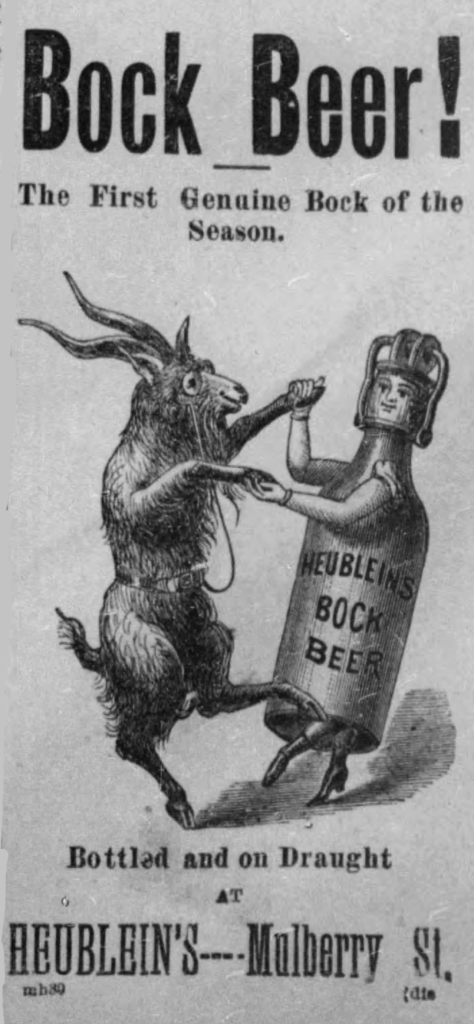
Last year I decided to concentrate on Bock ads. Bock, of course, may have originated in Germany, in the town of Einbeck. Because many 19th century American breweries were founded by German immigrants, they offered a bock at certain times of the year, be it Spring, Easter, Lent, Christmas, or what have you. In a sense they were some of the first seasonal beers. “The style was later adopted in Bavaria by Munich brewers in the 17th century. Due to their Bavarian accent, citizens of Munich pronounced ‘Einbeck’ as ‘ein Bock’ (a billy goat), and thus the beer became known as ‘Bock.’ A goat often appears on bottle labels.” And presumably because they were special releases, many breweries went all out promoting them with beautiful artwork on posters and other advertising.

Monday’s ad is for not for a specific Bock Beer, but instead a half-page panel celebrating the opening of hunting season in Montana in 1907. It was published on September 1, 1907. With the headline: “To Lakes, Rivers and Hills They Go in Bunches in Quest of Game, Now That the Season is Open,” there are below that several hunting-themed cartoons, including one featuring “Teddy Roosevelt in Disguise” standing with his boot on the back of a bock beer goat. The goat is exclaiming, “Here’s Where Bock Beer Gets the Worst Of It.” This ad ran in The Anaconda Standard, of Anaconda, Montana.

Filed Under: Art & Beer, Beers, Just For Fun, Related Pleasures Tagged With: Advertising, Bock, History, Montana

Historic Beer Birthday: Hathor, Egyptian Goddess of Drunkenness

August 29, 2025 By Jay Brooks

hathor-hieroglyph

Today in ancient Egypt was celebrated as the Nativity of Hathor. She “was a major goddess in ancient Egyptian religion who played a wide variety of roles. As a sky deity, she was the mother, or consort, of the sky god Horus and the sun god Ra, both of whom were connected with kingship, and thus she was the symbolic mother of their earthly representatives, the pharaohs. She was one of several goddesses who acted as the Eye of Ra, Ra’s feminine counterpart, and in this form she had a vengeful aspect that protected him from his enemies. Her beneficent side represented music, dance, joy, love, sexuality and maternal care, and she acted as the consort of several male deities and the mother of their sons. These two aspects of the goddess exemplified the Egyptian conception of femininity. Hathor crossed boundaries between worlds, helping deceased souls in the transition to the afterlife.” But she was also “called the mistress of music, dance, garlands, myrrh, and drunkenness.”

Here’s the initial part of her entry on her Wikipedia page:

Hathor was a major goddess in ancient Egyptian religion who played a wide variety of roles. As a sky deity, she was the mother or consort of the sky god Horus and the sun god Ra, both of whom were connected with kingship, and thus she was the symbolic mother of their earthly representatives, the pharaohs. She was one of several goddesses who acted as the Eye of Ra, Ra’s feminine counterpart, and in this form she had a vengeful aspect that protected him from his enemies. Her beneficent side represented music, dance, joy, love, sexuality and maternal care, and she acted as the consort of several male deities and the mother of their sons. These two aspects of the goddess exemplified the Egyptian conception of femininity. Hathor crossed boundaries between worlds, helping deceased souls in the transition to the afterlife.

Hathor was often depicted as a cow, symbolizing her maternal and celestial aspect, although her most common form was a woman wearing a headdress of cow horns and a sun disk. She could also be represented as a lioness, cobra, or sycamore tree.

Cattle goddesses similar to Hathor were portrayed in Egyptian art in the fourth millennium BC, but she may not have appeared until the Old Kingdom (c. 2686–2181 BC). With the patronage of Old Kingdom rulers she became one of Egypt’s most important deities. More temples were dedicated to her than to any other goddess; her most prominent temple was Dendera in Upper Egypt. She was also worshipped in the temples of her male consorts. The Egyptians connected her with foreign lands such as Nubia and Canaan and their valuable goods, such as incense and semiprecious stones, and some of the peoples in those lands adopted her worship. In Egypt, she was one of the deities commonly invoked in private prayers and votive offerings, particularly by women desiring children.

During the New Kingdom (c. 1550–1070 BC), goddesses such as Mut and Isis encroached on Hathor’s position in royal ideology, but she remained one of the most widely worshipped deities. After the end of the New Kingdom, Hathor was increasingly overshadowed by Isis, but she continued to be venerated until the extinction of ancient Egyptian religion in the early centuries AD.

File:Funerary banquet of Nebamun.jpg
Banquet scene from the tomb chapel of Nebamun, 14th century BC. Its imagery of music and dancing alludes to Hathor.

Music, Dance, and Joy

Egyptian religion celebrated the sensory pleasures of life, believed to be among the gods’ gifts to humanity. Egyptians ate, drank, danced, and played music at their religious festivals. They perfumed the air with flowers and incense. Many of Hathor’s epithets link her to celebration; she is called the mistress of music, dance, garlands, myrrh, and drunkenness. In hymns and temple reliefs, musicians play tambourines, harps, lyres, and sistra in Hathor’s honor. The sistrum, a rattle-like instrument, was particularly important in Hathor’s worship. Sistra had erotic connotations and, by extension, alluded to the creation of new life.

These aspects of Hathor were linked with the myth of the Eye of Ra. The Eye was pacified by beer in the story of the Destruction of Mankind. In some versions of the Distant Goddess myth, the wandering Eye’s wildness abated when she was appeased with products of civilization like music, dance, and wine. The water of the annual flooding of the Nile, colored red by sediment, was likened to wine, and to the red-dyed beer in the Destruction of Mankind. Festivals during the inundation therefore incorporated drink, music, and dance as a way to appease the returning goddess. A text from the Temple of Edfu says of Hathor, “the gods play the sistrum for her, the goddesses dance for her to dispel her bad temper.” A hymn to the goddess Raet-Tawy as a form of Hathor at the temple of Medamud describes the Festival of Drunkenness as part of her mythic return to Egypt. Women carry bouquets of flowers, drunken revelers play drums, and people and animals from foreign lands dance for her as she enters the temple’s festival booth. The noise of the celebration drives away hostile powers and ensures the goddess will remain in her joyful form as she awaits the male god of the temple, her mythological consort Montu, whose son she will bear.

A drawing based on an ancient Egyptian wall painting shows a drinking festival in progress. The upper row of figures features revelers drinking wine, including one woman who has overindulged. The lower row shows a procession with musicians. (by Betsy Bryan)

Festivals

Many of Hathor’s annual festivals were celebrated with drinking and dancing that served a ritual purpose. Revelers at these festivals may have aimed to reach a state of religious ecstasy, which was otherwise rare or nonexistent in ancient Egyptian religion. Graves-Brown suggests that celebrants in Hathor’s festivals aimed to reach an altered state of consciousness to allow them interact with the divine realm. An example is the Festival of Drunkenness, commemorating the return of the Eye of Ra, which was celebrated on the twentieth day of the month of Thout at temples to Hathor and to other Eye goddesses. It was celebrated as early as the Middle Kingdom, but it is best known from Ptolemaic and Roman times. The dancing, eating and drinking that took place during the Festival of Drunkenness represented the opposite of the sorrow, hunger, and thirst that the Egyptians associated with death. Whereas the rampages of the Eye of Ra brought death to humans, the Festival of Drunkenness celebrated life, abundance, and joy.

In a local Theban festival known as the Beautiful Festival of the Valley, which began to be celebrated in the Middle Kingdom, the cult image of Amun from the Temple of Karnak visited the temples in the Theban Necropolis while members of the community went to the tombs of their deceased relatives to drink, eat, and celebrate. Hathor was not involved in this festival until the early New Kingdom, after which Amun’s overnight stay in the temples at Deir el-Bahari came to be seen as his sexual union with her.

Several temples in Ptolemaic times, including that of Dendera, observed the Egyptian new year with a series of ceremonies in which images of the temple deity were supposed to be revitalized by contact with the sun god. On the days leading up to the new year, Dendera’s statue of Hathor was taken to the wabet, a specialized room in the temple, and placed under a ceiling decorated with images of the sky and sun. On the first day of the new year, the first day of the month of Thoth, the Hathor image was carried up to the roof to be bathed in genuine sunlight.

The best-documented festival focused on Hathor is another Ptolemaic celebration, the Festival of the Beautiful Reunion. It took place over fourteen days in the month of Epiphi. Hathor’s cult image from Dendera was carried by boat to several temple sites to visit the gods of those temples. The endpoint of the journey was the Temple of Horus at Edfu, where the Hathor statue from Dendera met that of Horus of Edfu and the two were placed together. On one day of the festival, these images were carried out to a shrine where primordial deities such as the sun god and the Ennead were said to be buried. The texts say the divine couple performed offering rites for these entombed gods.Many Egyptologists regard this festival as a ritual marriage between Horus and Hathor, although Martin Stadler challenges this view, arguing that it instead represented the rejuvenation of the buried creator gods. Bleeker thought the Beautiful Reunion was another celebration of the return of the Distant Goddess, citing allusions in the temple’s festival texts to the myth of the solar eye. Barbara Richter argues that the festival represented all three things at once. She points out that the birth of Horus and Hathor’s son Ihy was celebrated at Dendera nine months after the Festival of the Beautiful Reunion, implying that Hathor’s visit to Horus represented Ihy’s conception.

The third month of the Egyptian calendar, Hathor or Athyr, was named for the goddess. Festivities in her honor took place throughout the month, although they are not recorded in the texts from Dendera.

And here’s another account of the Festival of Drunkenness, from Just History:

There was an importance placed on beer in Egyptian culture as well. The source of this festival is a mythological story of how beer saved the world.

The story goes that Re, the sun god, was frankly salty about the “duplicitousness” of mankind and called his children together to discuss it. A Council of the Gods is called, and they decide to punish the rebellious men by letting loose the goddess Hathor. She stormed out in the form of Sakhnet, which literally means female magical power. In some stories this is the form of a great flood, and in others it is the form of a lion. Whatever this form is, Hathor went to town killing everyone up and down the Nile Valley. Re and the other gods started to feel bad about what they let loose, and tried to get her to stop, but at this point Hathor was in a blood rage and would not and could not stop. In order to stop her murderous rampage, the Council of the Gods flooded the fields with beer that had been tinted red with ocher to look like blood. Hathor greedily lapped it up and got drunk and passed out. Mankind was saved by drunkenness.

Originally, it was thought these rituals took place in later in Egyptian history when they were ruled the Greeks and Romans. However, recent discoveries from the excavations of the Temple of Mut complex in Luxor show they took place much earlier- around 1470 BCE. Dr. Betsy Bryan’s research has found the Festival of Drunkenness was celebrated by people at least once a year, sometimes twice, in homes, temples and makeshift desert shrines. It was different than many other temple ceremonies as the priests or pharaoh would act on behalf of the people. In this ritual, everyone participated together- the elites and the peasants. The scene is described in a hymn to Sakhnet as young women with flowing garlands in their hair serving alcohol to everyone They all drink to the point of passing out, then are awoken to the beating of drums and the priests carried out a likeness of the goddess Hathor and they present their petitions to her. It wasn’t just drinking going on either. Graffiti was found discussing “traveling the marshes”, which is a euphemism for having sex. These festivals took place at the beginning of the Nile floods in mid-August, which hearkened to the fertility and renewal of the land by the floods.

The excavations have found what is termed a “porch of drunkenness” associated with Hatshepsut, the woman who became pharaoh. The porch was constructed at the height of her reign. It has been theorized that Hatshepsut was instrumental in popularizing the festival to justify her assumption of pharaonic powers by association with a Great Goddess. There is also a tantalizing discussion of Hatshepsut driving off enemies of Egypt termed the “shemau”, which at least one historian believes was the Jewish people. Then the festivals would be a time to celebrate the fertility of the remaining Egyptians and to replenish their population. This would place the Biblical exodus much earlier than theorized. There is no additional corroboration for this theory however.

No one knows why the porch of drunkenness was taken down. Hatsheput’s name was stricken by her successor, Thutmose III, so it could have been part of that campaign. The ritual fell out of favor as well, and according to Bryan it had lost favor completely by the reign of Amenhotep III. She observed that Egyptians did not like the alcohol making them lose control, and that was what this ritual was about- taking them to the edge of chaos. However, in the time of the fun loving Greeks and Romans it regained popularity. Herodotus reported in 440 BCE that the festivals drew as many as 700,000 participants and drunkenness and sexual permissiveness was the rule. There are also mentions of the festival as late as 200 CE. Although the significance of it had gone, there’s nothing better than a good party.

The Ancient Egyptian Festival of Drunkenness

The Festival of Drunkenness is a religiously significant celebration that was held annually (said to be biannually in some places) by the ancient Egyptians. The background story for the celebration of this festival can be found in a text known as The Book of the Heavenly Cow . In this text, there is an ancient Egyptian myth involving the destruction of mankind. According to the myth, human beings were saved from extinction thanks, in part, to alcohol.

The Destruction of Mankind

In The Book of the Heavenly Cow , there is a myth known as the ‘Destruction of Mankind’. This story begins by stating that once upon a time, human beings lived together with the gods, and were ruled over by Ra (Re). It goes on to say that when Ra had grown old, mankind began to conspire against him. Ra became aware of mankind’s scheming, and decided to summon the other gods to his palace, in order to obtain counsel from them.

After explaining his dilemma to the gods, it was suggested to Ra that he ought to release his Eye, so that it might smite down humanity. He agreed with this suggestion, and sent his Eye in the form of the goddess Hathor to punish mankind. In the meantime, the humans fled to the desert, as they became fearful of Ra.

Nevertheless, Hathor, who was transformed into a lion (or the warlike goddess Sekhmet), descended and slew mankind in the desert. In one version of the story, the goddess went on a rampage, and was about to wipe out all of humanity when Ra took pity on mankind. It was through Ra’s subsequent intervention that mankind was saved. In an alternate version of the myth, it seems that Ra had planned the event to save mankind, so that he could be the savior of humanity.

Thus, Ra summoned his messengers, and ordered them to bring him a great amount of haematite from Elephantine. He then ordered the haematite to be ground. In the meantime, barley was also being ground to produce beer. When both substances were ready, Ra had the haematite put into the beer, so that it resembled human blood. It is written that 7,000 jars of this beer were made.

One night, Ra poured out the blood-like beer, which flooded the fields “three palms high.” On the morning of the next day, the goddess saw that the fields were flooded with what seemed to be human blood, and was delighted at the sight. She began drinking the liquid without knowing that it was actually beer, and soon became intoxicated, then fell asleep. As a result, mankind was saved from destruction.

The Day of Celebration

The Festival of Drunkenness is celebrated on the 20th day of Thoth, the 1st month of the ancient Egyptian calendar. The festival of drunkenness was a communal affair and on one level, the celebrations took place in temples. On another level, this festival took place in peoples’ houses and shrines.

Typically, the participants of this festival would be served lots of alcohol, get drunk, and fall asleep. It was not regarded, however, as a social drinking session, but was sacred event. In the temples, the celebrants would be awoken by the sound of drums and music. Upon waking up, they would worship the goddess Hathor.

Other aspects of the ritual celebration included dancing and the lighting of torches, which was performed in the hopes that the devotees of the goddess would receive an epiphany from her. Another activity believed to have been undertaken during the festival was sex. In a hymn regarding the festival, there is a phrase “traveling through the marshes”, and it has been speculated that this is an ancient Egyptian euphemism for having sex.

One explanation for this activity is provided by regarding Hathor in her role as a goddess of love. Alternatively, it may have been linked to the fertility of the land as well. The Festival of Drunkenness was typically celebrated around the middle of August, the period when the Nile began to rise. Therefore, sexual activity during the festival may have also been perceived as a means of bringing the Nile floods back, and thus ensuring the fertility of the land.

Egyptian painting of dancers and flutists, from the Tomb of Nebamun.

And apparently Hathor and drunkenness, too, played a role in Ancient Egyptian funerals.

Funerary Practices

As an afterlife deity, Hathor appeared frequently in funerary texts and art. In the early New Kingdom, for instance, Osiris, Anubis, and Hathor were the three deities most commonly found in royal tomb decoration. In that period she often appeared as the goddess welcoming the dead into the afterlife. Other images referred to her more obliquely. Reliefs in Old Kingdom tombs show men and women performing a ritual called “shaking the papyrus”. The significance of this rite is not known, but inscriptions sometimes say it was performed “for Hathor”, and shaking papyrus stalks produces a rustling sound that may have been likened to the rattling of a sistrum. Other Hathoric imagery in tombs included the cow emerging from the mountain of the necropolis and the seated figure of the goddess presiding over a garden in the afterlife. Images of Nut were often painted or incised inside coffins, indicating the coffin was her womb, from which the occupant would be reborn in the afterlife. In the Third Intermediate Period, Hathor began to be placed on the floor of the coffin, with Nut on the interior of the lid.

Tomb art from the Eighteenth Dynasty often shows people drinking, dancing, and playing music, as well as holding menat necklaces and sistra—all imagery that alluded to Hathor. These images may represent private feasts that were celebrated in front of tombs to commemorate the people buried there, or they may show gatherings at temple festivals such as the Beautiful Festival of the Valley. Festivals were thought to allow contact between the human and divine realms, and by extension, between the living and the dead. Thus, texts from tombs often expressed a wish that the deceased would be able to participate in festivals, primarily those dedicated to Osiris. Tombs’ festival imagery, however, may refer to festivals involving Hathor, such as the Festival of Drunkenness, or to the private feasts, which were also closely connected with her. Drinking and dancing at these feasts may have been meant to intoxicate the celebrants, as at the Festival of Drunkenness, allowing them to commune with the spirits of the deceased.

Hathor was said to supply offerings to deceased people as early as the Old Kingdom, and spells to enable both men and women to join her retinue in the afterlife appeared as early as the Coffin Texts in the Middle Kingdom. Some burial goods that portray deceased women as goddesses may depict these women as followers of Hathor, although whether the imagery refers to Hathor or Isis is not known. The link between Hathor and deceased women was maintained into the Roman Period, the last stage of ancient Egyptian religion before its extinction.

Hathor welcoming Seti I into the afterlife. (13th century BCE)

And Treasures of Egypt has a great overview of Hathor, and so does History Cooperative.

Filed Under: Birthdays, Just For Fun, Related Pleasures Tagged With: Egypt, History

« Previous Page
Next Page »

Find Something

Northern California Breweries

Please consider purchasing my latest book, California Breweries North, available from Amazon, or ask for it at your local bookstore.

Recent Comments

  • Bob Paolino on Beer Birthday: Grant Johnston
  • Gambrinus on Historic Beer Birthday: A.J. Houghton
  • Ernie Dewing on Historic Beer Birthday: Charles William Bergner 
  • Steve 'Pudgy' De Rose on Historic Beer Birthday: Jacob Schmidt
  • Jay Brooks on Beer Birthday: Bill Owens

Recent Posts

  • Beer In Ads #5258: Enjoy Delicious Bock Beer June 3, 2026
  • Historic Beer Birthday: Emil G. Sick June 3, 2026
  • Beer Birthday: Don Tse June 3, 2026
  • Beer In Ads #5257: Dessower Schlossbrauerei Bockbier June 2, 2026
  • Historic Beer Birthday: Thomas Hardy June 2, 2026

BBB Archives

Feedback

Head Quarter
This site is hosted and maintained by H25Q.dev. Any questions or comments for the webmaster can be directed here.