Brookston Beer Bulletin

Jay R. Brooks on Beer

  • Home
  • About
  • Editorial
  • Birthdays
  • Art & Beer

Socialize

  • Dribbble
  • Email
  • Facebook
  • Flickr
  • GitHub
  • Instagram
  • LinkedIn
  • Pinterest
  • RSS
  • Twitter
  • YouTube

Powered by Genesis

Patent No. 395468A: Apparatus For Making Malt

January 1, 2015 By Jay Brooks

patent-logo
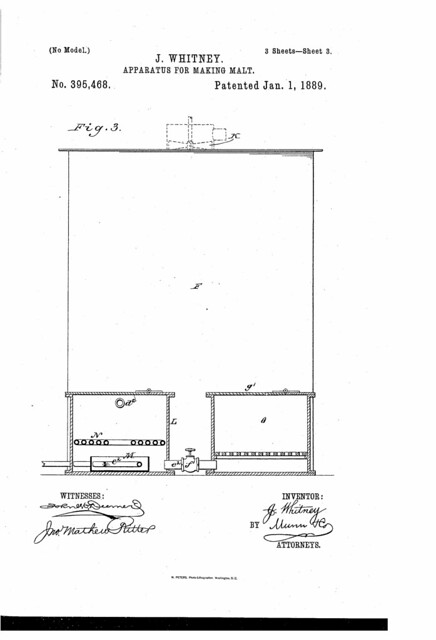
Today in 1889, US Patent 395468 A was issued, an invention of Justin Whitney, for an “Apparatus For Making Malt.” There’s no Abstract for this one, but you can read the full description about his “novel means and apparatus for making malt” at the patent page.
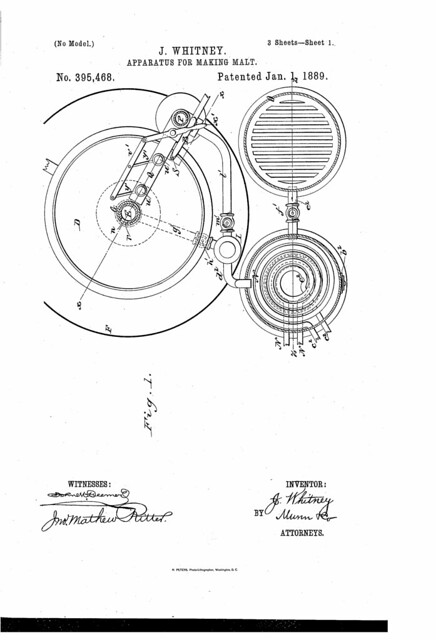
US395468-0

US395468-1

US395468-2

Filed Under: Beers, Just For Fun, Politics & Law, Related Pleasures Tagged With: Malt, Patent

The Drunkometer

December 31, 2014 By Jay Brooks

balloon-blowing
Here’s an interesting piece of history. Today, New Year’s Eve, in 1938, police in Indianapolis, Indiana used the first commercial test to discover scientifically if a person had been drinking alcohol and if so, how much. December 31, 1938 saw the debut of the Drunkometer, designed by Rolla Neil Harger, a chemistry professor at Indiana University. He began working on the device in the 1930s, and patented it in 1936.

The drunkometer collected a motorist’s breath sample directly into a balloon inside the machine. The breath sample was then pumped through an acidified potassium permanganate solution. If there was alcohol in the breath sample, the solution changed color. The greater the color change, the more alcohol there was present in the breath. The drunkometer was manufactured and sold by Stephenson Corporation of Red Bank, New Jersey.

drunkometer-1
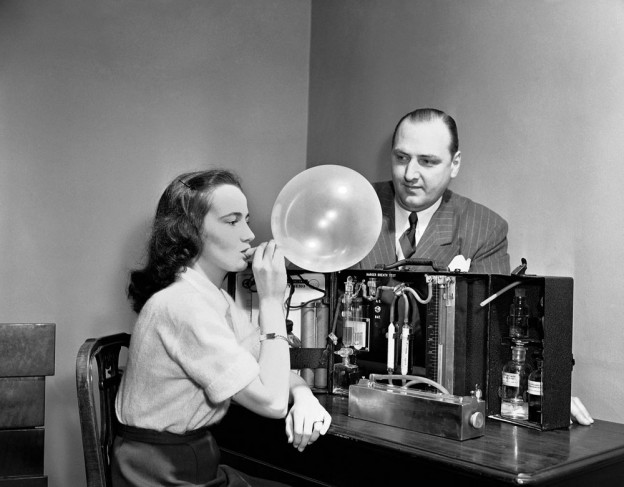
Dorothy Brengel helps W.D. Foden, Chairman of Statler Safety Committee, demonstrate the “Drunkometer”, a breath tests for alcohol, on display at the Greater New York Safety Council, Hotel Statler, March 28, 1950. For the preliminary test, the breath of the suspect is collected in a balloon and passed through a purple fluid (potassium permanganate and sulphuric acid) to see if it changes color. The breath of a non-drinking person will cause no change. If the purple color disappears, the amount of breath required to accomplish this indicates the approximate accumulation of alcohol in the blood. (AP/Carl Nesensohn)

In 1938, on New Year’s Eve, police in Indianapolis put a new piece of technology through its first practical test.

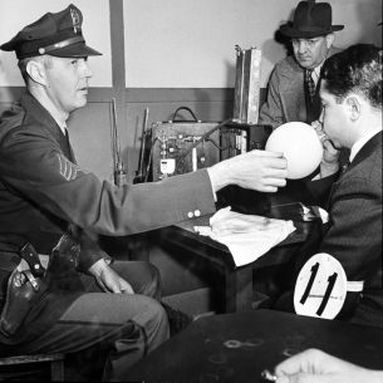
They used a breath analyzer to determine if someone had been drinking. What was then called the “Drunkometer” was based on the same idea as modern breathalyzers: a person blows into a bag, which contains chemicals that react according to how much alcohol is on a person’s breath.

drunkometer-4

The Daily Dose gives a good account of its early use:

Thanks to the end of Prohibition and a boom in car sales, drunk driving had become a fast-growing problem in America in the 1930s. But on this New Year’s Eve, police in Indianapolis, Indiana went out armed with a new weapon to fight against people who had gotten behind the wheel after having too much to drink.

It’s a contraption called a “drunkometer” and it’s the invention of an Indiana University chemist named Rolla Harger. He had been working on the device since the early 1930s and had patented it two years earlier. The concept behind the drunkometer was pretty basic. Drivers suspected of being drunk were asked to breathe into a rubber balloon, which was attached to a tube of purple liquid—a weak solution of potassium permanganate in sulphuric acid.

If there was alcohol on their breath, the chemical solution changed color–the darker it got, the more alcohol they had in their system. From the shade of the liquid, the cops could use a simple equation to estimate the alcohol level in a person’s bloodstream. Previously, the only way police could check a driver’s alcohol level was to get a blood or urine sample; Neither was a very practical option on the roadside. While the drunkometer looked a bit like a mini chemistry set, it was portable, able to fit into a small suitcase.

Harger made the device as simple as possible so that judges and juries would understand how it worked and police officers could easily be trained to use it. He also made the drunkometer hard to beat. Experiments showed that no illness affected the result, and that nothing a person might eat – garlic, cloves, strong onions – would make any difference. Once police started using it, the drunkometer was found to have another advantage. A dramatic change in the color of the liquid could often make people admit how much they had drunk.

Sometimes Harger would ride along with the police to see how his invention was being used. What he discovered was that a lot more people were driving drunk than he ever imagined.

The drunkometer was used by police departments all over the country until the 1950s when it was replaced by the breathalyzer, invented by another Indiana University professor, Robert Borkenstein. The breathalyzer is a much smaller and more sophisticated device that uses infrared spectroscopy to measure blood alcohol levels.

drunkometer-3
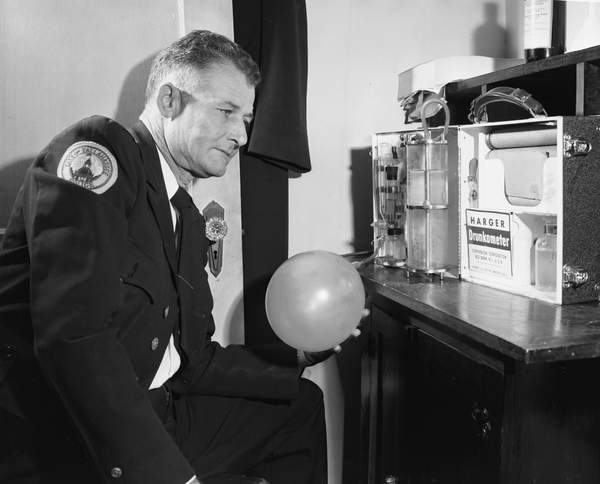
Tallahassee police officer with a Harger “Drunkometer” breathalyzer machine, photo taken in 1953.

The Drunkometer was replaced by the Breathalyzer in 1954, but for sixteen years was the way police nabbed drunk drivers. But who came up with that name? Happy New Year! Be careful out there.

Filed Under: Beers, Just For Fun, Politics & Law Tagged With: Science

Who Owns What

December 30, 2014 By Jay Brooks

business
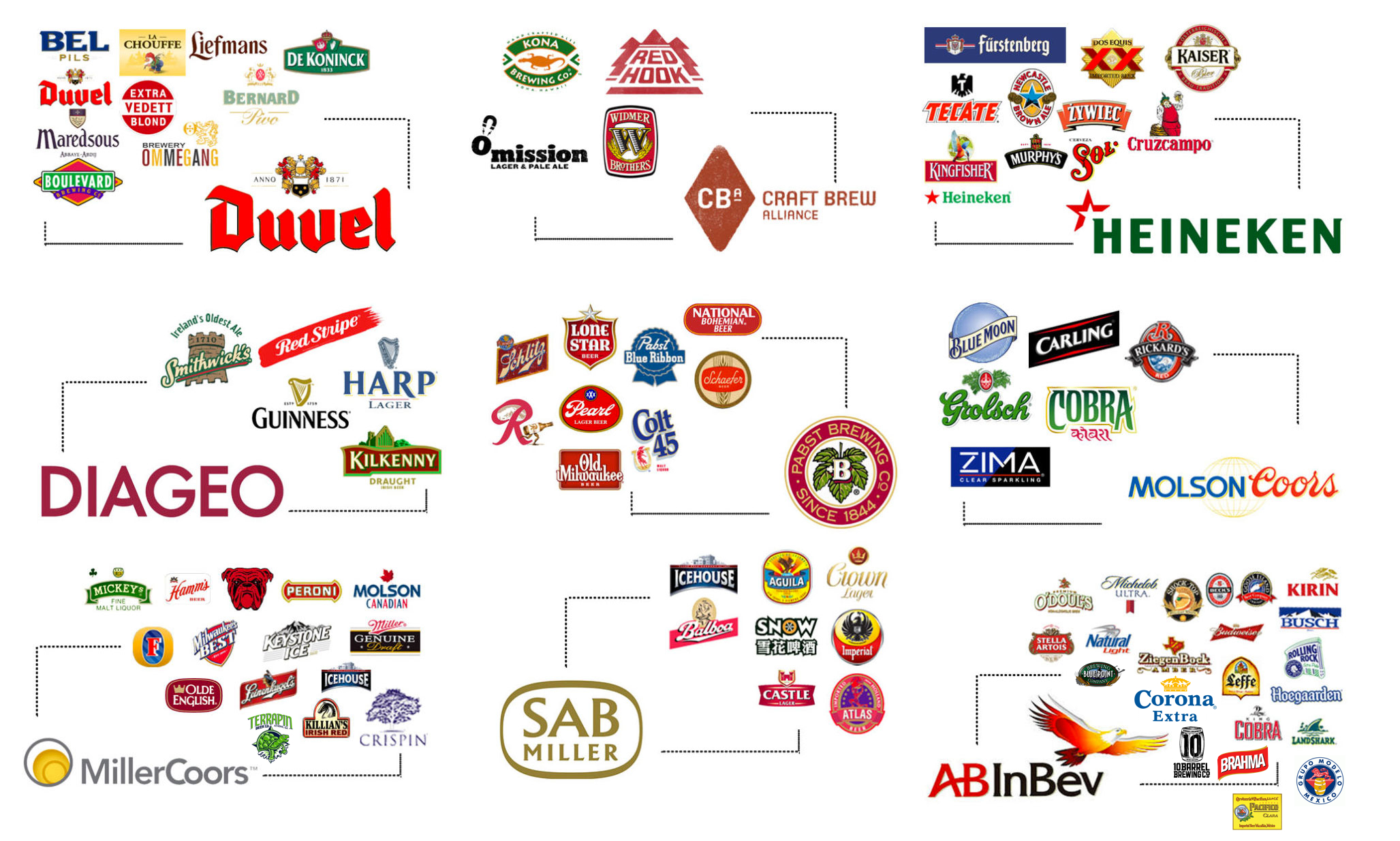
As the year’s winding down, I noticed this article from Booze News from last week entitled America’s Fastest Growing Beer Brands. While the article itself offered few insights, I noticed a graphic depicting which beer companies owned which brands. The graphic was taken from a Gizmodo article that ran a little over a year ago about Who Actually Owns Your Favorite Beers. I added one or two to ABI’s stable of brands, but otherwise a year on it’s still fairly accurate. If there’s any that need to be added, or changed, let me know in the comments and I’ll see what I can do.

beer-brands-2014
I think you can see the chart full size here. If not, try here instead.

Filed Under: Beers, Breweries, Just For Fun Tagged With: Big Brewers, Business, Marketing

Rules For Christmastime Pub Goers

December 24, 2014 By Jay Brooks

pub-sign
The Stoke Inn, located in Plymouth, England, looks like a typical British pub.

Stoke-Inn

But pub landlord Steve Bowen may be my new favorite bartender.

Stoke-Inn-Steve-Bowen

Apparently in Great Britain it’s a common occurrence for people who don’t regularly drink in pubs to visit them over the holidays. I suspect it’s much like every Irish-themed pub fills up each St. Patrick’s Day here in America, or is similar to people who attend church only twice a year, on Easter and Christmas. Essentially, such people are not regulars and often are unaware of the proper protocols or etiquette that more seasoned pub-goers follow. Five years ago, I did a similar list about my Top 10 Festival Pet Peeves about the same phenomenon at beer festivals.

Earlier this month, Bowen posted his tongue-in-cheek “Rules” for proper pub behavior over the holidays. It’s hilarious. Perhaps even funnier is how many people missed the point and complained about the list, meaning they’re most likely the people he was talking about, so definitely take a look at the comments, too. Below is his rules for the seasonal drinker. Enjoy.


Stoke-Inn
XMAS AT THE STOKE INN, PLYMOUTH

It’s that festive time of year when decent, honest boozers are plagued by non-drinkers. And not real non-drinkers, not people who don’t ever drink, they’re fine. We’re talking about people who don’t go near a pub for 11 months out of the year, the kind of awful human beings who buy their beer from supermarkets with the weekly shop, people who consume such a laughable quantity of alcohol that they can only be designated as “non-drinkers”.

Whether it’s the Christmas Work’s Do or a Festive Drink With Friends, you are ruining pubs for the rest of us. Everyone hates you. Every actual drinker in the pub hates you and all the serving staff hate you. You’re awful. Here’s a guide on how to not be quite so awful

DO NOT APPROACH THE BAR UNTIL YOU KNOW WHAT YOU WANT

• The bar is an intricate machine full of separate-yet-interconnecting cogs. It is NOT the place to think or choose or decide. The engine only works if everyone knows their place and performs their function. Do you hear that collective groan as you ask the Bartender if they’ve got Cranberry Juice? Or as you turn around to ask Barbara what she wants to drink? That groan is you single-handedly sucking life away from your fellow drinkers. Make a decision first, then go to the bar and order what you’ve selected. Just like ANY OTHER FORM OF COMMERCE!

DON’T START DRINKING AT 4PM

• You’re NOT a drinker. We haven’t seen you all year. You’re an amateur, so don’t start out with a Marathon. You can’t just rock up to the Premier League one day saying “I’m Match Fit, lads!” This is why you’re puking and crying before nine o’clock at night.

YOU ARE IN A ROUND

• I don’t care who you’re with, how many of you there are or how well you know them. You are in a Round with all the people you came in with. That’s how it works. You see those twenty-five loud, burly, drunken Rugby Players on the other side of the pub? They are a pleasure to serve compared to you. They order eight pints of lager, eight pints of Guiness, six pints of bitter and three Jack Daniels, then they pay the bill in one fell swoop. Your group orders ten drinks one-at-a-time and then pays for them all one-at-a-time as the rest of pub creeps closer to Death’s eternal grasp waiting for you to finish, despite the fact nine of you are drinking the same fucking drink and the last person, THE LAST PERSON, wants a Guiness putting on. Every single person waiting to get served wants your group to die in a complicated house fire.

KNOW WHERE YOU ARE

• Look around you. What kind of drinking establishment are you in? Is it a pub or a bar? If there’s 85 lads watching football on the telly, stop trying to be a drunk, flirty attention-whore because it won’t work. If the walls are cluttered with offers of 6 Shots Of Neon Sourz For A Fiver, don’t try asking for that Single Malt whiskey you memorized from Mad Men. Equally, if it’s a pub adorned with wood furnishings and hand-pulls, stop trying to get the Landlord to make that shitty cocktail you saw on Sex And The City

HOT GIRLS GET SERVED FIRST

• Welcome to Western Civilization.

iPHONE ETTIQUETTE

• Okay, the music isn’t great. It’s nothing to write home about. But it’s been specifically selected to offend the least amount of people. It’s background music. If you want anything else, then you want to be at a club or a gig. If, however, you’ve decided to“do the pub a favour” by blaring out a playlist from your iPhone, then you are a twat. A prize, prize twat. Other expletives come to mind. Likewise don’t get offended if the barman politely gives you a pound and rejects all six Abba songs you paid for.

ATTRACTING ATTENTION

• Newsflash: You are NOT next. You might have been in the bar queue longer than anybody else, but that doesn’t mean you’re next. Do you know why? Because there are no “Official Rules Of Queueing At The Bar.” The Bartender is 100% in charge of who is next. So do not piss them off. Yes, they can see you. You do not need to bang your change on the top of the bar. You do not need to wave your money around in the air, as if you’re the only person in the room with a tenner (unless it’s a Strip Club). You especially do not need to click your fingers like a Parisian Cafe prick or whistle like a Shepherd herding his flock. These tactics will only achieve one outcome: no matter how long you’ve been waiting up until this point, you’ve just moved yourself to the back of the queue.

PREFERENTIAL TREATMENT

• If an old bloke sat at the bar gets served before you do, and the Bartender knows him by name and even seems to know what he’s drinking before he orders it, just shut the fuck up. That’s Bob. Bob drinks here all the time. Bob drinks here five times a week, every week. Bob’s custom pays the bills. Bob and the other Regulars keep the pub open eleven months of the year whilst you’re having dinner parties and bulk-buying booze from the supermarket. Yes, they get preferential treatment. Accept it and shut the fuck up.

TIME IS TIME (sometimes)

• Pubs don’t stop serving because they hate you (that’s a lie, sometimes they do) or because it’s funny or because they get bored of selling beer. It’s a legal requirement for them to stop serving at a designated time. Once Time is called, they are legally unable to sell anymore beer. You cannot cajole them into selling more, because it’s a legal requirement. You cannot bribe them into selling more, either with the promise of drinks or money, because it’s a legal requirement. You cannot reason or argue them into selling more, because it’s a legal fucking requirement. “Who’s gonna know? There’s nobody around, I won’t tell anyone.” THAT’S HOW THE HOLOCAUST STARTED!

See you in twelve months, you fucking pricks.

Stoke-Inn-sign

I think the Stoke Inn is my new favorite pub. Happy Holidays.

Filed Under: Just For Fun, Related Pleasures Tagged With: Christmas, Holidays, Humor, Pubs

The Next Session Looks For The Next Great Beer Book

December 24, 2014 By Jay Brooks

session-the
For our 95th Session, our original host has gone missing, so happily Alan McLeod of A Good Beer Blog offered to come to the recuse and host the January Session, his third time hosting. For his topic, he’s asking one simple question. “What beer book which has yet to be written would you like to see published?” You can read Alan’s thought process and more about what he’s looking for in his post “I Answer The Call! Again I Host!!!,” but these are the important bits.

What is the book you would want to write about good beer? What book would you want to read? Is there a dream team of authors your would want to see gathered to make that “World Encyclopedia of Beer and Brewing”? Or is there one person you would like to see on a life long generous pension to assure that the volumes flow from his or her pen? Let us know.

Books&Beer

So put on your thinkin’ caps, let the synapses fire on an open flame. To participate in January’s Session, just come up with the next great beer book. Then on the second day of 2015 — see you’ve got until next year to work on this, plenty of time — post your idea in the comments section to Alan’s announcement. Then get writing. We’ll all want to see that book written by the following year at the latest.

books2

Filed Under: Just For Fun, The Session Tagged With: Announcements, Beer Books

Diocletian’s Edict On Beer Prices

December 22, 2014 By Jay Brooks

denarius
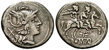
Today is the birthday of Diocletian, who was born in the year 244 C.E. He was a Roman Emperor, whose reign lasted from 284 to 305. During his time in charge and before, runaway inflation was a growing problem, which caused him to put a cap on prices in 301 C.E. Known as the “Ēdictum Dē Pretiīs Rērum Vēnālium” or Edict on Maximum Prices or occasionally the Edict of Diocletian, it set the maximum prices allowed on a variety of commodities, goods and services.

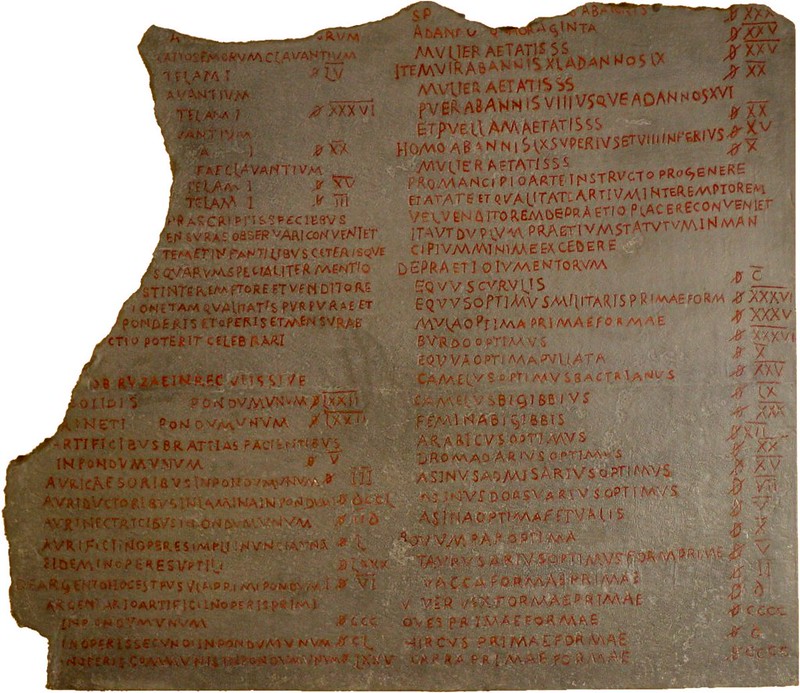
For example, a sextarius (roughly 500 ml, or about a pint) of Egyptian Beer had a maximum price of 2 Denarii. A Denarius was a common coin in Ancient Rome, beginning around 211 B.C. E. during the Second Punic War, becoming “the most common coin produced for circulation. The word denarius is derived from the Latin dēnī “containing ten”, as its value was 10 asses (later “retarrifed at sixteen asses”). It is the origin of several modern words such as the currency name dinar and the Italian common noun for money: denaro.”

Prsumably because it was better, the same amount of Gallic or Pannonian Beer had a maximum price set of 4 Denarii. Pannonia was a Roman province in the northern part of the empire, and was located in “present-day western Hungary, eastern Austria, northern Croatia, north-western Serbia, northern Slovenia, western Slovakia and northern Bosnia and Herzegovina.” Gaul was the area that is modern-day France.

Egyptian beer was sometimes translated as “Zythus” and at least another translation lists the Gallic or Pannonian Beer as “beer called Camus.” These other translations also list something called “Barley wine of Attica” with a hefty maximum price of 24 Denarii. Attica was the area around and including Athens in Greece. I have no idea if that was anything like our modern barley wine, and I can find no other mention of it in a quick search.

Another translation done in 1876 by an Edward Young, entitled “Labor in Europe and America: A Special Report on the Rates of Wages, the Cost of Subsistence and the Condition of the Working Classes” converted the Denarii prices to the then nearest American equivalent, which the author supposed was one-half cent to the Denarius. Using that scheme, the Egyptian beer would have been 7 cents, the Zythus, or Gallic or Pannonian Beer would have been 14 cents, and the barley wine of Attica 84 cents. Adjusting for inflation 138 years, in 2014 prices the maximum prices for a pint of our three beers would be $1.56, $3.11 and $18.67, which would be pretty expensive, even for 16 oz. of barley wine. But overall, those prices seem pretty decent. Salutaria!

Edict_on_Maximum_Prices_Diocletian
A fragment of the Edict on Maximum Prices, on display in Berlin.

Filed Under: Beers, Just For Fun, Politics & Law Tagged With: Business, History, Politics

Big Brands Continue To Slide

December 16, 2014 By Jay Brooks

sales-chart-down
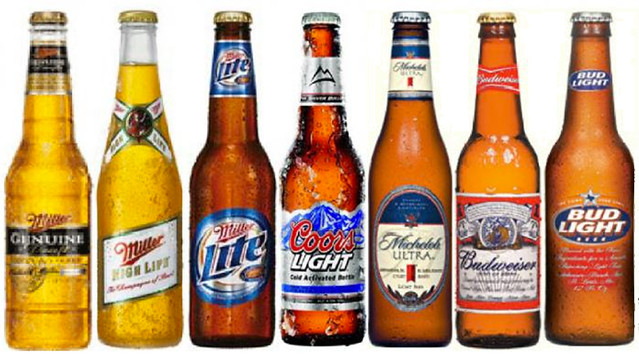
For the last several years, sales of some of the major beer brands have been slipping, and not just the sub-premiums or secondary packages but even once mighty flagships. 24/7 Wall Street has a new list of some of these brands, characterized as Beers Americans No Longer Drink. Using data from Beer Marketer’s Insights, here are seven brands that have lost significant sales, at least 20%, between 2013 and 2008. The negative number following the name is how much sales are down in that six-year period.

  • Miller High Life -21.2%
  • Budweiser -27.6%
  • Milwaukee’s Best Light -40.6%
  • Milwaukee’s Best -57.0%
  • Miller Genuine Draft -58.3%
  • Budweiser Select -61.1%

Some additional analysis and reasons for the decline, according to 24/7 Wall St:

Another key factor in the weakening sales has been price dynamics. “Beer prices were increased more aggressively over the last five years than wine and spirits,” Shepard said. Many people in the industry believe that, as a result, some customers replaced buying beer with the now relatively less expensive wines and spirits, he explained.

Several other products were also gaining at the expense of big brand-name beers, Shepard noted. While some customers have been moving to wine and spirits, others were switching to imported beer, particularly Mexican imports. Indeed, in the five years through 2013, shipments of Mexican brands Dos Equis and Modelo Especial more-than doubled. Similarly, he added, “Some [drinkers] are moving to craft [beer]. Clearly, there’s been a trade-up in the industry.”

Craft beers have largely bucked the overall downtrend in beer sales. From 2008 to 2013, shipments of craft beer rose by 80.1% to a total of more than 16 million barrels, or 7.6% of the U.S. beer market. While the craft beer category now outsells Budweiser, it remains a relatively niche market. For comparison, the nation’s top-selling brand, Bud Light, shipped 38 million barrels in 2013, accounting for 18% of all beer shipped.

big-brands

Filed Under: Beers, Breweries, Just For Fun, News Tagged With: Big Brewers, Business, Statistics

Where America Got Its Booze

December 11, 2014 By Jay Brooks

popular-science
Here’s a fun article I stumbled upon that appeared in Popular Science. “Where America Gets Its Booze” was a feature story in their May 1930 issue.

PopSci-1930-May-cover

“Where America Gets Its Booze” is an interview with America’s “Prohibition Commissioner,” Dr. James M. Doran, who was a chemist. And boy, doesn’t he look like a fun guy in that photo. According to a Time magazine article from the year before, even his wife was trying to help, as “she marshaled a platoon of reinforcements in the form of recipes for nonalcoholic cocktails. She had prepared a Book of Juices to meet the onslaught of the ‘winter social season just ahead.’ She announced a few of her recipes in advance. Explained Mrs. Doran: ‘Prohibition took something away from the American people, but we can give them something just as good—a cocktail that satisfies but does not inebriate.'” Well, that should do it.

PopSci-1930-May-pg19

PopSci-1930-May-pg20

PopSci-1930-May-pg21

PopSci-1930-May-pg146 PopSci-1930-May-pg147

Filed Under: Beers, Breweries, Just For Fun, Related Pleasures Tagged With: History, Prohibition

Craft: New Documentary About California Breweries

December 9, 2014 By Jay Brooks

craft-doc
This looks interesting. Jeff Smith and Fran Ellsworth are directing and producing a new documentary film about California breweries entitled “Craft: The California Beer Documentary.” They recently released their first trailer, which you can watch below. All I know at this point is from a short description of their project. “A road trip throughout California, learning from the master brewers of the state. It’ll also feature interviews with beer enthusiasts and home-brewers.”

Filed Under: Breweries, Just For Fun, News, Related Pleasures Tagged With: Announcements, California, Documentary, Film, Video

CCBA 25th Anniversary Round-Up Video

December 8, 2014 By Jay Brooks

ccba
Early last month, the California Craft Brewers Association celebrated its 25th anniversary with a two-day conference in Santa Rosa. I gave a talk on the history of craft beer in the Golden State, and there many other seminars, including a wonderful panel discussion with three craft beer pioneers, John Martin (Triple Rock), Ken Grossman (Sierra Nevada) and Fritz Maytag (Anchor), moderated by Vinnie Cilurzo (Russian River). The Film Squad created a fun video showing an overview of the conference.

Filed Under: Breweries, Just For Fun Tagged With: California, CCBA, Video

« Previous Page
Next Page »

Find Something

Northern California Breweries

Please consider purchasing my latest book, California Breweries North, available from Amazon, or ask for it at your local bookstore.

Recent Comments

  • Bob Paolino on Beer Birthday: Grant Johnston
  • Gambrinus on Historic Beer Birthday: A.J. Houghton
  • Ernie Dewing on Historic Beer Birthday: Charles William Bergner 
  • Steve 'Pudgy' De Rose on Historic Beer Birthday: Jacob Schmidt
  • Jay Brooks on Beer Birthday: Bill Owens

Recent Posts

  • Beer In Ads #5391: Billy And The Judge November 12, 2026
  • Historic Beer Birthday: Michael Arthur Bass November 12, 2026
  • Historic Beer Birthday: Samuel Liebmann November 12, 2026
  • Historic Beer Birthday: Philip R. Ebling November 12, 2026
  • Historic Beer Birthday: Joseph Coors Sr. November 12, 2026

BBB Archives

Feedback

Head Quarter
This site is hosted and maintained by H25Q.dev. Any questions or comments for the webmaster can be directed here.