

Remember hearing the music of the ice cream truck, and running outside to meet it so you didn’t miss out on getting a popsicle, or whatever your favorite frozen treat was? Well, it’s about two months until the kickoff of SF Beer Week, and they’ve created a hilarious teaser video, reimagining the ice cream truck, or in this case beer truck, as the clarion call for beer week. Enjoy.
Craft Beer Soccer Sponsorship Fantasies

Given that many of the regional breweries continue to grow by leaps and bounds, it’s only a matter of time before they start considering some of the same types of sponsorships that in the past were usually reserved for the really big beer companies. But they certainly couldn’t afford baseball, football or even basketball prices. But what about soccer (football)? Backheel, a website and podcast devoted to American Soccer, wondered what MLS jerseys might look like if they were sponsored by local breweries. More than wondered really, as author Trevor Hayward worked with graphic designer Edward Gaug and Dan Wiersema, of the Free Beer Movement, and they created a mythical league where all the teams are sponsored by breweries, proudly displaying their logos on the jerseys. The entire project can be seen at Major League Soccer x Craft Beer Jerseys. Below are few of my favorites, but check out all of them either on Backheel or in a slideshow at Imgur.

The San Jose Earthquakes, sponsored by Lagunitas.

The Seattle Sounders FC, sponsored by Elysian.

The LA Galaxy, sponsored by the Bruery.

The Portland Timbers, sponsored by Hair of the Dog.
But that’s not quite the end of the story. SB Nation’s Center Line Soccer (part of a group of 307 sports blogs) took it one step father, wondering if Petaluma-based Lagunitas was the best choice for the Quakes, who after all are in San Jose, quite some distance from Sonoma County. While they’re both in the Bay Area, it’s roughly a one-and-a-half to two hour drive between the two, depending on the always unpredictable traffic. So they imagined a few other choices for the Earthquakes. Again, here’s a few of my faves, and you can see all of them at What craft brewery would you like to see on the San Jose Earthquakes jersey?

The San Jose Earthquakes, sponsored by Russian River Brewing.

The San Jose Earthquakes, sponsored by 21st Amendment Restaurant & Brewery.

The San Jose Earthquakes, sponsored by Drake’s Brewing.

The San Jose Earthquakes, sponsored by Bear Republic Brewing.
Anchor Christmas Day 2014

Time was when today, the Monday before Thanksgiving, was the traditional day on which Anchor’s Our Special Ale — a.k.a. their Christmas Ale — was released each year. Every year since 1975 the brewers at Anchor Brewery have brewed a distinctive and unique Christmas Ale, which is now available from early November to mid-January.

From this year’s press release:
“Every year we’ve changed our Christmas Ale. It hasn’t just been for change’s sake, though,” said Mark Carpenter, Brewmaster at Anchor Brewing Company. “For the past few years we’ve evolved the recipe to perfect a particular style of dark spiced ale and I believe we succeeded. So this year we went on a different path, exploring new possibilities and making larger changes. I’m happy to say we’re very pleased with the results. This year’s ale is aromatic with hints of citrus fruit, spices, and subtle piney hop notes. The flavor has a sarsaparilla-like sweetness with rich caramel maltiness and a pleasantly balanced back-end bitterness. The mouth feel is smooth with a full, velvety texture. The beer pairs well with rich meats, thick saucy dishes, roasted vegetables, and even your aunt’s fruitcake! We’re happy with this year’s Christmas Ale and while I don’t yet know where we’ll take it next year, we’ll continue to keep Anchor fans guessing as we do every year.”
Since ancient times, trees have symbolized the winter solstice when the earth, with its seasons, appears born anew. The tree depicted on the 2014 Christmas Ale is the Giant Sequoia. It was hand-drawn by James Stitt, who has been creating Christmas Ale labels since 1975, to look as a “Big Tree” planted in 1975 might look today.
Anchor Brewing chose the Giant Sequoia for the 40th annual Christmas Ale in celebration of the 150th anniversary of the Yosemite Act. Signed into law by President Lincoln during the Civil War, it granted the Yosemite Valley and the Mariposa Big Tree Grove to the State of California “for public use, resorts, and recreation.” The first such land grant in American history, it marked the beginning of the California State Parks.
Anchor first began their active support of the California State Parks when they announced in 2012 that proceeds of Anchor California Lager would benefit the California State Parks Foundation. This year’s Christmas Ale continues the celebration of one of the Golden State’s most precious institutions and its natural heritage.
Christmas Ale is a traditional “Wassail” of medieval England. In the olden days, brewers often used delicious blends of natural spices to give their Christmas ale a distinctive character. Similarly brewed, the Anchor Christmas Ale recipe remains a closely guarded secret every year. It’s always brewed using malted barley, fresh whole hops, and a true “top-fermenting” yeast. Its deep, rich color is produced by using a blend of roasted malts, carefully selected to achieve not only the deep color of this ale, but also to provide much of its distinctive malty flavor. The whole-cone hops provide a balanced back-end bitterness and subtle piney hop aroma. This is accompanied with aromas of citrus fruit and herbal spices.
Even though for the last few years, Anchor’s Christmas Ale is released in early November, I continue to observe Anchor Christmas Day on the Monday before Thanksgiving. I know I’m a sentimental old fool, but I liked that they used to wait that long to release it, even though I understand why they had to abandon it. But some things are worth waiting for. If you agree with me, please join me in drinking a glass of this year’s seasonal release tonight. Happy Anchor Christmas Day!

A Beer Bestiary

A Bestiary is an old-fashioned idea, from the Middles Ages, where various animals and other creatures, often fanciful, mythical and fictitious, were illustrated, and then there was a detailed description of each beast, usually accompanied by an allegorical story with a moral or religious teaching. You can see examples of many of these imaginary creatures at the Medieval Bestiary. A Los Angeles illustrator and graphic designer, Ian O’Phelan, has created a modern version, which he calls a “Beer Bestiary.” With just four mythical creatures in his bestiary, his fantastic four you’ll likely recognize, if not individually, at least for what they can become as a superhero team, your next beer.
Barley Beast

Virginal Hops

Water Bear

Cockatrice d’Yeast

Mickey Mouse Drinking A Beer

Today is the day when Steamboat Willie debuted in 1928, the first Mickey Mouse cartoon, the one that made the Disney company the entertainment powerhouse that it is today. But even though Steamboat Willie is the famous one, it actually wasn’t the first Mickey Mouse cartoon created. Plane Crazy was actually the first one made, and The Gallopin’ Gaucho was the second, but both were shelved to work on Steamboat Willie, and specifically to add a synchronized soundtrack, which is what helped make Mickey Mouse so famous.
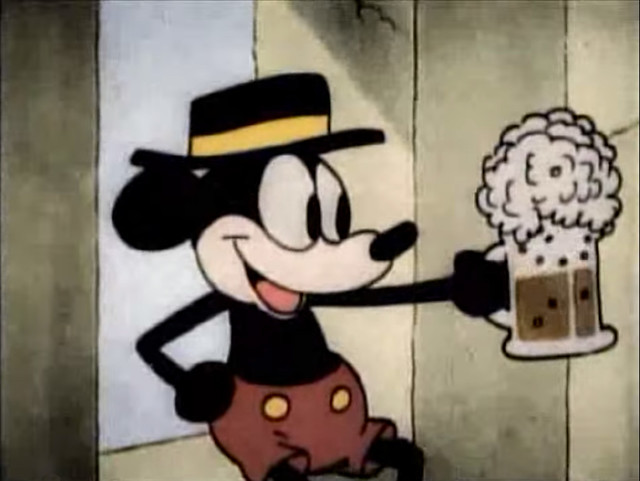
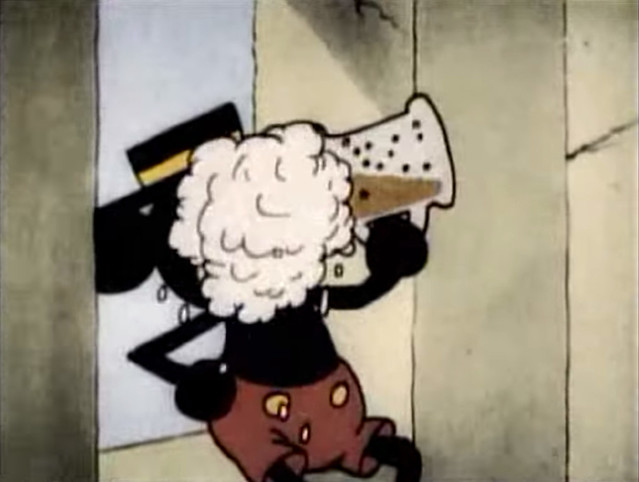
But the Gallopin’ Gaucho was notable for one other important reason. In the March 1929 cartoon, four years before the repeal of Prohibition, Mickey Mouse can be seen drinking a mug of beer. And not just drinking it, but really putting one away. But as he as south of the border, at the bar and restaurant called “Cantina Argentina,” he probably wasn’t breaking any laws.
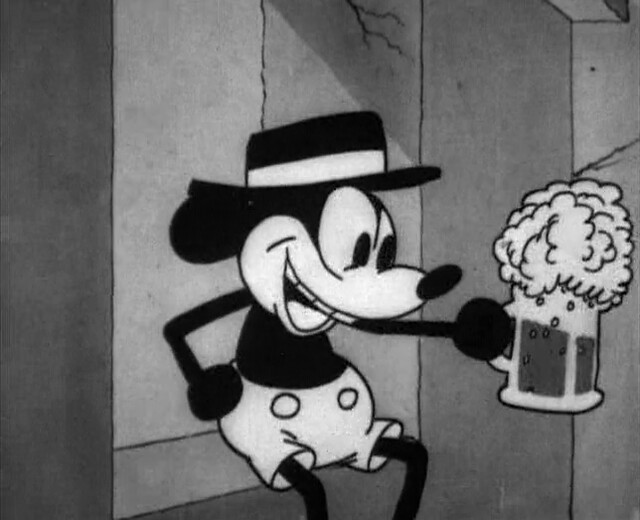
The original, of course, was in black and white.
Below is the entire cartoon, though the best version I could find was colorized.
Skunked Beer: Hide Your Shame

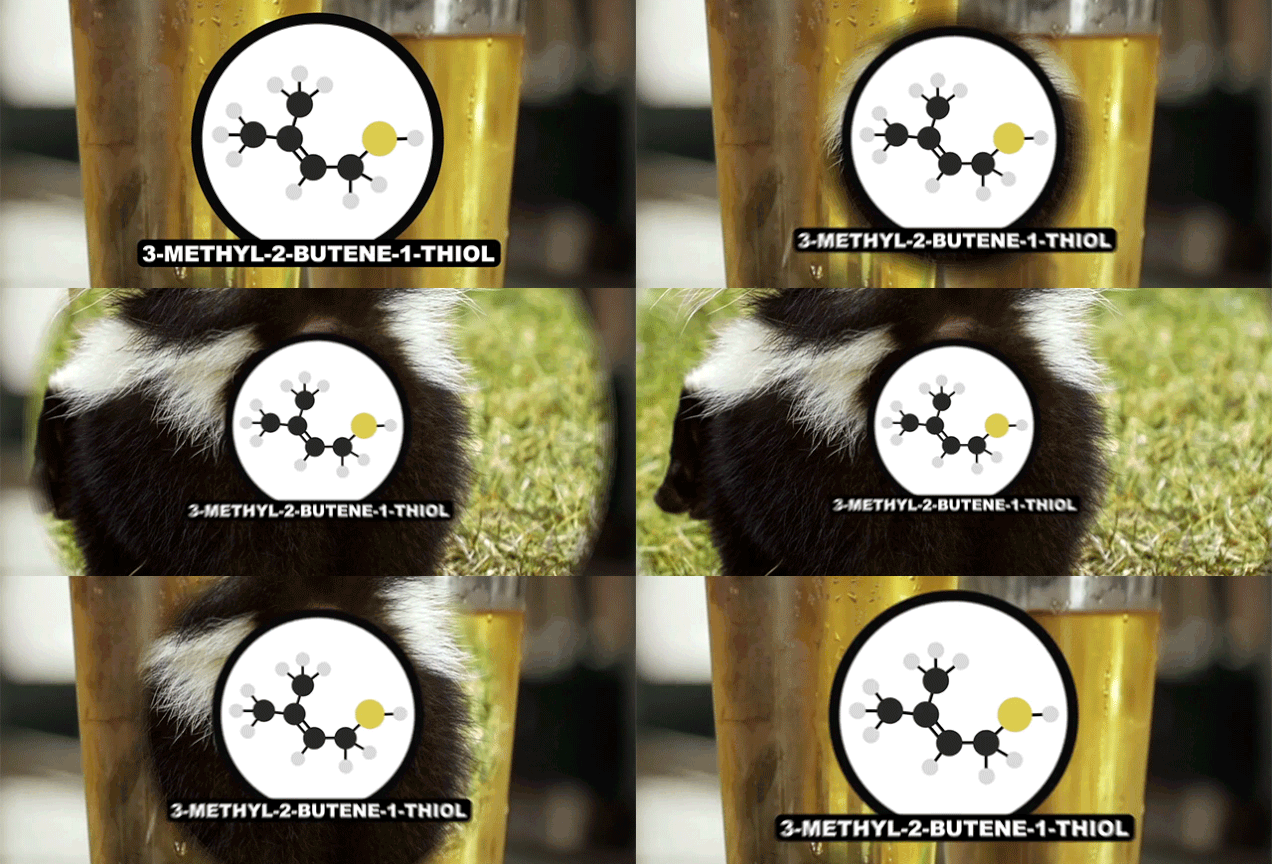
Wired magazine had a short article today giving a basic overview about how beer gets lightstruck, entitled What’s Up With That: My Beer Tastes Like a Skunk’s Bathwater.

It’s a fairly basic explanation of the process of a beer becoming lightstruck — often called skunky — written after interviewing Roger Barth, author of the textbook, the Chemistry of Beer. The author even takes a little thinly-veiled swipe at Corona. “This could explain why certain clear-bottled brands suggest you squeeze a lime into their beer to mask the skunk before taking a swig.” But it was the final sentence that had me in stitches. “But if you must, for reasons I will never understand, drink a Heineken, I suggest you get it on tap and hide your shame in a dark corner of the bar.”
Craft Beer By State

The Brewers Association released in an interactive infographic of sorts, showing State Craft Beer Sales & Production Statistics for 2013. Below is California, but there’s a similar chart for each state, with their respective numbers and rankings in a variety of categories. You can also follow links to find breweries within each state, along with specific state laws regarding beer and alcohol.

Where Do You Fit In The Next Session?

For our 94th Session, our host for the second time is Adrian Dingle, better known online simply as Ding through his Ding’s Beer Blog. For his topic, he’s asking folks to ponder their place in the world. Not the wider world, the whole ball of wax, but our little self-staked piece of it, the collective known as the beer community, or “Your role in the beer ‘scene’. What it is?”
[W]here do you see yourself? Are you simply a cog in the commercial machine if you work for a brewery, store or distributor? Are you nothing more than an interested consumer? Are you JUST a consumer? Are you a beer evangelist? Are you a wannabe, beer ‘professional’? Are you a beer writer? All of the above? Some of the above? None of the above? Where do you fit, and how do you see your own role in the beer landscape?

So time for a little self-examination — rubber gloves not included. To participate in December’s Session, simply try to figure out your very existence and post your answer on Ding’s comments section to his announcement or otherwise send Ding your link to your contribution by December 5th.

Which one are you?
Brewing: Love & Talent With Peter Bouckaert

You’re probably familiar with Ted Talks, but there’s also independently organized Ted events, known as TEDx. Recently Peter Bouckaert, the brewmaster at New Belgium Brewing gave one at TEDxCSU, the Fort Collins extension of the talks. In the talk, “[h]e explains his personal journey of challenging limitations to “brew” together a life of creativity,” and the YouTube page describes Peter as having “made a career through utilizing innovation and working outside the box.”
A Belgian native, he is a Biochemistry engineer, with a specialization in Brewing and Fermentation technology from the University of Ghent, Belgium. Before joining New Belgium in 1996, and moving to the US, he worked in the Belgian brewery world in breweries with difficult to pronounce names like Zulte and the world renowned Rodenbach. He was the 2013 winner of the Russell Schehrer award for innovation in Brewing.
It’s only a little longer than fifteen minutes. I only wish it was longer. Enjoy.
Top 10 Beer Brands Worldwide 2014

Last year, I posted a list of The World’s Top 10 Beer Brands . That list, from Drinks Business, was for sales as of the end of 2012. Earlier today, the Wall Street Journal tweeted a chart showing a newer list of the top ten, from Euromonitor International. Their data was accompanying a story, SABMiller Considers Best Route to a Global Beer Brand, though I couldn’t see the context, since only WSJ subscribers could see the entire article. No matter, I was keen to see if this year’s numbers were similar, as you’d expect, from last year, even though the source of the information is slightly different.

It’s pretty close to last year’s list. The top two, both Chinese brands, remain unchanged. But Bud Light has jumped up from #5 to claim the third spot, while Bud slipped down one to #4. Yanjing Beer, which was #4 on last year’s chart, slipped to #6, while Brazil’s Skol shimmied up from seventh to #5. Heineken moved up one to #7, while another Chinese brand (owned by ABI) — Harbin — is at #8, but was not on last year’s list. Finally, Brahma and Coors Light switched placed at the bottom of the list. Last year, Coors Light was #9, this year it’s Brahma. Corona was #6 on last year’s chart, but is not on the list at all this year.