Brookston Beer Bulletin

Jay R. Brooks on Beer

  • Home
  • About
  • Editorial
  • Birthdays
  • Art & Beer

Socialize

  • Dribbble
  • Email
  • Facebook
  • Flickr
  • GitHub
  • Instagram
  • LinkedIn
  • Pinterest
  • RSS
  • Twitter
  • YouTube

Powered by Genesis

Gnome For Me, Thanks

November 22, 2008 By Jay Brooks

achouffe
It is not known precisely where the mythical Gnome originated, or why, but their mythology spread throughout Europe. Eventually the more common garden gnome originated in Germany in the 1800s and by the 1840s had spread to England and other parts of Europe.

In Germany, the gnomes (or dwarfs as they are known there) were often portrayed as miners. There is a theory that miners, of small stature, came from the island of Crete around 1,500 BC to dig for gold and silver in parts of Europe, including southeast Germany, and they might have been the origin of the mining dwarf myth. Dwarfs often featured in German fairy tales, such as those told by the Brothers Grimm, and dwarf figurines were thought to bring good fortune to a home if placed in the house or garden which is why they were adopted by so many German homes. The familiar pointed red hat that we see on many garden gnomes today was originally a representation of the hat that was once worn by miners in the mountains of south-east Germany.

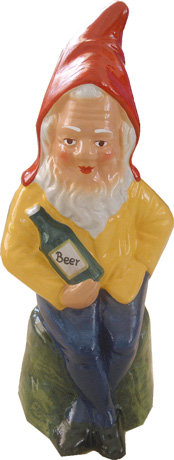
Now Gnomeland, a UK dealer in garden gnomes is offering a beer drinking garden gnome, perfect for your hop yard.
beer-gnome

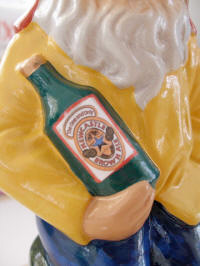
You can also customize the label on the beer bottle your garden gnome is holding on to, as shown in this Newcastle example.
beer-gnome-custom

Of course, at least one other beer variety exists, the gnomes created by Bas for his wife’s Urthel beer. Oh, and you want more gnomey puns — and who doesn’t? — check out Gnome Pun Intended.


Filed Under: Just For Fun, Related Pleasures Tagged With: gadgets, Gifts, UK

Halloween Beer Costumes, Pt. 1: Superheroes

October 25, 2008 By Jay Brooks

halloween
A couple of days ago while searching for an image to use, I noticed a number of odd beer-themed Halloween costumes and became curious about what beer-themed costumes were out there. There are a lot of them and, not surprisingly, they’re for adults. Halloween has become more of an adult holiday than when I was a kid, when it was almost exclusively a child’s holiday.

Halloween weekend has become the biggest keg sale period for most, if not all, retailers. It certainly was when I was the beer buyer at Beverages & more just a few years ago, and I’ve seen nothing to suggest that’s changing.

So for the next seven days, leading up to Halloween day I’ll be posting some of the costumes I found, with a different theme for each day. Below is part one of seven and the theme is superheroes. Enjoy.

 
Beer Man
costume-beerman
 

Beer Girl
 
costume-beergirl

 
Captain Six-Pack
costume-capt-6pk

 
Super Six-Pack
costume-super-6pk

Filed Under: Beers, Just For Fun, Related Pleasures Tagged With: Halloween, Holidays

Dinosaur Beer

September 2, 2008 By Jay Brooks

t-rex
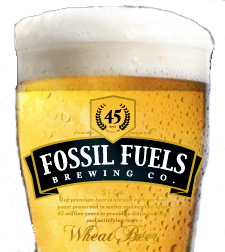
No, I don’t been those lumbering giants making flavorless beer-like industrial beverages which we all hope might one day become extinct, I’m talking about a beer made with roughly 45-million-year old yeast found in a bug entombed in amber, and extracted just like the plot of Michael Crichton’s Jurassic Park. This time around, the story involves Fossil Fuels Brewing Co., whose owners include Dr. Raul J. Cano, the Emeritus Professor at Cal. Poly in San Luis Obispo who originally made the discovery. According to the story in today’s Washington Post, the breakthrough came last month.

“I was going through my collection, going, ‘Gee whiz — this is pretty nifty. Maybe we could use it to make beer,’ ” says Cano, 63, now the director of the Environmental Biotechnology Institute at California Polytechnic State University in San Luis Obispo.

Last month? Hold on just a second. First of all the article mentions the following:

In April, at the World Beer Cup in San Diego, “we had one judge give us the highest marks, one just below and one who didn’t like it,” says Chip Lambert, 63, the company’s other second microbiologist. “We learned that the issue was that in these competitions, you brew to match the traditional concept of the style, which these yeast just don’t do.”

Ignoring for the moment that the World Beer Cup isn’t judged like that (there are no “highest marks” or anything similar), the Washington Post published this article yesterday, September 1. That would mean the World Beer Cup took place five months ago, not to mention that to enter that competition you have to register and submit your beer well in advance of the actual judging. I’m not trying to quibble with the story, a least that wasn’t my original intent, but this just doesn’t add up. Last month? Setting all that aside for the moment, I wrote about this two years ago, when Stumptown Brewing, in Guernville, California, made a beer called Tyrannosaurus-Rat, also using Dr. Cano’s ancient yeast.

This is part of what I wrote in Fall of 2006 in the Celebrator Beer News, reviewing a beer and barbecue festival held along the Guernville River at Stumptown:

But as good as the barbecue was, I was there for the beer. I was particularly keen to try what Stumptown was billing as a beer made with the world’s oldest yeast. Their “Tyrannosaurus-Rat” — or T-Rat for short — was essentially their popular “Rat Bastard,” but brewed using yeast that was 30 million years-old, give or take a few million years! How it got to be in Stumptown’s beer is nearly as interesting as the beer itself. It was discovered in the Dominican Republic trapped inside of a bee that was also trapped inside of a piece of amber, a terrific preservative. And the bee had been there for somewhere between 25 and 40 million years. Dr. Raul J. Cano, Emeritus Professor at Cal. Poly in San Luis Obispo, made the discovery in 1995 and managed to extract living bacterium, including a few strains of yeast, directly from the bee’s stomach. The ancient microorganisms were patented and also inspired the movie “Jurassic Park II.” It fell into Stumptown’s lap during a ski trip where the Hackett’s met a friend of Dr. Cano, and the rest, as they say, is literally ancient history.

I tried the T-Rat alongside of its modern counterpart, Rat Bastard, as they were the same in all respects except for the yeast. The Rat Bastard is a well-made pale ale, with good aromas and a crisp, clean palate. It has a generous hop bite that finishes bitter, then drops off sharply in the end. The T-Rat was much smoother, with softer, fruity flavor characteristics and just a touch of lemony sweetness that wasn’t tart. The finish is quite clean, with just a quiet hop presence lingering. While they’re both good beers, I think the T-Rat has a more complex, developed taste profile but its smoothness makes it great. The fact that it was made with such an old yeast is fascinating and given how good the beer is, no mere novelty.

There are also other anomalies. In my story, which relied primarily on Stumptown’s information, the yeast was found in a bee from the Dominican Republic. The Washington Post account, however, lists the Lebanese weevil as the yeast carrier. On top of that Dr. George Poinar, who was also involved in finding and extracting the DNA from amber, says on his biography web page that its age was 125 million-years old.

And here is the original press release for Stumptown’s version of the beer, from June 27, 2006:

For the first time, 25-40 million year old yeast has been used to brew a commercial batch of beer (“Tyrannosaurus Rat”) to be made available to the public on July 8th at Stumptown Brewery (15045 River Rd. Guerneville, Ca.). Dr. Raul Cano, Lewis “Chip” Lambert, and Peter Hackett will be celebrating this historic event and available for questions from 11:00A.M. on Saturday July 8th.

The public tasting of the T-Rat is the culmination of coincidences that involved a 20-40 million-year old bee trapped in amber and discovered in the Dominican Republic, a pair of renowned scientists, a ski weekend and an award winning microbrewery.

Amber is nature’s perfect preservative. It desiccates its specimens and protects them from damaging radiation of all types. Man has successfully used it to preserve their dead for thousands of years; Nature has preserved many of its inhabitants, including the recently identified spider web, in their elegant tombs for tens of millions of years.

Dr. Raul J. Cano, Emeritus Professor at California Polytechnic State University, San Luis Obispo, reported in Science (Volume 268, May 19, 1995) that he extracted a living bacterium from the gut of a stingless bee entombed in amber 25 – 40 million years ago. Independently, Lewis (Chip) Lambert, Fremont, CA, at the time Director of Pre-Clinical Research at a Bay Area biotech company, confirmed his work in a very skeptical scientific environment that has, for the most part, accepted its validity. In addition, Raul’s work became the underlying premise for the movie Jurassic Park.

The patented ancient microorganisms (USPO#5,593,883) became the focus of a new company based on the potential use of these microbial isolates for industrial and medical applications, and the hunt began. From the ancient-amber library came a few yeast strains and with them, the question, could they be used to make beer? The answer was a resounding yes as very good beer was brewed for the Jurassic Park II cast party and Raul’s daughter’s wedding reception.

After this initial success, Fossil Fuels Brewing Company was born with the motto “We bring good things back to life.” Using ancient yeasts that had all been thoroughly tested and selected for their beer-making properties, Fossil Fuels Brewing Co. planned to produce high quality distinctive beers with yeasts that had been isolated from amber.

The partners then proposed trials of these ancient yeasts to numerous microbreweries. Much to their surprise, in an industry that thrives on innovation, found a lack of enthusiasm among commercial breweries.

Fast forward a few years to the snowy slopes of Alpine Meadows where Carla Hackett was taking a ski lesson from Raul’s now friend and business partner, Chip. Carla had all the attributes of a great skier that her husband, an Aussie who owns the Stumptown Brewery in Guerneville, lacks. On the second, never the first, ride up the chair lift, an important relationship was established when the question was raised, “would you like to make some beer with some patented, 35-million year-old yeast?” The affirmative response started a brewing relationship between Stumptown Brewery and Environmental Diagnostics, Inc.

This random path led the ancient yeast to Stumptown Brewery on May 6th where Peter, Owner/Brewer, put the yeast to work. On June 21st came the news that “T-Rat” had finished fermenting and was conditioning. Perhaps most importantly, that it’s “very good, very unique. The yeast character is unusual, exotic, and very pronounced”.

fossil-fuels

On page two of the Post piece they finally do mention Stumptown’s involvement. The new versions, which include a wheat beer and a pale ale, are made at Kelley Bros. Brewing, which is in Manteca, California. I really enjoyed the pale ale version that Stumptown brewed and will eagerly try these two new versions. But I’m still a bit bewildered by the discrepancies that seem to accompany this story. But I guess history itself is a lot like that, so maybe it’s fitting after all. I wonder what “Cheers” is in dinosaur-speak? “Here’s tar in your eye?”

Filed Under: Beers, Just For Fun, News Tagged With: History

SF Beer Week Coming In February 2009

September 1, 2008 By Jay Brooks

sfbw
When Tom Dalldorf and I came up with the idea for Beerapalooza six years ago, our original vision was a week-long series of events celebrating all the wonderful beer here in the Bay Area, California. Unfortunately, there was just two of us, and we could never quite find the time to pull it together in a way that matched our imagination of what it should have been. Beerapalooza became static, with essentially five annual events—which were all great fun—but that was it. It started off with the Bistro’s Double IPA Festival and finished up with the annual Celebrator Anniversary Party. In between there was the cheese tasting at Rogue’s San Francisco Public House, the Beer Chef’s Beer & Chocolate Dinner and the legendary Toronado Barleywine Festival.

Then earlier this year, Philly Beer Week blew our socks off. What Tom Peters and Don Russell were able to pull off their first year was nothing short of amazing. We were envious and a little guilty that we hadn’t managed to put the same effort into to a similarly grand event here in the Bay Area. We returned from Philadelphia re-energized and committed to pulling it together.

So five of us involved in one capacity or another in the beer world formed an ad hoc committee to organize and promote the successor to Beerapalooza, which we’ve dubbed “SF Beer Week,” which will be held over ten days next year, February 6-15, 2009.

Philly Beer Week characterized their town as being “America’s Best Beer Drinking City.” Since we’re friends with the Philadelphia beer community — hell, I’m originally from Pennsylvania, having grown up just a hour west of Philly — we thought we’d have a little fun with an East Coast/West Coast smackdown and so we’re calling the Bay Area “America’s Original Craft-Beer Drinking City.” Not only are we having a bit of fun with the faux rivalry, but we think we have a pretty good claim to that title. With both Anchor Brewing and New Albion in the Bay Area, not to mention Sierra Nevada and Mendocino Brewing (started with New Albion’s eqiupment), and the fact that three of the first five brewpubs were located in the Bay Area, we feel confident of our claim to that title.

The plan is to showcase the legacy and heritage of beer in the Bay, with a goal of coordinating 100-150 events. The week will be anchored by the Bistro Double IPA Festival, the Toronado Barleywine Festival and will end with a new full-blown Bay Area Beer Festival. In between there will be beer dinners, cheese and beer pairing events, other gourmet food events savoring our world-class cuisine, meet the brewer evenings, homebrewing demonstrations, music, films and even a museum exhibition exploring the history of Bay Area brewing, from Monterey to Sacramento and beyond.

A new website went live over the weekend, in conjunction with handing out postcards announcing SF Beer Week at the Slow Food Nation convention. There’s not much there yet, but you can sign up to receive a newsletter to follow along as we add information over the coming months leading up to the 10-day celebration. Instead of just a few people doing a lot of work on SF Beer Week, we’re enlisting the help of as much of the beer community that’s willing and interested in helping. In that way, our goal is to create an event that’s not just for beer enthusiasts, but by them as well. We also hope to get the support of the wider community in the form of recognition by the City or cities and possibly the state along with support from local tourism boards.

If you’re interested in volunteering or getting involved with SF Beer Week by hosting an event, please contact us via Email. Either way, watch the SF Beer Week website or here for news about the event’s progress. And most importantly, consider showing your support for Bay Area beer by attending as many of the events as your liver and wallet will allow. There should truly be something for everyone, whether you live in northern California or have chosen SF Beer Week as the perfect time to visit us.

sf-beer-week

Filed Under: Events, Just For Fun, Related Pleasures, SF Beer Week Tagged With: Announcements, Bay Area, California

America’s Oldest Bars

August 21, 2008 By Jay Brooks

pub-sign

NOTE: This post and the list of the oldest bars has been moved here: The Oldest Bars In America. Please direct any comments or additions to that page, as this one will not be updated.

I stumbled upon this list of The 10 Oldest Bars in the United States on the blog for SloshSpot, an online portal for nightclubbing. Their original list:

  1. Jean Lafittes Blacksmith Shop; New Orleans, LA (1775)
  2. Bell In Hand; Boston, MA (1795)
  3. McSorley’s Old Ale House; New York, NY (1854)
  4. Old Ebbitt Grill; Washington, DC (1856)
  5. McGillin’s Olde Ale House; Philadelphia, PA (1860)
  6. The Saloon; San Francisco, CA (1861)
  7. The Little Shamrock; San Francisco, CA (1863)
  8. Ear Inn; New York, NY (1874)
  9. White Horse Tavern; New York, NY (1880)
  10. P.J. Clarke’s; New York, NY (1884)

My first thought was that seemed to missing some I’d heard of that were older than many on their list, and apparently I wasn’t the only one. Here is a more comprehensive list based on reader comments to the original post plus some of my own research and poking around. If you know of any others that should be on this list, please do let me know by posting a comment or sending me an e-mail.

NOTE: Updates will no longer appear here, but instead on a separate Page that I’ll continue to update as new information becomes available.

  1. White Horse Tavern; Newport, RI (1673)
  2. Jessop’s Tavern; New Castle, DE (1724)
  3. Red Fox Inn; Middleburg, VA (1728)
  4. General Lafayette Inn & Brewery; Lafayette Hill, PA (1732)
  5. Middleton Tavern, Middleton, MD (1750)
  6. Fraunces Tavern, New York, NY (1762)
  7. City Tavern, Philadelphia, PA (1773)
  8. Jean Lafittes Blacksmith Shop; New Orleans, LA (1775)
  9. Horse You Came In On; Baltimore, MD (1775)
  10. Griswold Inn; Essex, CT (1776)
  11. The Tavern; Abingdon, VA (1779)
  12. The Union Hotel (a.k.a. The Allentown Hotel, now DiMattias Restaurant & Lounge);
    Allentown, NJ (1779)
  13. The Warren Tavern; Charlestown, MA (1780)
  14. Gadsby’s Tavern; Alexandria, VA (1785)
  15. Wiggins Tavern; Northampton, MA (1786)
    [tavern moved from Hopkinton, New Hampshire]
  16. Bell In Hand; Boston, MA (1795)
  17. Old Absinthe House; New Orleans, LA (1815, possibly 1807)
  18. Broadway Hotel & Tavern; Madison, IN (1834)
  19. Knickerbocker Saloon; Lafayette, IN (1835)
  20. The Old Tavern; Niles, MI (1835)
  21. Spread Eagle Tavern & Inn; Hanoverton, OH (1837)
  22. Landmark 1850 Inn; Milwaukee, WI (1847; but currently closed for renovations)
  23. Ye Olde Trail Tavern; Yellow Springs, OH (1848)
  24. The Slippery Noodle; Indianapolis, IN (1850) [Wikipedia]
  25. Deer Park Tavern; Newark, DE (1851)
    [occupying the same spot as St. Patrick’s Inn, founded in 1747, but burned down in 1848]
  26. Breitbach’s Country Dining; Balltown, IA (1852)
  27. Genoa Bar & Saloon; Genoa, NV (1853) [new]
  28. McSorley’s Old Ale House; New York, NY (1854)
  29. Anvil Restaurant & Saloon; Ste. Genevieve, MO (1855)
  30. Old Ebbitt Grill; Washington, DC (1856)
  31. Tujague’s; New Orleans, LA (1856)
  32. McGillin’s Olde Ale House; Philadelphia, PA (1860)
  33. Arnold’s Bar and Grill; Cincinnati, OH (1861)
  34. The Saloon; San Francisco, CA (1861)
  35. Waterfront Hotel; Baltimore, MD (1861; building built in 1771)
  36. Pete’s Tavern; New York, NY (1864)
  37. Schloz Garten; Austin, TX (1866)
  38. The Original Oyster House; Pittsburgh, PA (1870)
    [Bear Tavern also opened on same site in 1827]
  39. Ulrich’s Tavern; Buffalo, NY (1870)
  40. Puddler’s Hall; Milwaukee, WI (1873; historical info)
  41. Ear Inn; New York, NY (1874)
  42. Shooting Star Saloon; Hunstsville, UT (1879)
  43. White Horse Tavern; New York, NY (1880)
  44. P.J. Clarke’s; New York, NY (1884)
  45. The Uptowner; Milwaukee, WI (1884)
  46. The Little Shamrock; San Francisco, CA (1893) [thanks to LS bartender Mike Flynn for correcting the date. The LS opened October 28, 1893, not 1863]

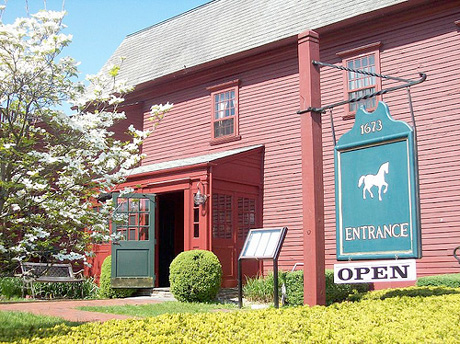
white-horse-ri
Arguably America’s oldest bar, the White Horse Tavern in Newport, Rhode Island.

The following are also contenders, but for one reason or another it isn’t clear if they were originally bars. They’re old, but they weren’t necessarily bars from their beginning or at a remote enough date in the past to make the list above.

  • The Pirates House; Savannah, GA (1753)
  • Napoleon House; New Orleans, LA (1797)

Also, the Green Dragon in Boston, MA opened in 1654 so presumably might be considered the oldest. In 1764, the St. Andrews Lodge of Freemasons bought the tavern. Unfortunately, the original location on Union Street was demolished in 1854. Its present location at 11 Marshall Street was built at a later date, but I can’t find out exactly when. It’s certainly old, but probably not more than 100 years, if that.

UPDATES: Karsen Luthi sent me information about the Genoa Bar in Nevada (thanks, Karsen).

Filed Under: Just For Fun, Related Pleasures Tagged With: History, Pubs

Brookston Beer Bulletin Fantasy Football Season 2008

August 18, 2008 By Jay Brooks

I tried this last year and it seemed to work out pretty well. I think everyone involved had a good time so we’re back again this year with some fantasy football.

NFL Football is pretty much the only major sport I pay much attention to these days. Of the arguably four major sports (baseball, football, basketball and ice hockey) it’s the only one I think that goes well with craft beer. Hear me out. I know you can get decent beer at most sporting events if you’re willing to pay a premium price and do some extensive searching around the park, stadium or whatever. But baseball is played in the summer months and both basketball and hockey are indoor sports so all three tend to favor warm weather light beers, the kind made in vats the size of Montana. Football, on the other hand, is usually played outdoors in the dead of fall or winter, in rain, sleet or snow, with the wind whipping through the frozen tundra turning everyone into human Popsicles. That’s the perfect time for a nice warming barleywine, doppelbock or Belgian tripel. Or perhaps a thick Imperial Russian Stout, an über hoppy Double IPA or even a nice Wee Heavy. Now those are football beers. Yum.

Despite having grown up in Pennsylvania, I’ve been a Green Bay fan my entire life. But after the Lombardi years, the Packers went through a twenty year drought that made my enthusiasm for the game pretty hard to sustain. It’s hard to keep rooting for a team that never wins, especially when all your friends are 49ers fans, it’s the Montana/Young era and they rub it in your face at every opportunity. But finally in the early nineties, Brett Favre joined the team and they finally started winning again. And ever since it’s been fun again to follow football. This year, with Favre at the New York Jets, I’ll have two teams to root for, though if they play Green Bay it’s no contest: Go Pack!

So I’ve set up two free Yahoo fantasy football games, one a simple pick ’em game and the other a survival pool, and you’re invited to play along. Up to 50 people can play each game, so if you’re a regular Bulletin reader feel free to sign up. It’s free to play, all you need is a Yahoo ID, which is also free. Below is a description of each game and the details on how to play.


Pro Football Pick’em

In this Pick’em game, just pick the winner for every game each week, with no spread, and let’s see who gets the most correct throughout the season. All that’s at stake is bragging rights, but it’s fun.

In order to join the group, just go to Pro Football Pick’em, click the “Sign Up” button (or “Create or Join Group” if you are a returning user). From there, follow the path to join an existing private group and when prompted, enter the following information…

Group ID#: 29057 (Beer Bulletin Pick’Em)
Password: bulletin


Survival Football

If picking all sixteen football game every week seems like too much, then Survival Football is for you. In Survival Football, you only have to pick one game each week. The only catch is you can’t pick the same team to win more than once all season. And you better be sure about each game you pick because if you’re wrong, you’re out for the season. Last man standing wins.

In order to join the group, just go to Survival Football, click the “Sign Up” button and choose to “Join an Existing Group”, then “Join a Private Group”. Then, when prompted, enter the following information…

Group ID#: 8612 (Beer Bulletin Survival)
Password: bulletin


Filed Under: Just For Fun, Related Pleasures Tagged With: Football, Games, Sports

Happy International Brewers Day

July 18, 2008 By Jay Brooks

ibd-circle100
Today is the first International Brewers Day. If you see a brewer today, remember to give him or her a hug. Or you could just buy him a beer or drink a toast to her honor, if that’s more your style. I’ve heard from people as far away and as far afield as New Zealand, Australia and Lithuania that are hosting IBD events today.

And hopefully, bloggers and beer writers will likewise take up the cause and write something today about a favorite brewer. If you haven’t already written me to tell me about your participation, please leave a comment here or at the International Brewers Day website. Or if you prefer, just send me an e-mail. Please give me the specific URL or address to your post about a brewer, or, if it’s event, give me the details (or even better send photos of the event and I’ll post them on the IBD website).

As it happens, I’ll be away until Sunday, so in reality you have through the weekend to write something about a brewer. As soon as I get back I’ll start posting links, photos and information about how everybody’s been celebrating the first International Brewers Day.

Filed Under: Events, Just For Fun, Related Pleasures Tagged With: Holidays

Brewers Day Profile: Brian Hunt

July 18, 2008 By Jay Brooks

moonlight
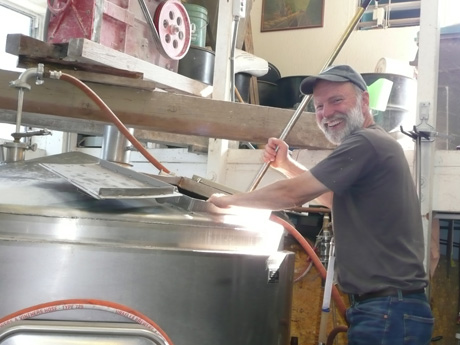
Shortly after I launched the website for International Brewers Day, I got an appropriately curmudgeonly comment disdaining the idea from my friend Brian Hunt, who owns Moonlight Brewing. Here’s what he had to say.

Let’s all just make good beer and drink it. The Brewer’s Association will log acres of forests for special posters and mailings. I can see Hallmark jumping on this one big time, and before long you’ll have to wade through all the K-Mart “holiday” ads looking for that right something for the brewers in your life. I vote no on this.

While hardly shy, I think having worked in the moonlight for so many years has made Brian shy away from the limelight. That alone made him the perfect choice for my first IBD profile. He is, to my mind, one of the truly unsung heroes of brewing, quietly making some of the nation’s best beers.

And happily I’m not the only one. In an article entitled Czech Mate, published in Forbes, the author reveals that of all the beers rated on Beer Advocate, Moonlight’s Reality Czech is the only golden lager on their list of the “Top Beers on Planet Earth.” Unfazed, Hunt explains.

“We have almost no concept in this country that we can have a beer that is light but also flavorful and vibrant,” explains Brian Hunt, Moonlight Brewing’s owner (and sole employee). “Making a great lager like that requires more time, more skill and more expense than making an ale.”

moonlight-ibd2

Brian Hunt was, of course, born in a log cabin near Sacramento, and walked ten miles to school, uphill — both ways — through blizzards in winter and punishing heat in summer. Alright, everything in that last sentence, except Sacramento, I made up. But Brian’s past just cries out to be remade as mythic fable.

ibd-vertical-red-grunge

Brian started college at U.C. San Diego as a biochemistry major, but soon realized that most of his fellow students were pre-med, a path he decidedly was not interested in pursuing. So he transferred to U.C. Davis to study fermentation sciences with an eye toward becoming a winemaker. But fate stepped in when he was randomly assigned Michael Lewis as his advisor. Needing income, he found himself working in Lewis’ laboratory and found it was easy to be persuaded to concentrate on beer instead of wine. He found his fellow brewing students much closer to his own temperament, more down to earth and fun. “Beer just seemed more enjoyable.” Hunt remarked.

After graduating with a degree in Fermentation Sciences in 1980, Hunt relocated to the heart of early brewing — Milwaukee, Wisconsin — to take a job at the Schlitz Brewery. He loved the history of the place. Everywhere you looked it was there. Hunt spent about eighteen months working for Schlitz. There were no computers in the place. Every step they took was done manually, so you learned the reason why you did certain things, and you could extrapolate those to subsequent steps, too. As a result, he learned a lot in that year and a half, crediting that experience with setting the tone for the rest of his career.

He moved back to California in 1981, brewing at the now long gone Berkeley Brewing Co., making ales and lagers on a 40-bbl system. After that venture went belly-up, he consulted on several brewing projects throughout the Bay Area, before ending up at Acme Brewing in Santa Rosa, California in 1985. He was there two years, but the brewery never had much of a chance owing to financial issues that the owners had not anticipated. The majestic 100-bbl brewhouse finally made its first batch of beer on March 2, 1987, but it was too late. Hunt says of his time there that it was a great MBA project and he learned most of what he needed (whether he wanted to or not) about the business side of the brewing industry.

When the Santa Rosa brewery finally shuttered its doors, Brian spent some time working for the other team at Grgich Hills Winery before a brief stint formulating two beers (whose recipes have since changed) and helping layout the brewery itself at the early Anderson Valley Brewing Co. in Boonville.

In 1988, Brian finally opened his own place in Napa with a descendant of the Hamms brewing family. He had a 1/3-share of Willett’s Brewing Co. (now Downtown Joe’s) from sweat equity and $1,100 of his own money. But by 1992, a get-rich-quick lawsuit brought by one of the brewpub’s employees forced Willett’s into bankruptcy. Brian Hunt saw the writing on the wall, and when someone phoned him to offer 100 Hoff-Stevens kegs, he bought them for himself and began … well, moonlighting.

moonlight-ibd3

The original Moonlight brewery was built in a barn behind the house he was renting. He built the entire system himself using equipment cobbled together from a variety of sources. Brian bought old kettles from a winery that couldn’t boil water, and so had to be adapted. Quite a number of items from Sierra-Nevada’s yard sale (when they opened their own larger brewery in Chico) found their way into Moonlight’s brewery barn, including fermenters and a keg washer. The whole enterprise was financed with credit cards and a $20,000 personal loan. The initial brewhouse included a 7-bbl system.

The original name was going to be Old Barn Brewery, but it never sounded quite right. New Moon Brewing was also an early contender of the hundreds of names that were brainstormed. But once the name Moonlight was floated, there was no turning back. It just worked on so many levels and it seemed to mean different thing to different people, a quality Hunt relished.

For the first two-and-a-half years, beginning in 1992, Brian literally slept 5-1/2 nights out of every seven. He was working two jobs, one at the newly opened Downtown Joe’s (where the bankrupt Willett’s brewpub had been) and at his own place in the barn. This continued until he could afford to concentrate just on Moonlight Brewing. But just a few years into the new venture, another monkey wrench was thrown Hunt’s way. His landlord decided he wanted the house Hunt and his family lived in for his own son and told Brian they had to go. Luckily, they let him keep the brewery in the barn until it could be moved. In 1999, Hunt and his family moved to their present location. It would take another four years until all he permits were in place and the new brewery was built. The new system was 21-bbl and was the original Hart Brewing system, which Brian bought from the Thomas Kemper brewery on Bainbridge Island in Washington. The present set-up has pieces from at least fifty different breweries, either ones that went out of business or upgraded.

stained-hops

Neither the original brewery now the new one has a computer of any kind in it, and that’s by design. It’s because of one of Hunt’s favorite quotes, this one by Albert Einstein. “Imagination is more important than knowledge.” Hunt sees one of the most important aspects of brewing as creativity and thinks of himself more as a tinkerer or toymaker of sorts. And, as he puts it, “you can’t see what’s happening if you’re just pushing buttons.” He believes that many young brewers don’t understand how to make “delicious” because of what he terms “a failure of imagination.” This is because, he says, “many are not taught how to think for themselves.

moonlight-ibd1

The first three beers Moonlight brewed are all still being made: Lunatic Lager, Death & Taxes, and Twist of Fate. Lunatic Lager’s original name, though, was Moonlight Pale Lager, so named because Hunt thought it would translate better to consumers already aware of the newly popular pale ales. The fourth beer Hunt made was Bombay by Boat IPA, also in 1992, and it was one of the first IPAs made in America. At that time, nobody really made one and certainly those few who did, did not call it an IPA.

moonlight-ibd4

Hunt believes that being small also allows him a flexibility that bigger breweries can only dream about. He can follow market trends and turn on a dime. Because he not only brews the beer, but also delivers it (he’s a one man operation, most of the time) he’s not removed from his customer but mingles and converses with them almost every day of the week.

His original plan was to hope that he could make a living in Sonoma selling whatever he brewed. Though his net is spread slightly wider than he originally thought, it’s not by much, and he’s remained true to initial vision. “I don’t find success by selling a lot, I find it by selling to people who respect it or appreciate it.” So long as that’s the case, we won’t be seeing Moonlight beer in grocery stores nationwide or even bottle locally. Brian’s just not looking for that kind of success. He’s content doing what he wants in his own way, an iconoclast to the end. As you’d expect, Hunt also doesn’t think much of competitions either. “Fame is empty.” He says. “Good beer should not be.” So while that may be a loss for the people who can’t find Moonlight beer in their neighborhood, it does make the Bay Area just that much more of special place for beer and provides yet another reason for beer fans around the world to make the pilgrimage to taste California beer.

moonlight-ibd5

Or put another way — as his pint glasses used to read — “good beer is as good beer does.”

Filed Under: Breweries, Just For Fun, News, Related Pleasures Tagged With: California, Interview, Northern California

More Beer Cake

July 11, 2008 By Jay Brooks

cake
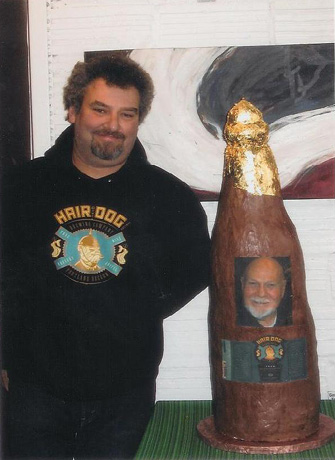
Alan Sprints, who owns the wonderful Hair of the Dog Brewery in Portland, Oregon, was inspired by the recently posted beer cake recipe to share his mother’s amazing beer cake, which she made for FredFest. According to Alan, “it [was] not made with Beer, but it tasted great with Beer.” Although there’s no recipe, he did share the secret of its construction. “It was made out of 20 chocolate and lemon cakes stacked over a wooden dowel.” Yum. Thanks, Alan.

fredfest-cake

Filed Under: Beers, Food & Beer, Just For Fun Tagged With: Food, Portland

Sam Calagione Uncorked

June 20, 2008 By Jay Brooks

dogfish-head-green
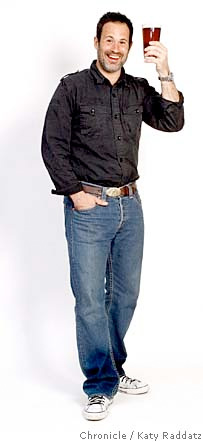
My “Uncorked” interview with Sam Calagione, from the Dogfish Head Brewery, is in today’s San Francisco Chronicle. I’m quite pleased with how it turned out. If you’re unfamiliar with the Uncorked series in the San Francisco Chronicle, they’ve been doing them for some time now, and it’s an interview that begins with some expository background information. They’re meant to be fun and a little thought provoking, with at least a few quirky, off-the-wall questions thrown in for good measure. I read a number of them in preparing my own questions, so I could get the tone right. So when I came up with my questions for Sam, I figured ask far more than I needed so that I could pick and choose the best ones. Sam, of course, is no stranger to public speaking and so made the process much easier. The hard part was choosing what to include and what to leave out. So here are a few more questions and answers from the original interview that I didn’t have the room to include in the Chronicle article.

sam-chron

What’s your favorite style of beer for spring?

I would have to say, just IPA. In general, whether it’s a big imperial IPA or a regular one. Those grassy, fruity, estery characters of an IPA remind me of the greening of the trees and the greening of the grass and just nature coming back to life.

Why should everybody in America be drinking craft beer?

Because Americans are starting to trade up and appreciate the finer things and recognizing that instead of a soul-killing SUV or vacation house, that they can spend $10 and get the world’s best beer. The craft beer renaissance is truly an affordable connoisseurship and compared to wine, where the world’s best bottles are going to cost hundreds, if not thousands, of dollars, anybody in America can buy the world’s best beers. And because every American lives within ten miles of their local brewery, it’s not only an affordable connoisseurship but it’s an accessible world, too.

As an Italian-American, what do you think of the recent Italian beer renaissance?

It’s beautiful. It’s just indicative of a culture that embraces the finer things, whether it’s wine, beer or culinary. They got their priorities right over there. It’s about living well and spending time with loved ones and friends around a table full of great food and drink. I think it’s a wonderful sign of the craft brewing renaissance to watch it landing in other cultures that had traditionally been more associated with wine.

Why Did You Choose Delaware?

To be perfectly honest, by the time I got my shit together and raised the money I needed to start it, there were only eight states left in America that didn’t have a brewery. And I thought it would be great marketing cache to be the first brewery in a state and the first brewery in the first state sounded good. My wife, Mariah, who runs the company with me was born and raised in Delaware. So I’d go down and visit her in the summer, and living right on the Atlantic beach seemed pretty cool. I love it, we’re two hours from D.C., Baltimore and Philly, and it’s a great place to live and have a brewery.

What is a Randall?

A Randall is an organicalyptic hop-inducing module. Basically it was an invention we came up with for an east coast vs. west coast beer event, where Russian River Brewing, and some others, brought their beers and at the end of the day the east coast brewers beat the west coast brewers for the best hoppy beers in the country. We’ve now made 300 Randalls, and they’re being used in breweries all around the world. Basically, it’s a glorified, customized pool filter that we load with whole leaf hops and the beer acts as a solvent and strips the oils off the hop leaves and pour them in your glass. It’s just a great tool to educate the consumer on what hops does to beer. Not many consumers see hops changing their beer at the point where they’re actually drinking it, so it’s been a neat educational tool for us.

Do you take a certain pride when brewer’s say about their own beers, “No Randall Required?”

I actually do. Basically, to me, it sounds like insecurity, like maybe they should start thinking about using a Randall.

You’ve done a couple of Rap CDs, the Pain Relievez, with your head brewer Bryan Selders, and on a few songs you taunt West Coast brewers. Are you worried about any reprisals while you’re in town, on their turf, so to speak?

I hope they don’t Tupac my Biggie. It’s all done in good fun and we love those guys. But boy, I hope they bring out a response album, but I don’t think they have the guts or the rhythm.

What did you drink last night?

About 10-12 beers, to be perfectly honest. I was with my good friends that own breweries from around the country and we collectively brewed this gueuze-style beer called Isabelle Proximus. So we ended the night with that, but we enjoyed each others’ beers in all the courses that led up to that. That project is indicative of how altruistic and mutually supportive the craft brewing industry is. It’s an amazingly unique community where we teach each other what we know for the greater good and try and help each other, recognizing that collectively 1450 breweries in America have less than a 5 percent share and three giant ones have over an 80 percent share, but the craft beer [segment] is where the growth is at and it shows that the consumer now understands and appreciates what the small breweries in America are doing.
 
The rest of the interview can be read in today’s San Francisco Chronicle (page F-3) or online at SFGate.com.

Filed Under: Breweries, Just For Fun Tagged With: Delaware, Interview

« Previous Page
Next Page »

Find Something

Northern California Breweries

Please consider purchasing my latest book, California Breweries North, available from Amazon, or ask for it at your local bookstore.

Recent Comments

  • Bob Paolino on Beer Birthday: Grant Johnston
  • Gambrinus on Historic Beer Birthday: A.J. Houghton
  • Ernie Dewing on Historic Beer Birthday: Charles William Bergner 
  • Steve 'Pudgy' De Rose on Historic Beer Birthday: Jacob Schmidt
  • Jay Brooks on Beer Birthday: Bill Owens

Recent Posts

  • Beer In Ads #5392: Anheuser-Busch Bock Beer November 14, 2026
  • Historic Beer Birthday: William IV, Duke of Bavaria November 13, 2026
  • Historic Beer Birthday: Hans Johann Claussen November 13, 2026
  • Historic Beer Birthday: Abram Nash November 13, 2026
  • Beer Birthday: Don Russell November 13, 2026

BBB Archives

Feedback

Head Quarter
This site is hosted and maintained by H25Q.dev. Any questions or comments for the webmaster can be directed here.