Brookston Beer Bulletin

Jay R. Brooks on Beer

  • Home
  • About
  • Editorial
  • Birthdays
  • Art & Beer

Socialize

  • Dribbble
  • Email
  • Facebook
  • Flickr
  • GitHub
  • Instagram
  • LinkedIn
  • Pinterest
  • RSS
  • Twitter
  • YouTube

Powered by Genesis

Thoughts On The New Dietary Guidelines From Beer Business Daily

February 3, 2011 By Jay Brooks

spirits-wine-beer
You most likely hard that the USDA released the quinquennial Dietary Guidelines for Americans at the end of last month. The 2010 version made a number of small, but significant changes with regard to food, such as “make half your plate fruits and vegetables” and “drink water instead of sugary drinks.”

In Chapter 3, they also made one small change to how they define an “alcoholic drink.”
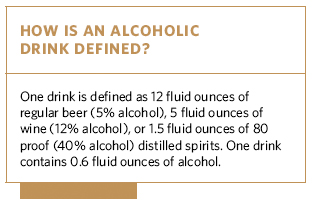
alcohol-defined

Harry Schuhmacher commented on the guidelines in today’s Beer Business Daily newsletter. With Harry’s permission, below I’ve reprinted his thoughts on the Dietary Guidelines and specifically the changes to the alcohol portion of them:

Earlier this week the USDA issued its 2010 Dietary Guidelines as it does every 5 years. It states: “One drink is defined as 12 fluid ounces of regular beer (5% alcohol), 5 fluid ounces of wine (12% alcohol), or 1.5 fluid ounces of 80 proof (40% alcohol) distilled spirits. One drink contains 0.6 fluid ounces of alcohol.”

Now, you’d think this maybe isn’t a big deal. Well, you’d be wrong on that. It is.

Here’s why: The previous USDA Dietary Guidelines five years ago had very similar language, although it was fought tooth and nail by the beer and wine lobbies. However, this time the feds added the crucial last sentence: “One drink contains 0.6 fluid ounces of alcohol.” [Emphasis added.]

This further puts the Feds on record as saying, basically, a drink is a drink is a drink, even though we all know in reality that’s not the case. You can be sure that Diageo and DISCUS — the spirits lobby — worked with a laser focus to get this sentence added. It’s the next step toward alcohol equivalency (for excise tax, labeling, and consumer access issues), even though Diageo and DISCUS have previously said this is not what they’re after.

LABELING: First let’s consider labeling. As we know, the federal TTB is considering (since 2003) allowing alcohol producers to include voluntarily display serving facts (which includes standard alcohol content for servings) on labels. This is an issue that large distillers support, but brewers and wineries typically oppose because some believe the push for serving facts is a stalking horse for equivalency.

INDUSTRY SPLIT ON STANDARD DRINK: The Wine Institute and DISCUS are on the same side of most issues, such as opposing the CARE Act, but standard drink isn’t one of them.

DISCUS followed the release of the Guidelines with a statement. “The Government today emphasized the scientific fact that a standard drink of beer, wine and distilled spirits each contains the same amount of alcohol,” said Dr. Monica Gourovitch, Distilled Spirits Council’s svp of scientific affairs. “Alcohol is alcohol and it all should be treated equally, as a matter of public health and public policy.”

Monica told our sister publication, WSD, that the updated definition is “very clear” and shows that “each standard drink contains the same amount of alcohol.” When looking at the science involved, each serving has the “same effect on the body — potential benefits and potential risks.” She also noted that the National Institute on Alcohol Abuse and Alcoholism (NIAAA) already defines a standard alcoholic drink as anything containing 0.6 fluid ounces.

Wait ….. 0.6 fluid ounces of alcohol? Not 0.5 fluid ounces? There are plenty of public health folks who defined drinks as having 0.5 fluid ounces of alcohol as a standard drink. Who, I wonder, lobbied the USDA to add that extra 0.1 fluid ounce to the definition?

The Wine Institute, for one, is livid. For once they are on the other side of DISCUS on an issue. The WI issued a statement on Tuesday, saying there is no such thing as a standard drink: “We agree with the time-tested definition of a serving as being 12 fl. oz. of regular beer, 5 fl. oz. of wine, or 1.5 fl. oz. of 80-proof distilled spirits but are concerned about the additional statement that each of the drinks contains the same amount of alcohol. A precise fluid-ounces-of-alcohol statement implies that the alcohol content is the same for every drink of wine, beer or distilled spirits when, in reality, alcohol content varies widely from drink to drink. Consumers should not be misled into believing there is such a thing as a ‘standard drink.’ In fact, the term ‘standard drink’ does not appear in the Dietary Guidelines.” This is true. But it doesn’t dull the fact that a federal agency has swallowed the equivalency argument hook, line and sinker while the rest of the industry sleeps.

The Beer Institute and the NBWA have remained mute on this issue, so far. But clearly it is important: As one alcohol politico told me: “Once the language is in a federal government guideline, it’s in the bloodstream.” What he meant by that is that, since the USDA has defined a drink as 0.6 ounces of alcohol, it gives the TTB cover to move forward with their “serving facts” labeling, and maybe it gives the states the argument to increase taxes on beer and wine and offer it at more times and in more channels, and maybe it gives the feds something to point to when considering an excise tax increase. It’s a slippery slope, my friends, toward equalization of taxes and access among the beverages, which works against beer and wine and is probably just bad public policy. In fact, if alcohol excise taxes were suddenly equivalent, it would virtually kill the wine and beer industries, and we’d be a nation of vodka swillers like Russia, wiping away 200+ years of cultural and policy differences between the beverages. It was Thomas Jefferson who logically first put forward the notion that moderation should be nurtured by the government by encouraging the consumption of beer and wine over spirits.

As usual, a distributor put it most succinctly: “So a Four Loko is the same as Jack Daniels is same as Coors Light is same as Mad Dog 20/20 is same as a hot 17% abv California cab is the same as an 11% abv Italian white? Really?”

It brings to mind the old story where August Busch III went to Capitol Hill and demonstrated to a Congressman considering equivalency that a drink is not a drink. He reportedly said, “I’ll drink these three Budweisers, and you drink these three dry martinis, and at the end we’ll see who is more intoxicated.” It’s a shame our beer industry leaders don’t pull more stunts like that.

Ethanol is ethanol, to be sure. But different types of bev-alc are consumed by the majority of Americans in different ways. Ethanol is ethanol, but a drink is not a drink.

Thanks Harry. If you don’t know about his Beer Business Daily, especially if you’re in the beer business, I highly recommend it. You really should subscribe to Harry’s newsletter.

Filed Under: Beers, Editorial, Food & Beer, Politics & Law, Related Pleasures Tagged With: Government, Guest Posts, Science

Rumors Of An Anheuser-Busch InBev & SABMiller Merger?

February 2, 2011 By Jay Brooks

abib sabmiller
Wow. This rumor is just mind-boggling. It makes the hairs on the back of my neck stand up. But could it be true? According to Harry Schuhmacher at Beer Business Daily, it’s not only being discussed but is considered “likely and lucrative.” Harry’s quoting analysts at Credit Suisse who believe “‘SABMiller selling to ABI would provide SAB management and shareholders an obvious and desirable exit strategy for all involved. The idea of a merger we believe could be sold to both sets of shareholders’ even though ‘this would be a large deal with many moving parts.'” Apparently there’s not much overlap between the two behemoths globally, but in the U.S. it would be more of an issue, with the two companies combining for around 80% of the domestic beer market. That, I imagine, would raise big anti-trust concerns and would loom large in the closing of the deal, which would also most likely lead to massive distributor consolidation. The price being thrown around is somewhere in the $9-10 billion range.

Obviously, there’s a lot more details to be worked out, and many of them are already addressed in the Beer Business Daily piece, which looks at pros and cons for both sides, and likely resolutions of certain issues both companies face. It’s not as far-fetched as you might think on first blush. To read the rest of it, I highly recommend a subscription to Harry’s newsletter.

When Anheuser-Busch and InBev merged, I remember someone joking that eventually there would be just one international beer company and it would just be called “Beer.” I chuckled at the time, but maybe they were on to something. Stay tuned, it’s going to be a bumpy ride.

Filed Under: Breweries, Editorial, News Tagged With: Big Brewers, Business, Rumors

When Zero Tolerance Makes Zero Sense

February 1, 2011 By Jay Brooks

cheerleader
There was a little item in the Brickbats section of Reason magazine for February about a high school cheerleader in Ohio who was suspended for two games. Why, you may ask? Because school officials found a photo of her on Facebook holding a beer at a family wedding. According to her own Mother, she wasn’t drinking it, just holding it. No matter, her school insists that even holding a bottle of beer violates their no-alcohol policy.

Where to begin? All by itself, it’s a rather absurd and silly incident, but what it represents is, I believe, much larger. It’s a little sad that school officials, with all the budget cuts schools are facing, even have time and the inclination to troll Facebook looking for school policy violations. But if it was at a family wedding, not a kegger, and her Mom was okay with whatever was going on (holding it for another adult?) and assures us nothing sinister was occurring, frankly that should have been the end of it. It should matter that it wasn’t even on school property, at a private, family event but believe it or not courts have actually ruled that schools can regulate a student’s behavior outside of school, which as a parent I find both frightening and infuriating. That’s not their job, it’s my job. Period. Education is their job.

But that’s the sort of nonsense zero tolerance causes. It ignores circumstances and common sense, creating results that have little to do with the spirit of the policy. It punishes the innocent indiscriminately, which could even lead to issues with authority for the students on the receiving end of such unjust treatment. Is that really the lesson we want to teach our children? Follow the letter of the law no matter how ridiculous or suffer the consequences. Don’t think for yourself or interpret, just obediently do what you’re told. No exceptions.

In theory, such a policy would mean I can’t ask my son to help carry groceries if one of the bags contain alcohol. (Or for my brethren in less fortunate states, where even beer in grocery stores is too dangerous and not permitted, how about carrying the beer from the state store or beer distributor.) Is that rational? Does it serve some higher purpose of education? Or does it further the demonization of alcohol and our already irrational fear of it? And what does it say about who controls our own children, when a school can override a parent’s choice of discipline. Parents have the ultimate responsibility for their child’s upbringing and welfare, but the school has the final say?

But there’s obviously nothing rational about alcohol in our society, as this incident so clearly reveals. Whenever it’s about beer, you can be sure decades of one-sided propaganda will create absurdist zero tolerance laws and policies that makes sense only to Franz Kafka.

Filed Under: Beers, Editorial, News, Politics & Law Tagged With: Law, Prohibitionists

The United States Of Beer?

January 31, 2011 By Jay Brooks

us-outline
This is a weird one. The Houston Press’ Brew Blog did a map showing soft drinks from each state in a post last week called the United States of Soft Drinks. Due to popular demand, they did a new one this week, tackling beer in another post entitled the United States of Beer. After a decidedly unfunny “alcoholics” joke, they apparently “hunkered down all weekend, doing the kind of brutal and difficult work that it takes to determine a fitting beer for every last one of our 50 states.” They’re not all bad choices. I might have chosen Anchor (for its history) or Sierra Nevada (for its size) in California, but Stone Brewing isn’t a bad pick. I imagine many could quibble with the choices of at least some of the other states, too.

map

But a few others are just embarrassing. Four Loko for Nevada? First of all, it’s not much of a beer, though technically a malt-based beverage and taxed as a beer, certainly it’s not marketed as a beer, and it was recently banned anyway. At any rate, Four Loko was made by Phusion Projects of Chicago, Illinois d.b.a. Drink Four Brewing Company. Then there’s the Epic Pale Ale they show for Utah. That Epic is a beer from … New Zealand. There is an Epic Brewing from Salt Lake City, but their Pale Ale is called Capt’n Crompton’s Pale Ale.

While Budweiser is certainly appropriate for Missouri, there’s an Anheuser-Busch family beer for Kentucky, South Dakota and West Virginia. And while ABI does operate a dozen breweries around the country, none are in those three states. Similarly Miller makes sense in Wisconsin, but there are also MillerCoors beers for Alabama, Florida and North Dakota. And again, MillerCoors does have ten breweries in as many states, but none are located in the three states listed on the map. Pabst Blue Ribbon is listed for Virginia. Pabst, of course, owns no breweries and, as far as I know, doesn’t brew their beer in Virginia. Their headquarters are in Illinois, although the Pabst website lists their home at the bottom of the page as Milwaukee, Wisconsin and the contact page takes you to San Antonio, Texas.

The post details some of what they refer to as the “logic” employed for some of their choices, but I’m not entirely certain logic was in fact used. What do you think of their choices?

You can see the map full size here, and it’s easier to read the key on the bigger map.

Filed Under: Beers, Breweries, Editorial, Just For Fun Tagged With: Texas, United States

Christianity & Beer: Another Point Of View

January 25, 2011 By Jay Brooks

jesus-drinks-beer
My friend and colleague, Rick Sellers, who writes at Pacific Brew News, published a thoughtful piece entitled Christianity & Drinking — Why Not?. Sellers is no stranger to religion, and in fact has “a degree in Biblical Studies” and even worked briefly as a pastor. It’s definitely worth a read.

Filed Under: Beers, Editorial, Related Pleasures Tagged With: Religion & Beer

ABI To Include Stella Artois In Super Bowl Ads

January 21, 2011 By Jay Brooks

stella-artois
Anheuser-Busch traditionally pulls out all the tops for the Super Bowl, one of the most-watched television events of the year, especially for their core demographic. And that looks to be true for this year’s game, as well. But according to a report from Advertising Age yesterday, they’ll be trying something new this year.

The biggest overall change is that “instead of running nine ads for a total of five minutes, as it did last year, A-B will air five ads that run over three-and-a-half minutes.” The ads themselves will be similar to past efforts. But 2011 will mark the first time they’ve deviated from their core brands of Budweiser and Bud Light. One of their spots, a 60-second ad, will be for the uninspired Belgian lager Stella Artois under the banner of a new campaign, “She is a thing of beauty.”

I’m fairly certain this isn’t the ad they’ll be running, but this one was supposedly directed by Wes Anderson and Sophia Coppola.

Despite the Marin Institute’s incessant complaining about alcohol advertising during the Super Bowl — oh, the horror, why won’t anyone think of the kiddies? — of the 28 planned advertisers, only one is an alcohol producer, Anheuser-Busch InBev. So not only are they misplaced about who watches the Super Bowl, but seeing as a mere 3.5% — exactly one — of the advertisers are alcohol producers it hardly seems worth all the hue and cry they’ve raised. Of the 3-4 hours of the game, just 3-1/2 minutes are taken up by beer ads, representing less than 2% to under 1.5%, depending on how long the game ultimately runs. Even at that, it assumes anyone watching would be glued the set the entire time, a dubious proposition at best, especially applied to children. But the Marin Institute won’t be happy until they’ve “freed the bowl” from even those three and half minutes.

Personally, I’m looking forward to this year’s Super Bowl, especially if my beloved Packers manage to win on Sunday. It’s been more then a decade since I’ve actually cared about who wins the game, it would sure be nice to have someone to root for this year.

Filed Under: Beers, Breweries, Editorial, News Tagged With: Advertising, Anheuser-Busch InBev, Big Brewers, Sports

“How Beer Saved The World” To Be Revealed January 30

January 21, 2011 By Jay Brooks

earthday
The documentary that the Discovery Channel was rumored to be working on, How Beer Saved the World, is now scheduled to air on Sunday, January 30 at 8:00 p.m. Pacific time. The trailer is a bit overwrought, but they appear to have some good people being interviewed on camera, such as Charlie Bamforth and Gregg Smith. This should be interesting.

If you want a good laugh, check out the ignorant comments on the YouTube page for this trailer. Their hilarity is only matched by their inanity. It’s certainly amazing how effective anti-alcohol propaganda is as evidenced by some of the nonsense being spouted. It’s also funny, and a little sad, to see the contrast between beer people, who can readily admit that there are some people who abuse alcohol and cause problems for themselves and others, and neo-prohibitionists who cannot bring themselves to concede that alcohol has any positive aspects to it whatsoever.

Filed Under: Beers, Editorial, Events, News Tagged With: Announcements, History, Television, Video

John Stuart Mill On “Sin Taxes” & Prohibition

January 18, 2011 By Jay Brooks

philosophy
The British philosopher John Stuart Mill was, besides being “particularly ill” on “half a pint of shandy,” a big proponent of the concept of free will, as the song says. In his book On Liberty, he also argues in favor free speech and, 150 years ago, was against minimum alcohol pricing as if it were today, which is why I bring it up.

In today’s UK newspaper, The Telegraph, British writer Brendan O’Neill argues convincingly against minimum pricing on alcohol in a piece entitled ‘Minimum alcohol pricing’ is a Sin Tax designed to punish poor people for the crime of getting hammered.

The British government has been discussing minimum alcohol pricing for a number of years as a way of stopping binge drinking, defined as uselessly there as here. O’Neill sees it rather differently, as “an assault on a certain kind of boozing, the kind indulged by the less well-off who prefer to drink lager or cider and let their hair down rather than quaff chardonnay and discuss Tunisia. The very term “binge drinking” — and bear in mind that, for a man, binge drinking means downing a paltry four pints in a night — is designed to conjure up images of the non-wine-drinking classes, who swig on bottles of beer with no sense of control or decorum; who scoff and down and binge rather than sip. Them, not Us.”

And that brings us back around to John Stuart Mill. I hadn’t seen these quotes before, but they’re brilliant. In On Liberty, he addressed this very issue by calling such price hikes a de facto “sin tax” because, then as now, it’s a regressive tax that punishes the poor for not behaving as some people might want them to.

Here’s what he wrote:

“Every increase of cost is a prohibition, to those whose means do not come up to the augmented price.”

And:

“To tax stimulants for the sole purpose of making them more difficult to be obtained is a measure differing only in degree from their entire prohibition, and would be justifiable only if that were justifiable.”

As O’Neill concludes, that’s simply “prohibition through the backdoor, targeted at those whom the political classes consider to be reckless and self-destructive.” On this side of the pond, it’s all that moralizing plus anti-alcohol groups trying to convince us it’s about safety and “the children” and saying that raising the price will fix all our problems, and the economy to boot. Problem is, it never works. It’s just another attempt at Prohibition. Prohibition Lite, perhaps, but the aims are the same.

Filed Under: Editorial, Just For Fun, News, Politics & Law Tagged With: Philosophy, Prohibitionists, UK

The Results Of Targeting Alcohol?

January 16, 2011 By Jay Brooks

target-alcohol
There’s a debate going right now about whether images and rhetoric that are extreme and potentially violent in nature can be responsible for actions taken by the people who view them. Obviously, the recent tragedy in Tuscon, Arizona is what sparked this debate, but it’s nothing new. Some people who are against people having legal access to abortions have painted the physicians who perform them as evil murderers and other people who have heard that message and internalized it have murdered abortion doctors. It’s happened more than once. If you’ve studied semiotics, you understand that at a minimum symbols and signs have power. Almost everything is a sign, both words and symbols, that is they mean something, often different things to different groups of people depending on how they’re framed or used. Dean Rader, in the San Francisco Chronicle, had an interesting piece applying semiotics to the events prior to, and leading up to, the Tuscon incident and assassination attempt in Palin, Crosshairs, and Semiotics: The Signs of the Times.

I bring this up because anti-alcohol and neo-prohibitionist groups have been painting alcohol as a great sin and inherently evil literally for decades. That includes both harmful propaganda and rhetoric along with graphic symbols, such as the banner used by one group showing a bottle of beer as a syringe, attempting to equate beer with heroin. The result of that, I believe, is that the average person does believe that drinking is a “sin” and that people cannot be trusted not to abuse it so therefore it must be highly regulated, taxed, demonized and marginalized. The other thing that such an incessant parade of propaganda might cause is the incident that occurred near Milwaukee, Wisconsin on Friday afternoon.

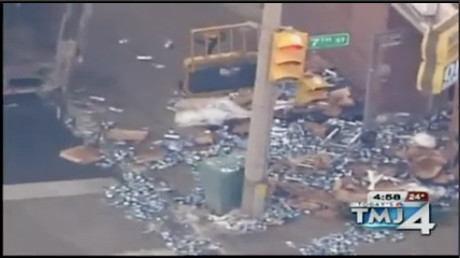
According to the Milwaukee Journal Sentinnel, an unidentified 32-year old man with a metal pipe several feet long and two inches in diameter walked up to a beer delivery truck making its rounds at Mid-Town Groceries and ordered him to stop delivering the beer. When the deliveryman continued doing his job, our wingnut began smashing the beer, and spent about thirty minutes destroying roughly $2,000 worth of beer — possibly Milwaukee’s Best. While he took pipe to beer can — and the intrepid deliveryman tried to get him to stop without getting beaned with a big metal pipe — he ranted about the evils of alcohol, and “scolded the deliverymen for bringing what he called ‘poison’ into his neighborhood.”

beer-terrorism

That’s the same tactic Carry Nation employed, smashing up bars — private property — with a hatchet just because she didn’t like what they were doing. It’s something she was celebrated for, but it’s still vandalism and without trying to sound overly dramatic, terrorism. My OED defines terrorism as “the use of violence and intimidation in the pursuit of political aims” and Merriam-Webster calls it “the systematic use of terror especially as a means of coercion.” Whether wielding a hatchet or a lead pipe, it’s using violence to promote your ideas and get your way.

Where did the Milwaukee man get the idea that beer is “poison” and it was acceptable behavior to smash someone else’s property? To me, that’s a great question we’ll probably never know the answer to, because this story’s not quite big enough news that we’ll likely see a follow-up report. Did these ideas infect him through years of neo-prohibitionist propaganda? Through the subtler, but no less effective, way in which so many take it for granted, thanks to our policies and laws, that drinking is “sinful” and that demonizing it only appropriate? With anti-alcohol propaganda so pervasive it seems quite unlikely to me that he came to this notion on his own. I take it for granted that he is indeed a lone wingnut and no neo-prohibitionist group will claim him as one of their own. But it makes you wonder. Rhetoric and symbols are powerful weapons that can influence just about anything, so why not a violent hatred for alcohol and the people who deliver it?

Filed Under: Editorial, Events, News, Politics & Law Tagged With: Prohibitionists

Our Kids Ain’t Learning Too Good

January 12, 2011 By Jay Brooks

Marin-I
Did you know that words can have more than one meaning? Pretty elementary stuff, you’d think. Unless, of course, you can use ignorance to create propaganda for your cause. This one might be funny, if it wasn’t presented so seriously. I can almost understand that the kids of Roseburg, Oregon might be confused, but their parents and the Marin Institute should feel at least a little embarrassed.

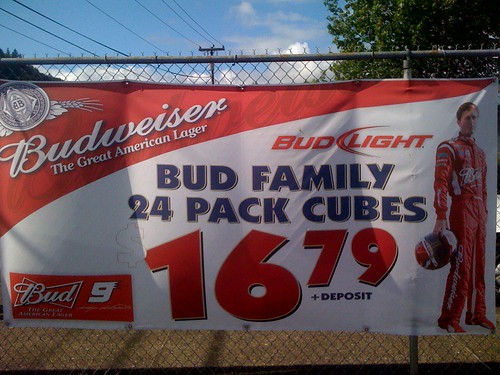
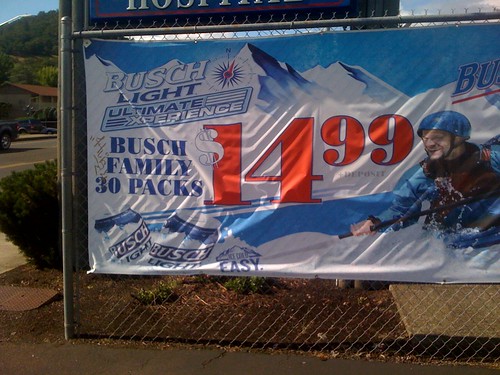
Here’s what happened. The Marin Institute today accused Anheuser-Busch InBev of targeting families by advertising “Family Packs” of beer for sale around the town of Roseburg. A youth group there, apparently confused, sent photos of the ads to the Marin Institute who promptly went on the attack.

Bud-Family

Here’s some of the rhetoric inspired by these ads:

“We knew that the Anheuser-Busch InBev marketing team was willing to stoop low, but this time they’ve really outdone themselves.”

“Cheaper than Capri Sun, it makes a perfect addition to a brownbag lunch for preschoolers and teenagers alike!”

Busch-Family

And here’s the final volley:

How does Anheuser-Busch InBev think they can get away with this? Maybe they figure if they keep it in local communities, next to your kids’ school (as opposed to say, on national TV during the Super Bowl), they won’t get caught. All the while, of course, proclaiming all the wonderful work they do to counter underage drinking with useless educational brochures. Sorry, Bud – you’re not fooling anyone.

Except that ABI isn’t advertising “Family Packs,” they’re advertising “24 Pack Cubes” and “30 Packs” of the “Bud Family” and “Busch Family.” Notice in the Bud ad, the two statements are on separate lines, “Bud Family” on one line, then “24 Pack Cubes” on the second. By “Bud Family,” ABI means the family of products under the “Budweiser label, which are:

The Bud Family

  • Budweiser
  • Bud Light
  • Budweiser Select
  • Bud Light Lime
  • Bud Light Golden Wheat

In the Busch ad, it’s on three lines. In this case, it includes the following beers:

The Busch Family

  • Busch
  • Busch Light
  • Busch Ice

Nobody’s trying to fool anybody. The ads are pretty clear if you know how to read and understand what words mean in context. Somebody really needs to buy the Marin Institute a copy of Eat, Shoots & Leaves. I don’t know the ages of the kids in the local “youth group,” so I can forgive them, but at some point an adult they encountered should have had enough book learning to point this out to them.

As to the fact that they accuse ABI of being “willing to stoop low” and declare “this time they’ve really outdone themselves,” all I can do is shake my head and think — yet again — this is such a perfect example of “the pot calling the [brew] kettle black.”

Filed Under: Breweries, Editorial, News, Politics & Law Tagged With: Oregon, Prohibitionists

« Previous Page
Next Page »

Find Something

Northern California Breweries

Please consider purchasing my latest book, California Breweries North, available from Amazon, or ask for it at your local bookstore.

Recent Comments

  • Bob Paolino on Beer Birthday: Grant Johnston
  • Gambrinus on Historic Beer Birthday: A.J. Houghton
  • Ernie Dewing on Historic Beer Birthday: Charles William Bergner 
  • Steve 'Pudgy' De Rose on Historic Beer Birthday: Jacob Schmidt
  • Jay Brooks on Beer Birthday: Bill Owens

Recent Posts

  • Beer In Ads #5164: Spring’s Almost Here … And Everyone Feels Like A Millions Bocks March 14, 2026
  • Historic Beer Birthday: Anthony J. McGowan March 14, 2026
  • Beer In Ads #5163: It’s Here Genuine New Jersey Bock Beer March 14, 2026
  • Beer In Ads #5162: Bock Beer Time Is Here gain March 13-18 March 13, 2026
  • Beer Birthday: Joe Tucker March 13, 2026

BBB Archives

Feedback

Head Quarter
This site is hosted and maintained by H25Q.dev. Any questions or comments for the webmaster can be directed here.