Brookston Beer Bulletin

Jay R. Brooks on Beer

  • Home
  • About
  • Editorial
  • Birthdays
  • Art & Beer

Socialize

  • Dribbble
  • Email
  • Facebook
  • Flickr
  • GitHub
  • Instagram
  • LinkedIn
  • Pinterest
  • RSS
  • Twitter
  • YouTube

Powered by Genesis

Beer In Art #53: George Morland’s Alehouse Politicians

November 22, 2009 By Jay Brooks

art-beer
Today’s artist comes from the very early days of England’s artistic beginnings. Before the 18th century, there was little that could properly be called “English art.” At that time, most art came from France, Spain, The Netherlands, Germany and a few others. That’s who English painters studied. But that began to change in the mid-1700 with such painters as Thomas Gainsborough, William Turner, John Constable, George Romney, Henry Raeburn and today’s featured painter, George Morland. While others painted portraits and some city life, Morland concentrated on rural life and, naturally, the county inn was often featured in his works. The initial painting that led me to Morland, pictured below, is known as Alehouse Politicians,, most likely painted during the 1790s.

Morland-alehouse_politicians
Like most of Morland’s popular paintings, others made copies of them as engravings to be sold to the public, such as this Mezzotint by W. Ward, published by Wards and Co. in 1801.

morland_alehouse_politicians2 (1)

Plenty more of Morland’s rural paintings depicted inns, such as the Fox Inn, painted in 1792.

Morland-fox_inn

Or The Bell Inn, from the Metropolitan Museum of Art:

Morland-bell_inn-color

Which itself was redone as a black and white engraving:

Morland-bell_inn

From his biography at Wikipedia:

Morland was born in London on 26 June 1763. His mother was a Frenchwoman, who possessed a small independent property of her own. His grandfather, George H. Morland, was a subject painter. Henry Robert Morland (c. 1719 – 1797), father of George, was also an artist and engraver, and picture restorer, at one time a rich man, but later in reduced circumstances. His pictures of Jaundry-maids, reproduced in mezzotint and representing ladies of some importance, were very popular in their time.

The finest of Morland’s pictures were executed between 1790 and 1794, and amongst them his picture of the inside of a stable, in Tate Britain, London, may be reckoned as a masterpiece. His works deal with scenes in rustic and homely life, depicted with purity and simplicity, and show much direct and instinctive feeling for nature. His coloring is mellow, rich in tone, and vibrant in quality, but, with all their charm, his works reveal often signs of the haste with which they were painted and the carelessness with which they were drawn. He had a supreme power of observation and great executive skill, and he was able to select the vital constituents of a scene and depict even the least interesting of subjects with artistic grace and brilliant representation. His pictures are never crowded; the figures in them remarkably well composed, often so cleverly grouped as to conceal any inaccuracies of drawing, and to produce the effect of a very successful composition. As a painter of English scenes he takes the very highest position, and his work is marked by a spirit and a dash, always combined with broad, harmonious coloring. He exhibited regularly at the Royal Academy from 1784 down to 1804, but few of his academy pictures can be identified owing to the inadequate description of them afforded by their titles.

Here’s yet another one, Outside the Alehouse Door, painted in 1792.

Morland-before-tavern

And here’s one final painting, Outside an Inn, Winter, painted around 1795, and part of the Tate Collection:

Morland-outside_inn

If you want to know more about George Morland, his Wikipedia page is a good start, but there’s also a good biography at the Online Encyclopedia. The Sterling Times has the most complete collection of his prints and Google Books has an online book about Morland, George Morland: his life and works. ArtCyclopedia has a good collection of links and more of his works can also be seen at The Old Print Shop, Intaglio Fine Art, the Art Renewal Center and the Tate Collection.

Filed Under: Art & Beer, Just For Fun Tagged With: England, Pubs, UK

Whither Goes News, Who Pays?

November 22, 2009 By Jay Brooks

newspaper
This is another one of my rambling rants that’s not really beer-related, or at least not beer-centric. If heavy media discussions are not your bag, feel free to stop here and just ignore this one. Beer topics will resume in a few moments. This topic does effect beer insofar as it effects everything in the world, the galaxy and the universe. I’ve long argued that as newspapers die their slow death, that people’s unwillingness to continue to support them and other “paid” media, will have a chilling effect on how the news is shaped, who shapes it, and ultimately how transparent and unbiased it is. I spoke a little bit about this during my time on The Brewing Network this past Sunday, and regular readers may recognize the topic, as well. I’ve been arguing that we have to be willing to pay for our news or we won’t have any news left, or at least not the diversity that’s essential to a free society. Now I realize the fourth estate is hardly free from bias as it stands now, but just wait until there’s only a couple of wire services left. We’re already going in that direction as smaller and regional newspapers lay off staff, create only their local news and rely on the wire services for state, national and world news. For almost any big story, especially overseas, the origin of the coverage is now from only a handful of sources, like the AP, Reuters or UPI.

In fact, there’s only two major U.S. news agencies (The Associated Press and United Press International) and maybe another five worldwide, all located in Europe. The other ones you’ve likely heard of include BBC News, Bloomberg, CNN and the PR Newswire. There’s many more smaller ones in addition, and Wikipedia list nearly fifty in total, which they consider “major”. The Mondo Times World Media Directory lists 34, and doesn’t appear to include the press release clearing houses. But there’s far less than there used to be, and the number is dropping all the time.

Once upon a time, most major papers, and at least the media groups, had “bureaus” all over the world with dedicated staff and reporters that were constantly monitoring local affairs and were ready at any time should a big story develop. Content varied widely and vigorous competition made each media outlet dig deeper and search for the fresh angle. Before that, most major cities had more than one newspaper competing for readership. That, too, made the news richer and fairer overall.

As much as I’d love that time to return, it’s just wishful thinking and the present is what it is. The internet, combined with other factors, have forever altered the way we consume information, and especially news. I’ve long thought that part of the reason for the media decline is because so much news is available free on the internet. As a result, people get their news from other sources than traditional media. The problem with that is, if people aren’t willing to continue paying for their news, then who’s going to collect it and report on it? Yes, blogging has taken up some of the slack in limited ways with amateur reporters finding unique voices and most media outlets now even have blogs as a part of the web presence.

But as cool as “citizen journalism” is, it can never completely replace traditional media, because somebody has to gather the original stories. The majority of blogs still rely on traditional media for source news. For example, I learn about a lot of the news in the beer world from a variety of sources. I get press releases from breweries and other beer-related companies. Friends in the industry let me know what they’re up to and send me samples. But I still have to rely on traditional media for some beer news, financial stuff, for example. Worldwide news, big brewery news, things like that are the type of things I have to rely upon other sources for. Like many bloggers, I strive to not just regurgitate the news, but analyze it, look deeper into its meaning or otherwise put my own stamp or spin on it. But if that source news isn’t there to comment on, all is lost. This is especially true for stories that aren’t clear cut or for which one side of it has an interest in being spun in a way that’s favorable to them. That’s already happening with dwindling media diversity where overworked newspapers don’t have the time or resources to tell the other side of a story or include contrary opinions so they instead rely heavily on press releases, which are notoriously one-sided. [I should disclose that I make a portion of my living writing for a traditional newspaper.]

I know plenty of people who work for different newspapers, and a lot of them are worried about their futures, personally, professionally and in a more general sense of what will happen when all the papers are no more. Yes, you can make the argument that all people resist change and history is littered with such examples. But I keep coming back to the point that if there are no more media (or more likely just a very few big) outlets paying reporters to gather the stories, then we’ll be relying on an ever decreasing number of sources for all news, which I can’t help but believe will make it easier to manipulate that news and spin it whichever way someone wants. Or at the very least, water it down more than it already is. And that’s what will happen if we don’t continue to support traditional media by paying for it.

My fears, I thought, were somewhat borne out by a recent poll reported in the New York Times. The article, entitled About Half in U.S. Would Pay for Online News, Study Finds, which concludes that “Americans, it turns out, are less willing than people in many other Western countries to pay for their online news.”

Among regular Internet users in the United States, 48 percent said in the survey, conducted in October, that they would pay to read news online, including on mobile devices. That result tied with Britain for the lowest figure among nine countries where Boston Consulting commissioned surveys. In several Western European countries, more than 60 percent said they would pay.

When asked how much they would pay, Americans averaged just $3 a month, tied with Australia for the lowest figure — and less than half the $7 average for Italians. The other countries included in the study were Germany, France, Spain, Norway and Finland.

“Consumer willingness and intent to pay is related to the availability of a rich amount of free content,” said John Rose, a senior partner and head of the group’s global media practice. “There is more, better, richer free in the United States than anywhere else.”

The question is of crucial interest to the American newspaper industry, which is weighing whether and how to put toll gates on its Web sites, to make up for plummeting print advertising.

Sounds bad, right? But here’s the thing, which in a weird way I think proves my point, at least to some extent. The Times article was based on a recent poll by the Boston Consulting Group. The title of their press release about that poll was News for Sale: Charges for Online News Are Set to Become the Norm as Most Consumers Say They Are Willing to Pay, According to The Boston Consulting Group, the title alone suggesting a different story than the one reported by the New York Times.

From the press release:

New research released today shows that consumers are willing to spend small monthly sums to receive news on their personal computers and mobile devices. In a survey of 5,000 individuals conducted in nine countries, BCG found that the average monthly amount that consumers would be prepared to pay ranges from $3 in the United States and Australia to $7 in Italy.

John Rose, a BCG senior partner based in New York who leads the firm’s global media sector, said, “The good news is that, contrary to conventional wisdom, consumers are willing to pay for meaningful content. The bad news is that they are not willing to pay much. But cumulatively, these payments could help offset one to three years of anticipated declines in advertising revenue.”

It has the same details as the Times, but the spin is completely the opposite. While the Times focuses on how little Americans are willing to pay, the BCG report emphasized the fact that their poll revealed people are willing to pay for news online, concluding that their “findings will benefit newspapers with unique voice and reporting and with strong subscriber bases[; i]n particular, national and local newspapers.” The only other story about this poll I could find was by Media Daily News, and they also spun it as bad news with the headline People Won’t Pay Much For Online Content. Is it possible they’re both taking a self-serving approach trying to persuade their readers that they should be willing to pay more? It seems to me if enough people are willing to pay a little bit, then it should work. Shouldn’t the better approach be to persuade people to pay something rather than berate them for not being willing to pay more?

So here’s a story that’s reasonably important, as what changes are occurring to our news effects every single one of us and the only two news outlets that cover it get it wrong, or at least recast it in a way that seems obviously more beneficial to them. One surprising tidbit that came out of the study is that the one group that appears to be willing to pay more are avid newspaper readers. Doesn’t that suggest that newspapers might be able to successfully move to a more online model? But instead of finding the news encouraging, America’s newspaper of record chastises the people most willing to pay for online content — their readers — for not being willing to pay enough. Strange times indeed.

But online or off, I continue to believe that we have to support traditional media or at least another model that achieves the same goal of having professional journalists as the primary source for news gathering. I absolutely love online media, and especially blogging, but I can’t see how it could supplant boots on the ground, so to speak. As a result, I subscribe to my local newspaper and also to online subscription websites like Salon. I’d encourage you to do the same. I don’t really believe news will disappear, of course. There will always be a demand for it, but the consolidation like we’ve seen in other industries (which I believe is always bad) is taking place. And the diversity that used to be readily available in news is most definitely in decline, even with the explosion of the internet. Information has undoubtedly increased online, but I’m not sure unique news online has kept pace. If we don’t support newspapers, all we’ll be left with is the USA Today. I shudder to think. I now return you to our regularly scheduled beer news.

Filed Under: Editorial, News, Related Pleasures Tagged With: Mainstream Coverage

Anchor’s Christmas Ale Artwork

November 21, 2009 By Jay Brooks

anchor-xmas09
The Monday before Thanksgiving is the traditional date that Anchor Brewery used to release their Christmas Ale (a.k.a. Our Special Ale), undoubtedly the first annual holiday beer in the silver age of brewing. For the last few years, it’s been released earlier, usually the first week of November. Last year I lamented that loss of seasonality and I continue to celebrate what I call Anchor Christmas Ale Day on that Monday before Thanksgiving. This year is the 35th annual release of the beer, which except for the first few years has been a different recipe every year.

anchor-xmas09-btl
For the past few years, Anchor’s Christmas Ale has been fairly similar each year, unlike the roller coast years of the mid-1990s, which, I confess, I remember with a special fondness. (Plus I also have several magnums of each year stretching back a decade and 12 oz. bottles a little farther.) I had an opportunity to try some last weekend and it’s about how I remember it last year, still tasting quite good and will undoubtedly be the beer I enjoy with my Thanksgiving dinner.

anchor-xmas09
The reason I bring this up today, instead of on Monday, is that the San Francisco Chronicle profiled the 82-year old Jim Stitt, the artist who’s drawn virtually all of Anchor’s beer labels, including 35 different Christmas Ale labels, beginning with Anchor Porter in 1974. (There’s also a photo gallery with more of Stitt’s labels.)

This year’s label features the “iconic Monterey cypress near Stanyan and Fell Streets, where the Panhandle meets Golden Gate Park. Lit up from head to toe shortly after Thanksgiving every year, it’s San Francisco’s unofficial Christmas tree. And this year, it becomes the very first San Francisco native to have its portrait on Anchor Brewing Co.’s Christmas Ale.”

My favorite quote from Stitt is this. “It’s a handmade beer, so the label should be hand-drawn.” Below are all 35 of Stitt’s hand-drawn labels for Anchor Christmas Ale.

Anchor-Xmas-poster09

Filed Under: Art & Beer, Beers Tagged With: Beer Labels, California, Holidays, Mainstream Coverage, Northern California, San Francisco

Iron City Auctioning Off Brewery Equipment

November 21, 2009 By Jay Brooks

iron-city
Originally, Iron City Brewing (f.k.a. Pittsburgh Brewing) claimed they were only closing the canning line, but it appears the whole kit and kaboodle is leaving Pittsburgh for the greener pastures of Latrobe. That’s another big loss of a historic brewery, one that’s been around since 1861. The Pittsburgh City Paper has a long, interesting article on what’s going on, entitled Bitter Beer: The Loss of Iron City Has Left A Bad Aftertaste. Needless to say, it doesn’t look good.

Filed Under: Breweries, News Tagged With: History, Pennsylvania

Star Trek’s Engineering Deck Brewery

November 21, 2009 By Jay Brooks

beer-trek
If you’re like me, you love what I call “brewery porn,” which is photos of brewing equipment either installed or by themselves. So when I watched the film reboot of Star Trek, I was convinced that portions of the movie — the engineering deck — were filmed inside a large brewery. Sitting in the darkened theater back in May, I remember thinking it looked a lot like Anheuser-Busch’s brewery in Fort Collins. But I forgot about it until last night, when I re-watched the film on DVD. It turns out I was half-right. It was filmed in a large Anheuser-Busch brewery, but it was the one in Van Nuys, California (which in retrospect makes sense, since it’s closer to Hollywood).

Reading over the Trekkie chatter about the movie, it appears that the decision to use the brewery as stand-in for the engineering deck was one of the least popular things about the new film. But perhaps what was most surprising was that, while to anyone reading the Bulletin or who’s been inside a brewery it was completely obvious, many people didn’t even realize what it was. But if you did know, it was a bit jarring and made it more difficult — as critics charged — to continue the suspension of belief necessary to get lost in the story. One common criticism I didn’t agree with was that while the rest of the ship was all shiny and new looking, the engineering deck (brewery) looked dark and dingy. But remembering the tours of cruise and military ships I’ve been on, that’s the way it often is. The places for the passengers are decorated for comfort and are appealing to the eye while in the places where it’s just for the employees, such niceties are ignored and decorated merely for convenience and functionality. Below are a few screencaps and other photos from the film inside the Anheuser-Busch brewery in Van Nuys. Being a Star Trek fan since I was a kid, I still liked the film and would recommend it on its own merits. Despite certain anomalies and inconsistencies, it was still entertaining and enjoyable to watch. Except, of course, for the brewery.

enterprise-brewery
Nuclear symbols were painted on the fermenters to make them look more reactor-like.

enterprise-brewery-2
A screen cap from the film inside the brewery in Van Nuys.

enterprise-brewery-5
Another screen cap, this one after the characters Captain Kirk and Scotty beam back aboard the Enterprise.

enterprise-brewery-3
Director JJ Abrams (in the foreground) directing Star Trek inside the A-B brewery.

enterprise-brewery-4
In this view, similar to the first one, you can see the flying camera used, and developed by J. Patrick Daily.

Filed Under: Breweries, Just For Fun, Related Pleasures Tagged With: California, Entertainment, Film, Southern California

Beer In Ads #6: Biere d’Alsace

November 21, 2009 By Jay Brooks

ad-billboard
The artist for today’s ad was born in the Alsace, in 1873, in what is today part of France. But two years before he was born, it belonged to the German Empire, who had annexed it after the Franco-Prussian War that began in 1870. Why is that relevant? Because Jean-Jacques Waltz, better known as “Hansi,” grew up hating the Germans and early in his career drew editorial cartoons poking fun at them. This won him few friends in Germany and in fact he even spent time in jail, “imprisoned several times by German authorities for making fun of the German military and professors.” In addition to putting down his captors, he wrote and drew scenes extolling Alsace’s virtues. One of his most famous works was a history of Alsace for kids by “Uncle Hansi,” L’Historie d’Alssace. The ad today features a girl in the traditional costume of the Alsace, and in fact it shows up in a number of Hansi’s works. I’m not sure if the illustration is advertising for a specific brewery of just beer from the Alsace generally. There is a brewery in Luttenbach (near the border between France in Germany in the Alsace) today known as Les Caves de la Brasserie. The date in the star, 1648, seems to suggest an older brewery, one that perhaps is no longer with us.

Hansi's Biere d'Alsace

Filed Under: Art & Beer, Beers, Just For Fun Tagged With: Europe, France, Germany, History

Pubs Becoming Hubs?

November 20, 2009 By Jay Brooks

My friend and colleague, Pete Brown, who wrote Hops and Glory, tweeted this interesting editorial that ran on today’s Guardian Online, entitled Are Pubs Finally Becoming Hubs?. Definitely worth a read.

Filed Under: Breweries, Editorial Tagged With: Mainstream Coverage, Pubs, UK

The Homebrew Chef’s Toronado Bars

November 19, 2009 By Jay Brooks

sean-paxton
The morning after the Monk’s Blood Beer Dinner, Sean Paxton delivered a tray of his newest confectionery concoction, Toronado Bars, to the CSBA meeting that began Tuesday morning at Russian River Brewing.

P1180117

All I know about them is they’re cake cookies that pay homage to the iconic San Francisco beer bar and they included cherries soaked in Russian River’s Consecration. Natalie even opened a few bottles of Consecration to pair with them. You’ll have to wait until the December issue of Beer Advocate magazine to get the full story (and the recipe). I can tell you they were incredibly delicious.

Filed Under: Breweries, Food & Beer Tagged With: California, Northern California

Monk’s Blood Dinner

November 19, 2009 By Jay Brooks

monks-blood-can
Monday night a beer dinner was held at the 21st Amendment Brewery & Restaurant in San Francisco to celebrate the release of their newest beer in a can, Monk’s Blood, the first in a new series they’ve dubbed the “Insurrection Series.” The cans themselves will be out in four-packs in about two weeks. Here’s what they’ll look like:
The Monk's Blood can
The text around the can reads as follows (thanks to the beer sage for transcribing it, and most importantly, saving me from having to do it):

Legend has it that in the evenings, the monks would retire to their chambers & settle in with a few passages from the Good Book. But Brothers Nicolas and O’Sullivan [21st Amendment partners] had other plans. Working in the brewhouse all day, they were forced to repeat the same old recipes the elder monks had invented years before. They needed a little diversion. And found it in the cellar of the monastery with a fresh twist they put on the beer and the way they enjoyed it. Brother Nicolas (or Nico to his close friend) brought some hand-rolled cigars. O’Sullivan, the outspoken one, broke the vow of silence by spinning a remix of some Gregorian chants. Together, they’d throw down a couple nice hands of Texas Hold’Em and savor the handcrafted brew they created in secrecy. Everyday was good. Or so it seemed. But deep in his heart, Nico knew they were drifting into the ‘dark side’ of beer. Next thing you know they’d be skipping Lent. Then on night they’d face the Judgment for their actions with a hard knock at the door. Outside, the Abbots and elders would be holding stone in the air. A threat the brothers were sure would lead to the spilling of Monk’s Blood.

From the press release:

Monk’s Blood pays homage to the monks of Belgium’s monasteries who have been brewing some of the world’s great beer for centuries. During times of fasting, the monks subsist solely on beer, which they refer to as “liquid bread”. Beer, quite literally, is in their blood. The most sublime of the monk’s premium brews is dark like blood, rich and nourishing.

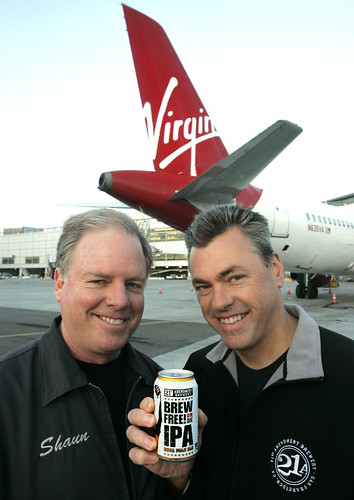
21st Amendment founders Nico Freccia and Shaun O’Sullivan traveled to Belgium to develop the recipe for this special beer, visiting small, traditional breweries in the hop fields of west Flanders, not far from the famous Trappist abbey of Westvletren. Monk’s Blood is designed to pair beautifully with rich winter stews, creamy cheeses, unctuous desserts or just by itself, in a Belgian tulip glass, with a good book by the fire.

The beer itself is a strong, dark Belgian-style beer that’s 8.3% abv. It’s 34 IBUs, using Centennial, Magnum and Amarillo hops. In addition to the eight malts (including Special B and oats), an Abbey ale yeast, it is flavored with dark Belgian candi sugar, cinnamon, vanilla beans, and dried black Mission Figs. Then it’s aged on oak. The result is a complex, delicious beer with a sweet nose consisting of a melange of aromas. The flavors, too, are complex with caramel and candy sweetness balanced by American hop character that works surprisingly well. The finish is long and sweet.

A toast by the Homebrew Chef, Sean Paxton
The Homebrew Chef, Sean Paxton, relaxing with some Monk’s Blood after the end of the beer dinner.

Sean Z. Paxton, put on the five-course dinner using all of the Belgian-style 21st Amendment beers from the BRU/SFO Project that’s going on all month at 21A and Magnolia. To see the meal and the beers poured at the dinner, see the photo gallery below.

Me and My Own Frites (by Jesse Friedman)
My favorite part of the dinner was the frites, of course, and while most table shared a basket or two of them, because Sean knows my love of frites, I got my own basket of frites. (Photo by Jesse Friedman. To see his account of the dinner, see his Beer & Nosh post.)


Here is a slideshow of the Monk’s Blood Beer Dinner. This Flickr gallery is best viewed in full screen. To view it that way, after clicking on the arrow in the center to start the slideshow, click on the button on the bottom right with the four arrows pointing outward on it, to see the photos in glorious full screen. Once in full screen slideshow mode, click on “Show Info” to identify each photo.

Filed Under: Beers, Events, Food & Beer, Reviews Tagged With: California, Northern California, Photo Gallery, San Francisco

Want A Healthier Heart? Drink More Beer!

November 19, 2009 By Jay Brooks

health
This has got to drive the anti-alcohol lobby nuts, and especially their medical co-conspirators who continue to insist that a binge drinker is simply someone who drinks five or more drinks in one session. The UK newspaper, The Independent, had an interesting article today, provocatively titled “Drink half a dozen beers every day and have a healthier heart: Teetotallers more likely to have heart attack than drinkers, study shows.”

According to the article, “Drinking a bottle of wine a day, or half a dozen beers, cuts the risk of heart disease by more than half in men, it has been shown.” That’s based on a study just published in the medical journal Health entitled Alcohol intake and the Risk of coronary heart disease in the Spanish EPIC cohort study.

In the Abstract:

Background
The association between alcohol consumption and Coronary Heart Disease (CHD) has been broadly studied. Most studies conclude that moderate alcohol intake reduces the risk of CHD. There are many discussions on whether the association is causal or biased. The objective is to analyse the association between alcohol intake and risk of CHD in the Spanish cohort of the European Prospective Investigation into Cancer (EPIC).

Methods
Participants from the EPIC Spanish cohort were included (15,630 men and 25,808 women). The median follow up period was 10 years. Ethanol intake was calculated using a validated dietary history questionnaire. Participants with a definite CHD event were considered cases. A Cox regression model was performed adjusted for relevant covariables and stratified by age. Separate models were carried out for men and women.

Results
Crude incidence rate of CHD was 300.6/100,000 person-years for men and 47.9/100, 000 person-years for women. Moderate, high and very high consumption was associated with a reduce risk of CHD in men: HR 0.86 (95% CI= 0.54-1.38) for former drinkers, 0.64 (95% CI= 0.4-1.0) for low, 0.47 (95% CI= 0.31-0.73) for moderate, 0.45 (95% CI= 0.29-0.69) for high and 0.49 (95% CI= 0.28-0.86) for very high consumers. In women a negative association was found with p values above 0.05 in all categories.

Conclusions
In men aged 29-69 years, alcohol intake was associated with a more than 30% lower CHD incidence. Our study is based on a large prospective cohort study and is free of the abstainer error.

The Independent distills it in clearer language:

In one of the largest studies of the link between alcohol and heart disease, researchers have found that the protective effects of a daily tipple are not limited to those who drink moderately but also extend to those who consume at what are conventionally considered to be dangerously high levels.

The research was conducted among 15,000 men and 26,000 women aged from 29 to 69 who were followed for 10 years.

The results showed that those who drank a little — a glass of wine or a bottle of beer every other day — had a 35 per cent lower risk of a heart attack than those who never drank. Moderate drinkers, consuming up to a couple of glasses of wine a day or a couple of pints of ordinary bitter, had a 54 per cent lower risk.

The surprise was that heavy drinkers consuming up to a bottle of wine or six pints of ordinary bitter had a similar 50 per cent reduction in risk of a heart attack to moderate drinkers. Those drinking at even higher levels were still half as likely to suffer a heart attack as the teetotallers.

Larraitz Arriola, who led the study, said alcohol caused 1.8 million deaths a year around the world and 55,000 deaths among young people under 30 in Europe alone. “The first thing to say about our research is that alcohol is very harmful. If you drink heavily, you should drink moderately. The more you drink, the worse off you will be.” The researchers only looked at the effect of alcohol on the heart and confirmed what 30 years of studies have shown — that it is protective. The effect was independent of the form in which the alcohol was taken, as beer, wine or spirits. However, people who only drank wine had slightly less protection.

Not surprisingly, British “scientists” are calling the results “flawed,” most likely because it flies in the face of their politically-motivated advice and the ridiculous (and recently revealed to be completely arbitrary) “units of alcohol” that set the nation’s alcohol policy for over twenty years. In a BBC article, they’re still treating the guidelines as if they mean something, which is almost funny.

In May of 2006, Danish study that also found healthy heart benefits for alcohol drinkers, though in that study they concluded that drinking levels above moderate would not increase benefits. This new Spanish study appears to conclude otherwise. In every article I’ve seen on this study, everyone is scrambling to make sure to tell people not to go out and start drinking more, due to other risks from heavy drinking. I’d say anyone that suddenly started binging based on this study probably deserves whatever ill effects they experience. But seriously, do health professionals really believe people are that stupid? I’m sure there are a few stupid enough (P.T. Barnum had it right) but it’s more likely they were already unhealthy drinkers just looking for an excuse.

What I take away from this is simply that the arbitrary and self-serving definitions of binge drinking are not only wrong, but very, very wrong. I attend beer dinners all the time, drinking an average of four, five or six different beers (and sometimes more) over several hours, paired with several courses. These dinners cost $50, $75, $100 (and sometimes more). They are attended by people who can afford that, people with good jobs, professionals, people with families, upstanding members of their communities. Yet in the U.S., the CDC claims if you have “five or more drinks in a row,” you’re an unhealthy binge drinker, endangering your own life, and possibly those around you. That makes every one of the people at all the beer dinners I attend, binge drinkers, and, to some in the anti-alcohol movement, automatic alcoholics, too. Could any standard be farther from reality?

Despite all the warnings of binge drinking, it appears by defining it in a way that’s so far removed from ordinary experience, that it actually makes it completely meaningless. Certainly there are people who drink too much and put their health at risk. But lumping them together with those who occasionally drink “five or more drinks in a row” safely and without sinking into alcoholism, the problems of the people who really need help never get addressed. All it does is give the AnAl’s more ammunition to scare people with, and few media outlets ever call them on it. After all, it has the stamp of a government agency. But we all know it’s not accurate by any stretch of the imagination to call the average beer dinner attendee a binge drinker. At least now we know their heart will get a boost. In the end, I think the best advice is “everything in moderation … including moderation.”

Filed Under: Beers, Editorial, News, Politics & Law Tagged With: Health & Beer

« Previous Page
Next Page »

Find Something

Northern California Breweries

Please consider purchasing my latest book, California Breweries North, available from Amazon, or ask for it at your local bookstore.

Recent Comments

  • Bob Paolino on Beer Birthday: Grant Johnston
  • Gambrinus on Historic Beer Birthday: A.J. Houghton
  • Ernie Dewing on Historic Beer Birthday: Charles William Bergner 
  • Steve 'Pudgy' De Rose on Historic Beer Birthday: Jacob Schmidt
  • Jay Brooks on Beer Birthday: Bill Owens

Recent Posts

  • Beer In Ads #5236: Beverage Of The Gods! April 30, 2026
  • Historic Beer Birthday: Gustav Hodel April 30, 2026
  • Historic Beer Birthday: Lawrence Steese April 30, 2026
  • Beer In Ads #5235: The Buck Is Loose! April 29, 2026
  • Historic Beer Birthday: Robert Cain April 29, 2026

BBB Archives

Feedback

Head Quarter
This site is hosted and maintained by H25Q.dev. Any questions or comments for the webmaster can be directed here.