Brookston Beer Bulletin

Jay R. Brooks on Beer

  • Home
  • About
  • Editorial
  • Birthdays
  • Art & Beer

Socialize

  • Dribbble
  • Email
  • Facebook
  • Flickr
  • GitHub
  • Instagram
  • LinkedIn
  • Pinterest
  • RSS
  • Twitter
  • YouTube

Powered by Genesis

Anatomy Of A Propaganda Piece

March 21, 2012 By Jay Brooks

anatomy-of-murder
With Alcohol Justice promoting it, I just knew there had to be more to the CNN story Movies May Increase Binge Drinking in Teens. The article is based on a study published in the journal Pediatrics with the more benign title Alcohol Consumption in Movies and Adolescent Binge Drinking in 6 European Countries. But either way, Hollywood is, of course, the bogeyman. The study “surveyed 16,500 students ages 10 to 19 from Germany, Iceland, Italy, the Netherlands, Poland and Scotland.”

The students were asked how often they drank five alcoholic beverages during one sitting [interesting a European study has adopted the ridiculous U.S. definition of “binge drinking”], and about the types of movies they watched. Participants were given a list of 50 movies to choose from, which included many top box-office hits from the U.S. The number of drinking scenes was tallied for each movie.

I don’t have the resources to pay to see the whole study, so I don’t know what films are on the list, but the first thing I have to wonder is how many of those films are age-appropriate for 10-year olds? Many Hollywood blockbusters would be at least “PG-13” (so no 10-12 year olds allowed) or “R” (no 10-17 year olds allowed). Are there many movies with “drinking scenes” that are “G” or that every parent would find appropriate for their 10 through 19 year old child? There’s also no breakdown of how many kids were 10, 15, 19, etc., but I have to believe there’s a vast difference between the effect of watching a film on a ten-year old and a young adult, age 18 or 19. The researchers apparently also considered other so-called “risk factors,” and somehow accounted for each “teen’s levels of rebelliousness or sensation-seeking, peer drinking levels, family drinking patterns, affluence and gender.” That’s a lot of data on 16,500 kids, and almost none of it could be considered the “hard facts” type.

The overall results were that “27% of the sample had consumed >5 drinks on at least 1 occasion in their life.” So roughly 1 out of 4 of the “kids” had consumed 5 drinks at least once, and possibly ONLY once, in their life. And of those 16,500, some of the “kids” were legally allowed to drink 5 beers if they wanted to. In Germany, Italy and the Netherlands, the minimum age for drinking is 16. In Poland and Scotland it’s 18 (though once source I have says it’s 16 in Poland). In Iceland it’s 20. So for at least half the countries where the kids were surveyed, they were permitted to drink at least beer 4 out of the 10 ages of “kids” in the study.

For five-sixths of the countries, at least some of the ages of children surveyed were likewise legally allowed to drink alcohol. Like the age breakdowns, there’s no information available (at least to me) about how many of those surveyed were from which country. Given all the supposed control factors they accounted for, the legal age at which people in the surveyed countries are permitted to drink alcohol seems nakedly absent and, at least to my way of thinking, a rather important omission.

And one last comment about their methodology, such as it was. To determine each film’s — I don’t know, “quotient,” “unworthiness” or whatever — “the number of drinking scenes was tallied for each movie” by the researchers. But is the sheer number of times there’s a scene of people drinking in any way relevant? Is there no context to each scene? Are there not positive and negative ways to portray drinking alcohol? I already know the answer to that one, as obviously the researchers are convinced that ANY depiction of people drinking alcohol they consider wrong, but of course a second’s thought will reveal that to be patently nonsense. Just counting how often people are seen drinking alcohol in a film really tells you nothing about how influential it will be, or indeed, if it registers anything at all. Shown being consumed responsibly, it could just as easily be a positive influence.

Personally, I’m much more concerned about my kids seeing casual violence in films than drinking. But there, as well as in America, research continues to claim that there’s a direct “link between drinking in movies and adolescent alcohol consumption habits.” This latest study’s conclusion likewise claims that the “link between alcohol use in movies and adolescent binge drinking was robust and seems relatively unaffected by cultural contexts.”

But in the last paragraphs — well after most people probably stopped reading — was what I’d been thinking as I read this, that “even though the European study shows a strong association between what is seen on the movie screen and binge drinking, it cannot show cause and effect.” Like Otto Preminger’s Anatomy of a Murder, not everything is as it seems.

And despite the tone of the story up until that point having been confidently certain, as expressed in the headline’s more movies, more binging (or better mo movies, mo binging), it may not be as certain as they would have you believe. Here’s the smoking gun.

It may be that binge drinking teens seek out movies that have alcohol scenes, or it could be that seeing scenes of alcohol use in movies makes them more likely to binge drink. More research is needed to confirm these findings.

I continue to be troubled by the wide range of ages surveyed, because in my experience those are the ages when people change more in a shorter period of time than at any other time in their entire life. The conclusion suggests that to combat this scourge, parents should “go to the movies with [their kids] and discuss what you’re seeing. What you say matters more than what one TV show or one movie says.” In other words, be a parent. So is this a problem of parenting or the movies? Should movies be stripped of adult content because kids might watch them? That does seem to be a common strategy by neo-prohibitionist groups, especially with regard to advertising.

In the end, this seems like yet another study riddled with more questions than answers. But, as is typical, those questions — if the media raises them at all — are buried at the end of the article, well after the average person has given up reading and has moved on to something else. What we’re left with is a “survey” (and we all now how teenagers always tell the truth about what they’re doing) of kids in six varied nations (with different minimum drinking ages) who are of widely different ages (from a childlike ten to a young adult 19) who appear to binge drink more (or at least once) if they see Hollywood blockbuster movies (or it may be teens who drink prefer those movies). Tell me again how exactly that’s news?

Filed Under: Beers, Editorial, Politics & Law Tagged With: Anti-Alcohol, Europe, Film, Mainstream Coverage, Prohibitionists, Propaganda, Statistics

Creativity & Beer

March 21, 2012 By Jay Brooks

lightbulb
One of the unspoken benefits of beer is that it’s a very useful relaxation tool. After a hard, stressful day of work, a tasty beer is just the thing to calm one’s nerves. It would be nearly impossible to quantify, but I have to wonder how much better off many people are because of the relaxation afforded them through the simple act of drinking a beer. How many didn’t do something that they might later regret had they remained tense, stressed and on edge. It’s worth considering, especially as the neo-prohibitionists increasingly insist that beer has no health benefits. But the mental health benefits that most of us get from a calming glass of beer can’t be ignored.

But there’s apparently one more mental health benefit to a beer, as reported recently in the Wall Street Journal (and thanks to Jeff B. for sending me the link). The essay, by Jonah Lehrer, is How To Be Creative, and the teaser subtitle give a nutshell account of what’s to come. “The image of the ‘creative type’ is a myth. Jonah Lehrer on why anyone can innovate—and why a hot shower, a cold beer or a trip to your colleague’s desk might be the key to your next big idea.” The fascinating story is about where creativity and innovation come from, something science has only very recently even tried to explain. The essay discusses several theories and gives examples of different ways that creativity is sparked and influenced. One of those, of course, is through drinking a glass of beer.

Interestingly, Mr. Beeman and his colleagues have found that certain factors make people much more likely to have an insight, better able to detect the answers generated by the aSTG [superior anterior temporal gyrus]. For instance, exposing subjects to a short, humorous video—the scientists use a clip of Robin Williams doing stand-up—boosts the average success rate by about 20%.

Alcohol also works. Earlier this year, researchers at the University of Illinois at Chicago compared performance on insight puzzles between sober and intoxicated students. The scientists gave the subjects a battery of word problems known as remote associates, in which people have to find one additional word that goes with a triad of words. Here’s a sample problem:

Pine Crab Sauce

In this case, the answer is “apple.” (The compound words are pineapple, crab apple and apple sauce.) Drunk students solved nearly 30% more of these word problems than their sober peers.

What explains the creative benefits of relaxation and booze? The answer involves the surprising advantage of not paying attention. Although we live in an age that worships focus — we are always forcing ourselves to concentrate, chugging caffeine — this approach can inhibit the imagination. We might be focused, but we’re probably focused on the wrong answer.

And this is why relaxation helps: It isn’t until we’re soothed in the shower or distracted by the stand-up comic that we’re able to turn the spotlight of attention inward, eavesdropping on all those random associations unfolding in the far reaches of the brain’s right hemisphere. When we need an insight, those associations are often the source of the answer.

So if you’re having trouble with your latest creative project, stuck somewhere with no solution in sight? Relax, don’t worry, have a beer. That may prove to be just the thing to free your mind and in the process unlock the creativity necessary to solve your problem. Liquid gold indeed.

Filed Under: Beers, Editorial, Politics & Law, Related Pleasures Tagged With: Science

Beer In Ads #567: Go Team Red Cap

March 20, 2012 By Jay Brooks


Tuesday’s ad is for Carling’s Red Cap Ale. I’m not sure of the year the ad ran, but there is a clue at the bottom. It says that for 109 years it was made in Canada but as of the date of the ad was being made in the U.S. It’s a great illustration and I’m assuming it ran in the fall, sometime during football season, since the only element in the ad is the generic “Go Team!” football badge in blue and gold and some ticket stubs, presumably from the game.

carling-redcap-ad

Filed Under: Art & Beer, Beers Tagged With: Advertising, Canada, History

Tunisia Beer

March 20, 2012 By Jay Brooks

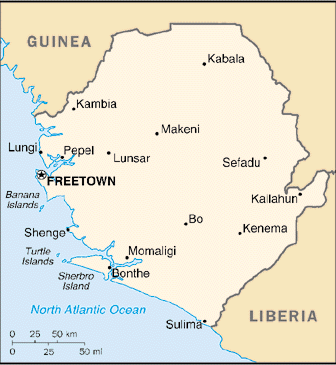
tunisia
Today in 1958, Tunisia gained their Independence from France.

Tunisia
tunisia-color

Tunisia Breweries

  • Brasserie Le Berbère
  • Brasseries De Tunisia
  • Brauhaus Yasmine
  • Golfbräu

Tunisia Brewery Guides

  • Beer Advocate
  • Beer Me
  • Rate Beer

Other Guides

  • CIA World Factbook
  • Official Website
  • U.S. Embassy
  • Wikipedia

Guild: Société Frigorigique Et Brasserie

National Regulatory Agency: None

Beverage Alcohol Labeling Requirements: Not Known

Drunk Driving Laws: BAC 0.05%

Tunisia

  • Full Name: Tunisian Republic
  • Location: Northern Africa, bordering the Mediterranean Sea, between Algeria and Libya
  • Government Type: Republic
  • Language: Arabic (official, one of the languages of commerce), French (commerce)
  • Religion(s): Muslim 98%, Christian 1%, Jewish and other 1%
  • Capital: Tunis
  • Population: 10,732,900; 79th
  • Area: 163,610 sq km, 93rd
  • Comparative Area: Slightly larger than Georgia
  • National Food: Couscous
  • National Symbols: Jasmine; Star and Crescent
  • Nickname: The Eagles of Carthage
  • Affiliations: UN, African Union, Arab League
  • Independence: From France, March 20, 1956

tunisia-coa

  • Alcohol Legal: Yes
  • Minimum Drinking Age: 20
  • BAC: 0.05%
  • Label Requirements: N/A
  • Number of Breweries: 5

TunisiaPNew-10Dinars-2005-dml_f

  • How to Say “Beer”: beereh (biræ)
    جعة / شراب من الشعير / جعة / المزر شراب نوع من الجعة / بيرة
  • How to Order a Beer: Waheed beera, meen fadleek
  • How to Say “Cheers”: Bismilah / Fi schettak or Fisehatak (“to your health”)
  • Toasting Etiquette: N/A
  • Notes: Tunisia has a selective ban on alcohol products other than wine, with consumption and sale being allowed in special zones or bars “for tourists” and in large cities.

tunisia-map

Alcohol Consumption By Type:

  • Beer: 63%
  • Wine: 32%
  • Spirits: 5%

Alcohol Consumption Per Capita (in litres):

  • Recorded: 1.09
  • Unrecorded: 0.20
  • Total: 1.29
  • Beer: 0.67

WHO Alcohol Data:

  • Per Capita Consumption: 1.09 litres
  • Alcohol Consumption Trend: Decrease
  • Excise Taxes: Yes
  • Minimum Age: 20
  • Sales Restrictions: Time, location, specific events, intoxicated persons, petrol stations
  • Advertising Restrictions: No
  • Sponsorship/Promotional Restrictions: No

Patterns of Drinking Score: 2

Prohibition: None

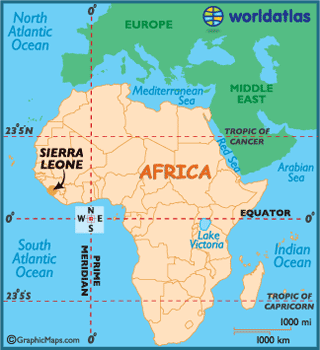
tunisia-africa

Filed Under: Beers, Breweries Tagged With: Africa, Tunisia

Session Beer Day To Be Celebrated April 7

March 20, 2012 By Jay Brooks

session
My friend and colleague Lew Bryson is promoting a new holiday, to take place on April 7. Session Beer Day was created to bring awareness to the idea that low-alcohol beers can be every bit as flavorful as their more spirited cousins, beers of average or high alcohol. Lew’s Session Beer Project has been a pet project of his for a few years now, its purpose likewise is “to popularize and support the brewing and enjoyment of session beers.” You can read more about Session Beer Day on Lew’s blog Seen Through a Glass.

While there are no hard and fast rules as to what constitutes a “session beer,” for purposes of the holiday, the focus will be on beers that are 4.5% a.b.v. and below. If you’re a beer lover, on April 7, consider drinking only session beers and making a special point to ask for session beers at your favorite watering holes. Many places don’t even carry any beers that would fit the working definition and this holiday is an opportunity to educate places that aren’t stocking at least one session beer.

If you’re in a position at a bar, pub, brewery, restaurant, etc., consider offering session beer on April 7, perhaps even making a special promotion for the day (or week surrounding) Session Beer Day. You could even really step up and serve ONLY session beers and see how many you can find from your local brewers.

Here’s how Lew describes what to do on Session Beer Day:

If you work at a bar (or manage one, or own one), please consider throwing some under-4.5% beers on for April 7th, and making a special price or promotion for them. Tell folks it’s Session Beer Day, and encourage them to see how good lower alcohol beers can be. (Good day to get a “We Support” window sticker, too!) If you’re a brewer or wholesaler, encourage your accounts to pick up your under-4.5% beers for that day; it’s a great chance to promote those beers! If you’re a beer blogger/tweeter/writer, please consider spreading the word about Session Beer Day: use the hashtag #sessionday . And if you’re a session beer drinker…get out there and ask for it!

If you don’t recognize the significance of April 7, that was the day in 1933 when the Cullen-Harrison Bill, signed into law by FDR on March 23, took effect. Here, I’ll let Bob Skilnik take up the rest of the story:

Congressional events leading up to April 7, 1933 allowed only the resumption of sales for legal beer with an alcoholic strength of no more than 3.2% alcohol by weight (abw), weak by today’s standards. Congress had earlier passed the so-called Cullen-Harrison Bill which redefined what constituted a legally “intoxicating” beverage. President Franklin Delano Roosevelt signed the bill on March 23, 1933. The bill’s passage took the teeth out of the bite of the Volstead Act of 1919 and raised the Prohibition-era legal limit of alcoholic drinks from .05% abw to 3.2% abw.

Bringing breweries back online on April 7, 1933 in states whose legislatures agreed to go “wet” again gave a tremendous shot in the arm of an economy in the throes of the Depression. In just forty-eight hours, $25,000,000 had been pumped into various beer-related trades as diverse as bottling manufacturers to the sawdust wholesalers whose product lay strewn on the floors of saloons. For the first day of nationwide beer sales, it was estimated that the federal tax for beer brought in $7,500,000 to the United States Treasury.

To learn more about this period of history, read Skilnik’s New Beer’s Eve, April 7, 1933. So it seems an appropriate day to celebrate session beers, the day when only session beers were available after thirteen years of no (legal) beer of any kind.

So now you know. April 7 will be celebrated as Session Beer Day. Won’t you you join us?

sbp-we-support

If you’re asking yourself if we can just declare any day a holiday, the answer is “yes.” If you’re a regular reader of the Bulletin, you know I’m a holiday geek and list many obscure holidays for every day of the year. Almost all of those are legitimate. Apart from “official” holidays which are voted on by Congress, anyone can declare any day a holiday. The trick is to get others to recognize it. So there are lots of small holidays. Some are self-serving holidays by industries to promote their products. Some are by non-profits hoping to build awareness for their cause. Some are wacky ideas by goofy people (like me) who just want to have some fun. Some are rooted in old traditions and others are just completely made up. Some succeed while others are relegated to the scrap heap of forgotten holidays. Many of the holidays we take for granted, such as Thanksgiving or Mother’s Day, were simply thought up by individuals hoping to promote a good idea and only gained wider acceptance over time. Thanksgiving has only been an annual event since 1863 and Mother’s Day, in its current form, wasn’t made an official holiday until 1914. So any holiday has a chance of becoming a big holiday with Hallmark cards and special traditions to celebrate it as long as enough people buy into it and observe it as a holiday. So Session Beer Day is a holiday if we say it’s holiday. It’s that simple. So this April 7th, make Session Beer Day a reality simply by drinking some session beers. Oh, and don’t forget to celebrate International Brewers Day on July 18.

Filed Under: Beers, Just For Fun, News Tagged With: Announcements, Holidays

Beer In Ads #566: A Great Nation’s Greatest Beer

March 19, 2012 By Jay Brooks


Monday’s ad is for an old Pabst brand, Andeker Beer, also referred to as “Andeker of America.” It’s from 1972 and refers to itself as “The Beer Supreme.” The tagline is great: “A Great Nation’s Greatest Beer.” The painting shown in the ad is by George Caleb Bingham. The ad says the title is Pioneers Crossing the Cumberland Gap, but it’s usually referred to as Daniel Boone Escorting Settlers through the Cumberland Gap.

andeker-73

Filed Under: Art & Beer, Beers Tagged With: Advertising, History

Now Made With Craft Beer

March 19, 2012 By Jay Brooks

food-placesetting-blue
So I’m walking through the grocery store the other day; and I’m hungry, which is never a good combination. I’m perusing the frozen food section, when something catches my eye. It’s Cheddar Bites, or more specifically “Crispy Beer Battered Aged White Cheddar” by Alexia. Now it’s not that they’re beer-battered — which I’m pleased about — but it’s nothing new. That’s not what caught my attention. On the box is a small tri-colored square, at an angle, to the right of the main label, declaring that these cheddar bites aren’t made with just any old beer, but are “Craft Beer Battered!” Woo Hoo! We’ve come a long way, baby, when that becomes a selling point. It made me laugh a bit, and naturally there’s no information about what craft beer was used for the batter. The company’s in Washington, so that’s a clue, I suppose.

Still, I find it interesting that a food company thought it was enough of a selling point to include it as a separate element on the packaging. That certainly suggests that they believed it would appeal to a certain type of consumer, and specifically one for whom the fact that the beer was “craft beer” had some meaning. That’s an interesting development. And it worked, I suppose, since I bought them. The family verdict was mixed. My wife thought they were just “meh,” whereas I liked them just fine; though in fairness my tastes run toward anything that’s not too good for me and can be considered comfort food.

Has anyone else seen similar labeling on packaged foods? It’s the first time I’ve noticed it, but I’m curious if this is happening enough to be considered the beginning of a trend.

cheddar-bites

Filed Under: Beers, Editorial, Food & Beer, Just For Fun Tagged With: Comfort Food, Food, Humor

Anchor Video On History Of California Lager

March 19, 2012 By Jay Brooks

anchor-new
Anchor Brewing today posted a new video about the history of California Lager, and their new Zymaster series which attempts to recreate the beer brewed by Boca Brewing in the 1870s. You can read more about that history on their blog, too, in Part 1 and Part 2.

Filed Under: Breweries, Just For Fun Tagged With: Anchor Brewery, California, History, Science of Brewing, Video

Oh, The Horror: Children Recognize Beer Brands

March 19, 2012 By Jay Brooks

beer-kids
Another classic propaganda study was just released in Britain, using the all-too-common meme of “think of the children” as the wedge to attack alcohol advertising. Ever since Prohibition ended miserably here in the U.S., anti-alcohol groups turned their attention to other methods of crippling alcohol, and attacking advertising has been a favorite strategy. It’s quite common in the UK, too, as similar groups there have no doubt witnessed its effectiveness on our side of the pond. This one is being reported by the Daily Mirror as More Children Familiar with Alcohol Brands Than Snacks, which is no doubt exactly the alarm that the anti-alcohol organization behind it was hoping to raise. The so-called “study” the Mirror is reporting on was conducted for Alcohol Concern, a “national charity on alcohol misuse” which certainly sounds like one of our American organizations that cover themselves in the cloak of health and concern for the children.

So let’s look at the study. 400 children, ages 10 and 11 (the same age as my son Porter), were shown brand names and images. Of those, 79% correctly recognized Carlsberg as a beer, or at least as alcohol. The same percentage also correctly identified Smirnoff as alcohol whereas only 74% recognized Ben & Jerry’s Ice Cream (which must have greatly chagrined Ben & Jerry’s ad agency). Oh, the horror! From there, of course, the leap is made that tighter controls need to be placed on the advertising of alcoholic beverages lest the kiddies remain able to know what’s alcohol and what’s not. Because if children know which brands are alcohol, then obviously they will drink them. If then can identify them, then obviously they’re being targeted and all ads therefore “encourage immoderate consumption.” Alcohol Concern asserts that alcohol advertising must be “not attractive to children,” as if adults and children like completely different things.

Okay, a couple of things. First, being able to identify which brands are alcoholic drinks and which are not does not mean the recognition came from advertising. That almost 4 out of 5 kids could identify Carlsberg, one of the best-selling beers in the UK, is just as likely due to its popularity, being in those kids’ homes, sitting in the refrigerator, and seeing their parents drinking it. Or seeing it when they’re at the local football game, with family and family friends drinking it while watching the game; or at a picnic; or they may see it walking the supermarket aisles as their parents shop. There are many places where kids can see alcohol brands, including many positive experiences, that do not have to do with advertising. Kids do not have tunnel vision and only retain what they see in ads on television. Yet Mark Leyshon, from Alcohol Concern, insists their “study” does “provide more evidence that alcohol marketing messages are getting through to young people well before they are legally able to buy alcohol.” I’d say that’s true only if you ignore reality.

On some level, isn’t it good news that kids know the difference between alcohol and soda? And guess which one they prefer? Think about it. Do kids like bitter tastes like beer or sugary sweet flavors like soft drinks? Study after study I’ve seen, and not just ones by neo-prohibitionists, always show young people prefer sweet tastes over bitter ones. I know my kids do. Don’t yours? So it’s in their interest — and yours and society’s if the anti-alcohol nutjobs are to be believed — if they don’t accidentally reach for a bottle of Carlsberg thinking the green bottle contains Sprite or 7Up? Knowledge should be a good thing, but apparently Alcohol Concern thinks it would be better if our children were completely ignorant.

Second, the study itself seems overly simplistic at best. The kids were shown “the brand names and logos of common alcohol products, as well as images from TV alcohol advertisements,” along with “brand images, logos and TV adverts for popular non-alcoholic products such as soft drinks and breakfast cereals.” Then it was multiple choice. The kids could choose for each image they were shown between three choices: “food,” “soft drink” or “alcoholic drink.” I can’t speak for their ten and eleven year olds, but I’m fairly certain my own son (who’s 10-1/2) could do a pretty good job of just guessing between those three choices. Most successful brand images work because the association with the products are natural or complimentary, not inscrutable and hard to figure out.

But even so, would it have been better for children’s health if they could more easily identify the “soft drinks” or “sugary snacks,” which ultimately are at least as bad for their health as alcohol? I know that kids under 18 in civilized places (or 21 in places less so) should not be drinking alcohol, and I accept that children should not have unrestricted access to it. But the fact remains that, all things being equal, the excess sugar and other chemicals in soft drinks and many, many processed foods are terrible for everybody, children included. Yet Alcohol Concern — and indeed most anti-alcohol groups — seem to have no difficulty with the many unhealthy products in the world and are single-mindedly convinced that it’s alcohol alone that it is the cause of society’s woes.

For me personally, as a parent, I find this concern completely absurd, unfounded and misguided. My kids could name more alcohol brands than the average ten and seven-year old, because it’s “daddy’s work.” Their hearts sink every time a package arrives on our doorsep and it’s not a new book or toy, but instead is beer. Our house is full of beer. It’s lining the hallway, in boxes in the foyer, sitting around the dining room, the kitchen, the garage, and stuffed into four refrigerators. But my kids have no interest in it whatsoever. Zip, zero, nada. They know it’s “for adults.” And that’s partly why I’m convinced these sorts of attacks on alcohol advertising using children as a shield are not about the kids in the least. They never are. I’m glad my kids know the difference between what they’re allowed to drink and what they’re not. Don’t all parents teach their kids what they can drink? In our home, it’s simple, really. No soda, no beer and no alcohol. They know, and that knowledge is powerful and effective. Just say know.

Filed Under: Beers, Editorial, Politics & Law Tagged With: Anti-Alcohol, Prohibitionists, Propaganda, Statistics, UK

Beer In Art #166: Albert Edelfelt’s Portrait of Louis Pasteur

March 18, 2012 By Jay Brooks

art-beer
Today’s work of art is by the Swedish-speaking Finnish artist Albert Edelfelt, who in 1886 painted a Portrait of Louis Pasteur. Pasteur, of course, while primarily known for pasteurization of milk, did his initial studies of fermentation and unlocked many of the mysteries of how yeast worked in brewing, paving the way for brewers to better understand and control the process of making beer. In 1873 he published his Treatise on Fermentation.

Albert_Edelfelt_-_Louis_Pasteur_-_1885

The painting today hangs in the Musee d’Orsay in Paris. The museum describes Portrait of Louis Pasteur:

Like many of his contemporaries from Northern Europe, the Finn Albert Edelfelt came to France when he was scarcely twenty to study at the fine arts school in Paris. He quickly took part in the official exhibitions and soon won medals and awards. The presentation of his portrait of the chemist and biologist Louis Pasteur at the Salon of 1886 marked a new stage in his career because it earned him the Legion of Honour. At a time when painters readily chose contemporary scientific subjects rather than historical painting, which was bogged down in the reproduction of anecdotes, this portrait of one of the most famous scientists of the time was very popular.

Pasteur is shown in his laboratory in the rue d’Ulm, in the midst of his experimental apparatus. He is holding a jar containing the spinal cord of a rabbit infected with rabies which he used to develop a vaccine against rabies. As a result of this discovery, he was hailed as a benefactor of mankind. Far from being a heroic representation, the painting is the epitome of poise, both in its composition and lighting. Light from a window out of sight on the right spreads delicately over the scene, highlighting the equipment and the scientist’s thoughtful face.

To learn more about Albert Gustaf Aristides Edelfelt, you can start with Wikipedia, and you can also see links to his works online at ArtCyclopedia, Painting Giant, Vaasa, the Athenaeum and Wahoo Art.

Filed Under: Art & Beer, Breweries Tagged With: brewers, Finland

« Previous Page
Next Page »

Find Something

Northern California Breweries

Please consider purchasing my latest book, California Breweries North, available from Amazon, or ask for it at your local bookstore.

Recent Comments

  • Bob Paolino on Beer Birthday: Grant Johnston
  • Gambrinus on Historic Beer Birthday: A.J. Houghton
  • Ernie Dewing on Historic Beer Birthday: Charles William Bergner 
  • Steve 'Pudgy' De Rose on Historic Beer Birthday: Jacob Schmidt
  • Jay Brooks on Beer Birthday: Bill Owens

Recent Posts

  • Historic Beer Birthday: Anton Schwartz April 23, 2026
  • Beer Birthday: Christian Kazakoff April 23, 2026
  • Beer In Ads #5228: We Are Coming On The Run … April 22, 2026
  • Beer In Ads #5228: All Together For Newark April 21, 2026
  • Beer Birthday: Steve Parkes April 21, 2026

BBB Archives

Feedback

Head Quarter
This site is hosted and maintained by H25Q.dev. Any questions or comments for the webmaster can be directed here.