Brookston Beer Bulletin

Jay R. Brooks on Beer

  • Home
  • About
  • Editorial
  • Birthdays
  • Art & Beer

Socialize

  • Dribbble
  • Email
  • Facebook
  • Flickr
  • GitHub
  • Instagram
  • LinkedIn
  • Pinterest
  • RSS
  • Twitter
  • YouTube

Powered by Genesis

Waxing Nostalgic Extemporaneously For The Next Session … Today!

May 4, 2018 By Jay Brooks

session-the
For our 135th Session, our host will be Alistair Reece, who writes Fuggled. For his topic, he’s taking a look back in Sepia Tones, by which he challenges us to “indulge in a little beer nostalgia, a bit of personal beer history you might say.”

Until this morning, we were without a host, so a big thanks to Alistair for stepping up last minute and hosting. (That also means right now you should think about hosting June or beyond!) So understandably his topic is lean, although not so mean. Here are his instructions on participating:

What kind of things would be suitable topics for today? Well, here’s some suggestions:

  • Discontinued beers that you miss.
  • Breweries you once loved that are no longer around.
  • Beers that are simply not what they once were.
  • Your early steps in the world of beer drinking, whether craft or just in general.

There you have it, get melancholy, drag up memories of good times gone by, and join us in this month’s Session.
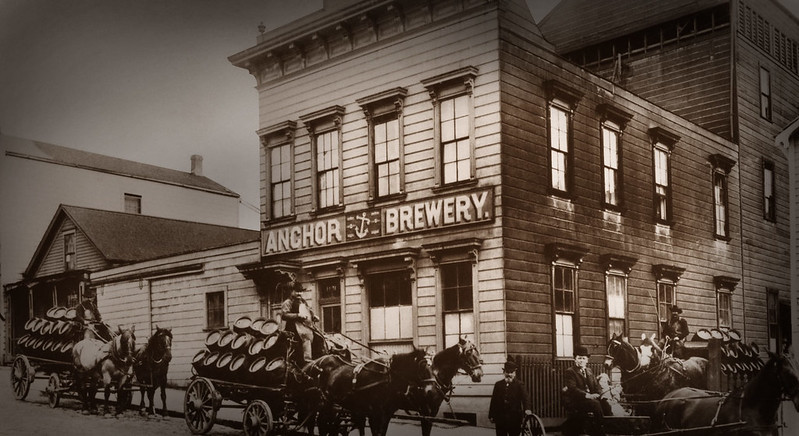
anchor-brewery-sepia

So no time to waste, it’s already the first Friday of May, so time to start waxing nostalgic and write your session post today. Then post a link to your session post at the original announcement or I imagine you could tag him on Twitter, too. Either way, don’t delay. Time’s a wasting.

Filed Under: Beers, Breweries, Just For Fun, The Session Tagged With: Announcements, History

Bistro IPA Festival Winners 2018

April 14, 2018 By Jay Brooks

bistro
Today was the 21st annual IPA Festival and the Inaugural Hazy IPA Festival at the Bistro. The weather cooperated and it ended up being a cool but sunny in Hayward, making it was near perfect beer-drinking weather once we emerged from judging in the basement. This year the judging was split into two groups, regular clear IPAs and hazy IPAs. There were 41 traditional American-style IPAs. The full list of winners is below.

BIPAF18-1

West Coast IPA Festival Winners

  • 1st Place: Chain Shot (Moonraker Brewing)
  • 2nd Place: Rakau (Triple Rock Brewing)
  • 3rd Place: Danker Will Robinson (Alpha Acid)

For the first time, this year we separately judged Hazy, East Coast, New England IPAs, or whatever you want to call them. We had 36 in the first round, and eight in the final round.

BIPAF18-2

East Coast or Hazy IPA Festival Winners

  • 1st Place: DDH Cantaloupe Island (Cellarmaker Brewing)
  • 2nd Place: Citra Dream (New Glory Craft Brewery)
  • 3rd Place: Relax (Bruery Offshoot)

Filed Under: Beers, Events, Just For Fun Tagged With: Announcements, Awards, IPA, Northern California

The Next Session Visits A Beer Garden

March 23, 2018 By Jay Brooks

session-the
For our 134th Session, our host will be Tom Cizauskas, who writes Yours For Good Fermentables. For his topic, he’s tackling Beer Gardens, or more specifically, “What (and Where) is a Beer Garden?”

Liebermann-beer-garden-in-brannenburg

Here’s what he means by that question:

What is a beer garden? Or what isn’t a beer garden? Or what should a beer garden be? Or where is a beer garden?

Is a beer garden a place of foliage and shrubberies? Or is it a plot of concrete with umbrellas? Is a beer garden an outdoor bar? Or an outdoor Biergarten pavilion with Gemütlichkeit und Bier? Or is a beer garden to be found at a brewery with a hop trellis de rigueur?

Is a beer garden to be found outdoors, or can it be, alternatively, an interior third place, an arboretum with beer? Is a beer garden a real thing or is it a Platonic ideal, an imagined gueuzic nostalgia? Or is it a place indeed, once or often visited, not Bill Bryson in the woods, but Lew Bryson in a beer garden? If so, where is it? Tell us (with or without Lew).

According to the Beer Bloggers Conference, there are over 1,000 active “Citizen Beer Blogs” in North America, over 500 “Citizen Beer Blogs” throughout the rest of the world, and another couple hundred industry beer blogs. So, jump in folk. Please contribute!

boho-hall-slider-garden-night
The Beer Garden at Bohemian Hall in New York City.

So by Friday, April 6 — which by the way is New Beer’s Eve — or thereabouts, give us your take on beer gardens. To participate in the April Session, simply leave a comment at the original announcement and leave the URL to your post there, or tag him on Instagram or Twitter, or by posting a link and comment on his Facebook page.

Springfield_The_Seven_Duffs
At the Duff Gardens beer garden.

Filed Under: Beers, Just For Fun, The Session Tagged With: Announcements, beer gardens

Top 50 Breweries For 2017

March 14, 2018 By Jay Brooks

ba
The Brewers Association just announced the top 50 breweries and craft breweries in the U.S. based on sales, by volume, for 2017, which is listed below here. I should also mention that this represents “craft breweries” according to the BA’s membership definition, and not necessarily how most of us would define them, as there’s no universally agreed upon way to differentiate the two. For the tenth year, they’ve also released a list of the top 50 breweries, which includes all breweries. In the past I’ve posted the two lists separately, but have decided going forward to present them together since the two are getting increasingly intermingled. Here is this year’s craft brewery list:

Top 50 Craft Brewing Companies

RankBrewery NameCityState
1D. G. Yuengling & Son, IncPottsvillePA
2Boston Beer CoBostonMA
3Sierra Nevada BrewingChicoCA
4New Belgium BrewingFort CollinsCO
5Duvel MoortgatPaso Robles/Kansas City/CooperstownCA/MO/NY
6GambrinusSan Antonio/Berkeley/PortlandTX/CA/OR
7Bell’s Brewery, IncComstockMI
8Stone BrewingEscondidoCA
9CANarchyLongmont/Tampa/Salt Lake City/
Comstock Park
CO/FL/UT/MI
10Deschutes BreweryBendOR
11Brooklyn BreweryBrooklynNY
12Dogfish Head Craft BreweryMiltonDE
13Minhas Craft BreweryMonroeWI
14Artisanal Brewing VenturesDowningtown/LakewoodPA/NY
15SweetWater BrewingAtlantaGA
16New Glarus BrewingNew GlarusWI
17Matt BrewingUticaNY
18Harpoon BreweryBostonMA
19Alaskan BrewingJuneauAK
20Great Lakes BrewingClevelandOH
21Abita BrewingAbita SpringsLA
22Odell BrewingFort CollinsCO
23Stevens Point BreweryStevens PointWI
24August Schell BrewingNew UlmMN
25Summit BrewingSaint PaulMN
2621st Amendment BreweryBay AreaCA
27Shipyard BrewingPortlandME
28Flying Dog BreweryFrederickMD
29Full Sail BrewingHood RiverOR
30Troëgs BrewingHersheyPA
31Long Trail BrewingBridgewater CornersVT
32Rogue AlesNewportOR
33Rhinegeist BreweryCincinnatiOH
34Narragansett BrewingProvidenceRI
35Gordon Biersch BrewingSan JoseCA
36Allagash BrewingPortlandME
37Uinta BrewingSalt Lake CityUT
38Ninkasi BrewingEugeneOR
39Surly BrewingMinneapolisMN
40Revolution BrewingChicagoIL
41Karl Strauss BrewingSan DiegoCA
42Bear Republic BrewingCloverdaleCA
43Green Flash BrewingSan DiegoCA
44Left Hand BrewingLongmontCO
45Three Floyds BrewingMunsterIN
46Saint Arnold BrewingHoustonTX
47Lost Coast BreweryEurekaCA
48North Coast BrewingFort BraggCA
49Wachusett BrewingWestminsterMA
50Avery BrewingBoulderCO

six-glasses

This list, by contrast, is the Top 50 Overall Brewing Companies in the U.S. based on sales, by volume, for 2017. This includes all breweries, regardless of size or any other definitions or parameters.

Breweries in bold are considered to be “small and independent craft brewers” under the BA’s current definition. That there are so many footnotes (23 in total, or almost half of the list) explaining exceptions or reasons for the specific entry, seems illustrative of a growing problem with the definition of what is a craft brewery. I certainly understand the need for a trade group to have a clearly defined set of criteria for membership, but I think the current one is getting increasingly outdated again, and it’s only been a few years since the contentious debate that resulted in the current BA one. But it may be time to revisit that again. This is the same number of footnotes as last year, so this is a problem that is not resolving itself.

Top 50 Overall Brewing Companies

RankBrewery NameCityState
Bold = small and independent craft brewery
1Anheuser-Busch, Inc (a)Saint LouisMO
2MillerCoors (b)ChicagoIL
3Constellation (c)ChicagoIL
4Heineken (d)White PlainsNY
5Pabst Brewing (e)Los AngelesCA
6D. G. Yuengling & SonPottsvillePA
7North Amer. Breweries (f)RochesterNY
8Diageo (g)NorwalkCT
9Boston Beer Co (h)BostonMA
10Sierra Nevada BrewingChicoCA
11New Belgium Brewing (i)Fort CollinsCO
12Craft Brew Alliance (j)PortlandOR
13Duvel Moortgat (k)Paso Robles/Kansas City/CooperstownCA/MO/NY
14Gambrinus (l)San Antonio/Berkeley/PortlandTX/CA/OR
15Founders Brewing (m)Grand RapidsMI
16Bell’s Brewery, Inc (n)ComstockMI
17Sapporo USA (o)La CrosseWI
18Stone BrewingEscondidoCA
19CANarchy (p)Longmont/Tampa/Salt Lake City/Comstock ParkCO/FL/UT/MI
20Deschutes BreweryBendOR
21Brooklyn BreweryBrooklynNY
22Dogfish HeadMiltonDE
23Minhas Craft Brewery (q)MonroeWI
24Artisanal Brewing Ventures (r)Downingtown/LakewoodPA/NY
25SweetWater BrewingAtlantaGA
26New Glarus BrewingNew GlarusWI
27Matt Brewing (s)UticaNY
28Harpoon BreweryBostonMA
29Alaskan BrewingJuneauAK
30Great Lakes BrewingClevelandOH
31Abita BrewingAbita SpringsLA
32Odell BrewingFort CollinsCO
33Stevens Point (t)Stevens PointWI
34August Schell (u)New UlmMN
35Summit BrewingSaint PaulMN
3621st AmendmentBay AreaCA
37Shipyard Brewing (v)PortlandME
38Flying Dog BreweryFrederickMD
39Full Sail BrewingHood RiverOR
40Troëgs BrewingHersheyPA
41Long Trail Brewing (w)Bridgewater CornersVT
42Rogue AlesNewportOR
43Rhinegeist BreweryCincinnatiOH
44Narragansett BrewingProvidenceRI
45Gordon Biersch BrewingSan JoseCA
46Allagash Brewing CoPortlandME
47Uinta BrewingSalt Lake CityUT
48Ninkasi BrewingEugeneOR
49Surly BrewingMinneapolisMN
50Revolution BrewingChicagoIL

six-glasses

2017 Top 50 Overall U.S.
Brewing Companies Notes

Footnotes from brand lists are illustrative, and may not be exhaustive – ownership stakes
reflect greater than 25% ownership:

(a) Anheuser-Busch, Inc includes 10 Barrel, Bass, Beck’s, Blue Point, Bud Light,
Budweiser, Breckenridge, Busch, Devils Backbone, Elysian, Four Peaks, Golden
Road, Goose Island, Karbach, King Cobra, Landshark, Michelob, Natural Rolling
Rock, Shock Top, Wicked Weed, Wild Series brands and Ziegenbock brands.
Does not include partially owned Coastal, Craft Brew Alliance, Fordham, Kona,
Old Dominion, Omission, Red Hook, and Widmer Brothers brands;
(b) MillerCoors includes A.C. Golden, Batch 19, Blue Moon, Colorado Native,
Coors, Hamms, Hop Valley, Icehouse, Keystone, Killian’s, Leinenkugel’s,
Mickey’s, Milwaukee’s Best, Miller, Olde English, Revolver, Saint Archer, Steel
Reserve, Tenth & Blake, and Terrapin brands;
(c) Constellation Brewing Co includes domestic brands Ballast Point, Funky Buddha,
and Tocayo Brands; it also includes imported brands Corona, Modelo, Pacifico,
and Victoria;
(d) Heineken Brewing Co includes domestic brand Lagunitas Brewing Co as well as
imported brands Dos Equis and Tecate;
(e) Pabst Brewing Co includes Ballantine, Lone Star, Pabst, Pearl, Primo, Rainier,
Schlitz and Small Town brands;
(f) North American Breweries includes Dundee, Genesee, Labatt Lime,
Mactarnahan’s, Magic Hat, Portland and Pyramid brands as well as import
volume;
(g) Diageo Brewing Co includes both domestically produced and imported Guinness
brands;
(h) Boston Beer Co includes Alchemy & Science and Sam Adams brands. Does not
include Twisted Tea or Angry Orchard brands;
(i) New Belgium Brewing Co includes Magnolia Brewing Brands (partial year);
(j) Craft Brew Alliance includes Kona, Omission, Red Hook and Widmer Brothers
brands;
(k) Duvel Moortgat includes Boulevard, Firestone Walker, and Ommegang brands;
(l) Gambrinus includes BridgePort, Shiner and Trumer brands;
(m)Founders ownership stake by Mahou San Miguel;
(n) Bell’s Brewery, Inc includes Bell’s and Upper Hand brands;
(o) Sapporo USA includes Anchor Brewing Co (partial year), Sapporo and Sleeman
brands as well as export volume;
(p) CANarchy includes Cigar City, Oskar Blues Brewing Co, Perrin and Utah
Brewers Cooperative brands;
(q) Minhas Craft Brewery includes Huber, Mountain Crest and Rhinelander brands as
well as export volume;
(r) Artisanal Brewing Ventures includes Victory and Southern Tier brands;
(s) Matt Brewing Co includes Flying Bison, Saranac and Utica Club brands;
(t) Stevens Point Brewery includes James Page and Point brands;
(u) August Schell Brewing Co includes Grain Belt and Schell’s brands;
(v) Shipyard Brewing Co includes Casco Bay, Sea Dog and Shipyard brands;
(w)Long Trail Brewing Co includes Long Trail, Otter Creek and The Shed brands;

BEER-generic

Here is this year’s press release. For a few years, the BA had helpfully annotated the list, saving me lots of time, since I’d been annotating the list for nearly a decade, but they abandoned that practice three years ago. And I’ve also given up on annotating, too. It used to be fun to see who was doing well and rising and who was slipping, but it’s as much about business dealings as hard work and brewing, so I give up.

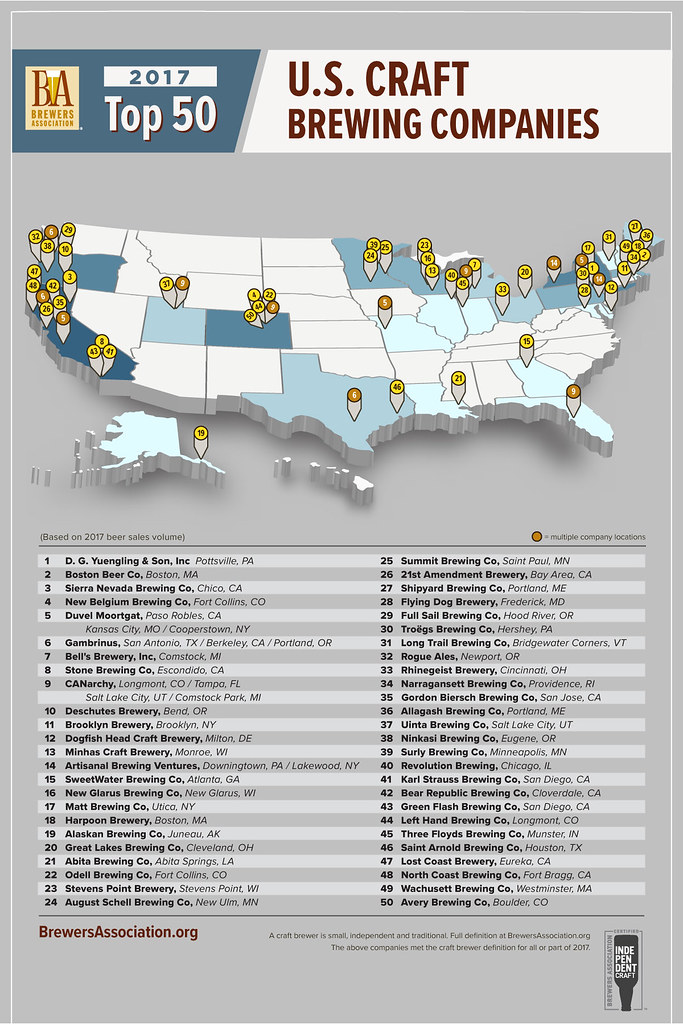
And similar to the last couple of years, the BA created a map showing the relative location of each of the breweries that made the list.

Top50_2017

Filed Under: Breweries, Editorial, Just For Fun, News, Politics & Law, Related Pleasures Tagged With: Big Brewers, Brewers Association, Business, Statistics, United States

Jack Kerouac’s Beer Prank

March 12, 2018 By Jay Brooks

kerouac
Today is Jack Kerouac’s birthday, one of the original beat writers, whose most famous work, On the Road, provided the voice for an entire generation. By all accounts he favored margaritas when drinking, and was quoted as saying “Don’t drink to get drunk. Drink to enjoy life.” After his premature death at 47, he’s continued to be hailed as a great writer. In 1987, John Montgomery compiled and published (through Fels & Firn Press), The Kerouac We Knew, of which only 1500 copies were printed.

kerouac-we-knew

It’s a collection of remembrances, essays and photographs about Kerouac, one of which was entitled “Footnotes from Lowell.” It’s apparently written by the Kerouac family’s paperboy, who was only in his teens when Kerouac died. His (or possibly her) mother worked at the local newspaper, the Lowell Sun, and apparently when she worked the night shift, would occasionally give Kerouac a ride home. The author reminisces with the following tale about one of Kerouac’s beer pranks.

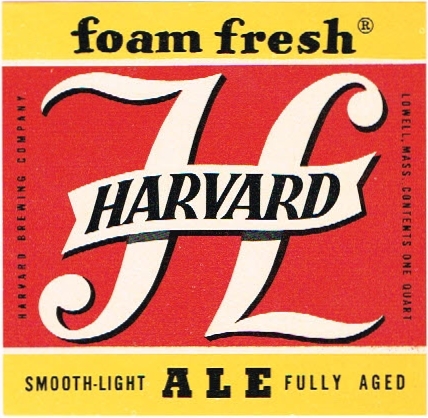
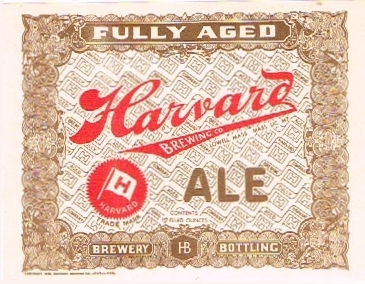
One evening, he persuaded them to stop off at Droney’s Pub on Broadway, his favorite, prior to Nicky’s: maybe in December, 1953. At one point he got off a stool and collected all the empty Harvard Ale bottles (brewed in Lowell, now defunct: Kerouac’s favorite beer, in green bottles with a cork). When he had gathered an armful, he re-stoppered them and one by one and slipped them into the old wood-burning Franklin stove in the center of the floor. The few people who did notice him figured he was just stoking the fire (the only source of heat). After he had filled the stove with 15 or 20 bottles he left the lid off and resumed his silent seat at the bar. Within minutes the pub was transformed into a diminutive Pearl Harbor. Kerouac just sat on his stool, surveying his work, laughing like a madman. This is the kind of escapade for which Jack is remembered in Lowell; escapades that poked fun at Lowell people in a loving way.

Apparently Jack Kerouac was known for his pranks, and this was a favorite one. The author speculates that this was his favorite beer, too, but I can’t find any other evidence for that, so who knows? Still, a fun little story.

Harvard-Ale--Labels-Hampden-Harvard-Breweries

Harvard-Ale-Labels-Harvard-Brewing-Company

Filed Under: Beers, Just For Fun, Related Pleasures Tagged With: History, Literature

Beer Birthday: Jay Brooks, Yes That One

March 3, 2018 By Jay Brooks

brookston
Today is my 59th birthday, and I’ve again been overwhelmed by an embarrassment of riches from well-wishers sending me notes via e-mail, Twitter and Facebook. My sincere thanks to one and all! As it’s usually me posting embarrassing photos of my friends and colleagues, here’s some more howlers of me from over the years.

birthday-2
One of my first birthdays, with far less beer.

indian-bday
A birthday in a simpler time, wearing my Y-Indian Guides uniform.

striped-suit
I wish I still had this striped jacket.

cat
Not quite ready for cat ownership.

construction-2
Ready for my Village People audition.

zerostat
Death by Zerostat (only old time audiophiles will get this).

bearded
Trying a beard. It didn’t last.

stare
I wish I could always make this face. The truth is I’m probably just reaching for some potato chips.

redhook
Visiting Redhook for the first time on my honeymoon in 1996. This was before GPS and we had some difficulties finding it thanks, I maintain, to a faulty map (not my misreading of it). But here I’m pointing out our location on the map, having finally made it after a few wrong turns.

Filed Under: Birthdays, Just For Fun, Related Pleasures Tagged With: History, Humor, Personal

Chalybeate Beer

February 20, 2018 By Jay Brooks

chalybeate
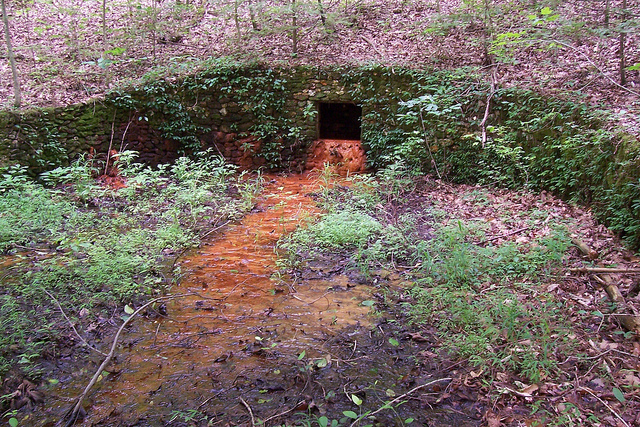
Today is the birthday of Henry James Pye, who “was an English poet, and Poet Laureate from 1790 until his death” in 1813. In one of his works, entitled “The sportsman’s dictionary: or, The gentleman’s companion: for town and country.” and his version was based on an earlier anthology work which he “Improved and Enlarged” and published in 1807. Under the entry for “Glanders” — an infectious disease primarily in horses — something was prescribed called “Chalybeate Beer” that included directions for how to make it. From what I can tell, “Chalybeate waters, also known as ferruginous waters, are mineral spring waters containing salts of iron.” They were apparently thought to be good for you and “in the 17th century, chalybeate water was said to have health-giving properties and many people have promoted its qualities.” Water from the springs was bottles and sold as medicine. Chalybeate springs were located throughout Europe, though especially in England, Scotland Wales, and there were at least seventeen prominent springs in the United States.

mineral-spring
A chalybeate spring, identifiable because of how the iron turns the color of the water.

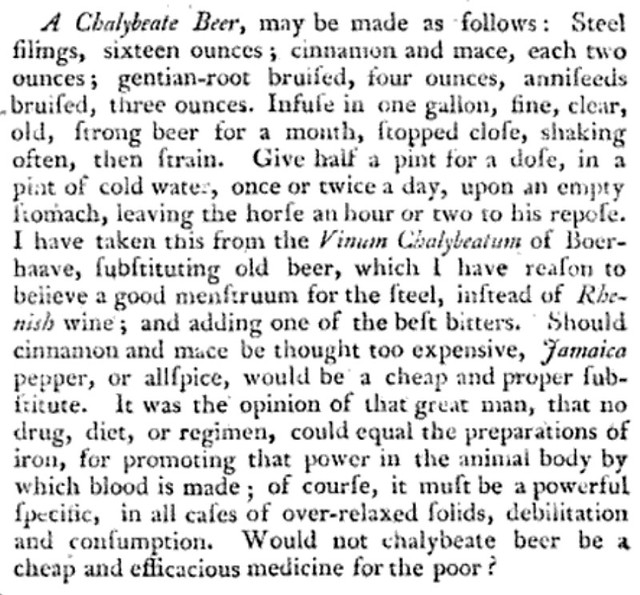
Here’s the passage about how to make Chalybeate beer (followed by the original):

A Chalybeate Beer, may be made as follows: Steel filings, sixteen ounces; cinnamon and mace, each two ounces; gentian-root bruised, four ounces, anniseeds bruised, three ounces. Infuse in one gallon, fine, clear, old, strong beer for a month, stopped close, shaking often, then strain. Give half a pint for s dose, in a pint of cold water, once or twice a day, upon an empty stomach, leaving the horse an hour or two to his repose. I have taken this from the Vinum Chalybeatum of Boerhaave, substituting old beer, which I have reason to believe a good menstruum for the steel, instead of Rhenish wine; and adding one of the best bitters. Should cinnamon and mace be thought too expensive, Jamaica pepper, or allspice, would be a cheap and proper substitute. It was the opinion of that great man, that no drug, diet, or regimen, could equal the preparations of iron, for promoting that power in the animal body by which blood is made; of course, it must be a powerful specific, in all cases of over-relaxed solids, debilitation and consumption. Would not chalybeate beer be a cheap and efficacious medicine for the poor?

chalybeate-beer-text

Now doesn’t that sound tasty?

Sandrock-Chalybeate
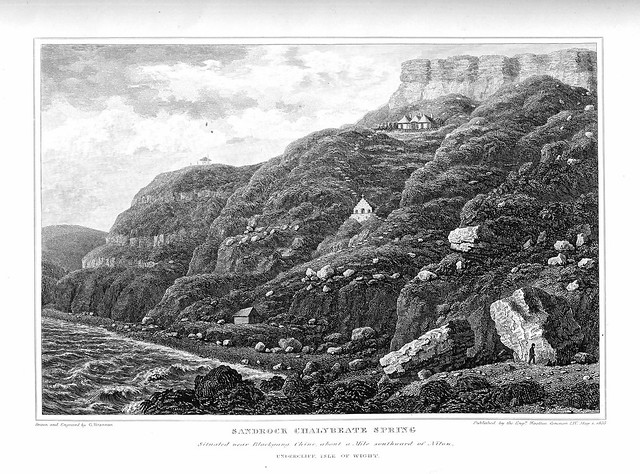
The Sandrock Spring, looking towards Blackgang Chine, located on the Isle of Wight.

Filed Under: Beers, Just For Fun, Related Pleasures Tagged With: England, Health & Beer, History, Science

Pretzels In America

February 8, 2018 By Jay Brooks

pretzel
While the exact origin of the pretzel is unknown, the best guess is that they originated in Europe, most likely among monks during the early Middle Ages.

Within the Christian Church, pretzels were regarded as having religious significance for both ingredients and shape. The knot shape has been claimed to represent hands in prayer. Moreover, the three holes within the pretzel represent the three persons of the Holy Trinity: God the Father, God the Son, and God the Holy Spirit. Pretzels made with a simple recipe using only flour and water could be eaten during Lent when Christians were forbidden to eat eggs, lard, or dairy products such as milk and butter. As time passed, pretzels became associated with both Lent and Easter. Pretzels were hidden on Easter morning just as eggs are hidden today, and are particularly associated with Lent, fasting, and prayers before Easter.

Not surprisingly, it was Germany — where they drink a lot of beer — that pretzels really came into their own. “Pretzel baking has most firmly taken root in the region of Franconia (modern German states of Bavaria and Baden-Württemberg) and adjoining Upper German-speaking areas, and pretzels have been an integral part of German baking traditions for centuries.” In fact, while the origin of the name “pretzel” is also uncertain, “the German name “Brezel” may derive also from Latin bracellus (a medieval term for ‘bracelet’), or bracchiola (‘little arms’),” and this is one theory of where the word came from.

But it wasn’t long before they arrived in America, too. “The Palantine Germans, later known as the Pennsylvania Dutch, brought pretzels to America in 1710. German children wore the pretzels around their necks on New Year’s for good luck.” According to Wikipedia, “In the late 18th century, southern German and Swiss German immigrants introduced the pretzel to North America. The immigrants became known as the Pennsylvania Dutch, and in time, many handmade pretzel bakeries populated the central Pennsylvania countryside, and the pretzel’s popularity spread.”

Sturgis-Pretzels-Julius-Sturgis-pretzel-sign

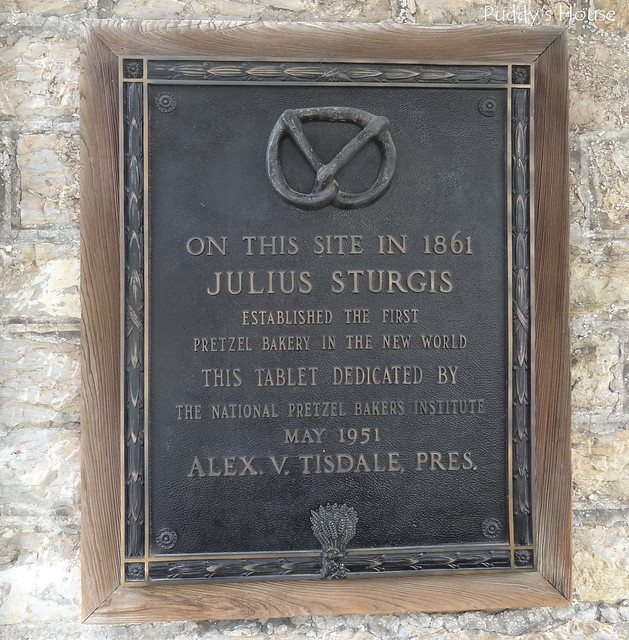
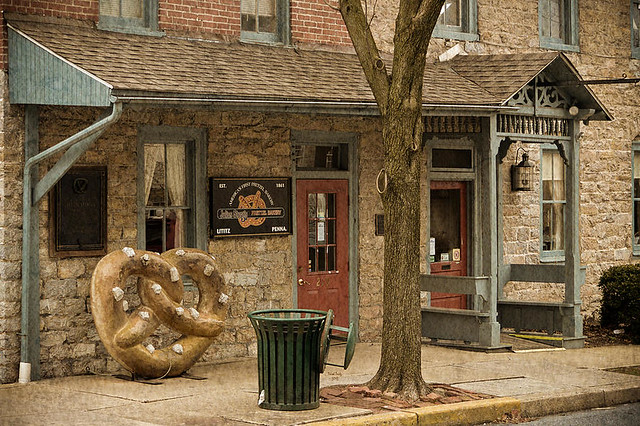
On February 8, 1861, Julius Sturgis opened the first commercial pretzel bakery in the U.S., in Lititz, and Julius Sturgis Pretzels is still open today, and still owned by the Sturgis family. Pennsylvania. Lititz is in Lancaster County, which is the next county over from Berks County, whose biggest city is Reading. I grew up near Reading, Pennsylvania, in the small town of Shillington, which was also the home of Tom Sturgis Pretzels, started by a relative of Julius.

julius-sturgis-pretzel-factory
The Julius Sturgis pretzel factory today.

According to the pretzel company website:

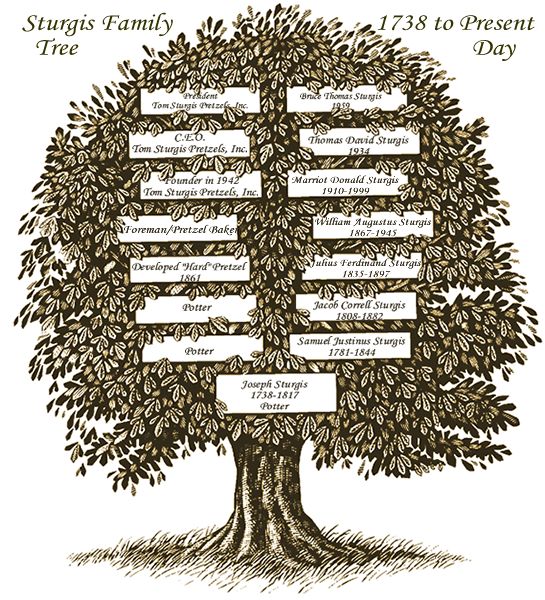
The Sturgis family continues to bake pretzels today, using the same old-fashioned recipe and methods established by Julius Sturgis in 1861. Marriott Sturgis, grandson to Julius, was born in 1910 and learned much of the pretzel baking trade in the original Lititz bakery, working for the family business before and after school. One of the bakers he worked alongside was his uncle Tom Keller, and because their mannerisms and baking styles were so similar, the other bakers began calling Marriott “Tom Sturgis”.

julius-sturgis-logo

When he was 14, “Tom’s” family moved from Lititz to Reading, Pennsylvania, where he continued to work in pretzel bakeries, including one run by his cousin Victor Sturgis. In 1936, he opened a pretzel bakery with his brother Correll called “Sturgis Brothers”, but World War II conscription took their entire workforce and by 1942 they were forced to close their doors.

Sturgis_family_tree

In 1946, after working at a munitions factory during the War, Tom Sturgis established another bakery, which he called Tom Sturgis Pretzels.

tom-sturgis-logo

Tom Sturgis Pretzels continues to operate today, run by his son, Tom Sturgis, Jr. and his grandson, Bruce Sturgis. The Sturgis family also now manages the Julius Sturgis Pretzel Bakery.

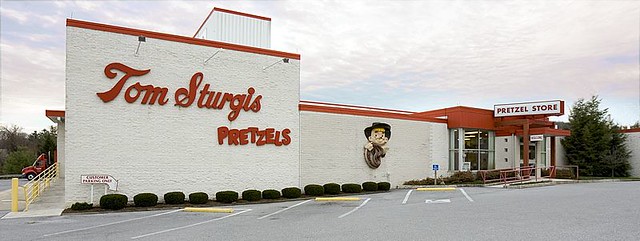
tom-sturgis-building
Tom Sturgis Pretzels in Shillington, Pennsylvania.

The grandson they mentioned, Bruce Sturgis, was a classmate of mine in high school. Though we weren’t close friends, we knew one another and later when I was the beer buyer at Beverages & more, I helped arrange for us to buy a truck of Tom Sturgis Pretzels for our stores. Bruce’s wife used to be married to the brother of a close friend of mine, and was also the sister of another classmate, and she came to stay with me in California for a couple of weeks before she remarried.

J-Sturgis-1800s
The Julius Sturgis preztel factory in the late-1800s.

My hometown of Reading, which has billed itself as the “Pretzel Capital of the World,” had an article entitled “Reading, Pretzel Capital of the World,” which originally appeared in the April 1948 issue of the Historical Review of Berks County:

A year or two before the Civil War, a pretzel baker moved with his family from the Moravian Village, Lititz, to Reading, then a city of some 20,000 inhabitants. And today, just 88 years later, Reading is the pretzel capital of the world.

An article in the Lancaster “Volksfreund” of July 30, 1879, states that “the first pretzel in the United States is said to have been baked in the city of Lancaster by one Scherle in the year 1827. He was followed by Ambrose Ranch in Lititz and later by a baker in Reading.”

The pretzel baker, Ambrose Ranch, had an apprentice, Julius Sturgis, who is generally credited as being first in America to establish pretzel baking as an industry, back in 1861, in Lititz. The Sturgis family has remained in the business ever since. There are two Sturgis pretzel plants in Reading today. Victor Sturgis, of West Lawn, was incorporated in 1924, followed by a cousin, Tom Sturgis, of South Second Street in 1928.

The baker in Reading, mentioned by “Der Volksfreund,” was Benjamin Lichtenthaler. He was born in Lititz on March 17, 1817. Lichtenthaler began baking pretzels which soon won great popularity throughout this and adjoining states. His factory was located at 37 Apple Street and later at 207 Cherry Alley. At the time of his death, in 1893, the factory output was 1,500,000 pretzels a year. The Lichtenthaler Bretzel Company was succeeded by the Pennsylvania Bretzel Company in 1900.

The local pretzel bakeries, incidentally, spelled their product “bretzels” as late as the early 1900’s. The only concern in Reading which has retained the original spelling is Billy’s Butter Bretzels, established in 1931 by William R. Edmundson at 242 Plum Street.

If Mr. Lichtenthaler established his bakery in 1860, the year he came to Reading, the where and when of the beginning of the pretzel industry in this country might be disputed and if “two teams constantly on the road,” comprise an industry, even Mr. Lichtenthaler may have to yield his laurels to John Sauermilch, Sr., of Boyertown, who started baking pretzels in that place about 1846.

In the Reading “Weekly Eagle,” of Feb. 25, 1893, there appears an interesting article, entitled “An Old Pretzel Baker.” From this source we learn that John Sauermilch, Sr., the subject of this article, was born in Germany in 1808 and that he learned the pretzel trade from his father, who was an expert baker in Germany. Sauermilch came to America when he was twenty years old. After working as a lime burner for eighteen years, he established a bakery in Boyertown, where he made pretzels just as his father had taught him in Germany. At the time the Eagle correspondent interviewed Mr. Sauermilch, the old, retired pretzel baker claimed that his pretzels had been in their day quite as popular as the Lichtenthaler pretzels of that time.

Mr. Sauermilch said at the time, “Americans are in many things ahead of the old country, but not so far as pretzels are concerned. In the United States it is much more difficult to find a good pretzel, than in Germany to find a bad one.”

Then the Eagle reporter asked why it was that so few bakers could make a first class pretzel. Mr. Sauermilch answered, “They don’t understand pretzel baking and yet think themselves proficient in the work. It is a trade by itself. Some bakers take only bread dough for their pretzel. The proper pretzel dough differs widely from bread dough.”

We leave Mr. Sauermilch and his reporter friend, discoursing upon the pleasant pastime of drinking beer (something which, according to Mr. Sauermilch, Americans did not know how to do either) and on eating pretzels in a beer garden along the Rhine.

Patriotism notwithstanding, Mr. Sauermilch was correct about the number of Americans who were not bona fide pretzel men. Often the bread bakers made left over pieces of dough into pretzels and gave them away with loaves of bread to encourage mothers to buy their product. True pretzel bakers, like Sturgis in Lititz and Lichtenthaler in Reading, had jealously guarded trade secrets and secret yeast formulas. In fact, both places at one time or another have seriously confided that the secret of the success of their pretzel lay in some special quality of the water found in their town. The pretzels were cooked in lye and there was also a great deal of secrecy observed as to where the lye was obtained. Lye from straw ashes was considered best, and next, the ashes of hardwoods. Hickory, walnut and maple were used by others. It is probable that the secret of the different flavors resided in the mixture of the various ashes.

While Benjamin Lichtenthaler has taken the place of most renown there were many others in Reading dedicated to the art of pretzel baking.

John S. Hendricks and John T. Adams, who operated as Hendricks and Adams, constantly referred to themselves in their advertisements, in the 1890’s as having formerly been with Lichtenthaler. The volume, “Reading, Its Representative Business Men and Its Points of Interest,” published in 1893, says of the Hendricks and Adams Firm: “The growth of their trade has already required the employment of six experienced men. The firm has a capacity of making 6,000 regular size bretzels per day, and their trade is constantly on the increase. They were located at 335 Cherry Street, began in business in 1893 and in 1898 employed eight men, operated two ovens and manufactured over 4,000 barrels of pretzels annually. Their investment was $5,000 and their annual product was worth $12,000. They were succeeded by J. T. Adams & Co., in 1907.

Another of the better known men of our town was Andrew Muntz, whose father, Augustus, began a bakery in 1856. He was located at 121 North Eight Street and, according to the personal recollection of Ira J. J. Reber, a well-known local collector, was well versed in the Bible and renowned for his wit and caustic tongue. In his daily selling trips about the county, he delighted in baiting all comers, local and “foreigner” alike. Mr. Reber recalls an occasion when lie asked a New Yorker why the people of New York never ate the cross in the pretzel, and after properly confounding the stranger, replied, “Because then they’d have nothing to sell.”

Mr. William A. Newmoyer, a baker at Quinlan’s, recalls that he learned pretzel baking at the Addison Guyer bakery, 435 N. Ninth Street, fifty-eight years ago. Other names that have long since disappeared are those of Daniel Mayer at 709 Penn St. and Christian Mayer at 52 N. Tenth St.; George May at 344 Locust St. and Charles Muntz at 1410 Muhlenberg St., who advertised his product: “200 for 1 dollar.” Frank P. Nistle started in 1903 on Walnut, above Locust, and William H. Behrle had a bakery on Fairview Avenue. The latter’s son, J. Behrle, is still associated with pretzel baking at the present Heller Bakery on North Ninth Street.

There is only one name, that, beginning many years ago, remains today as one of the largest representatives in the industry. In 1884, Joseph S. Bachman began baking pretzels in a small plant on Nicholas Street. The business prospered to such an extent that it was found necessary to take over additional space. On the death of Mr. Bachman, in 1923, the business was incorporated and moved to its present location in Hyde Park.

There are many types of pretzels available today. Many more have apparently disappeared with the years and new ones have taken their places. The popular butter pretzel, using shortening in addition to the other ingredients, seems to be a modern innovation. Also new are the pretzel sticks, extra thins and penny rods. The soft pretzel is considered one of the oldest types. The stamped cracker pretzel is popular. The sugar pretzel, similar to a sweet bun, has seemingly disappeared.

Mrs. Edith Rumbaugh recalls when Tom Hannahoe, Reading’s famous Mayor of Irishtown, kept three or four goats in the rear of his domicile. The neighbor children brought pails of potato peelings, apparently the mainstay of the animals’ diet, for which they were rewarded by Mr. Hannahoe’s housekeeper. The reward was an oblong pretzel-like cracker, known and remembered by the children as a “Tom Doodle.” Who made them, and how? There the trail of the “Tom Doodle” pretzel ends. We are not left in doubt concerning the close association between Reading and the pretzel, since even across the football field or basketball floor comes the derisive chant of the opponent’s cheering section:

“Pretzels and beer, pretzels and beer, Bach du lieber, Reading’s here!”

Pretzels are no longer, as they once were, necessarily the companions of beer. They are today served with ice cream and other delicacies. In fact, Quinlan’s claims the credit for bringing the pretzel out of the saloon into the parlor.

Although the process of manufacturing the pretzel is essentially unchanged today, modern machinery has speeded production from the “6,000 regular size bretzels per day” of the Hendricks and Adams era, to the 1,000,000 per day capacity of the present Quinlan Pretzel Co., which was started in 1923.

Today most of the pretzels are made from pure wheat flour to which is added only yeast, salt and water. After the dough is made, it is cut off into small pieces and rolled out into strips for twisting. This is done by hand or machinery according to the size of the bakery. The pretzel is let stand for a few minutes for the dough to rise and is then quickly placed in boiling water to which soda has been added. Here the pretzel is partly cooked, just as dumplings, noodles or other doughs are cooked in boiling water. After the pretzels are removed from the boiling solution, they are sprinkled with salt and placed in the oven, The heat of the oven prevents the salt from dissolving, and it clings tightly to the pretzel as it begins to bake. After being thoroughly baked, the pretzels are then placed in a drying or toasting oven to insure crispness.
pretzel-making

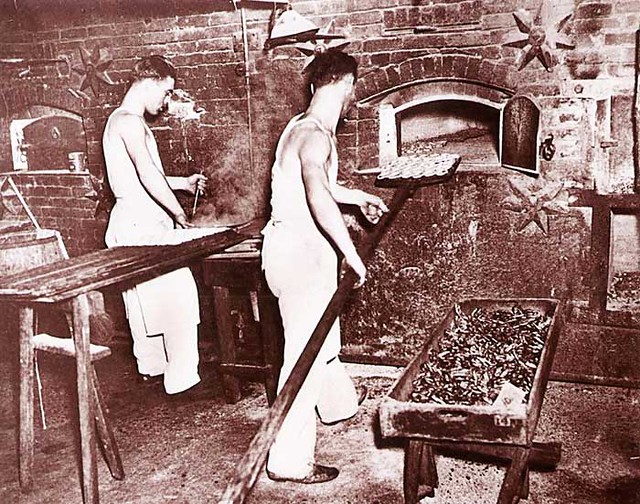
For almost a century the pretzels were baked in the same old style hearth ovens. It was a tedious process to place the pretzels in rows in the oven with a long handled wooden shovel, called a peel, and then to remove them again by the same method. The baker was always under a constant pressure to hustle them out in time to prevent burning. In the early days dough was kneaded on the quarter oak, with a jumping rail. A man sat on a lever and jumped up and down until the dough was thoroughly mixed.
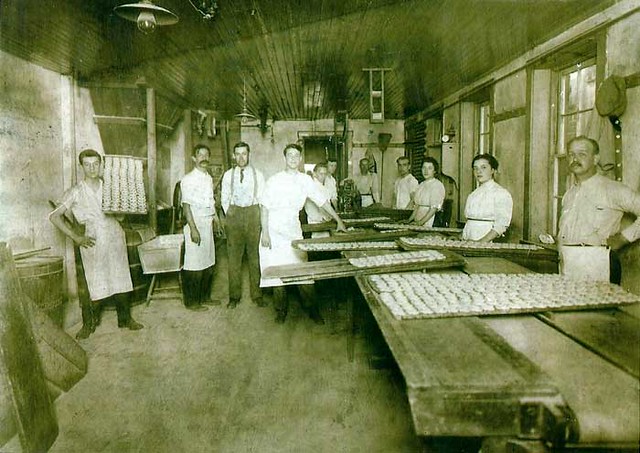
Gradually, each process was modernized. First the dough was mixed by a machine and then the correct quantity was cut off automatically and rolled; ready to be picked up and twisted by hand.

The Reading “Adler,” August 5, 1879, quotes from “Der Volksfreund” of Lancaster, July 30, 1879: “A skilled pretzel baker can form seven to eight pretzels out of dough in one minute and no more. However, three men in Lincoln [Lancaster County] have just invented an ingeniously constructed automatic pretzel machine and have had it patented. The names of the three men are Thomas K. Keller, Martin S. Keller and C. W. Myers. The new machine can form sixty to one hundred pretzels per minute or 3,000 to 6,000 an hour.”

Apparently “Der Volksfreund” was a bit premature with its announcement, for a check of the patent office in Washington reveals that no such patent was issued. From a Lititz newspaper clipping, dated October 1, 1942, in the possession of the Sturgis family, we learn that Thomas Keller had married one of Julius Sturgis’ daughters and was also a pretzel manufacturer. Although he had worked on a machine to twist the dough into the pretzel shape, he never succeeded. The trouble was that the dough was never the same consistency.

So the twisting itself stumped the inventors for many years and even Robert Ripley said, “believe it or not,” it couldn’t be done. Reading did it. In 1933 a pretzel machine was perfected by Quinlan’s and in the same year, Earl Curtis, of South Temple, now associated with the Bachman Bakeries, challenged by Mr. Ripley’s statement, also produced the impossible.

Mrs. Helen Hoffer, of Quinlan’s, also surpasses “Der Volksfrennd’s” statement of “seven to eight pretzels per minute and no more.” She deftly spins out the curleques at the rate of forty-five per minute. The rate on the machine varies with the type of pretzel and consistency of the dough, from about fifty to one hundred twenty per minute.

In 1943, the pretzel industry sent a brief to the VVar Manpower Commission, requesting that they be declared an essential industry. It was then that the Honorable Clair Booth Luce, in her usual vituperative manner, ran afoul of the industry by referring to pretzels and the W. M. C. as an indissolvable group of waltzing mice and pretzel benders.”

Congresswoman Luce promptly received her chastisement in the form of a letter from the National Pretzel Baker’s Institute and the “pretzel benders” were declared essential. In fact, it was proven that while bread trucks carry 60 per cent moisture, pretzels were the most perfectly dehydrated food made.

The pretzel industries of Reading ship their merchandise to all corners of the globe. Here is an excerpt from a Chamber of Commerce News Letter: “You perhaps are wondering just who it is that has a taste for pretzels in these [far away] places. Well, to be frank with you the Pretzel Industries are just as much mystified. The idea of a turbaned Hindu in India, or a saronged native in Batavia, munching on a pretzel is a bit hard to conceive. Nevertheless, if we are to believe the shipping addresses, that must be the case.

Reading produces one-third of all the pretzels baked in the United States. The production capabilities of our city’s industry are 15,000,000 pretzels per five-day week, using 900 barrels per week of winter wheat bought, we are informed, all in Berks County. According to the Department of Agriculture, twenty bushels of wheat is the yield per acre. Therefore, manufacturing the pretzels takes the output of 210 acres of farmland, week after week.

Aside from its unquestionable industrial importance, this oddly shaped little item has made for us a multitude of friends. It has been introduced to countless strangers by local concerns as Christmas gifts, and one of the first ideas for alleviating the lonesomeness and homesickness of a far away friend or relative, is the thought of sending some pretzels!

bakers-loading

One of my favorite memories as a child was being in downtown Reading with my stepfather. He took me down a side street, almost an alley, and I could smell baking pretzels. I think it may have been Unique Pretzels, which was Dad’s favorite brand, but I’m not sure. At any rate, it was a stone building, and my Dad went inside, while I peered in from the sidewalk, and could see the stone oven inside, with workers there using a large flat paddle to pull out freshly baked pretzels from it. Soon after, my father reappeared outside, handing me a hot, crunchy pretzel straight from that oven. Although I’m sure I’ve romanticized it over the years, that must have been the best-tasting pretzel I’ve ever had.

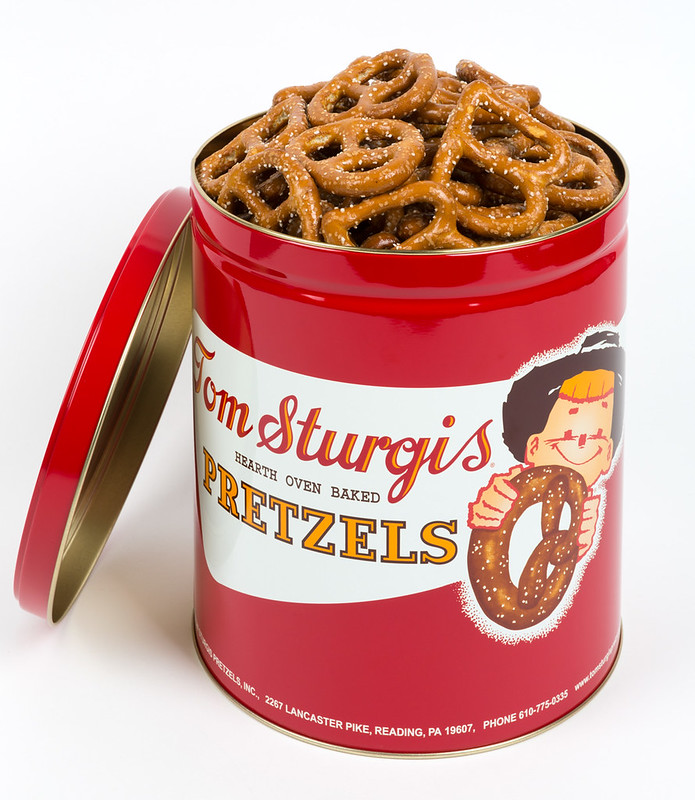
Although for everyday pretzels, I still do love the Tom Sturgis pretzels. They can be ordered mail order over the internet, and I treat myself to some every few years. I suppose it’s probably because they’re the ones I grew up with, but there were many others that were just as good, too. Sadly, we can’t get any decent pretzels here in California. Snyder’s used to be about it for anything decent, though I confess they’re about at the bottom of my list of edible pretzels. Happily, Cost Plus recently started carrying a large plastic tub of Utz Sourdough Specials that the family seems to go through at least one a month.

sturgis-can

Filed Under: Food & Beer, Just For Fun, Related Pleasures Tagged With: Bars, Comfort Food, Food

Brewhog Determines 6 More Weeks Of Winter Beers For 2018

February 2, 2018 By Jay Brooks

groundhog-day
Over in Gobbler’s Knob, in Punxsutawney, Pennsylvania, Phil the Groundhog — a.k.a. the Brewhog — raised up his head this morning and looked around, and this year and saw his shadow. You know what that means? It’s six more weeks of drinking winter beers this year. Or something about a late spring, I can’t keep it straight. You can see a video of Punxsutawney Phil here. And there’s more information about Groundhog Day at the Punxsutawney Groundhog Club.

groundhog-field-beer

But this year, I suppose given how the year is going, it isn’t too surprising, not every groundhog agrees on what the future hold. For example, both Staten Island Chuck along with Shubenacadie Sam in Canada have predicted an early spring. But General Beau Lee in Georgia agrees with Punxsutawney Phil that we’re in for more cold weather.
punxsutawney-philser

Although another Canadian groundhog, Balzac Billy, from Alberta, Canada, also predicted an early spring and so did Essex Ed of Orange, New Jersey. Ed also predicted the Patriots would beat the Eagles on Sunday so I’m not sure how reliable he is. But so did Big Al, a 14-foot, 1,000-pound alligator, from Texas, who is given KFC chicken each February 2. If he eats the chicken, it’s an early spring, if he passes, then it’s more winter. This year, he ate.

Then again, Buckeye Chuck of Ohio was saying we’re in for more winter

So it’s up in the air whether, I mean weather, we’ll have an early spring or more winter. I tend to go with the original, Punxsutawney Phil, but for no better reason then I’m from Pennsylvania. I guess we’ll have to wait and see.

alaskan-marmot
In Alaska, they celebrate Marmot Day.

Fingers crossed. And if you don’t have time to watch all of the deliciously wonderful Groundhog Day film today, here it is in a slightly shorter version just over three minutes.

Filed Under: Just For Fun, News, Related Pleasures Tagged With: Holidays, Pennsylvania

Start A Homebrewing Conversation For The Next Session

January 30, 2018 By Jay Brooks

session-the
For our 132nd Session, our host will be John Abernathy, who writes about beer at The Brew Site website. For his topic, inspired by the news that BA and AHA founder Charlie Papazian recently announced his retirment, has been thinking about homebrewing and is calling his topic Homebrewing Conversations. Essentially he’s calling for anything about “homebrewing — the good, the bad, your experiences, ideas, (mis)conceptions, or whatever else suits you, as long as it starts the conversation!”

carboy-range

Here are some suggestions Jon has about how you could approach the topic:

  • Do you homebrew, and if so, for how long? How did you get started?
  • Talk about the best beer you ever brewed at home—and your worst!
  • Are you a member of a local homebrew club (or even the AHA)? Tell us about your club.
  • Describe your home set up: do you brew all grain? Extract? Brew in a bag? Unusual mashing/sparging/etc. methods?
  • Have you ever judged a homebrew competition? Talk about that experience.
  • Are you a BJCP or other accredited beer judge? Talk about the process of becoming certified/official.
  • Never homebrewed/not a homebrewer? No problem! Consider these questions:
    • Do you know any homebrewers?
    • Have you ever tasted someone’s home brewed beer?
    • Would you ever be interested in learning how to brew? Why or why not?

homebrewing
So by this Friday, February 2, or thereabouts, start your homebrewing conversation. To participate in the February Session, simply leave a comment at the original announcement and leave the URL to your post there, or tag him on Twitter or on Facebook (or even Instagram) with your post, and I’ll round up all the entries early next week.

keep-calm-and-drink-homebrew

Filed Under: Beers, Just For Fun, News, The Session Tagged With: Announcements, Blogging, Homebrewing

« Previous Page
Next Page »

Find Something

Northern California Breweries

Please consider purchasing my latest book, California Breweries North, available from Amazon, or ask for it at your local bookstore.

Recent Comments

  • Bob Paolino on Beer Birthday: Grant Johnston
  • Gambrinus on Historic Beer Birthday: A.J. Houghton
  • Ernie Dewing on Historic Beer Birthday: Charles William Bergner 
  • Steve 'Pudgy' De Rose on Historic Beer Birthday: Jacob Schmidt
  • Jay Brooks on Beer Birthday: Bill Owens

Recent Posts

  • Beer In Ads #5389: Point & Brunswick Bock Beer November 10, 2026
  • Historic Beer Birthday: Edward Cecil Guinness November 10, 2026
  • Historic Beer Birthday: Jacob Betz November 10, 2026
  • Beer In Ads #5388: Bock Beer Vats In The Brewers Hall November 9, 2026
  • Historic Beer Birthday: Peter Barbey November 9, 2026

BBB Archives

Feedback

Head Quarter
This site is hosted and maintained by H25Q.dev. Any questions or comments for the webmaster can be directed here.