
Just found this fun little infographic entitled The World’s 25 Weirdest Drinking Customs. Not sure these are the weirdest, but it’s a fun list nonetheless.

To see the infographic full size, click here.

Just found this fun little infographic entitled The World’s 25 Weirdest Drinking Customs. Not sure these are the weirdest, but it’s a fun list nonetheless.
To see the infographic full size, click here.

Our 93rd Session is hosted is Brian Devine, who writes The Roaming Pint, along with Maria Scarpello, and the pair “have been traveling around in their 29-foot RV, named Stanley, since August 2010 seeking out all kinds of great beer destinations.” For their topic, they’ve understandably chosen Beer Travel.
Since travel is such an important part of our lives I wanted our topic to focus on beer travel. In Session #29, Beer by Bart asked writers to tell them about their favorite beer trips to which they got some great responses of personal favorites and general tips for certain cities.
So as not to tread over old ground my question is going to focus on the “why” more than the “what”. So I ask you fellow bloggers and beer lovers, why is it important for us to visit the place the where our beers are made? Why does drinking from source always seem like a better and more valuable experience? Is it simply a matter of getting the beer at it’s freshest or is it more akin to pilgrimage to pay respect and understand the circumstances of the beer better?
Beer travel has exploded in the last few decades and has become a far bigger part of the success of smaller and local breweries than we often acknowledge. When I was a kid — yes, I’m old — most of the big breweries offered tours but because there were so few operating in the U.S., they were few are far between. Before I was old enough to drink I’d been inside the Budweiser brewery in Virginia (then associated with what used to be called Busch Gardens: The Old Country, an amusement park in Williamsburg), Yuengling (not too far from where I grew up in Pennsylvania) and the old Reading brewery in my hometown (though not for a tour, my stepfather stopped by to see a friend, with me in tow). But apart from the national breweries and the regionals hanging on by their fingernails, there simply wasn’t a lot of beer tourism opportunities around.
Abroad was slightly different, certainly in nations with rich brewing traditions. But this was before Americans traveled very much, before air travel became affordable for many more people. When I was young, a trip by plane was rare for almost everybody I knew. I was ten before I set foot on a plane, and I still beat many of my friends into the air. By contrast, my kids had flown maybe a dozen times before they reached double digits, and tellingly they’ve been complaining lately that it’s been far too long since we’ve taken a vacation via airplane (so we’re spending Thanksgiving in Hawaii). But back then, most people who discovered good beer in other countries were stationed there as part of their military service or had business travel in Europe. You hear that story repeated a lot.
My first trip to England was in 1982, when I was still a civilian, but I still managed to visit a couple of breweries — Fuller’s and the old Orange Brewery in Pimlico, an early British brew pub. But among my friends, at least, that was still a rarity. I moved to California in 1985, and between the many new breweries opening then along with Safeway’s Liquor Barn chain, things finally started to open up. But it’s been a slow, if steady climb. With renewed interest in beer generally, travel to beer locations like England, Belgium, Germany and the Czech Republic seemed to increase dramatically, and there were tour companies set up for the occasional beer tour, and some of the early beer magazines set up their own tours, as well. Little by little, breweries started getting more visitors each year. The smart ones prepared for them, hired tour guides, created gift shops with merchandise to sell, added tap rooms for sampling, which only increased the people coming.

Inside the Trappist brewery at Rochefort.
In the 2000s, beer weeks started emerging, providing even greater incentives for beer travel. Smart tourism boards in cities and towns embraced these as a way to encourage travel to their areas, and the beer weeks that have flourished have been great for their respective hometowns. I used to keep track of all the beer weeks (though sadly have fallen behind) but as of a couple of years ago there were over 100 beer weeks worldwide, though the bulk of them are in North America.
But now that we’re approaching 3,000 breweries in America, beer travel has gone mainstream. There’s just so many to visit, and most new breweries plan for visitors. Few breweries open these days without merchandise, tours or a tasting room. They know people will visit them, in a children of the barleycorn “if you build it, they will come” sort of way. Many guilds and visitors centers have created brewery tour maps as part of the literature available for tourists, knowing many will ask for this information. People, friends and relatives, I know who are outside the beer bubble most of us live or work in, are coming back from trips with tales of breweries visited, something almost unthinkable a decade or two ago. Even my recently retired schoolteacher uncle and nurse aunt, who barely drank a drop before, are counting breweries as places visited in their globetrotting golden years. It’s definitely become a thing, with a life of its own.
But the question posed by this Session’s host was not is it happening, but why? Why do we want to visit a brewery? Why is the source a “valuable experience?” It is, if you think about it, a curious development. Breweries are, at their most basic, factories; manufacturing plants; or temples to scientific and technological achievement. I’ve never admired my television enough to visit the factory where it was produced, nor virtually anything else in my home. These things may even inspire me, or make my life easier, or better, but I’ve never mustered the same curiosity about how they were made that would make me set sail on a pilgrimage to their birthplace. I’m not dying to see where the car parked in my driveway came to life, so to speak. Why not?
I’m sure someone will come up with a better answer, but I think it’s because those are all tools. They remain outside of ourselves. Beer, like all food and beverages, we ingest. It literally becomes part of us. We take it in and it becomes part of who we are. Clothes don’t make the man (or woman), but food and drink do. Food and beverages feed our soul. Food starts grand novels. Drinking fuels poetry.
Given my love for potatoes, you won’t be surprised to learn I’ve visited several potato chip makers. I’ve even been to two pretzel factories. Growing up, Hershey’s Chocolates (near where I grew up) had a wonderful tour inside the plant, the air positively thick with chocolate aromas as you walked past giant vats of it (sadly, today it’s merely a ride at Hersheypark where they pump in the chocolate smells as you sit passively in a moving car winding through dioramas). The point is I want to see where my food comes from, especially my favorite foods.
With beer, for me at least, the importance of seeing the brewery is the context. I like seeing where it was created, the space itself, the coiled hoses (ask anybody), the gleaming copper or stainless steel brewery porn. I love the smells hanging in the air, both in and around the brewery. Hearing (and seeing) the brewer explaining his process, or how he came up with the idea or recipe for a beer, is different on his or her home turf, as opposed to a meet the brewer event at a pub or behind a table at a festival.
Similarly, I like to see where the hops were grown, or the barley malted. Does it make the beer taste better? No. Does it even make me appreciate it more? Maybe, but probably not. It’s just the context of seeing where it came from, how it was put together and then tasting the finished beer. It’s a more complete picture, but I’ll certainly enjoy the beer without all that pageantry. That is, my taste buds and stomach will, my soul is another story. For that to be piqued, I need the added context of place; of geography. Where, and under what circumstances, we eat or drink anything, will alter the way it tastes, the very experience of tasting it. We know this to be true, so why should it be a surprise that place matters. Location, location, location.

Wading through the hop fields in Yakima, Washington.

Andy Capp, the British comic strip by Reg Smyth has been running in London newspapers, and around the world, since 1957. Even though Smyth himself passed away in 1998, the strip continued on, done by a trio of writers and artists, Roger Kettle, Lawrence Goldsmith and Roger Mahoney. Capp, of course, is a longtime fan of beer, spending much of his time down the pub. Longtime Bulletin reader Miles (thanks Miles) sent me a link to a recent Sunday strip that tackled the newer phenomenon of beer tourism, relevant to me because when it arrived in my inbox I was indeed touring breweries in Belgium. Enjoy.


This year the California Craft Brewers Association (CCBA) celebrates its 25th anniversary, and they just concluded a two-day conference in Santa Rosa. I missed the first day (traveling home from Belgium) but gave a talk yesterday morning on the history of craft beer in California. But the highlight of day two was a panel discussion with three craft beer pioneers, John Martin (Triple Rock), Ken Grossman (Sierra Nevada) and Fritz Maytag (Anchor), moderated by Vinnie Cilurzo (Russian River).
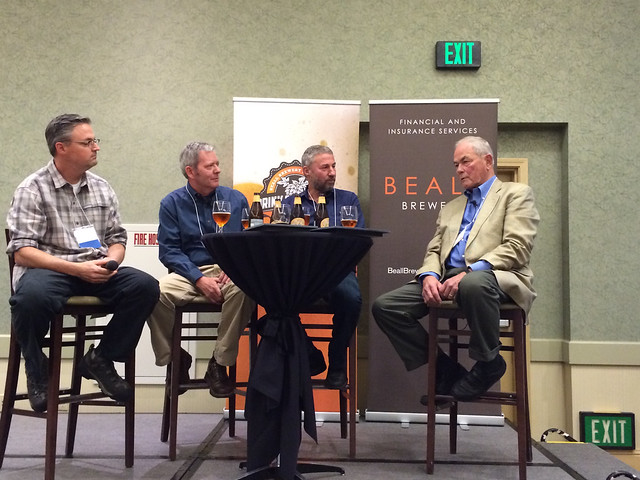
The trio spoke for around an hour, then the audience asked a few questions. I captured the main part of the talk (not the Q&A) in two parts (due to limitations of my camera) which you can watch below. There’s a short gap in between the two videos, only a few seconds. It’s a fun and fascinating talk. Enjoy.
And here’s Pt. 2.
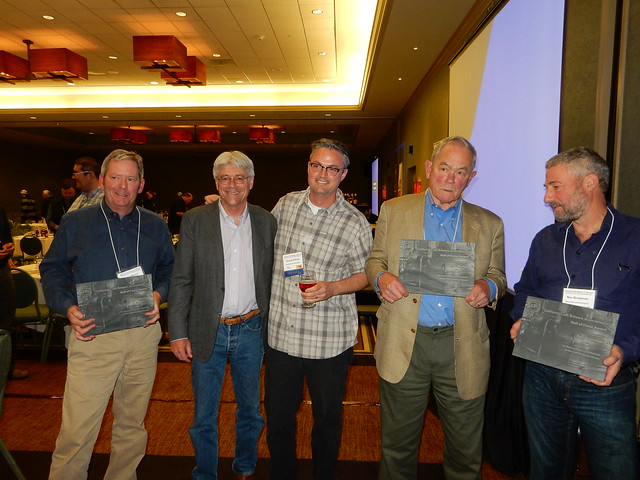
After the talk, John Martin, CCBA executive director Tom McCormick, Vinnie Cilurzo, Fritz Maytag and Ken Grossman.

There was an interesting story posted on Popular Science, specifically their BeerSci series. They did a great job of spinning the story as a love story, albeit an unusual one between fruit flies and brewer’s yeast, especially since the original title of the study they’re reporting on was The Fungal Aroma Gene ATF1 Promotes Dispersal of Yeast Cells through Insect Vectors. But it is, and in How Flies Are Responsible For Beer’s Tasty, Fruity Smells, they detail how,”[i]n a series of experiments, biologists from several institutes in Belgium demonstrated that brewer’s yeast makes fruity, floral smells to attract fruit flies. In the wild, yeast might live on rotting fruit and entice flies to come to them there. Yeast and flies’ relationship benefits them both, the biologists found. Previous studies have found that eating yeast helps fruit fly larva develop faster and survive better. This new study found that fruit flies help spread yeast to new environments, like a bee spreading pollen.” In effect, their study demonstrates “the co-evolution of two species.”
Here’s the summary from the original, published in Cell Reports.
Yeast cells produce various volatile metabolites that are key contributors to the pleasing fruity and flowery aroma of fermented beverages. Several of these fruity metabolites, including isoamyl acetate and ethyl acetate, are produced by a dedicated enzyme, the alcohol acetyl transferase Atf1. However, despite much research, the physiological role of acetate ester formation in yeast remains unknown. Using a combination of molecular biology, neurobiology, and behavioral tests, we demonstrate that deletion of ATF1 alters the olfactory response in the antennal lobe of fruit flies that feed on yeast cells. The flies are much less attracted to the mutant yeast cells, and this in turn results in reduced dispersal of the mutant yeast cells by the flies. Together, our results uncover the molecular details of an intriguing aroma-based communication and mutualism between microbes and their insect vectors. Similar mechanisms may exist in other microbes, including microbes on flowering plants and pathogens.

You can also read the entire study as a pdf, but to get a sense of what it all means, read Francie Diep’s How Flies Are Responsible For Beer’s Tasty, Fruity Smells and keep in mind her warning from the outset. “Sorry, but brewer’s yeast did not evolve for you.” Perhaps not, but at least we can still reap the benefits of the relationship between those fruit flies and the yeast used to create delicious beer.


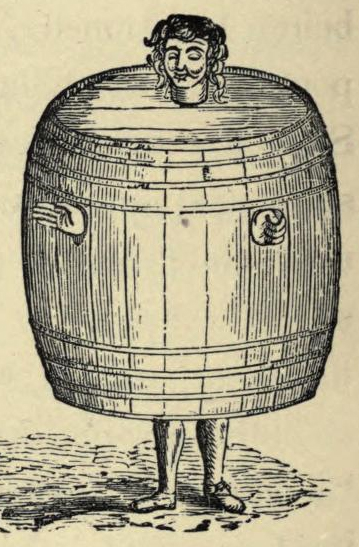
Once upon a time, society kept everybody in line through social pressure, and if that didn’t work, public humiliation. The pillory was a common punishment, and you’re undoubtedly familiar with the main type, a wooden stake with two perpendicular pieces of wood that fit together, with holes for a person’s head and both hands, so that once all three were secured, you were stuck in the public square for a period of time depending on the severity of your crime. But that was only the most common type, and there were several others, such as the scold’s bridle or the jougs. But there was also a specific pillory used in the case of public drunkenness. In England, it was known as a Drunkard’s Cloak.
According to one source, “Drunkenness was first made a civil offence in England by the Ale Houses Act 1551 and the drunkard’s cloak became a common method of punishing recidivists, especially during the Commonwealth of England. From 1655 Oliver Cromwell suppressed many of England’s alehouses, particularly in Royalist areas, and the authorities made regular use of the cloak.”
The 1655 publication England’s Grievance Discovered, by Ralph Gardiner, describes the Drunkard’s Cloak like this.
Men drove up and down the streets, with a great tub, or barrel, opened in the sides, with a hole in one end, to put through their heads, and to cover their shoulders and bodies, down to the small of their legs, and then close the same, called the new fashioned cloak, and so make them march to the view of all beholders; and this is their punishment for drunkards, or the like.
“Drunkards are to pay a fine of five shillings to the poor, to be paid within one week, or be set in.”
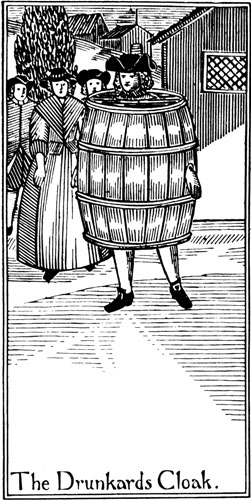
In 1655, John Willis claimed that in Newcastle-upon-Tyne, England, “he hath seen men drove up and down the streets with a great tub or barrel opened in the sides, with a hole in one end to put through their heads, and so cover their shoulders and bodies, down to the small of their legs, and then close the same, called the newfangled cloak, and so make them march to the view of all beholders; and this is their punishments for drunkards and the like.”
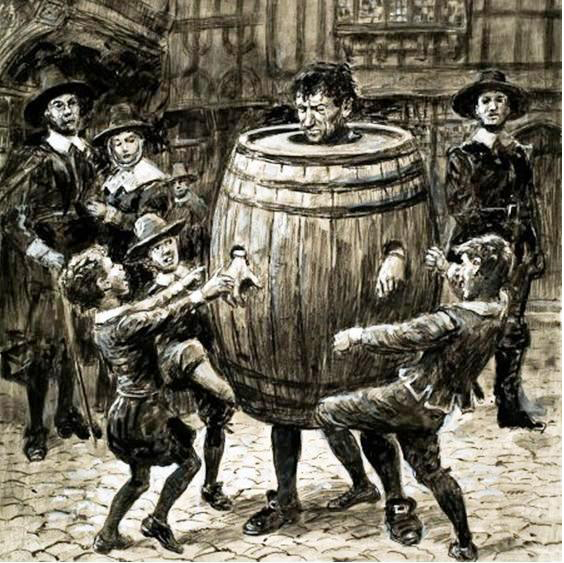
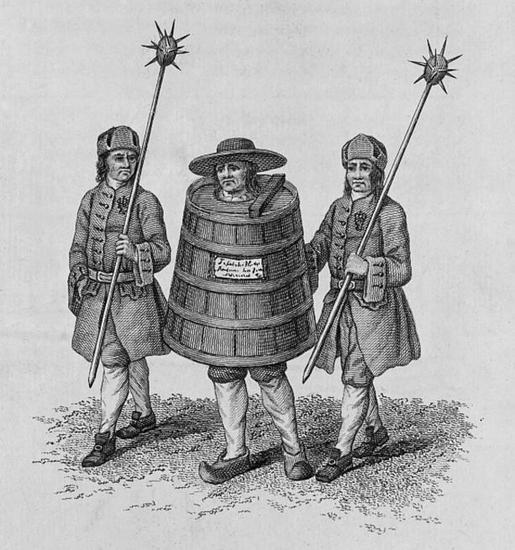
It was also used in other parts of Europe, though often called by different names, such as the Spanish Mantle or the Barrel Pillory. In Germany, it was called a Schandmantel, which means “coat of shame” or “barrel of shame.”
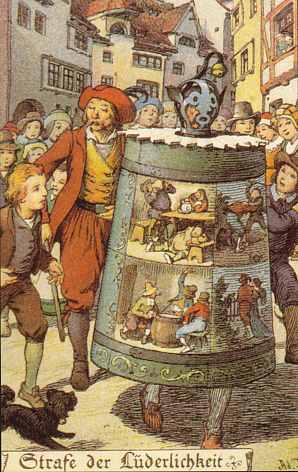
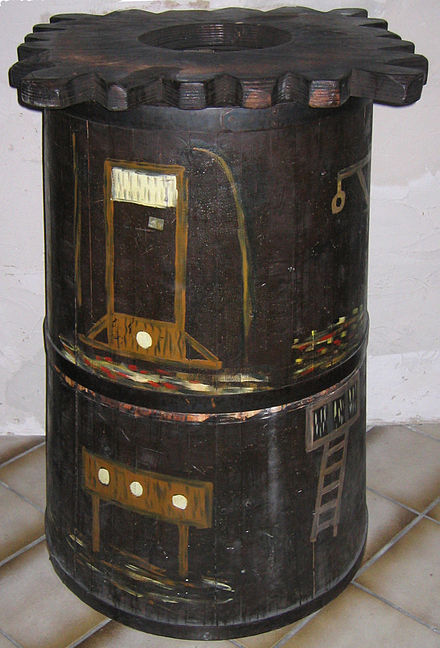
And there’s actual one in the torture museum in Freiburg im Breisgau, Germany.
By some accounts, the Spanish Mantle may have been a more serious torture device, intended to inflict more than just humiliation.
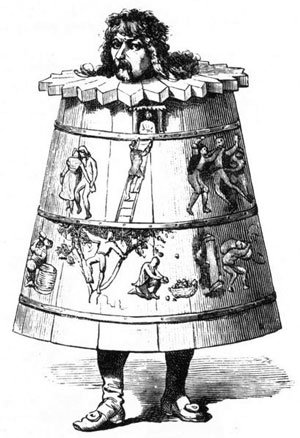
A 1641 diary entry by John Evelyn described one in Delft, Holland as “a weighty vessel of wood, not unlike a butter churn, which the adventurous woman that hath two husbands at one time is to wear on her shoulders, her head peeping out at the top only, and so led about the town, as a penance for her incontinence.”
Apparently this type of punishment was not confined to Europe, and also made its way to the American colonies.
Massachusetts Bay Governor John Winthrop, in 1634, noted that Robert Cole (1598-1655), who had come to Massachusetts with the Winthrop Fleet in 1630, “having been oft punished for drunkenness, was now ordered to wear a red D about his neck for a year.” Some literature professors suggest that this was the origin of the story written by Nathaniel Hawthorne, The Scarlet Letter.
“Robert Cole was living in Roxbury, Massachusetts, when he petitioned to be made a “freeman” on 19 Oct 1630, and was granted that status by the General Court on 18 May 1631, along with 113 other men. He was disfranchised 4 Mar 1634, for a short time on account of his problem with drinking too much wine, when he was also ordered to wear a red letter “D” on his clothing for a year; however, his freeman status was reinstated about two months later on 14 May 1634, and the requirement to wear the letter ‘D’ was also revoked at that time.”
And according to Curious Punishments of Bygone Days, published in 1896 by Alice Morse Earle, it was used during the American Civil War, as well.
Another Union soldier, a member of Company B, Thirteenth Massachusetts Volunteers, writes that while with General Banks at Darnstown, Virginia, he saw a man thus punished who had been found guilty of stealing: With his head in one hole, and his arms in smaller holes on either side of the barrel, placarded “I am a thief,” he was under a corporal’s guard marched with a drum beating the rogue’s march through all the streets of the brigade to which his regiment was attached. Another officer tells me of thus punishing a man who stole liquor. His barrel was ornamented with bottles on either side simulating epaulets, and was labelled “I stole whiskey.” Many other instances might be given. There was usually no military authority for these punishments, but they were simply ordered in cases which seemed too petty for the formality of a court-martial.
This “barrel-shirt,” which was evidently so frequently used in our Civil War, was known as the Drunkard’s Cloak, and it was largely employed in past centuries on the Continent.
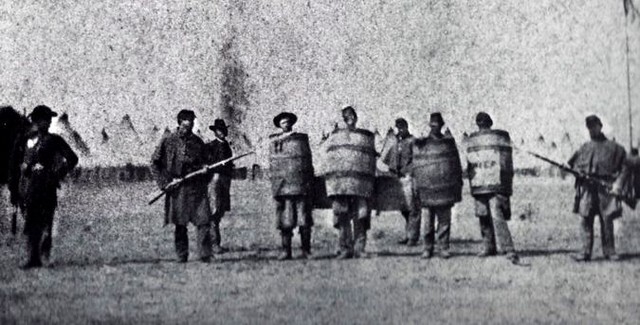
Another eyewitness account from 1862 described the scene as follows. “One wretched delinquent was gratuitously framed in oak, his head being thrust through a hole cut in one end of a barrel, the other end of which had been removed; and the poor fellow loafed about in the most disconsolate manner, looking for all the world like a half-hatched chicken.”
Surprisingly, the most recent example I found for the Drunkard’s Cloak was in 1932, when it was still in use in American prisons, such as the Sunbeam Prison Camp, in Florida, which is where the photo below was taken.
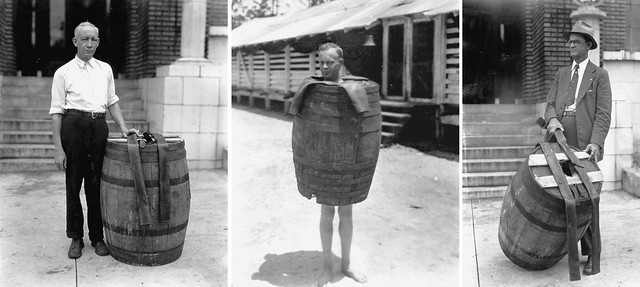
I’m certainly glad that public shaming has, for the most part, been removed from our justice system. Although I’ve never been arrested for public drunkenness, I’ve certainly made a fool of myself in private or with friends, and this certainly seems a bit excessive. Clearly, it was ineffective at controlling peoples’ behavior, but I wonder what it was in the end that finally stopped it being used as a punishment?

I learned this trick from my great aunt, who used to put dishes of stale beer out to attract and kill various pests, including slugs. I knew it worked it, but I don’t think I ever quite knew why. According to a short article in the September issue of Mental Floss, Why Do Slugs Love Beer?, the answer is that the “sweet smell of yeast attracts slugs to beer like moths to a flame.” Quoting Ian Bedford, head of the John Innes Centre’s Entomology Facility in Great Britain, “A lot of slug species feed on decaying plant material,” adding that “beer resembles overripe fruits, which burst with naturally fermenting yeasts that slugs can’t resist.”


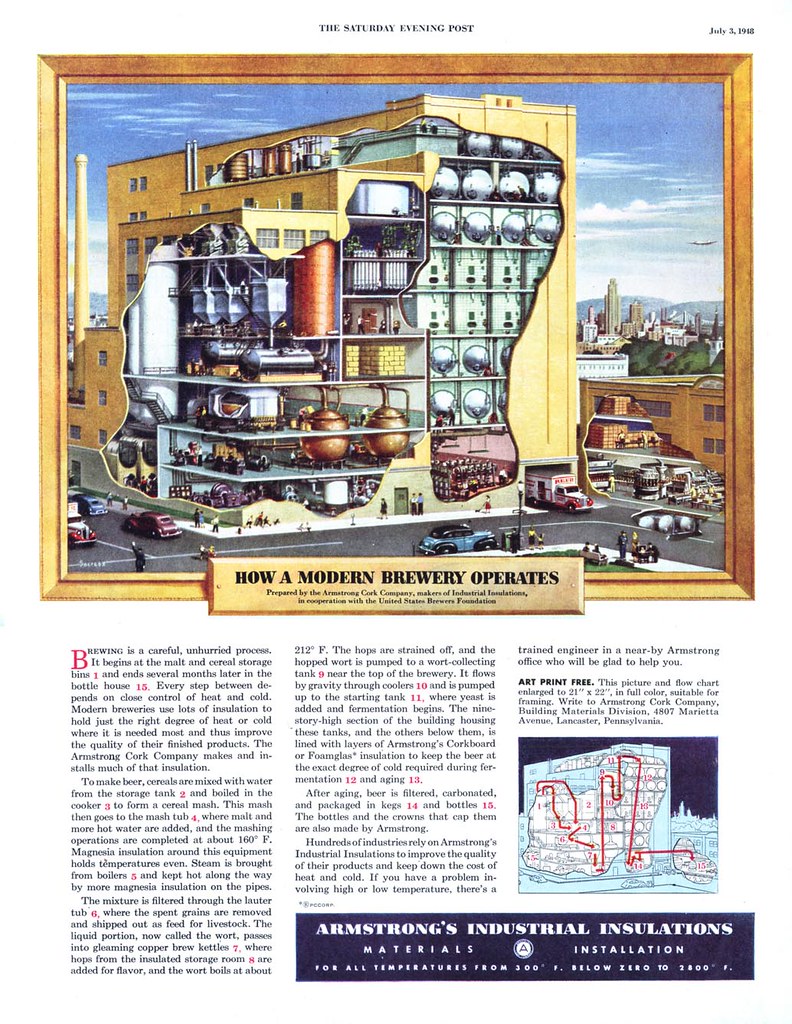
Here’s another fascinating artifact of the 1940s, by a little-known artist, Frank Soltesz. “How a Brewery Operates” was one of around 29 cutaway illustrations he did for a client, Armstrong’s Industrial Insulations (specifically their Armstrong Cork division). The ads were produced between 1947 and 1951, and ran in the Saturday Evening Post, each one designed to show how Armstrong’s products were used in a wide variety of scenarios. Apparently you could even send away for a 21″ by 22″ print, which was, as the ad says, “suitable for framing.” “How a Brewery Operates” ran in the Post on July 3, 1948. It can viewed full size here. You can also see many more of his cutaways at Full Table or Past Print.

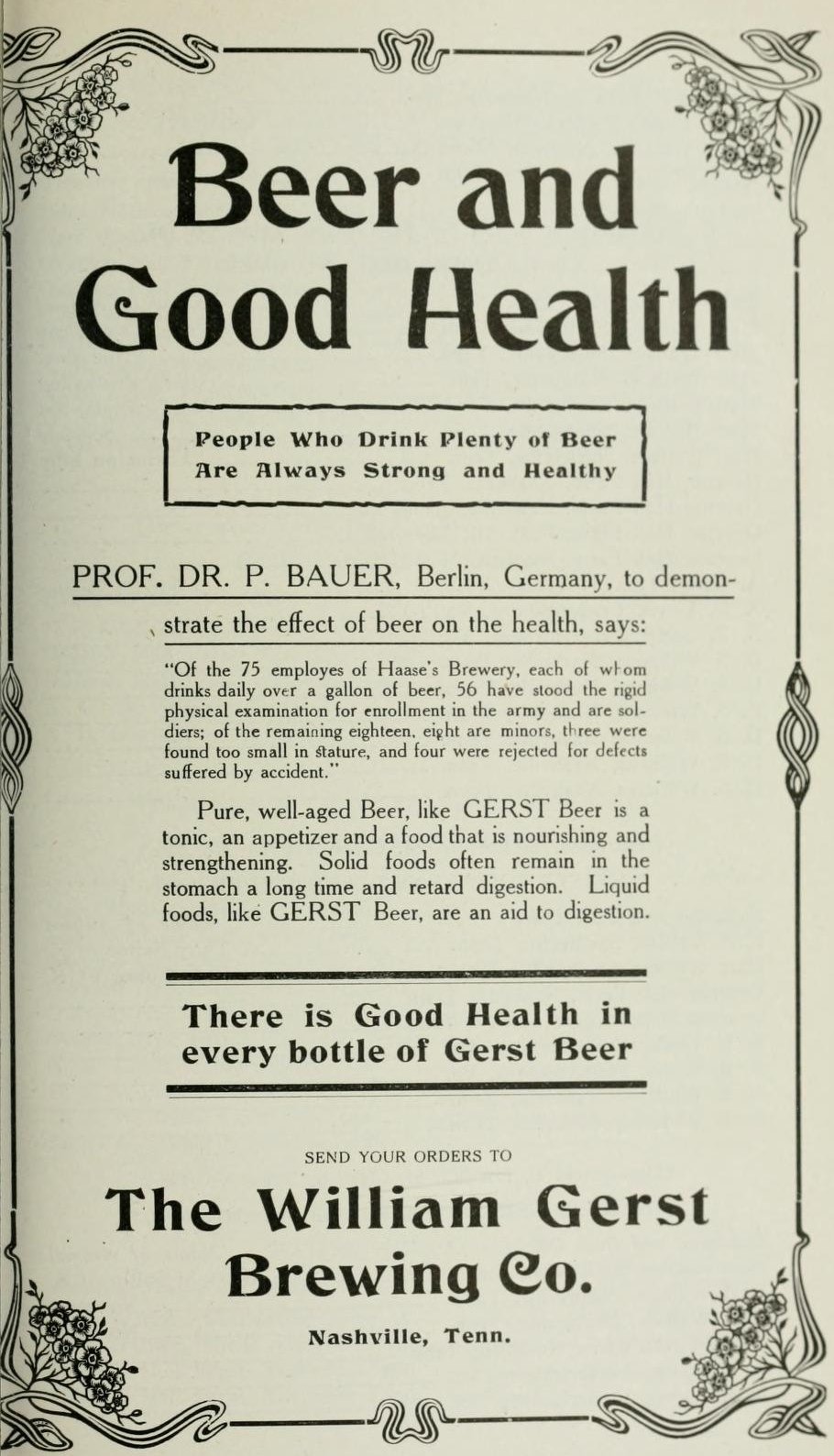
Here’s another interesting historical artifact on beer and good health. This is from the Tennessee State Fair Official Souvenir Program and Guide, from 1907, advertising a talk by a German professor, Dr. P. Bauer, “demonstrating the effect of beer on the health.” It looks like his appearance was sponsored by the William Gerst Brewing Co. of Nashville, Tennessee. One insight he could be expected to give: “Solid foods often remain in the stomach a long time and retard digestion. Liquid foods, like GERST Beer, are an aid to digestion.” Oh, and there’s this subtitle. “People Who Drink Plenty of Beer Are Always Strong and Healthy.” The ad then ends with this branded tagline: “There is Good Health in every bottle of Gerst Beer.”

This was too funny not to share. Today, October 2, in 1959, during the World Series between the Chicago White Sox and the Los Angeles Dodgers, White Sox left fielder Al Smith had something of an unpleasant time. In the fifth inning, an excited fan in the outfield leapt to his feet, and in the process accidentally knocked over the beer that had been resting on the top of the outfield wall.
The spilled beer and cup rained down on Smith, hitting him square on the head, and dousing him pretty thoroughly. At first he thought it was intentional, but the field umpire assured him it had been accidental. After the game, they learned that the fan was “Melvin Piehl, a motor oil company executive, who later stated that he was trying to catch the ball so it would not hit his boss’s wife.” The White Sox went on to lose this second game at Comiskey Park, and ultimately the Dodgers won the 1959 series, four games to two. Luckily, Ray Gora of the Chicago Tribune snapped a picture at precisely the right moment and captured a piece of history.
