Brookston Beer Bulletin

Jay R. Brooks on Beer

  • Home
  • About
  • Editorial
  • Birthdays
  • Art & Beer

Socialize

  • Dribbble
  • Email
  • Facebook
  • Flickr
  • GitHub
  • Instagram
  • LinkedIn
  • Pinterest
  • RSS
  • Twitter
  • YouTube

Powered by Genesis

Anchor To Release Liberty Ale In Cans

May 12, 2015 By Jay Brooks

Anchor-Liberty-Ale
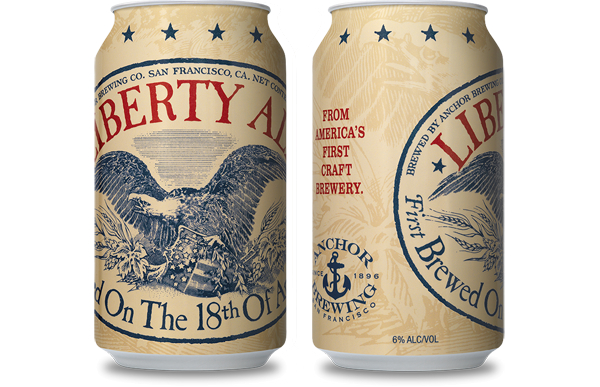
Anchor Brewery announced today that they will be releasing Liberty Ale in 12 oz. cans, at least for a limited time. The cans are “a commemorative offering celebrating the 40th anniversary of the historic beer that started a revolution.” From the press release:

“I remember brewing the first batch of Liberty Ale with Fritz Maytag 40 years ago. We were both young and eager beer lovers and knew we wanted to create a beer unlike anything else at that time,” said Anchor Brewing Brewmaster Mark Carpenter. “We had come across a new hop variety called Cascade that had a distinct piney bitterness that we used in the brew. Through Fritz’s interest in history and travel he’d learned of a process European brewers used called dry-hopping; adding dry hops to beer fermenting in the cellar to boost its hoppy aroma. So we dry-hopped the ale with whole-cone Cascade hops, as well. During an era when light lagers were prevalent, Liberty Ale was a very hoppy ale for most people. Their palates were shocked and delighted by such a unique beer.”

The beer was originally sold to the public beginning in 1975, when the country was seized by bicentennial fever. Liberty Ale commemorated the 200th anniversary of Paul Revere’s ride. Considered the first American IPA brewed after prohibition,” it was also “the first modern dry-hopped ale in the US and was the beer that popularized the now-iconic Cascade hop.” Beginning this month, Liberty Ale 6-pack cans, as well as bottles and kegs, will be available throughout the U.S.

Anchor-libery-cans

Filed Under: Beers, Breweries, News Tagged With: Anchor Brewery, Announcements, Cans, new release, Press Release, San Francisco

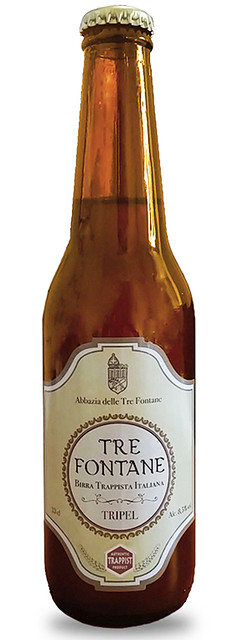
Italy’s Tre Fontane Approved As Newest Trappist Brewery

May 11, 2015 By Jay Brooks

trappist-brown tre-fontane
Last week, the International Trappist Association approved the 11th monastery brewery to be allowed to designate their beers as “officially” Trappist. There are now six Trappist breweries in Belgium, two in the Netherlands, and one each in Austria, the U.S.A. and now Italy. The latest monastery brewery, Abbey at Tre Fontane, is located in Rome, Italy. It was a religious spot since Roman times (from around the first century), and became affiliated with the Cistercian Order in 1625. According to Wikipedia:

Belonging to the monastery are three separate churches. The first, the Church of St. Paul of Three Fountains, was raised on the spot where St. Paul was beheaded by order of Emperor Nero. Legend accounts for the three springs (fontane) with the assertion that, when severed from Paul’s body, his head bounced and struck the earth in three different places, from which fountains sprang up. These still flow and are located in the sanctuary.

tre-fontane

That’s where the beer’s name comes from, Three Fountains Tripel, which is an 8.5% a.b.v. Tripel, brewed with Eucalyptus. That’s because the monks of the Tre Fontane Abbey planted fields of eucalyptus to combat malaria beginning in 1870. They also make olive oil, honey (flower, acacia, and eucalyptus), chocolates, and a Trappist liqueur.

Tre-Fontane-tripel

The beer is described by the ITA like this:

“The high carbonation gives the mouthfeel a pleasant dry finish. The mildly sweet aftertaste comes from the soothing flavor of eucalyptus herb, which cleanses and refreshes the palate. While the beer gives the impression of being light, it has abundant body. The high alcohol content adds a warm, refined feeling to the soothing highlights of the eucalyptus.”

Filed Under: Beers, Breweries, News Tagged With: Italy, Trappist Beer

American Craft Beer Week 2015

May 11, 2015 By Jay Brooks

acbw-2015
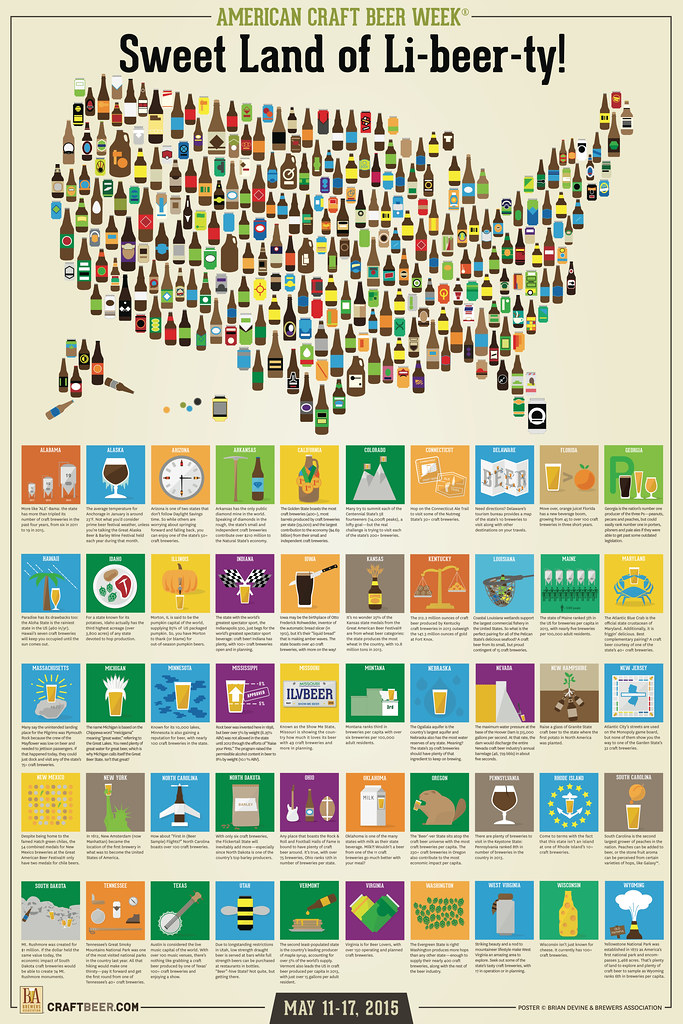
Today begins the 10th annual American Craft Beer Week, which is themed this year as Cheers to the Sweet Land of Li-beer-ty. This year it will take place May 11-17, and “all 50 states will hold events including exclusive brewery tours, special craft beer releases, food and beer pairings, tap takeovers and more to honor the ever-advancing craft beer culture and unite tens of thousands of beer lovers nationwide.”

“American Craft Beer Week has provided independent beer fans across the country a chance to support their local breweries since 2006,” said Julia Herz, publisher of CraftBeer.com and craft beer program director at the Brewers Association. “With celebrations happening in all 50 states, this is truly an annual national event that recognizes all those involved in making craft beer from small breweries in the U.S. such a success.”

You can also follow news of ACBW and see what events have been scheduled and the list can be searched by state. The BA this year has also “created an interactive graphic with fun facts to commemorate each state and their commitment to craft brewing.”

acbw-map-2015
Click here to see the ACBW poster full size.

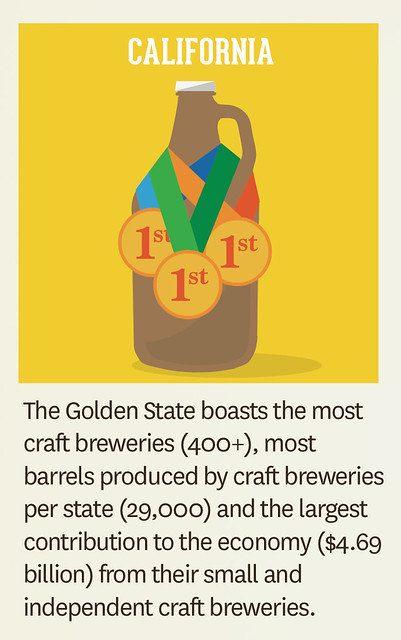
And here’s a larger view of what they had to say about California.

acbw-map-2015-cal

Filed Under: Beers, Breweries, Events, Just For Fun, News Tagged With: Beer Weeks, Brewers Association, Holidays

Economic Impact Of California Beer

May 6, 2015 By Jay Brooks

california
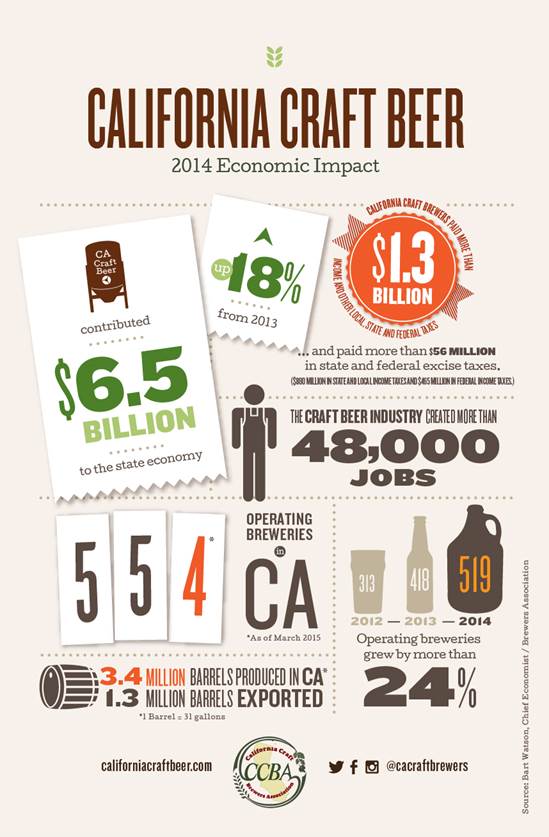
The California Craft Brewers Association (CCBA) recently commissioned an economic impact study of the state’s brewing industry for last year. And the news is pretty great. Here’s some of the highlights:

Economic Impact: In 2014 craft beer contributed more than $6.5 billion to the economy of California. That’s up 18% from 2013. That’s a fairly conservative number and they’ll have a more accurate and most likely higher numbers in June when the full report is finished. The craft beer industry in California has a higher economic impact than any other state in the US.

Employment: In 2014 Craft Brewers employed more than 48,000 Californians.

Growth: During 2014 the number of operating breweries grew by over 24% giving us a total of 520 operating breweries in California.

Taxes: In 2014 California craft brewers paid over $56 million in State and federal excise taxes and paid more than $1.3 billion in income and other local, state and federal taxes ($880 million in state and local income taxes and $465 in federal income taxes).

Production Volume: 3.5 Million Barrels

Exports: 1.3 million barrels. (That’s still higher than the total production of all but two other states (PA and CO)).

cal-econ-2015

Filed Under: Beers, Breweries, News, Politics & Law, Related Pleasures Tagged With: California, CCBA, Economics, Infographics, Statistics

Norway’s E.C. Dahls Joins Brooklyn Brewery Family

April 27, 2015 By Jay Brooks

brooklyn
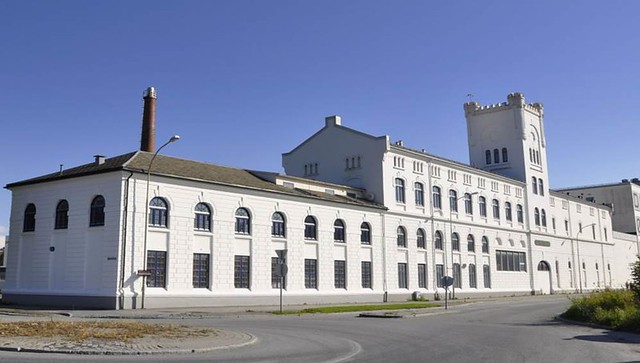
The Brooklyn Brewery announced today that E.C. Dahls Joins the Brooklyn Brewery Family. E.C. Dahls Brewery was originally founded in 1856 (there’s more history at Wikipedia) and today is owned by the Carlsberg Group. Here’s the press release from the Brooklyn Brewery:

Welcome to the Continuing International Adventures of Brooklyn Brewery. In our last episode, just over a year ago, we teamed up with our friends and importers at Carlsberg to open Nya Carnegiebryggeriet (NCB) in Stockholm, Sweden. NCB is our first sister brewery and its launch was the first time any American craft brewery ever entered into such a venture abroad. Today we’re proud to announce that we’re getting the gang back together once again to welcome E.C. Dahls Brewery in Trondheim, Norway into the Brooklyn Brewery family.

dahls-brewery

We’re excited to be part of a new era in brewing at E.C. Dahls. Founded in 1856, Dahls has been a treasured presence in Trondheim for generations, and its traditional pilsner is a household name there. We’re dedicating ourselves to preserving this storied history while infusing the new venture with the spirit of brewing creativity and innovation that have become hallmarks of Brooklyn Brewery around the world. The new E.C. Dahls will blend American and Norwegian culinary cultures to create new beers that we’ll enjoy brewing and we believe Norwegian beer fans will enjoy drinking.

This is far from our first journey to Trondheim, of course. Brewmaster Garrett Oliver has regularly gone out of his way to visit during his many travels. Between the streetscapes of the seaside city, the thriving Scandinavian food scene that Garrett has followed for more than a decade, and the wonderful local appreciation of Brooklyn beer, it was always pretty easy to be enthralled with Trondheim. A couple years ago, Garrett hosted a beer dinner with local restaurateur Roar Hildonen, and the two quickly bonded over Roar’s great food and stellar Cognac collection. Roar became a fast friend and will now join us in leading the kitchen of the planned E.C. Dahl’s Tasting Room.

“The new E.C. Dahls will celebrate the great tradition of Dahls and bring the brewery and its portfolio into the thriving world of craft beer,” said Garrett. “Norway already has a great beer scene, and we’re really excited to become an even more active part of it.” As in Stockholm at NCB, there will be no Brooklyn brewed in Norway but visitors will be able to have some Brooklyn in the Tasting Room.

The Carlsberg Group also released their own press release, where they characterize the deal as a “collaboration.”

With the aim of creating the premier beer experience in Norway, the collaboration will see a new brewery with pub, restaurant, conference facilities and visitor center established at the existing Ringnes E.C. Dahls brewery site in Trondheim, Norway. The brewery will produce both popular local Dahls beer, as well as new craft beers that take inspiration from both Norwegian and US craft brewing traditions.

The brewery will welcome beer and food enthusiasts from around the world and become a laboratory for new ideas and experimentation. E.C. Dahls will have a top-class restaurant operated by local restaurateur Roar Hildonen.

“This is great news for the E.C. Dahls brewery, and great news for beer lovers in Norway and beyond”, says Jørn Tolstrup Rohde, Senior Vice President for Western Europe at Carlsberg Group. “Carlsberg’s collaboration with Brooklyn continues to explore new possibilities in craft brewing. Carlsberg started its life as a small brewery in Copenhagen back in 1847, and thanks to the resurgence of craft brewing in recent times, more and more people are getting interested in the world of beer. We think that’s very positive.”

Another interesting international development as American beer spreads its reach globally.

dahls

Filed Under: Breweries, News Tagged With: Brooklyn, Norway, Press Release

Brains & Beer

April 23, 2015 By Jay Brooks

brain-2
There was an interesting article this March on the Huffington Post by a neuroscience Ph.D. student at Northwestern University, with a BA in Behavioral Biology from Johns Hopkins University, Lisa Qu, entitled Why Brain Science and Beer Go Hand-In-Hand. In it, she observes that in her field of study, which she describes as olfaction, beer and neuroscience “can be tightly intertwined.” It’s something we all know, but it’s great to see that science is taking it more seriously, and that it’s being talked about in mainstream media, too.

beer-on-the-brain

Filed Under: Beers, Just For Fun, News, Politics & Law, Related Pleasures Tagged With: Science

What 3,465 Breweries Are Doing To The Hop Supply

April 22, 2015 By Jay Brooks

hop
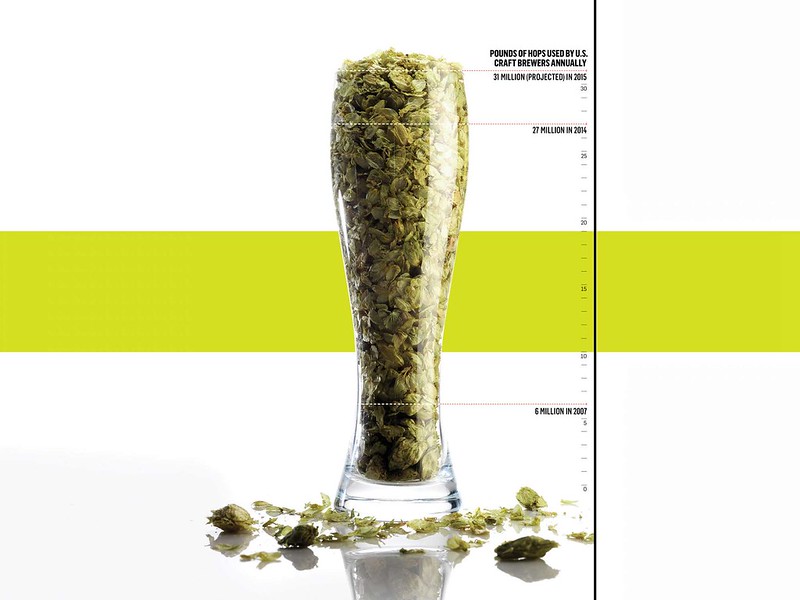
I admit there’s a certain “duh” factor to this, but it’s still interesting to see the numbers. With IPA and other hoppy beers accounting for over 20% of the craft beer market, there’s not enough hops being grown to keep up with current demand, and it will only get worse as interest continues to grow, as it seems likely the popularity of hoppy beers will be with us for the foreseeable future. This is from the May 2015 issue of Popular Science, which has a short article entitled Craft Beer is Annihilating the Hop Supply, which adds that demand for hops has “nearly quadrupled in the past decade.”

The article is subtitled “why that might be a good thing,” presumably alluding to the increased demand, but never really answers that question satisfactorily. There’s a quote from the former director of the Hop Growers of America, Doug MacKinnon, saying “Craft brewing is sucking up every pound of hops in the U.S. Growers can’t expand fast enough,” and suggesting that’s opening up the market beyond Washington, Oregon and Idaho, where U.S. hop growing has been concentrated at least since prohibition ended.

The article cites as proof that “single-acre hop operations are popping up on other types of farms across the country, including “Growers in New York, Minnesota, and Colorado,” and I’m also aware of similar efforts with commercial farms in Maine, Wisconsin and California, and I’m sure I’m forgetting somebody. Hops-Meister, which is near Clearlake, started in 2004 and grows ten different varieties on at least 15 acres. Co-owner Marty Kuchinski will be talking to my class tonight about hop farming. California used to grow more hops than any other state prior to prohibition, but never rebounded as farmers here found they could make more per acre growing grapes, but it’s why that legacy includes the town of Hopland and the Hop Kiln Winery. And New York used have an entire hop industry in the 19th century, until a downy mildew problem and other issues forced many to move production out west. So it’s little surprise that, with more modern farming methods, this growing demand would bring back hop farming to many parts of the country, not to mention a strong desire for brewers to have more local ingredients.

But the numbers just seem crazy: 27 million pounds of hops in 2014, and an estimated 31 million pounds this year.

hops-use

Filed Under: Beers, Breweries, Editorial, News, Related Pleasures Tagged With: Hops, IPA, United States

The Incredible Beerable Egg

April 19, 2015 By Jay Brooks

egg
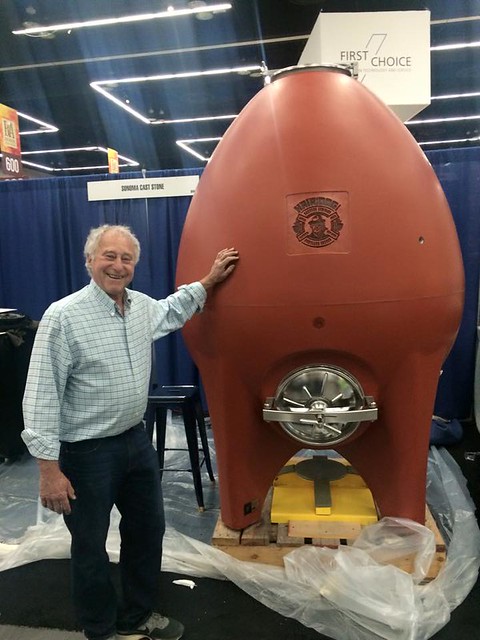
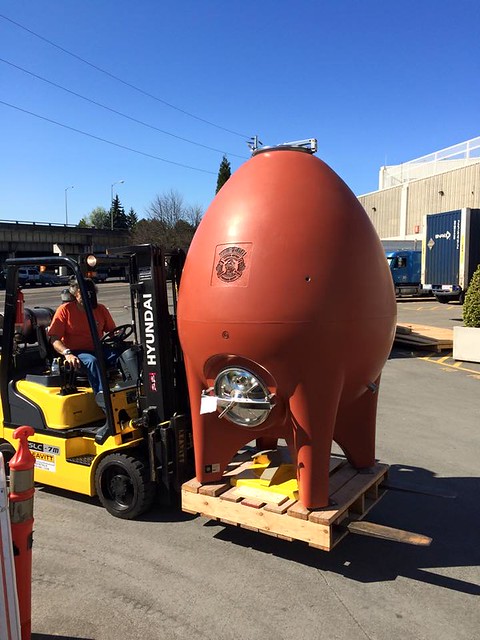
One of the highlights of this years Craft Brewers Conference in Portland was a potential innovation in brewing undertaken by Alan Sprints at Hair of the Dog Brewing. Alan posted a picture of his newest fermenter arriving to be displayed at the trade show, with Steve Rosenblatt from Sonoma Cast Stone, who manufactured the concrete fermenter.

egg-arrives

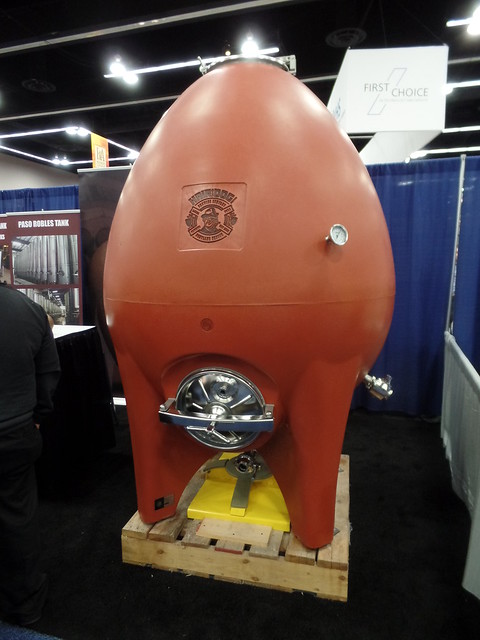
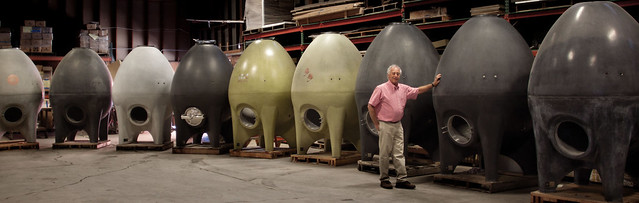
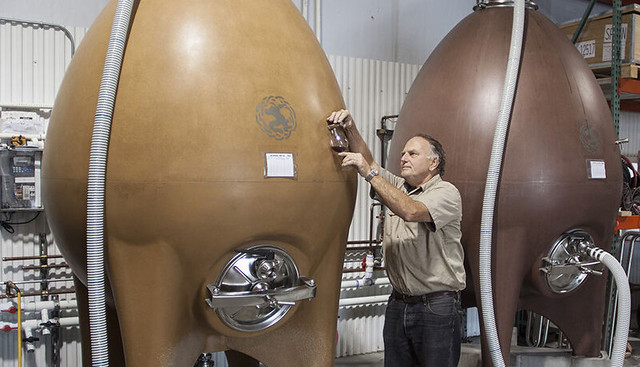
I was immediately intrigued and finding it in the trade show was one of my first missions of CBC. It turns out it was made in Petaluma, which is just down the road from where I live. The company has been making concrete fermenters for the wine industry, but this is the first one they’ve made for a commercial brewer. They have a separate website for this part of their business, Concrete Beer Tanks.

SAM_0428

There’s two sizes, the Amphora, which is 320 gallons and the one Hair of the Dog ordered, which is the Egg Shape, which is 476 gallons (or just over 15 barrels).

egg-wide

Their brochure lists the benefits of a concrete fermenter:

  • Concrete has natural temperature stability, and our tanks offer an optional, embedded glycol system for precise control.
  • Concrete allows the design of organic shapes, promoting convectional fermentation flow with no corners for fluid to pocket or stagnate.
  • The porosity of concrete allows for micro-oxygenation to aid in initiating the fermentation process.

egg-1

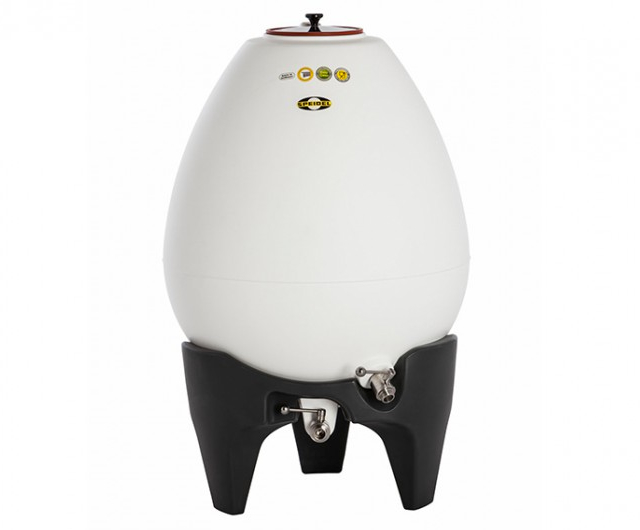
Apparently the wine industry has been using these increasingly in recent years, but they have been used for centuries prior to the advent of stainless steel. Just a quick search reveals quite a few articles about their growing use in winemaking. For example, in Wine Spectator, Wine Enthusiast, Wines and Vines, Seattle Magazine and the North Bay Business Journal. And there’s at least one other domestic manufacturer, Vino Vessel and a German company, Speidel, that makes a Gärei Fermentegg, or Fermentation Egg.

gaerei

Here’s how Speidel describes their fermentation egg:

The organic fermentation in the egg-form is based on the golden ratio without corners and edges. Wine, beer and cider could move fluently during the fermentation and storage. This gentle process guarantees on keeping the completely development of the product. The idea of fermentation or aging in the egg is just to come back to the ancient methods but with the new materials. Already in the ancient times beer has been placed for resting into the egg-formed amphoraes. Recently there were several successful tests for storage wine in the egg-formed fermentation vessels made of concrete. Shortly after Speidel has developed the fermentation egg made of food-safe polyethylene.

The fermentation egg is appropriate for the fermentation of wine, beer and cider. Fans and devotees of the fermentation egg confirm that the fermentation process runs spontaneous, therefore wine and beer taste more filigree and complex. Check it out and convince yourselves! Our food-safe polyethylenes have high permeability of oxygen. This ensures the evenly influence of oxygen and perfect conditions for the fermentation and maturation. It is very easy to clean the egg because of its smooth surface inside.

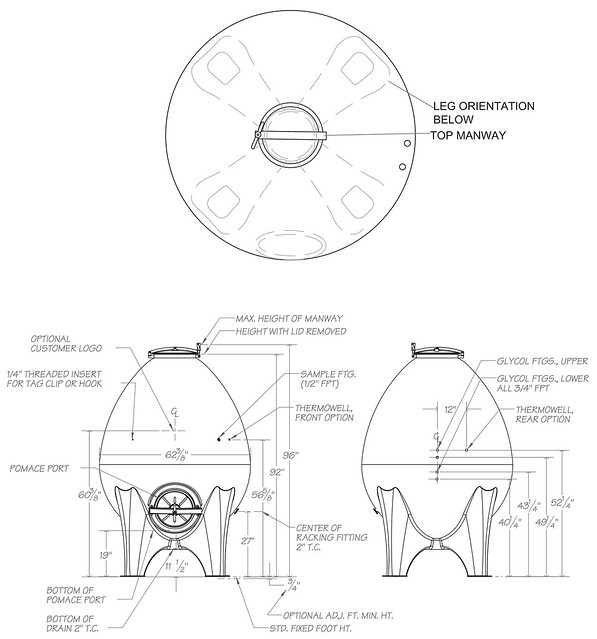
Here’s a drawing of the tank.
egg-tank-specs

Sonoma Cast Stone online has their reasons why brewers should consider concrete beer tanks:

Winemakers love concrete…

Winemakers all over the world are rediscovering the benefits of using concrete as a medium for fermentation, finding the virtues of both of oak and stainless steel with the drawbacks of neither. Now, most of the world’s highest-rated wines are made in concrete.

The craft beer industry is at least as creative and dynamic as the wine industry, and we at Sonoma Cast Stone are thrilled to offer you artisans of fermentation a new medium to create with. We predict a renaissance of innovation, producing an exciting, new generation of wild beers, sour beers, meads and porters.

Concrete is cool! No… really.

Concrete can take the heat, or the cold. It’s a natural insulator and will stabilize the temperature of whatever is inside of it. This stability makes for a smooth and gradual fermentation, because there are no temperature spikes to make the yeast become aggressive.

Sonoma Cast Stone also offers a unique temperature control system. Our system is hidden within the walls of the tank itself and does not make contact with that wine.

Just breathe!

Concrete is porous, albeit on a microscopic scale, and that’s where it beats stainless steel. The environment in stainless steel is too perfect to be ideal for fermentation. A gradual introduction of micro-oxygenation, the wine remains flat. It cannot breathe and evolve.

Wine fermented in concrete has the round mouthfeel of wine fermented in oak, but it has much greater purity of fruit flavor, even a greater intensity of fruit color. For fermentation, storage or aging, concrete is simply phenomenal.

Staying neutral…

Even neutral oak is not neutral. All oak will give a bit of itself to your beer, whether you like it or not. Concrete makes for a truly neutral vessel, imparting only a slight and desirable minerality.

What this means for a beer maker is control. Control over what your beer tastes like, and with the optional, embedded glycol tubing system, you also have precise control over the temperature you maintain throughout fermentation.

Hair of the Dog Brewing had their new concrete tank delivered yesterday and it should be installed and ready to go shortly. Alan told me that Adam will be the first beer he makes in concrete. It will be interesting to see how the new Adam tastes, especially in comparison to the old version.

egg-delivered

Filed Under: Beers, Breweries, Just For Fun, News, Related Pleasures Tagged With: Brewing Equipment, Science of Brewing

Bistro IPA Festival Winners 2015

April 11, 2015 By Jay Brooks

bistro
After missing this festival for the past few years, I finally made it back to judge this year’s Bistro IPA Festival. This year’s big winner was Solana Beach IPA, from Pizza Port Solana Beach, which was chosen best in show, out of 70 IPA offerings, at the 18th annual IPA Festival today at the Bistro in Hayward, California. The full list of winners is below.

  • 1st Place: Solana Beach IPA (Pizza Port Solana Beach)
  • 2nd Place: Spring IPA (Faction Brewing)
  • 3rd Place: Raceway IPA (Pizza Port Carlsbad)
  • People’s Choice: Knee Deep Breaking Bud (Knee Deep Brewing)

Filed Under: Beers, Breweries, Events, News Tagged With: Awards, Bay Area, California, IPA

The California Drought: Almonds, Water (And Beer)

April 10, 2015 By Jay Brooks

almonds
You probably noticed that California is living under severe drought conditions, especially since governor Jerry Brown recently imposed restrictions on our water use. One of the frequent industries to bear the brunt of blame is, of course, agriculture, which uses a lot of water to feed the country. But more specifically, a lot of blame has come down on almonds with stories in the Chronicle, the Guardian and even Slate declaring 10 Percent of California’s Water Goes to Almond Farming, among many others. I haven’t paid too much attention to that, mostly for the selfish reason that I’m not much of a fan of almonds, and couldn’t care less if they stopped growing them.

Gizmodo has an interesting article suggesting that all that stuff about almonds was hooey entitled Seriously, Stop Demonizing Almonds. In a persuasive piece, it’s revealed that “Almonds might take 10 percent of the state’s water, but as the same report notes, they’re generating about 15 percent of the state’s total farming value and almost 25 percent of the agricultural exports from the state.” Of course, I’m no expert on these things, but I encourage you to read it and decide for yourself.

But I actually bring this up for wholly non-almond related reasons. Something in the article caught my attention, which is the chart below. It’s an infographic which originally was published in the L.A. Times, which the Gizmodo author, Alissa Walker, characterizes as a “very misguided infographic of “water-hungry foods.” The title indicates it shows the relative amount of water used to make the finished product, “Gallons of water per ounce of food.”

gallons-water-per-oz-food

But look where beer is on the chart. Beverages are in blue. Soymilk looks like it uses the most, but apparently there was an error that’s now been corrected, and it’s actually pineapple juice that’s the biggest water hog, using 6.36 gallons per ounce of juice. Compared to all the drinks listed, beer looks to be the most efficient, and the interactive portions of the chart on the L.A. Times website indicates that beer uses 1.96 gallons to produce one ounce of beer. But even that seems high.

A bunch of years ago I wrote a feature article for All About Beer entitled It Ain’t Easy Bein’ Green: The Greening of America’s Breweries, that examined the steps breweries were taking to lighten their burden on the planet, not just with water, but all sorts of things. One thing I learned was that brewing used roughly a 10-to-1 ratio of water, meaning they use 10 gallons for every gallon of beer. At that time, I also found. “Examining smart ways to conserve water, several breweries have reduced that ratio to four or five-to-one and Uinta Brewery from Utah has gotten it down to 3-to-1.” More recently, the Brewers Association’s Water and Wastewater: Treatment/Volume Reduction Manual claims that the average is now more like 7-to-1 gallons, with a few breweries actually below 3-to-1. Two years ago, Environmental Leader reported that MillerCoors managed to get their ratio of water use down to “3.82 barrels of water per barrel of beer.”

But even staying with a ratio of 10-to-1 for ease of math, this seems egregiously high. Converting the L.A. Times figure of 1.96 gallons to 1 ounce figure to ounces, it becomes 250.88 ounces of water per ounce of beer, or a 251-to-1 ratio, or 25 times reality, and undoubtedly more.

So where did this figure come from? All the Times reveals about its methodology is this. “Totals were converted to U.S. gallons per ounce (weight). Beverage values were additionally converted into fluid ounces using the USDA National Nutrient Database for Standard Reference.” But that doesn’t really tell us where they got the numbers they’re basing this on. It doesn’t really tell us anything. But one thing seems clear, breweries are relatively efficient in their water use, much more so than is being reported during the California drought. And that brings us back to a statement U.S. Davis professor Charlie Bamforth recently made, which seems even more relevant in light of this. “When in drought, drink more beer.”

Filed Under: Beers, Editorial, News, Politics & Law, Related Pleasures Tagged With: California, Food, Water

« Previous Page
Next Page »

Find Something

Northern California Breweries

Please consider purchasing my latest book, California Breweries North, available from Amazon, or ask for it at your local bookstore.

Recent Comments

  • Bob Paolino on Beer Birthday: Grant Johnston
  • Gambrinus on Historic Beer Birthday: A.J. Houghton
  • Ernie Dewing on Historic Beer Birthday: Charles William Bergner 
  • Steve 'Pudgy' De Rose on Historic Beer Birthday: Jacob Schmidt
  • Jay Brooks on Beer Birthday: Bill Owens

Recent Posts

  • Historic Beer Birthday: Emma Bentzen Koehler February 25, 2026
  • Historic Beer Birthday: Robert Neame February 25, 2026
  • Beer In Ads #5129: Try A Glass Of Magnolia Bock Beer Today February 24, 2026
  • Historic Beer Birthday: Jim Patton February 24, 2026
  • Historic Beer Birthday: August Meiresonne February 24, 2026

BBB Archives

Feedback

Head Quarter
This site is hosted and maintained by H25Q.dev. Any questions or comments for the webmaster can be directed here.