Brookston Beer Bulletin

Jay R. Brooks on Beer

  • Home
  • About
  • Editorial
  • Birthdays
  • Art & Beer

Socialize

  • Dribbble
  • Email
  • Facebook
  • Flickr
  • GitHub
  • Instagram
  • LinkedIn
  • Pinterest
  • RSS
  • Twitter
  • YouTube

Powered by Genesis

Beer In Ads #5070: Well-Aged Beer, See The Fun Show

September 2, 2025 By Jay Brooks

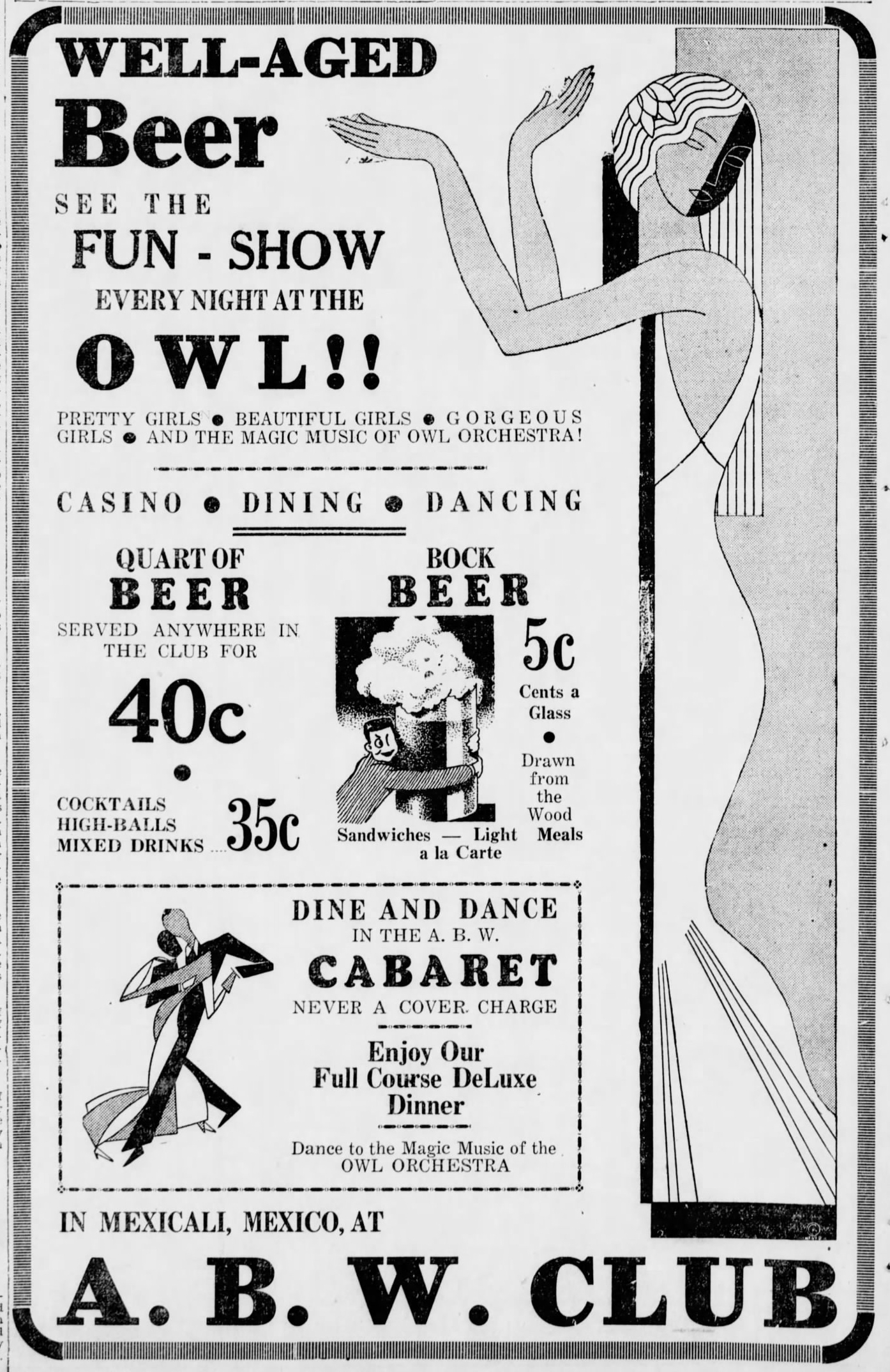
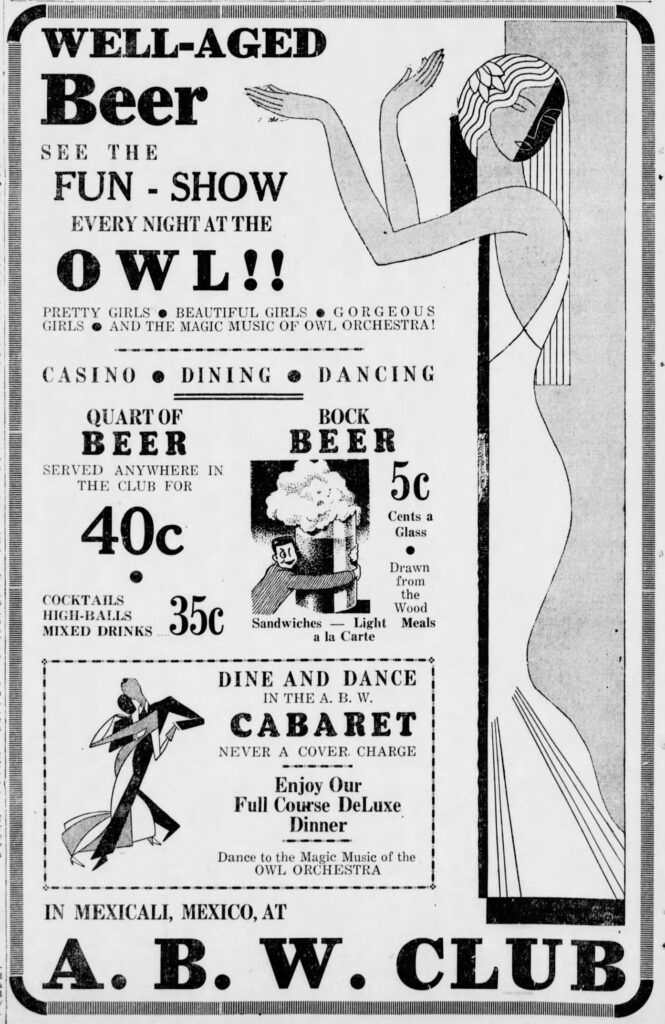
Last year I decided to concentrate on Bock ads. Bock, of course, may have originated in Germany, in the town of Einbeck. Because many 19th century American breweries were founded by German immigrants, they offered a bock at certain times of the year, be it Spring, Easter, Lent, Christmas, or what have you. In a sense they were some of the first seasonal beers. “The style was later adopted in Bavaria by Munich brewers in the 17th century. Due to their Bavarian accent, citizens of Munich pronounced ‘Einbeck’ as ‘ein Bock’ (a billy goat), and thus the beer became known as ‘Bock.’ A goat often appears on bottle labels.” And presumably because they were special releases, many breweries went all out promoting them with beautiful artwork on posters and other advertising.

Tuesday’s ad is again not for a specific Bock Beer, but instead is advertising the A.B.W. Club, a.k.a. the Owl Club, in Mexicali, Mexico. They do advertise selling a glass of Bock Beer for a nickel. And the dude hugging the giant mug of bock is pretty awesome. It was published on September 2, 1933.  This ad ran in The Imperial Valley Press, of El Centro, California.
Filed Under: Beers

Historic Beer Birthday: Frank B. Haberle

September 2, 2025 By Jay Brooks

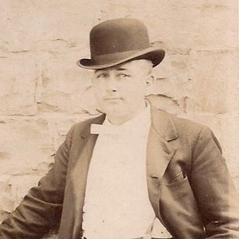
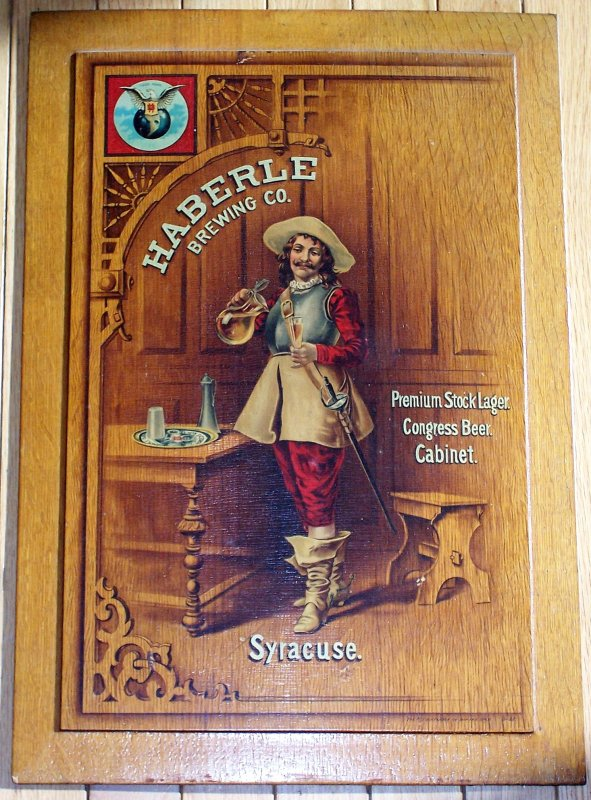
haberle-color
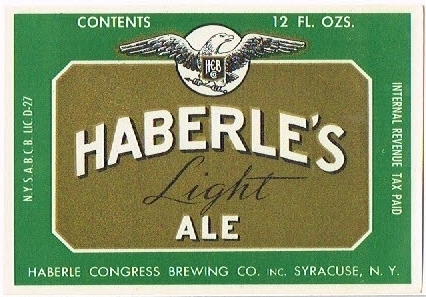
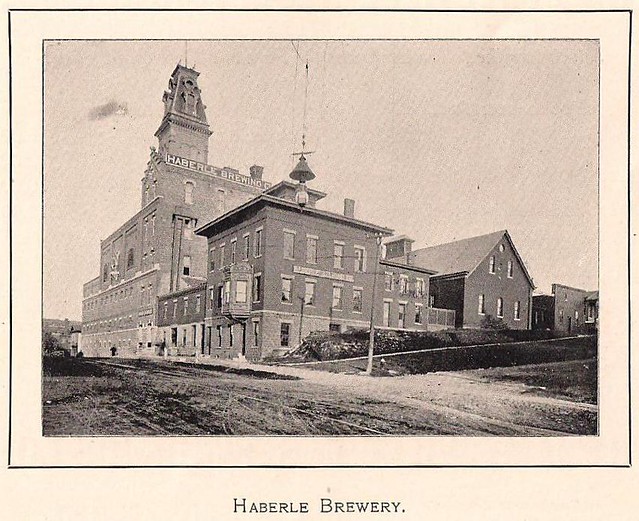
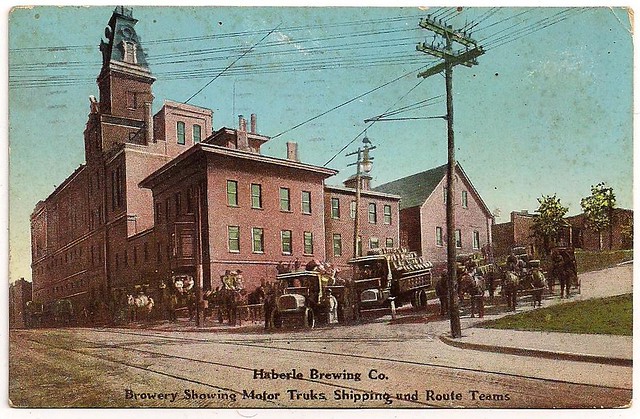
Today is the birthday of Frank B. Haberle (September 2, 1855-September 8, 1916). He was born in Syracuse, New York, the son of Benedict Haberle, who founded the Benedict Haberle Brewing Co. in 1857. Frank went to college in Germany to learn brewing, and returned to join his father in the business in 1875, when the name was changed to B. Haberle & Son. When Frank’s father Benedict died in 1881, it was incorporated as the Haberle Brewing Co. After merging with the Crystal Spring Brewing Co. in 1892, the name was again changed to the Haberle-Crystal Spring Brewing Co. (and also the Haberle Brewery) until 1920, when it was closed by prohibition. It reopened in 1933 as the Haberle Congress Brewing Co., and it remained in business until 1961, when it closed for good.

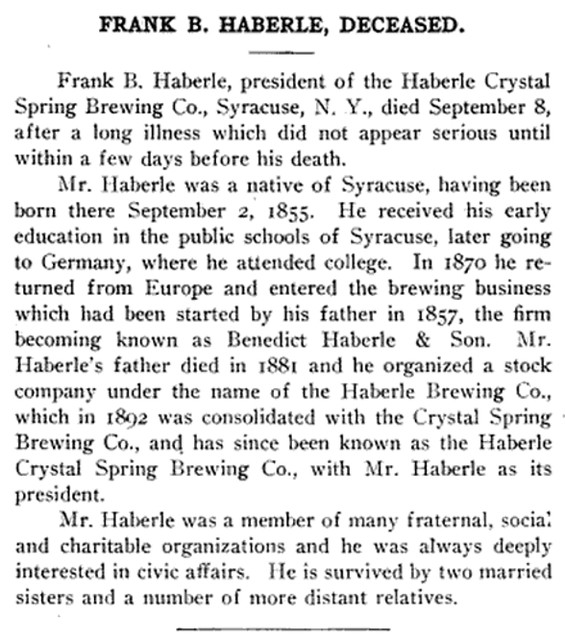
Here’s his obituary from the Herald newspaper of Syracuse, New York:

FRANK B. HABERLE, HEAD OF BREWING COMPANY, DEAD
Had Been Ill Long Time, Critically So Since Monday.
Deceased Born in This City in 1855 – Studied in Germany.

Frank B. Haberle, one of the pioneers in the brewing business of the city, died this morning at 8:30 o’clock at his home, No. 802 McBride street. He was 61 years of age.

Mr. Haberle had been in poor health for a long time. He had been seriously ill since Monday. Mr. Haberle was a lifelong resident of the city and was affiliated with more than thirty societies, some of which he had helped to ring into existence here.

Born here on September 2d, 1855, Mr. Haberle was the son of Benedict Haberle. After receiving an education in the schools of Syracuse, he went to Germany and attended college for a year. In 187- he returned to this city and engaged in the brewing business, which had been started by his father in 1857. The firm was known as Benedict Haberle & Son.

His father died in 1881 and Mr. Haberle reorganized the brewing company into a stock company, known as the Haberle Brewing company. He became president of the new concern. In 1892, the company was merged with the Crystal Springs Brewing company, under the name of the Haberle Crystal Springs Brewing company. Mr. Haberle was president of this new company up to the present time.

Mr. Haberle was active socially. His father had been one of the founders of the Syracuse Turn Verein and the Syracuse Leiderkranz. His name is on the membership roll of more than thirty societies in the city. He was affiliated with Salt Springs lodge, F. and A. M.; Syracuse lodge of Elks, Syracuse Aerie of Eagles, the Odd Fellows, Syracuse Turn Verein, Syracuse Leiderkranz, Independent Order of Foresters and several other societies.

Mr. Haberle was devoted to charity work and had done much to relieve suffering among the poor. His charitable work was carried on quietly and he avoided publicity. He was never married and politics never aroused his interest.

Mr. Haberle leaves two sisters, Mrs. Olive Biehler and Mrs. W. T. Woese; six nieces, Mrs. George O’Hara, Mrs. Burns Lyman Smith, Mrs. Leonora Haberle Warner of New York, Miss Amorita C. Schwarz, Miss Louise Haberle Schwarz and Miss Marion Schwarz; and five nephews, Frank Biehler, Benedict F. Haberle, Carl Haberle, Warren J. Haberle and Carl F. Woese.

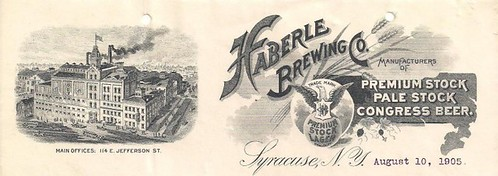
Haberle-Brewery-lg

Here’s another obituary from the Brewers Journal, Volume 47:

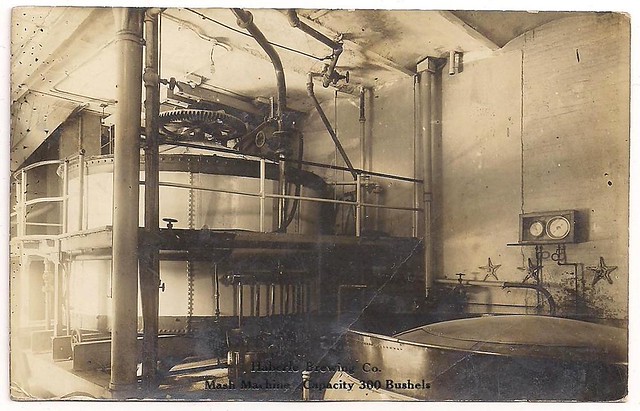
haberle-brewing-postcard

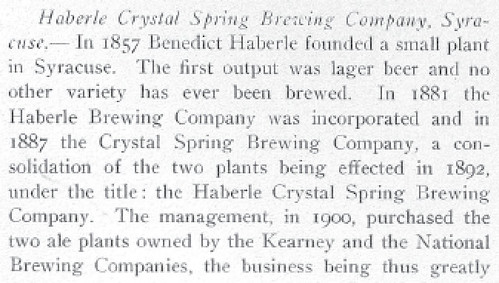
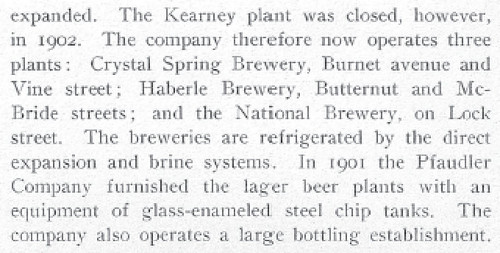
And this account is about the brewery, from 100 Years of Brewing:

haberle-brewhouse

Filed Under: Birthdays, Breweries, Just For Fun Tagged With: History, New York

Historic Beer Birthday: J.C. Jacobsen

September 2, 2025 By Jay Brooks

carlsberg-crown
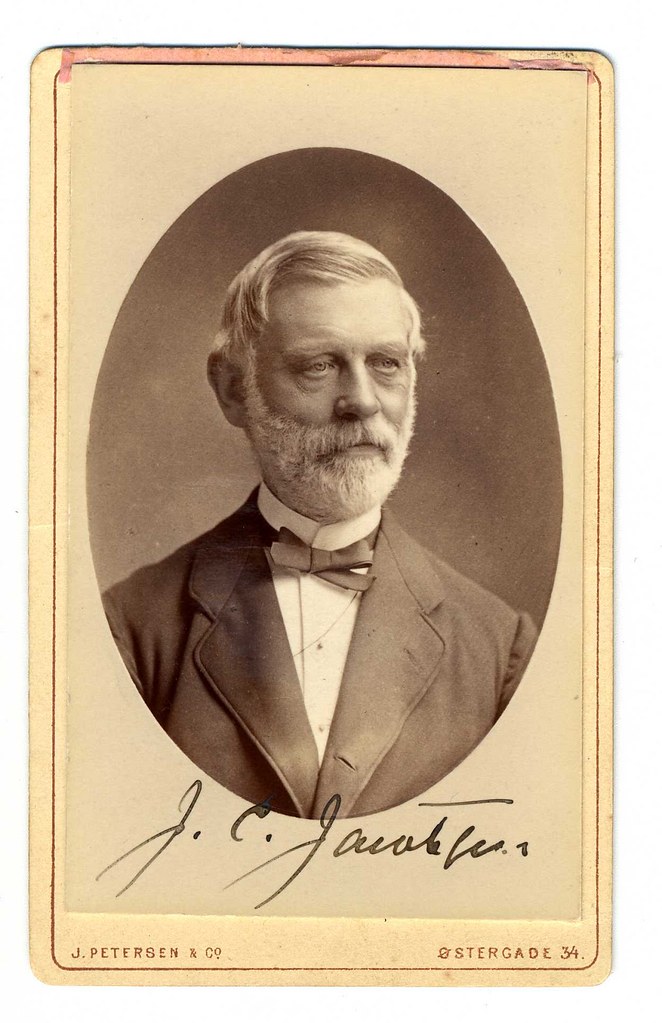
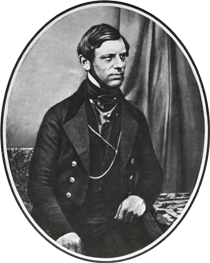
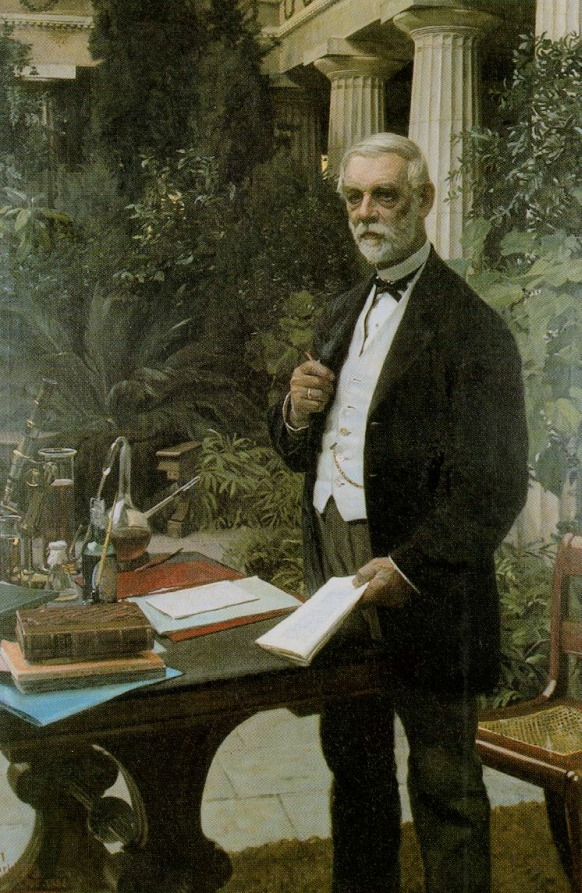
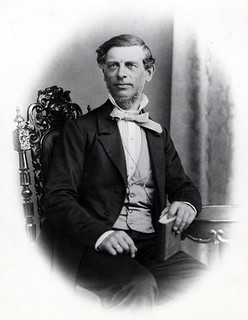
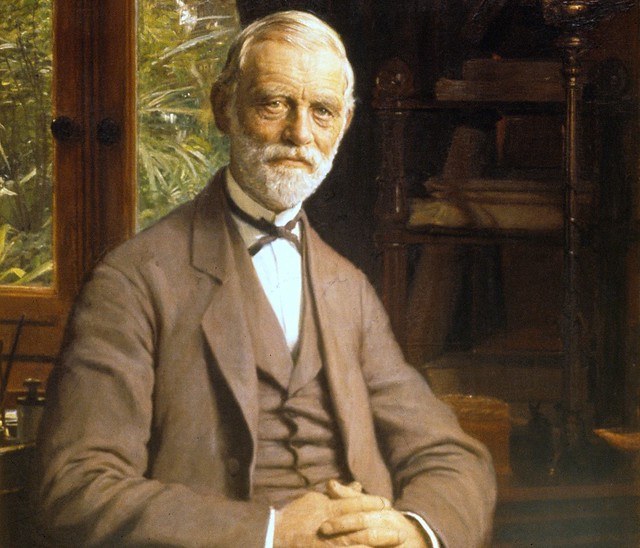
Today is the birthday of J.C. Jacobsen, or Jacob Christian Jacobsen (September 2, 1811-April 30, 1887). He “was a Danish industrialist and philanthropist best known for founding the brewery Carlsberg,” which he named for his son Carl Jacobsen.

Carlsberg - J C Jacobsen Signature 1886

Here’s a short biography from his Wikipedia page:

He had no formal academic or scientific training (although he had attended some lectures by Hans Christian Ørsted). In the 1840s he had come to realise that production of beer, which had until then been done in numerous small breweries, now had to be based on scientific methods and to be industrialised.

Jacobsen was only 24 when he founded the brewery.

Starting in 1847, he established his brewery Carlsberg (named after his son, Carl Jacobsen), in Valby on the outskirts of Copenhagen, on a site where it has remained since. Being extremely scrupulous as for the securing of high quality beer, in 1875 he founded the Carlsberg Laboratory.

He took much interest in public affairs and supported the National Liberal Party – being gradually more of a conservative – both as a Member of Parliament for some periods between 1854 and 1871 and as a strong supporter of the case of defence. Besides he was a well-known patron of art. After the fire of Frederiksborg Palace in 1859 he paid its rebuilding.

1876 he also founded “Carlsberg-fondet” – the Carlsberg Foundation that became his heir because of family problems of the next years. A bitter conflict with his son Carl led to the latter’s foundation of the Ny Carlsberg (New Carlsberg) Brewery 1882. A reconciliation was however obtained 1886. This conflict was the theme of a debated Danish TV drama series aired in 1997.

J.C. Jacobsen, by Danish portrait artist August Jerndorff

Here’s the biography that Carlsberg Group has on their website, entitled “Creating Carlsberg: The Greatest Gift of J.C. Jacobsen.”

It wouldn’t be hyperbolic to dub Jacob Christian Jacobsen, better known to most as J.C., “a legend.” The man did, after all, found one of the world’s most renowned breweries. And well over a century after his death, he remains one of Denmark’s most epochal characters.

It was a Wednesday – November 10th, 1847 – when J.C. Jacobsen’s newly created brewery Carlsberg completed its first brew. Shortly after, his traditional Bavarian lager was introduced to the Danish masses. The name Carlsberg was chosen to combine the name of his sole-surviving son “Carl” and the German word “berg,” meaning hilltop after the hilltop it was built upon.

Established in record time, the brewery used groundbreaking science to bring new brewing methods into the age of industrialization. Twenty-one years later, Carlsberg began exporting beer to Great Britain.

A young boy’s passion for brewing and science

Strange as it may sound today, it was clear from a very young age that J.C. would dedicate his life to brewing. He was, after all, the son of a brewer. It was in his blood.

As a child, J.C. could often be found experimenting in the basement of his father’s brewery on Brolæggerstræde in central Copenhagen. He was completely dedicated to the craft of beer and the intricacies of the natural sciences, both of which he went on to study as an adult at the new Technical University in Copenhagen. He sat in on lectures taught by H.C. Ørsted—a chemist who was particularly interested in the fermentation and brewing industries—and it was these lectures that inspired J.C.’s lifelong journey to “develop the art of making beer to the greatest possible degree of perfection.”

The year was 1836 when, in a wine merchant’s cellar, J.C. tasted his first imported Bavarian lager beer. Impressed and intrigued, J.C. ventured to Hamburg to study the production method first-hand. Upon returning to Copenhagen, he spent the next several years producing and selling small batches of Bavarian beer.

In 1838, J.C. married Laura Holst, a merchant’s daughter, and on March 2nd, 1842 their son Carl was born. But becoming a family man didn’t slow down J.C.’s pursuit towards crafting the perfect beer.

In 1845 he traveled to the Zum Späten brewery in Munich, where he was introduced to bottom-fermenting yeast. Although he didn’t know it at the time, this was to become the backbone of the beer produced at Carlsberg.

Beyond Beer: Establishing The Carlsberg Foundation

But more than a brewer and entrepreneur, J.C. was a patron of the arts, sciences, and, most notably, his home country of Denmark.

In 1875, he founded the Carlsberg Laboratory to explore and improve the beer-making process. It was here where the method for cultivating pure yeast was discovered—a discovery that J.C. shared with brewers all across the globe to improve the quality of beer everywhere – not just in his own brewery. A year later, using funds from the brewery, he created The Carlsberg Foundation to provide support to the Carlsberg Laboratory and also to Danish research ranging from the natural sciences and mathematics to the humanities and philosophy. The Carlsberg Foundation still exists today as a major contributor to modern science and art. It is run by a team of scientists who are the deciding shareholders of Carlsberg A/S and are also responsible for appointing a handful of the company’s board of directors—including the chairman.

Due to the turbulent nature of the relationship between J.C. and his son Carl, J.C. left his brewery to the Foundation—not Carl—when he passed away. In 1902, about a decade before Carl’s death, the Foundation also claimed ownership of the New Carlsberg Brewery.

Historically, The Carlsberg Foundation has been a part of many momentous projects in Denmark. In 1878, it sponsored the restoration of Frederiksborg Castle during its transformation into the Museum of National History. And in the spirit of J.C. himself, the Foundation continues to provide generous support to Danish pioneers. For example, it funded the building of The Danish Institute in Athens, a research center for archeologists, Greek historians, and philologists. There’s also the Danish Institute in Rome, established by The Carlsberg Foundation in 1967 to facilitate a cultural exchange between Denmark and Italy. In addition, The Foundation awards yearly monetary grants to Danish scientific researchers.

Outside of Carlsberg, J.C. held interests in politics and the arts. He served as a member of the Danish Parliament (“Folktinget”) for two terms. He designed and funded the Palm House at the University of Copenhagen’s Botanical Garden. He also designed his own Villa, which became a meeting grounds for the era’s intellectual elite like author Hans Christian Andersen and chemist Louis Pasteur.

J.C. died in 1887, on a visit to Rome.

His ingenuity and generosity continue to inspire generations of Carlsberg employees, who want to achieve, as their predecessor once said, “the greatest possible degree of perfection.”

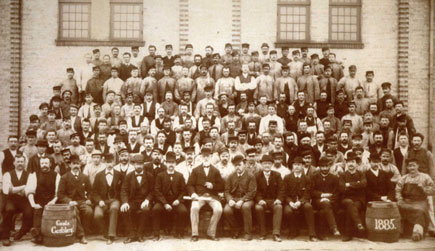
J.C. Jacobsen with his entire staff.
Photographed in 1885 at the Carlsberg brewery.

J.C. Jacobsen’s Childhood

Before J.C. created Carlsberg, he was simply the son of Caroline Frederikke Schelbeck and Christen Jacobsen. Caroline was the daughter of a Copenhagen silk weaver, while Christen grew up a farmer’s son in Northern Jutland. In 1801, Christen packed his bags and made way for Copenhagen to start a better life for himself, quickly finding work as a brewery hand in the King’s Brew-House (Kongens Bryghus) and shortly thereafter becoming the director. By 1826 he’d set up his own brewery on Brolæggerstræde in central Copenhagen, in the same building where his son J.C. spent his childhood.

J.C., the first and only child of Caroline and Christen, was born on September 2nd, 1811. Drawn to his father’s work at an early age, J.C. took on many responsibilities as his father’s health began to fail. In 1835, when Christen died, J.C. continued his father’s legacy and ran the family brewery. When his mother died a decade later, J.C. inherited both the brewery and also a great sum of money, which was later invested into the founding of Carlsberg Brewery.

JC Jacobsen 1886 - Carlsberg Group

And here’s a promotional video history of Carlsberg, created by the Carlsberg Group:

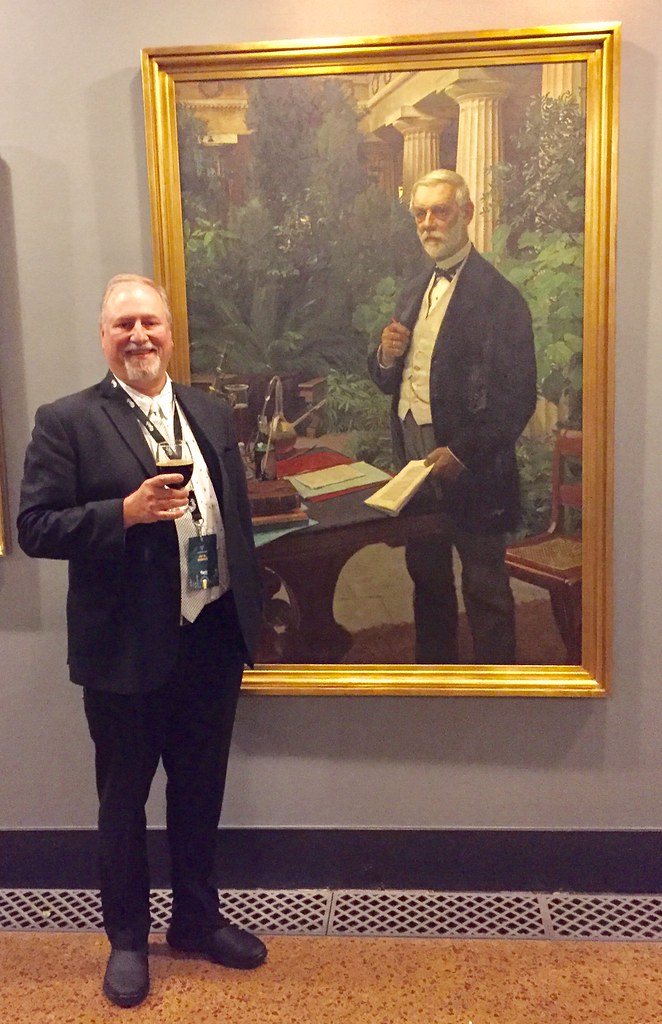
A few years ago I was in Copenhagen, meeting with J.C. Jacobsen, or at least standing in front of his portrait while Martyn Cornell snapped our photo.

FullSizeRender (2)

Filed Under: Birthdays, Just For Fun Tagged With: Carlsberg, Denmark, History

Beer In Ads #5069: Hunting Season Opens Today

September 1, 2025 By Jay Brooks

Last year I decided to concentrate on Bock ads. Bock, of course, may have originated in Germany, in the town of Einbeck. Because many 19th century American breweries were founded by German immigrants, they offered a bock at certain times of the year, be it Spring, Easter, Lent, Christmas, or what have you. In a sense they were some of the first seasonal beers. “The style was later adopted in Bavaria by Munich brewers in the 17th century. Due to their Bavarian accent, citizens of Munich pronounced ‘Einbeck’ as ‘ein Bock’ (a billy goat), and thus the beer became known as ‘Bock.’ A goat often appears on bottle labels.” And presumably because they were special releases, many breweries went all out promoting them with beautiful artwork on posters and other advertising.

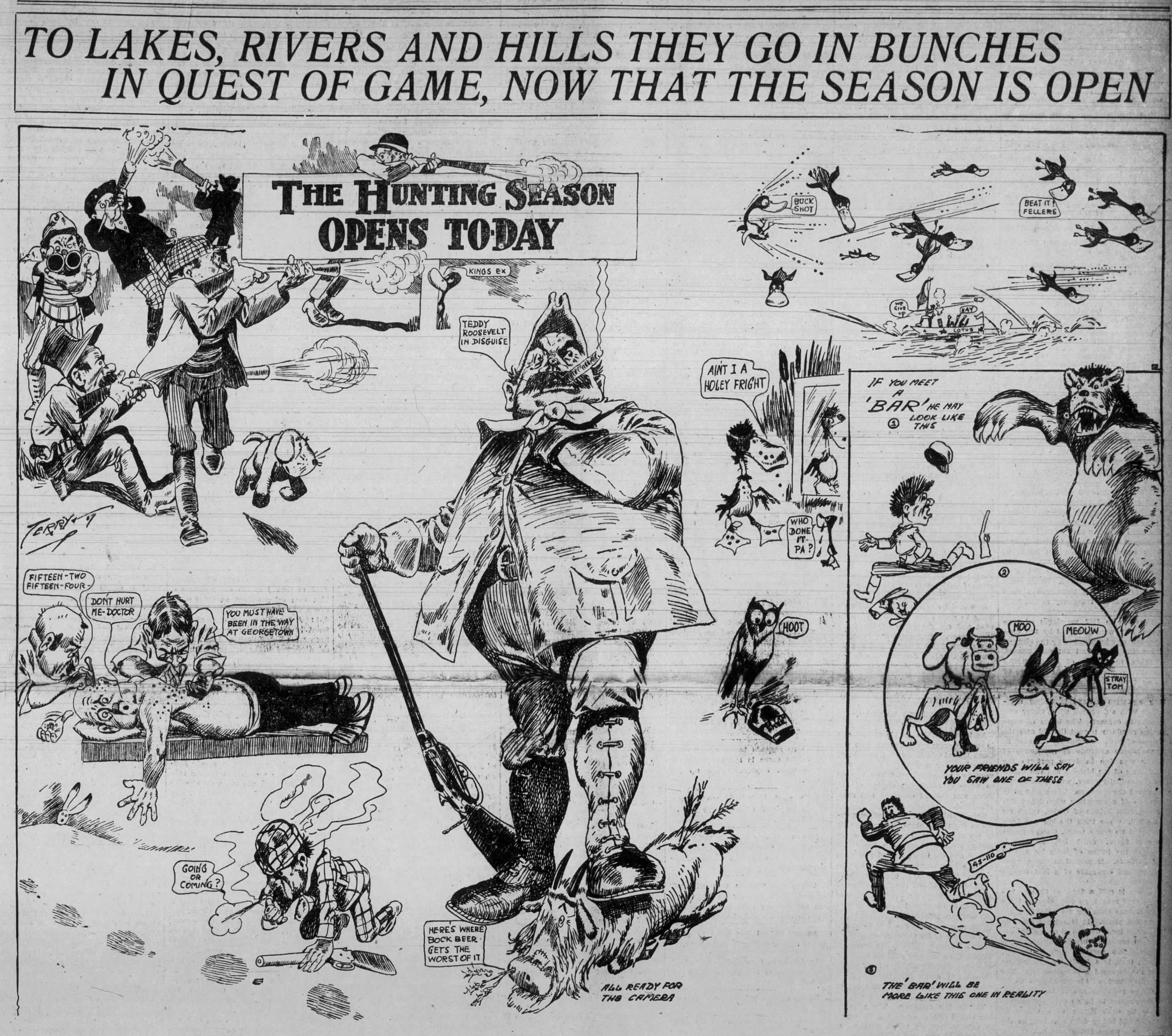
Monday’s ad is for not for a specific Bock Beer, but instead a half-page panel celebrating the opening of hunting season in Montana in 1907. It was published on September 1, 1907. With the headline: “To Lakes, Rivers and Hills They Go in Bunches in Quest of Game, Now That the Season is Open,” there are below that several hunting-themed cartoons, including one featuring “Teddy Roosevelt in Disguise” standing with his boot on the back of a bock beer goat. The goat is exclaiming, “Here’s Where Bock Beer Gets the Worst Of It.” This ad ran in The Anaconda Standard, of Anaconda, Montana.

Filed Under: Art & Beer, Beers, Just For Fun, Related Pleasures Tagged With: Advertising, Bock, History, Montana

Historic Beer Birthday: John F. Betz Jr.

September 1, 2025 By Jay Brooks

betz-pa
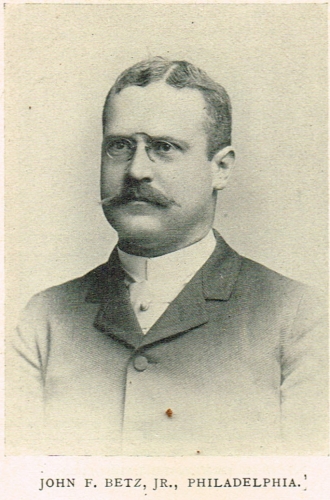
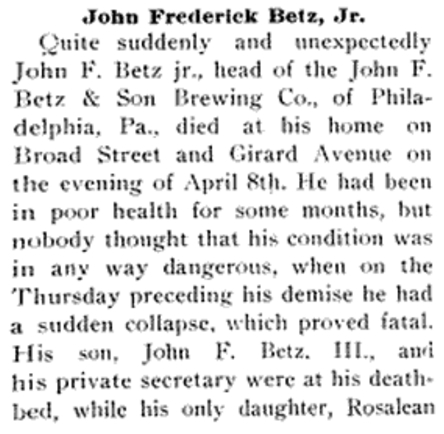
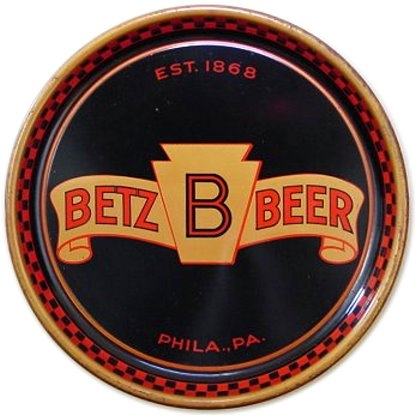
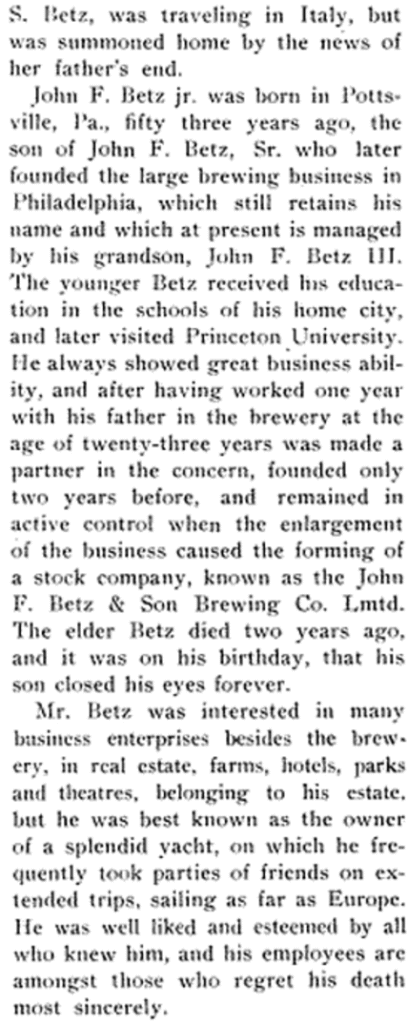
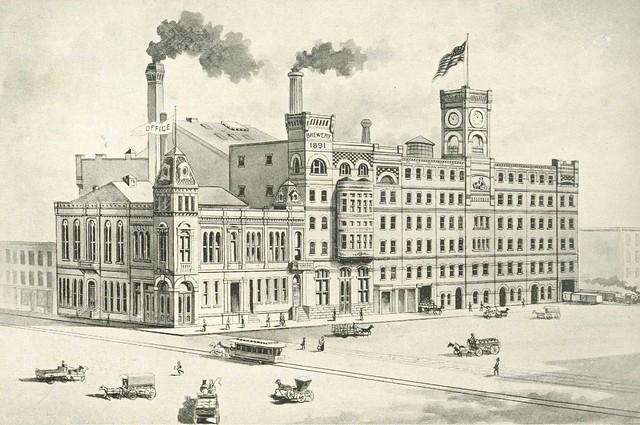
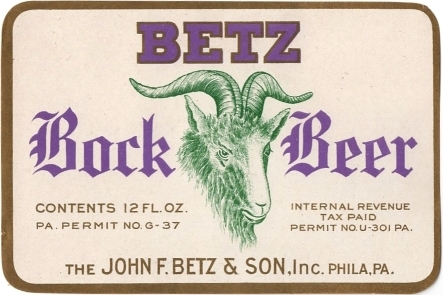
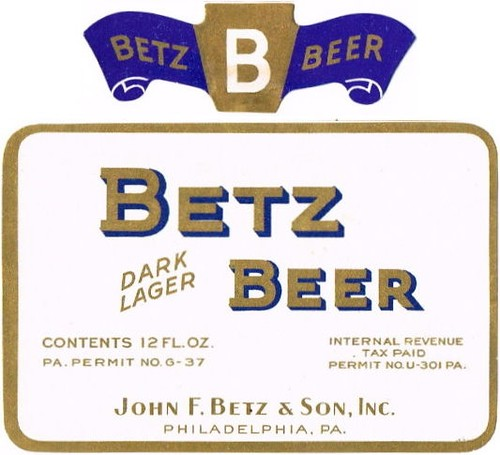
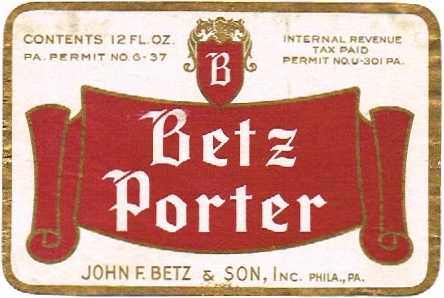
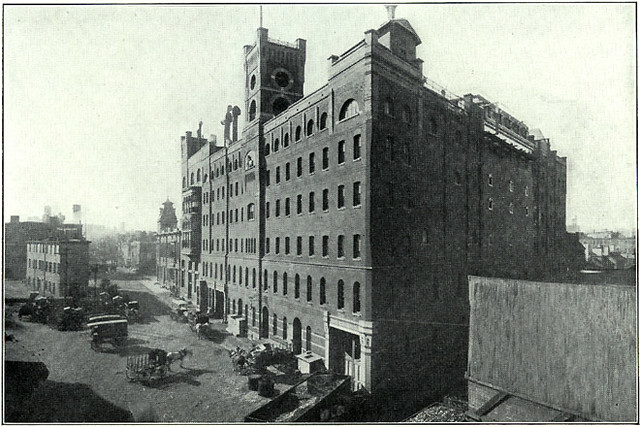
Today is the birthday of John F. Betz Jr. (September 1, 1856-April 8, 1910). He was born in Pennsylvania, the son of John F. Betz, who in 1867 bought what was the Robert Hare & J. Warren Porter Brewery when it opened in 1775, but was the William Gaul Brewery when Betz acquited it, but Betz changed it to the John F. Betz Brewery. When John Jr. joined his father in the business in 1880, they changed the name to the John F. Betz & Son Brewery. The brewery survived prohibition, but closed for good in 1939.

Here’s his obituary from the American Brewers’ Review:

John-F.-Betz-Sons-Brewery
The Betz brewery in Philadelphia.
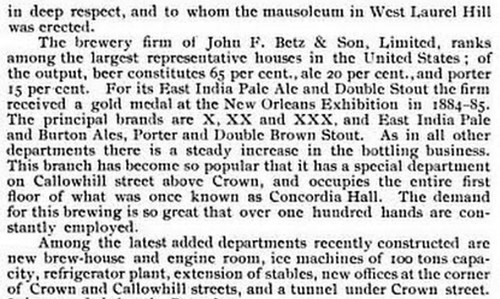
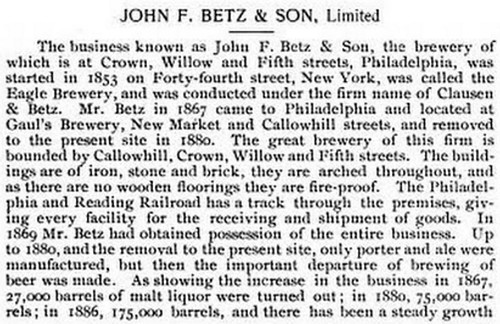
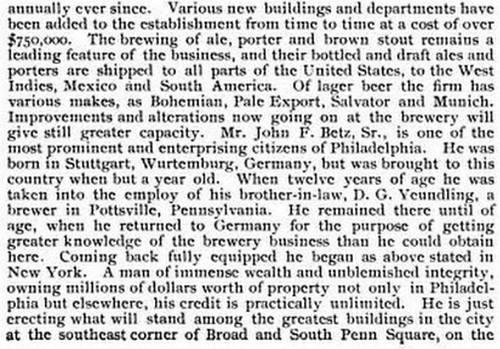
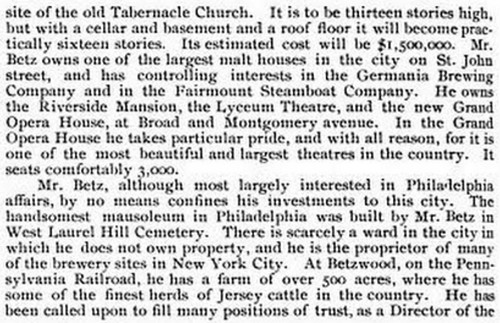
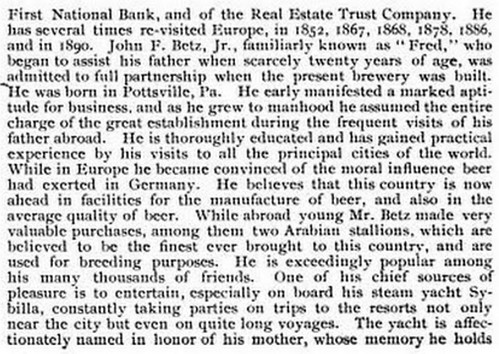
This much longer account is from “Philadelphia and Popular Philadelphians,” published in 1891. It’s mostly about Junior’s father, but he is mentioned in the course of the article:
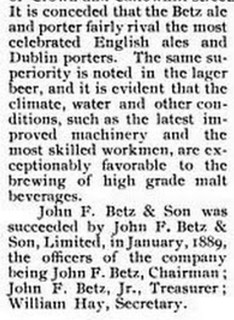
Betz-Brewery-pa
The Philadelphia brewery.

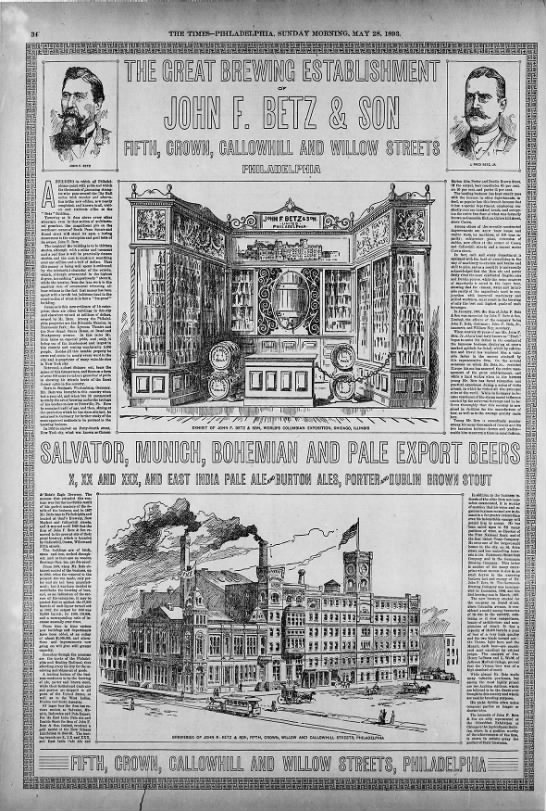
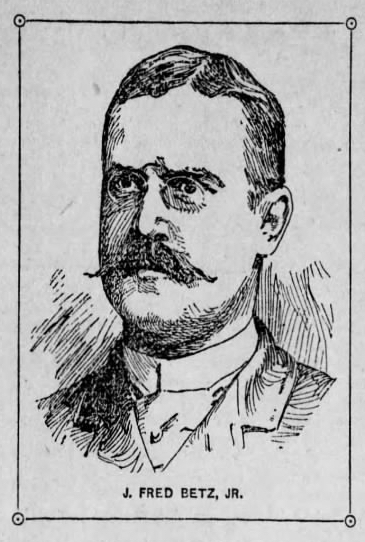
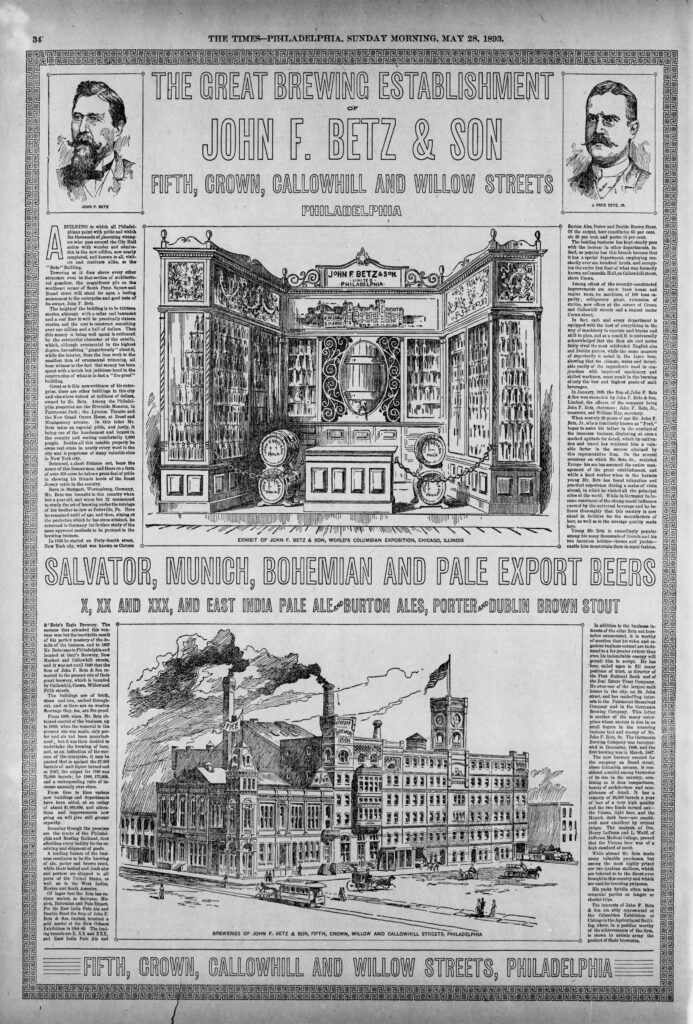
I’m not sure if this was a newspaper advertisement or some very favorable coverage, but this was a page from The Times—Philadelphia on May 28, 1893. But in the right-hand corner is where I discovered the only image of John F. Betz Jr. that I could find.

Filed Under: Birthdays, Breweries, Just For Fun Tagged With: History, Pennsylvania, Philadelphia

The Ballad Of Steam Beer

September 1, 2025 By Jay Brooks

Today is the birthday of William S. “Billy” Barnes (September 1, 1864-March 13, 1910). He was born in San Francisco, left to attend Harvard, and then after graduation returned home to join his father’s law office, and was later elected District Attorney for San Francisco. He also belonged to the San Francisco Press Club, and appears to have dabbled in some writing of his own. I guess he was also a fan of Anchor Steam Beer, because in 1897 his poem “The Ballad of Steam Beer” was published in The Wave, a well-regarded local magazine. Former Anchor Brewing historian Dave Burkhart wrote about it for Anchor’s old website, and the story is also included in his great book, The Anchor Brewing Story. But who knows what will happen to the website’s archives, so I thought it was worth keeping it alive here.

The Ballad of Steam Beer


By William Sanford (Billy) Barnes (1864–1910)
As published in The Wave, San Francisco, March 13, 1897

You may talk of your Moet and Chandon,
And all the Cuvees of Champagne,
Of Burgundy, ruby and royal,
From Romanée’s storied demesne;
Of Lafitte and of Lachramae Christi
Or the warm, blushing vintage that grows
Where Yquem and the premier cru Grand Vins
Gush forth from the Hills of Bordeaux;
Of crusty old port and Madeira,
And all of the sherries of Spain,
All the liquers of castle and convent
That ever came over the main.
But I chant out a hymn to Gambrinus,
The god of small change and good cheer,
For I sing you the Song of the Nickel
That buys the big glass of Steam Beer.

A fig for straw-covered Chianti,
Or brandy a century old,
For foaming and flashing Spumante
That sparkles and glitters like gold.
Benedictine and opaline Absinthe
That gourmets and viveurs adore,
And the life-blood of amorous grape vines
That cluster along the Cote D’Or.
Not for me burn the molten sun-kisses
Upon the warm vineyards of France,
Not for me weave the chaplets of Bacchus
Nor call Satyrs and Nymphs to the dance.
I care not for these classical pleasures;
They are for my income too dear,
But still I can compass the nickel
That buys me my Schooner of Beer.

No flagons or wassail cups fill me
Of vintages priceless and rare,
Away with a stoup or a beaker,
And I scorn an effete petit verre;
My chalice is glittering crystal
Full-bosomed, deep-chested, divine,
With the glorious crown of the hop-lands
That mocks at the glory of wine.
Come! drink of the soft flowing amber,
Come! lave in its somnolent streams,
Come! taste of the foam-flecked Nepenthe
That flows from the Kingdom of Dreams.
And sing, as afloat on its tideway
We gently and drowsily steer:
“Here’s a health to the Nickel of
Commerce That buys me my Schooner of Beer!”

B. B.

Filed Under: Beers, Just For Fun Tagged With: Anchor Brewery, Bay Area, History, San Francisco

Beer Birthday: Ben Edmunds

September 1, 2025 By Jay Brooks

Today is the 44th birthday of Ben Edmunds. Ben is the co-founder and head brewer at Breakside Brewery in Portland, Oregon. Originally from Michigan, he attended Siebel Institute after college and settled in Portland. In 2010, Scott Lawrence opened Breakside with Ben doing the brewing. I don’t remember exactly when I met Ben but I’m pretty sure it was shortly after they opened, and I’ve been seeing him around ever since at various beer events. Ben’s a great advocate for craft beer and fun to hang out with, too. Join me in wishing Ben a very happy birthday.

Ben and me at CBC in Nashville earlier this year.
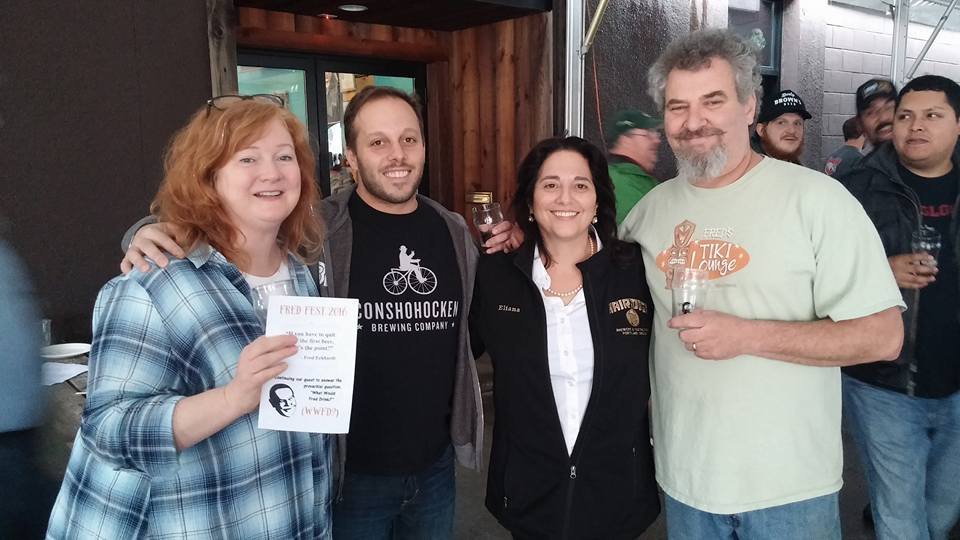
At FredFest a few years back. [photo by Don Scheid.]
Luc and Ben in Nashville.

Filed Under: Birthdays, Just For Fun Tagged With: Oregon, Portland

Beer In Ads #5068: GB Dark Bock Beer

August 31, 2025 By Jay Brooks

Last year I decided to concentrate on Bock ads. Bock, of course, may have originated in Germany, in the town of Einbeck. Because many 19th century American breweries were founded by German immigrants, they offered a bock at certain times of the year, be it Spring, Easter, Lent, Christmas, or what have you. In a sense they were some of the first seasonal beers. “The style was later adopted in Bavaria by Munich brewers in the 17th century. Due to their Bavarian accent, citizens of Munich pronounced ‘Einbeck’ as ‘ein Bock’ (a billy goat), and thus the beer became known as ‘Bock.’ A goat often appears on bottle labels.” And presumably because they were special releases, many breweries went all out promoting them with beautiful artwork on posters and other advertising.

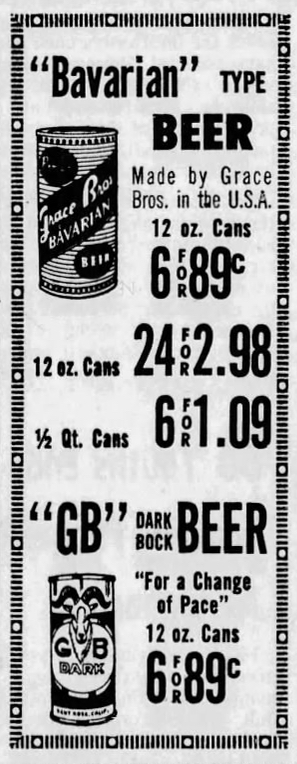
Sunday’s ad is for GB Bock Beer, which was published on August 31, 1966. This one was for The Grace Brothers Brewing of Santa Rosa, California, which was originally founded in 1872 by William Metzger as the Santa Roa Steam Brewery, but became Grace Bros. beginning in 1897. The ad is first for their “Bavarian” Type Beer and then, “For a Change of Pace,” try their “GB” Dark Bock Beer.  This ad ran in The Ventura County Star, of Camarillo, California, but serving all of Ventura County.

Filed Under: Beers

Beer Birthday: Theo Flissebaalje

August 31, 2025 By Jay Brooks

netherlands
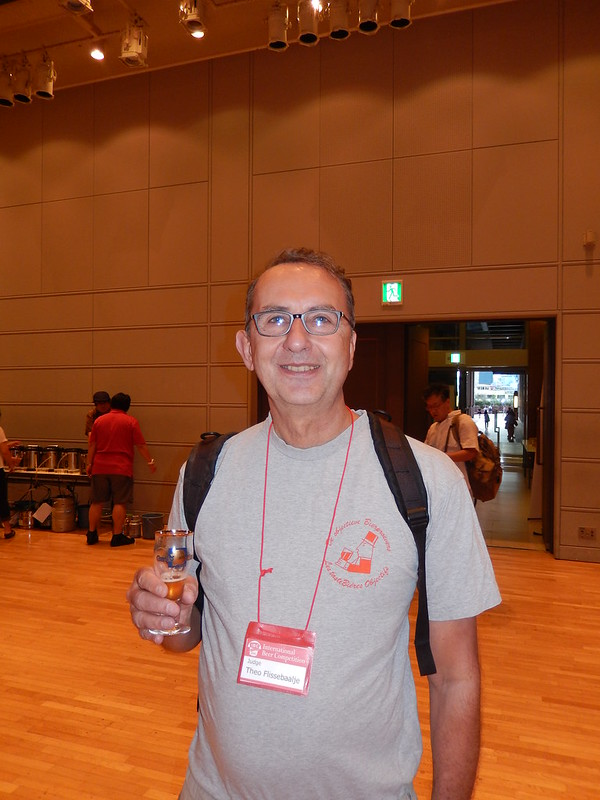
Today would have been the 76th birthday of Theo Flissebaalje, but sadly he passed away earlier this year, in May. Theo’s from the Netherlands, and co-founded StiBON, and he’s also active in the beer consumer organization PINT. He’s also on the international judging circuit. I first met him judging in Tokyo, Japan, but have also judged with him in Europe and America, as well. Join me in wishing Theo a very happy birthday.

Theo in Japan.
SAM_3622
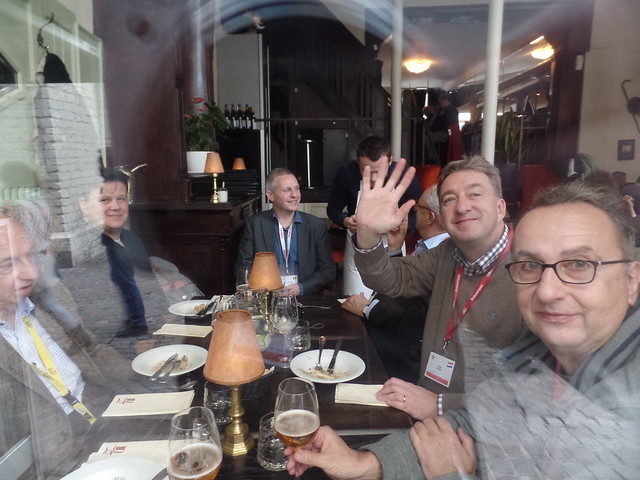
Through a window in Antwerp during lunch for the Brussels Beer Challenge in 2015, that’s Theo on the far right.
DSCN2939
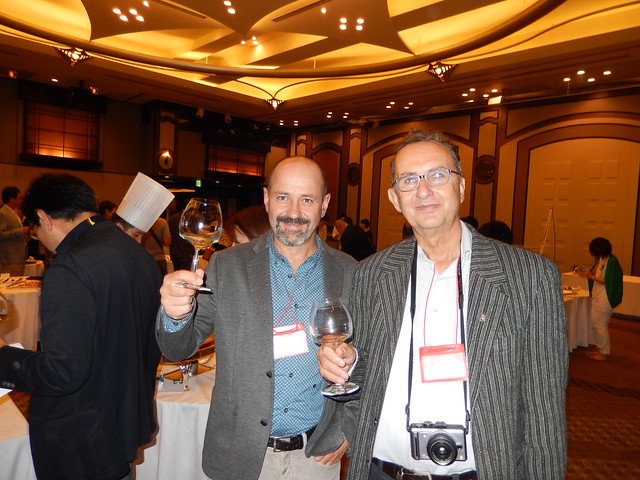
Agostino Arioli, from Birrificio Italiano, with Theo, also in Japan in 2013.

Filed Under: Birthdays Tagged With: The Netherlands

Beer Birthday: Michael Ferguson

August 31, 2025 By Jay Brooks

bjs-new
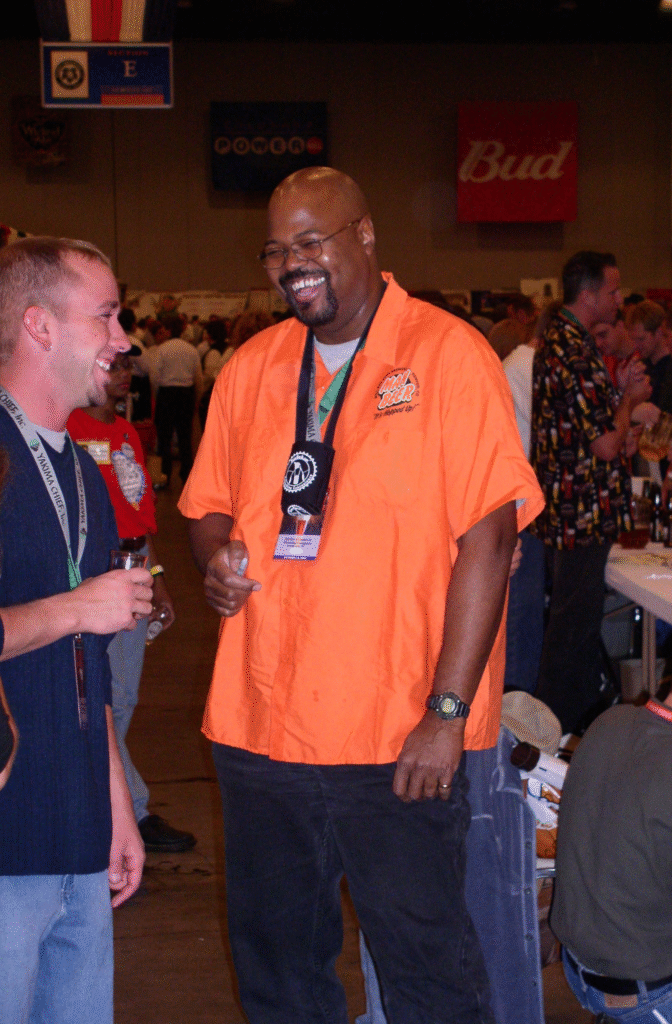
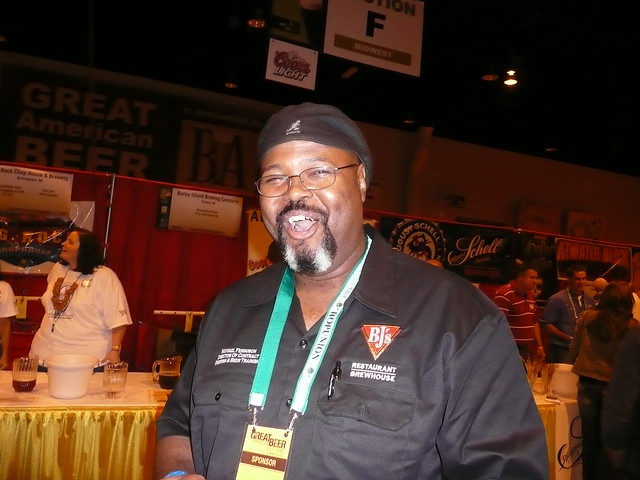
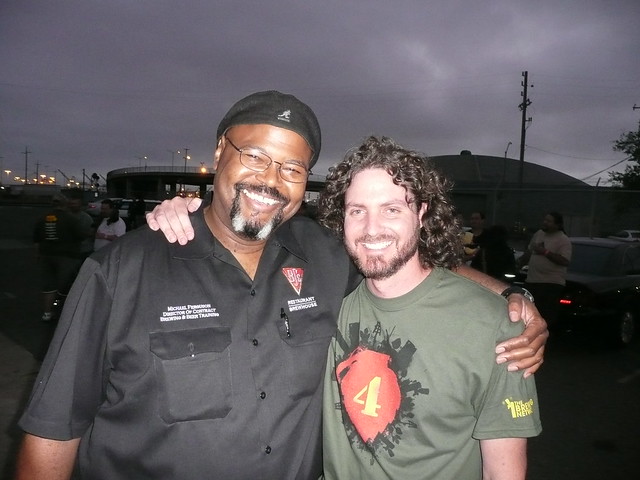
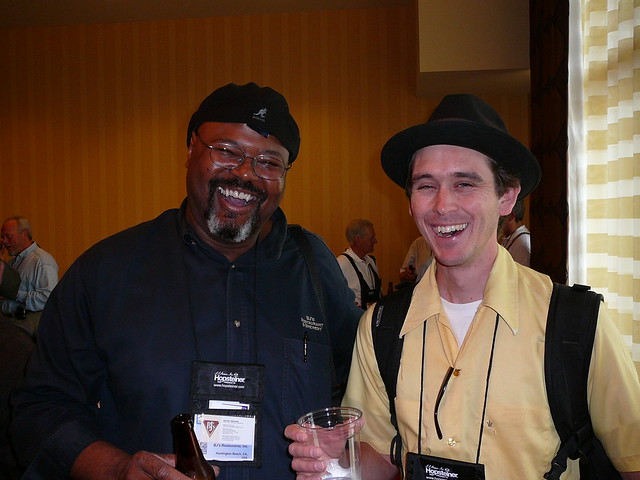
Today is the 72nd birthday of Michael J. Ferguson, although I’m guessing at his age. I first met Michael when he was brewing in Las Vegas, but for over a decade brewed for the BJ’s brewpub chain as their Director of Brewery Operations. More recently he’s the Director International Marketing and Business Development for Aalberts Dispense Technologies and is also doing brewery consulting for his own firm, BrewerFX. Michael has one of the best laughs in all of brewing (only Lew Bryson gives him any competition) and is a great person, to boot. Join me in wishing Michael a very happy birthday.

P1120252
At GABF in 2008.
P1150202
Michael, when he was with BJ’s, with Justin Crossley at Oakland’s Linden Street Brewery during the AHA convention a few years ago.
P1030825
At CBC in Austin, Texas, in 2007, Michael with Lee Chase, formerly with Stone Brewing.
P1070169
Michael, and JoAnne Carilli in the foreground when she was with White Labs, at CBC in 2008.
Michael at GABF in 2006.

Filed Under: Birthdays, Just For Fun Tagged With: Texas

« Previous Page
Next Page »

Find Something

Northern California Breweries

Please consider purchasing my latest book, California Breweries North, available from Amazon, or ask for it at your local bookstore.

Recent Comments

  • Bob Paolino on Beer Birthday: Grant Johnston
  • Gambrinus on Historic Beer Birthday: A.J. Houghton
  • Ernie Dewing on Historic Beer Birthday: Charles William Bergner 
  • Steve 'Pudgy' De Rose on Historic Beer Birthday: Jacob Schmidt
  • Jay Brooks on Beer Birthday: Bill Owens

Recent Posts

  • Historic Beer Birthday: Frederick Kirschner May 21, 2026
  • Beer Birthday: Nick Matt May 21, 2026
  • Historic Beer Birthday: Oliver Hughes May 20, 2026
  • Historic Beer Birthday: Benjamin, Lord Iveagh May 20, 2026
  • Historic Beer Birthday: Eduard Buchner May 20, 2026

BBB Archives

Feedback

Head Quarter
This site is hosted and maintained by H25Q.dev. Any questions or comments for the webmaster can be directed here.